
Updated · Published
How to Study for Step 2 CK A Proven Guide to a High Score
Discover how to study for Step 2 CK with this proven guide. Learn battle-tested strategies, resource management tips, and a clear timeline to ace your exam.

To crush Step 2 CK, you need a personalized game plan. That plan has to be built on three things: an honest look at where you are now, a clear score you're aiming for, and a daily schedule you can actually stick to. This isn't about downloading some generic calendar; it's about creating a smart, flexible strategy that plays to your strengths and shores up your weaknesses, making every study hour count.
Building Your Personal Step 2 CK Study Plan
Forget those one-size-fits-all study plans. Your road to a top Step 2 CK score is your own, shaped by how you did on your clerkships, what specialty you're aiming for, and how much time you have. A truly great plan is a system you build from the ground up—one that works for your life. The goal is to study smarter, not just harder, by putting your energy where it will make the biggest difference.
This simple flow shows you the core pieces: start with a baseline, set a target, and then build the schedule.
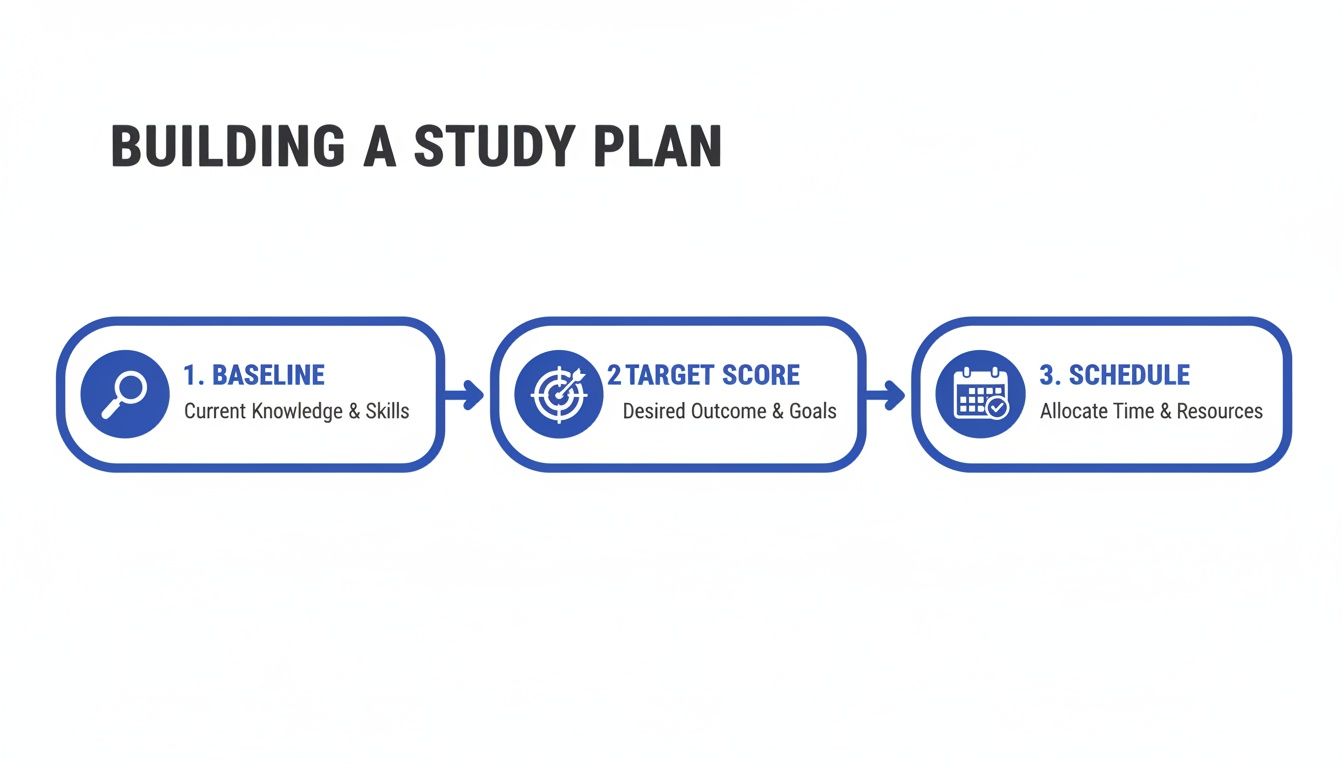
This three-phase process is the blueprint for your entire dedicated study period. It ensures every decision you make is logical and backed by data.
Start with an Honest Baseline Assessment
Before you even think about opening UWorld, you need to know where you stand. The best data you have is your shelf exam performance from third year. Did you consistently honor IM but barely pass Surgery? That’s not just a grade; it's a bright, flashing sign pointing directly at your high-yield weaknesses.
For the most objective starting point, take a diagnostic NBME self-assessment right at the beginning of your dedicated period. It’s going to feel scary, but the goal isn't a great score—it's an honest baseline. That first number helps you set realistic expectations and immediately flags the knowledge gaps your clerkships might have papered over.
Set a Data-Driven Target Score
Don't just pull a target score out of thin air. It needs to be anchored to your real-world career goals. Now that Step 1 is pass/fail, your Step 2 CK score is one of the most important numbers for residency program directors. Look up the average scores for matched applicants in the specialty you want.
Keep in mind, the bar is rising. The USMLE is bumping the passing score from 214 to 218 starting July 1, 2025. While the average score for US and Canadian students hovers around 248-250, competitive specialties demand much more. For example, a score of 240 between 2022-2025 only put you at the 24th percentile—meaning 76% of people scored higher. Knowing these numbers is crucial for setting a goal that's both ambitious and achievable.
A specific target score does more than just motivate you; it dictates the entire intensity of your study plan. A student shooting for a 265 for dermatology needs a completely different level of rigor than someone aiming for a 245 for family medicine.
Design a Sustainable Study Schedule
Your schedule is where ambition meets reality. Whether you have four dedicated weeks or you're trying to study during rotations, consistency is king. A good day mixes up different types of learning to keep you sharp and stave off burnout.
Here’s what a balanced daily structure could look like:
- Morning (Peak Focus): Knock out two timed, random 40-question UWorld blocks. This builds exam stamina and simulates the real deal.
- Afternoon (Review & Consolidate): This is the most important part of your day. Do a deep, thorough review of your morning blocks. Make Anki cards for every incorrect and for concepts you were shaky on.
- Late Afternoon (Content Reinforcement): Zero in on a weak subject you identified earlier. Maybe that means watching a video on renal tubular acidosis or drilling biostats formulas.
- Evening (Active Recall): Finish your daily Anki reviews. This is non-negotiable for locking in that long-term memory.
The table below provides a high-level overview of how you might structure a 6-week dedicated study period. Think of it as a template to guide your own personalized schedule, breaking down the massive task of Step 2 prep into manageable phases.
Sample 6-Week Dedicated Step 2 CK Study Timeline
| Study Phase | Weeks | Primary Focus | Key Activities |
|---|---|---|---|
| Phase 1: Foundation | 1–2 | Baseline Assessment & Content Gaps | Take diagnostic NBME. First pass of UWorld (timed, random). Create Anki cards for incorrects. |
| Phase 2: Consolidation | 3–4 | Weakness-Targeted Review & Stamina Building | Continue UWorld blocks. Take NBME 9/10. Focused review on lowest-performing shelf exam subjects. |
| Phase 3: Integration | 5 | Exam Simulation & High-Yield Review | Take NBME 11/12 and UWSA1/2. Review incorrects from all practice exams. Drill Divine Intervention. |
| Phase 4: Final Polish | 6 | Confidence Building & Logistics | Take the Free 120. Review notes, biostats, and ethics. Relax the day before the exam. |
This timeline isn't rigid; it’s a framework. Adjust it based on your progress and how you feel. Some people might need more time on content gaps, while others might focus more on test-taking strategy in the final weeks.
As you build out your schedule, it's smart to incorporate effective study tool strategies, especially for making your weekends both productive and restorative.
Finally, protect your time off. Seriously. Schedule at least half a day every week to completely unplug. This isn't being lazy—it’s a strategic move to prevent burnout, and it will make a huge difference in your focus and motivation during the final stretch.
Choosing Your High-Yield Study Resources
The sheer volume of resources for Step 2 CK prep can feel paralyzing. I’ve seen countless students make the mistake of thinking that more resources automatically equal a better score. It’s a total fallacy. Your real goal is to master a few high-yield tools, not just collect a library of them. We're going to build your essential toolkit by focusing on what’s been proven to work.
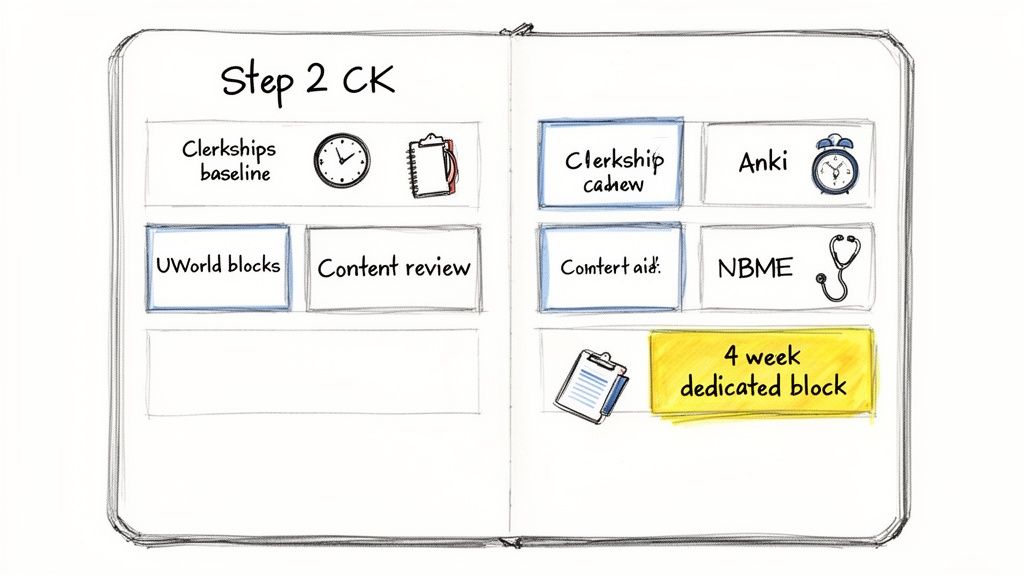
This section will cut through the noise. I’ll break down the specific role each key resource plays and show you how to weave them together for the biggest impact.
UWorld: The Engine of Your Study Plan
Let's be perfectly clear: UWorld is the single most important resource for Step 2 CK. It's not just another question bank; it's your primary learning tool. With its nearly 4,000 questions mimicking real clinical scenarios, it forces the kind of active, question-based learning this exam demands.
Your entire study schedule should revolve around completing and deeply reviewing UWorld. Here’s how to do it right:
- Timed, Non-Tutor Mode: Always, always do your blocks in timed mode without the tutor explanations on. This is non-negotiable. You need to build the mental stamina and pacing for a grueling 9-hour exam day.
- Deep Review is Everything: The real learning happens after you finish the block. Your goal isn't just to see the right answer but to understand precisely why it's right and why every other option is dead wrong. If you can't explain the concept to a classmate, you haven't reviewed it well enough.
- One Pass Is Enough (If Done Right): Students constantly ask about a second pass. For most, a single, meticulously reviewed first pass is far more valuable than rushing through a second time where you're just recognizing patterns. Focus on true mastery the first time through.
Anki: Your Memory Consolidation Tool
Anki is a powerful spaced-repetition program that cements short-term knowledge into long-term memory. But it’s also a tool that can easily become a massive, time-sucking burden if you misuse it. The key to using Anki effectively for Step 2 is ruthless selectivity.
Do not download a massive, pre-made deck that covers every topic under the sun. Your Anki deck should be a personalized log of your weaknesses, built directly from your own mistakes.
Your Anki workflow should be dead simple. While reviewing your UWorld blocks, make cards for three things:
- Questions you got wrong.
- Questions you got right but were just guessing on.
- Key diagnostic criteria, vaccine schedules, or biostats formulas you can never seem to remember.
This method ensures you're reinforcing the exact concepts you find difficult, which makes your daily reviews incredibly high-yield.
NBME Practice Exams: Your Progress Barometer
The NBME self-assessments (and the UWorld Self-Assessments, or UWSAs) are your objective measure of progress. They’re the best predictor of your final score, period. Why? They’re written by the same people who create the real exam, so they perfectly mirror its logic and style.
Think of these as crucial data points, not just learning tools. Use them to:
- Establish a Baseline: Take one early in your dedicated study period to see where you’re starting.
- Track Your Growth: Space them out every 1-2 weeks to make sure your study methods are actually working.
- Identify Weak Areas: A detailed review of a practice exam can expose system-wide weaknesses. You can then target those with focused content review.
Supplementary Resources: Use Sparingly
So what about resources like AMBOSS, OnlineMedEd, or Divine Intervention? While all are excellent, they should be considered supplements, not essentials. They're best used to fill specific knowledge gaps you’ve already identified.
Here’s a quick guide on when to pull them off the shelf:
- AMBOSS: Fantastic for its detailed library and specific study plans on tricky topics like ethics, patient safety, and biostats. Use it after completing UWorld to drill weak areas.
- OnlineMedEd (OME): Can be helpful if you're starting a clerkship or feel completely lost on a topic, but its content is often too superficial for dedicated Step 2 prep.
- Divine Intervention Podcast: A great resource for passive learning during a commute or workout, especially for high-yield rapid review topics in the final weeks before your exam.
Thinking about other tools to add to your study plan? You might be interested in our guide on how Confetto’s AI can supplement your medical education resources by helping you master the communication and ethical reasoning skills tested on the exam.
Ultimately, how you study for Step 2 CK comes down to sticking to a minimalist, high-impact resource list. Master UWorld, use Anki for your mistakes, and trust your NBME scores to guide you. This focused approach will save you time and lead to a better score.
Mastering Your UWorld Question Strategy
Just grinding through thousands of UWorld questions isn’t the secret to a high Step 2 CK score. Anyone can do that. The real magic—the part that separates the good scores from the truly great ones—happens in how you review those questions. This is where you turn a question bank from a simple assessment tool into your most powerful teacher.
Your goal isn’t just to answer questions; it’s to build the clinical reasoning and pattern recognition the exam demands. A systematic approach to review transforms every UWorld block into a high-yield learning session, dissecting question stems, spotting clever distractors, and pulling multiple learning points from a single explanation.
Adopting a Systematic Review Process
The single biggest mistake I see students make is blasting through their review. They see the right answer, give a quick nod, and speed on to the next question. This is a massive missed opportunity.
A thorough, effective review of a single 40-question block should take you far longer than the hour it took to complete it. We're talking 2 to 3 hours, easily. If you're finishing faster, you're probably leaving valuable points on the table.
Your goal is to understand not just what the right answer is, but why it's correct and, just as critically, why every other option is dead wrong. For every single question, ask yourself:
- What specific clues in the vignette (age, symptoms, lab values) were screaming the correct diagnosis?
- What was the key piece of information that made the other top choices incorrect?
- If I missed this, was it a pure knowledge gap, a misread of the stem, or a test-taking blunder?
This kind of deep dive is what builds true clinical intuition. You'll start recognizing the classic scripts and subtle variations the NBME loves to use, a skill that pays huge dividends on exam day.
The Art of Reviewing a Single Question
Let’s walk through a common scenario. You get a question about a patient with chest pain. You confidently pick acute coronary syndrome (ACS), but the correct answer was pulmonary embolism (PE).
A surface-level review is just noting, "Ah, it was PE." A deep, score-boosting review looks like this:
- Analyze the Correct Answer: You dive back into the question stem and hunt for the clues you skimmed over—the sudden onset of pleuritic chest pain, the unexplained tachycardia, and that mention of a recent long-haul flight. You burn this specific PE presentation into your brain.
- Analyze Your Mistake: Why did you choose ACS? You probably latched onto "chest pain" and ran with it, ignoring that the pain was sharp and pleuritic, not crushing and substernal. This tells you to slow down and pay more attention to the quality of the symptoms.
- Mine the Explanations for Gold: The UWorld explanation is a goldmine. It doesn't just explain PE; it carefully breaks down why ACS, aortic dissection, and pericarditis were all less likely. From this, you make a quick note or an Anki card about the key features that distinguish these diagnoses.
See what happened? From one incorrect question, you’ve reinforced your understanding of five different high-yield cardiovascular and pulmonary emergencies. That’s efficiency. A solid question bank is your best friend here; check out our guide on how to pick the right question bank to make sure you're using the best tools available.
Creating High-Yield Anki Cards from UWorld
Your Anki deck should be a personalized diary of your weaknesses, not some pre-made, 30,000-card monster you downloaded. The most effective cards are always the ones you create yourself, pulled directly from your UWorld reviews.
The process is straightforward: for every question you got wrong or felt shaky on, create one to three quick, focused Anki cards.
Pro Tip: Don't just copy and paste the entire UWorld paragraph. That’s lazy and ineffective. Instead, make simple, question-and-answer cards that target a single, digestible learning point. For example: "What is the most accurate diagnostic test for a suspected PE?" or "What EKG finding is classic for acute pericarditis?"
This keeps your daily Anki reviews lean and targeted, ensuring you’re constantly hammering away at the exact concepts you struggle with most.
Tracking Performance to Find Hidden Weaknesses
UWorld's performance analytics are your personal data scientist. Use them. Regularly check the "Performance" tab to see which subjects and systems are consistently dragging your scores down.
This data-driven approach lets you study smarter, not just harder. If you notice you’re consistently bombing neurology questions, you know exactly where to focus your next content review session. It's a much more potent strategy than just plowing ahead with random blocks and hoping for the best.
This rigorous, systematic approach is what builds the confidence and competence needed to crush this exam. It’s no coincidence that students who embrace these habits perform better. Data from the 2023-2024 testing cycle shows first-time Step 2 CK takers achieved an 89% pass rate, a stark contrast to the 61% for repeaters. Mastering your UWorld strategy from day one is a huge factor in landing in that successful first-time group. You can dig into more details in the USMLE performance data on their official site. A focused plan is everything.
Using Self-Assessments to Track Your Progress
If UWorld is where you build your clinical knowledge muscle, then the NBME self-assessments are your game days. Think of these practice exams as the single most reliable predictor of how you'll perform on the real Step 2 CK. They aren't just for learning content; they're critical data points telling you if your study strategy is actually working.
Using them strategically is the key to walking into test day with confidence, knowing exactly where you stand. These exams are dress rehearsals, written by the very same people who create the real Step 2 CK. They perfectly mimic its unique question style, clinical logic, and pacing, which makes them an invaluable tool for tracking your progress and fine-tuning your plan.
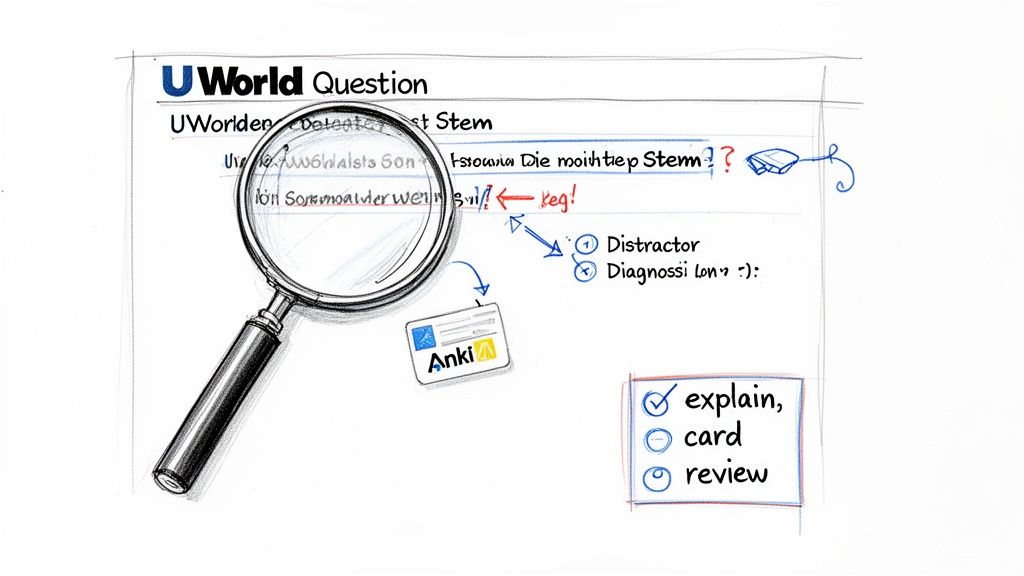
Creating Your Self-Assessment Timeline
Timing is everything. You don't want to burn through these valuable exams too early, but waiting until the last minute to discover a major weakness is a recipe for panic. A smart timeline lets you monitor your improvement and adjust your focus when it matters most.
For a standard 6-week dedicated study period, here’s a schedule that works:
- Start of Week 1: Kick things off with an older NBME (like Form 9) to get a diagnostic baseline. The score itself doesn't matter. Its only job is to expose your initial weak points and set a starting line.
- End of Week 3: Time for another NBME (Form 10 or 11 are good options). This is your first real progress check. You should see a significant jump from that initial baseline score.
- End of Week 4/Start of Week 5: Take UWSA 1. This assessment is known for having incredibly detailed explanations, offering a slightly different angle on your progress.
- One Week Before Exam: The final push. Take a final NBME (like Form 12 or 13) and UWSA 2. These last two scores, especially UWSA 2, are often highly predictive of your actual score.
This spaced-out approach gives you regular, objective feedback. It helps you catch and correct issues before they snowball and builds the mental stamina you'll need for the marathon of exam day.
The Magic Happens in the Review
Just taking a practice exam and glancing at the three-digit score is a massive wasted opportunity. The real learning comes from a deep, honest review of every single question—especially the ones you got wrong. This is where you separate simple knowledge gaps from more complex test-taking errors.
Your goal during review isn't just to memorize facts, but to get inside the test-maker's head. Figuring out why you fell for a specific distractor or misinterpreted a vignette is just as important as learning the correct management step.
As you review, start categorizing each mistake. Did you get it wrong because you genuinely didn't know the material? Or was it something else—did you misread the question stem, overthink a straightforward answer, or fall for a classic "next best step" trap? This analysis tells you exactly what to fix.
Turning Mistakes into Actionable Steps
Once you've sorted your errors, you can build a targeted plan. This moves you from passively reviewing to actively shoring up your weaknesses.
- For Knowledge Gaps: If you missed a question because you couldn't recall the diagnostic criteria for adrenal insufficiency, that’s a clear content problem. The fix is direct: make a few focused Anki cards and maybe watch a quick video or review the AMBOSS article on the topic.
- For Test-Taking Errors: Maybe you correctly diagnosed the patient but picked the wrong "next best step." That’s a reasoning error. This is your cue to slow down and more carefully think through management algorithms during your next UWorld blocks.
Most students find their final Step 2 CK score lands within +/- 10 points of their average on the last two or three practice exams. Trust this data. It's your most accurate guide and will help you make informed decisions—whether that means doubling down on a weak subject or even pushing your test date back to ensure you hit your goal.
Your Final Weeks and Test Day Game Plan
The final two weeks before Step 2 CK are all about consolidation and confidence. Forget cramming new information—your job now is to shift from learning to a razor-sharp review, making sure every bit of hard-earned knowledge is ready to go when the clock starts. This is where you lock in your strategy and tame anxiety with a clear, doable plan.
Think of it like a marathon runner tapering before a big race. You absolutely cannot walk into a nine-hour exam feeling burnt out. Your brain needs to be fresh to perform at its peak.
Tapering Your Study and Shifting Your Focus
In the last 7-10 days, your one and only rule is: no new material. Your time is now exclusively for rapid, high-yield review of topics that are easy to forget but quick to refresh.
Here’s what that looks like in practice:
- Haunt your incorrects: That list of questions you got wrong in UWorld and on your NBMEs? That's your most personalized, high-yield study guide. Go through it one last time.
- Keep your Anki streak alive: Stay on top of your daily Anki reviews, but stop adding new cards. You're reinforcing, not building.
- Scan the essentials: Do a quick pass of your notes, especially for things like biostats formulas, ethics principles, and those ever-changing screening guidelines.
This period is more critical than ever. With Step 1 now pass/fail, your Step 2 CK score has become a primary filter for residency programs. The data doesn't lie: for matched U.S. MDs, average scores range from 257 for Dermatology down to 244 for Family Medicine. Unmatched applicants often lag by 10-20 points. And while an estimated 88% of first-timers pass, a huge part of that success comes from being intimately familiar with full-length exam simulations. This final push is where you secure your edge. You can find more specialty-specific score data to see exactly what you’re aiming for.
Simulating the Full Exam Day Experience
About a week before your exam, you need to do a full-length, 8-block, 9-hour simulation. No shortcuts. Combine the official Free 120 questions with a recent NBME or UWSA to create your own personal test day. The goal isn't just a final score prediction; it's about building mental and physical stamina and nailing down your logistics.
This simulation is your final dress rehearsal. Treat it with absolute seriousness. Wake up at the same time, eat the same breakfast, and most importantly, map out and practice your break strategy.
This is your chance to figure out exactly how you'll use your break time. A small snack after every block? A quick review of your cheat sheet, or just closing your eyes to reset? Deciding this now eliminates a massive source of stress on the actual day.
Finalizing Your Test Day Logistics
The day before the exam should be as light as humanly possible. Do one last, quick scan of your cheat sheet with key formulas and mnemonics, but aim to be completely done with studying by early afternoon. Then, shift your focus to getting packed and organized.
Here’s what you’ll need:
- Your ID and scheduling permit: Double-check that they're valid and put them somewhere you can't possibly forget.
- Layers of clothing: Test centers are notoriously unpredictable—be ready for anything from a sauna to a meat locker.
- Lunch and snacks: Pack things that are easy on your stomach and won't lead to an afternoon sugar crash. Think protein, complex carbs, and lots of water.
- Earplugs: The center provides headphones, but if you're used to foam earplugs, bring your own just in case.
Get a good night’s sleep. You've put in the countless hours. Now, it's just about execution. Trust your prep, stick to your plan, and walk in there with confidence. You’ve got this.
Common Questions About Step 2 CK Prep
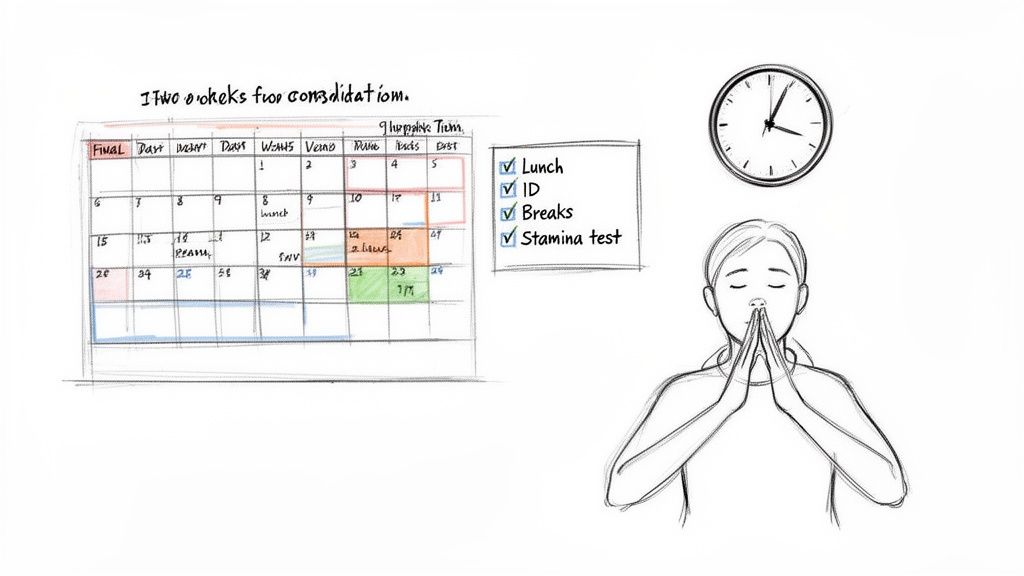
Once you start mapping out your Step 2 CK plan, the same questions always seem to surface. The logistics can feel just as complicated as the content itself. Let’s cut through the noise and tackle the most common concerns I hear from students.
Think of this as the practical advice everyone needs but might not ask. Getting these details sorted out early will save you a ton of stress and keep you on track.
How Long Should I Study for Step 2 CK?
There's no single magic number, but the sweet spot for most medical students is a dedicated period of four to eight weeks. Your ideal timeline really depends on your clinical foundation and what else is going on in your life.
- Four Weeks: This is a sprint, not a marathon. It can work if you’re coming in with a strong foundation from clerkships, consistently honored your shelf exams, and can lock yourself away for full-time, focused study.
- Six to Eight Weeks: This is a much more common—and frankly, more sustainable—approach. It gives you enough breathing room for a deep content review and a manageable daily pace, especially if you have other commitments or need to really shore up some weak spots.
No matter the timeline, the real goal is to log 300-400 hours of quality, focused work. A consistent, high-quality effort beats a chaotic, rushed schedule every time.
What Is a Good UWorld Percentage for Step 2 CK?
It's so easy to get obsessed with your UWorld percentage, but it’s a classic trap. Seeing scores in the 50s or 60s when you first start your dedicated period is completely normal. Do not panic. Remember, UWorld is a learning tool first and an assessment tool second.
The metric that actually matters is your upward trend. Your scores should be climbing as you move through the material. A great target by the end of your dedicated block is an average of 70-80% on timed, random blocks. That’s a strong indicator you’re in a good position, especially if you're aiming for a 250+.
Should I Do a Second Pass of UWorld?
This is the eternal debate. For most students, the answer is no—at least not a full, repetitive second pass. A much more efficient strategy is to zero in on your incorrect and marked questions. This forces you to confront your documented weaknesses, which is the fastest way to rack up points.
If you blow through your first pass and still have a lot of time left, consider a different Qbank like AMBOSS. This exposes you to different question phrasing and prevents you from just memorizing UWorld answer patterns. The goal is mastering concepts, not just recognizing questions.
The real value isn't in seeing a question a second time; it's in deeply understanding why you missed it the first time. A single, meticulous review of your mistakes is far more powerful than a rushed second pass where you're just pattern-matching.
How Predictive Are the NBME and UWSA Practice Exams?
They are incredibly predictive. The self-assessments you take in the final few weeks are the most reliable snapshot of your readiness.
Countless students find their final score lands within +/- 10 points of their average on the last two or three practice tests, like the newer NBME forms and UWSA 2. Treat them as your compass. If your scores are consistently off-target, it’s a clear sign to rethink your strategy or even consider pushing back your test date. Trust the data.
Understanding these key moving parts helps demystify the prep process, and that clarity is everything. As you look ahead, make sure you're also thinking about what comes next. Check out our resources on preparing for your residency interviews to get ready for the next stage of your journey.
Preparing for residency interviews is the next major hurdle after your exams. With Confetto, you can practice with an AI interviewer that simulates MMI and panel interviews, providing instant feedback on your communication, empathy, and critical thinking. Turn your interview prep into a confident performance by visiting https://confetto.ai to start your free trial.