
· 31 min read
MMI Questions and Medical School Interview Questions, With Answers
MMI questions and medical school interview questions by type, eight worked stations with model answers, scoring basics and a free timed practice station.

Most MMI questions and medical school interview questions fall into a small number of types, and each type rewards a different kind of answer. This guide gives you example questions for every type, what a strong answer covers, eight full stations with model answers, and the ten traditional questions that come up at schools that do not use the MMI.
Try a station before you read the answers. Open our free timed MMI practice station: a fictional scenario, reading and response timers, and a self-review checklist. No sign-up is needed. It does not record or score your answer, so use the checklist to review your own reasoning, then compare it with the examples below.
When you want more than one station, the Confetto question bank has over 500 questions, and the AI interviewer asks follow-ups the way a real interviewer does. You can start with a 7-day free trial. If you are still working out how to schedule your preparation, read our MMI practice and preparation guide next.
The model answers here are blueprints, not scripts. Interviewers can tell when an answer is memorized. Use them to see the shape of a good answer: a clear structure, more than one point of view, and a decision you can defend.
How an MMI is run and scored
The Multiple Mini Interview was developed at McMaster University and replaces one long interview with a circuit of short stations. You rotate through them, and each one is a fresh start.
- Timing. You usually read the prompt outside the door for one to two minutes, then respond for roughly five to ten minutes. Circuits commonly run somewhere between 6 and 12 stations. Schools set their own timings, so check your school's guide before you practice. The timer on our MMI timer lets you change reading and response time to match.
- Station types. Most stations are a spoken scenario with an interviewer who may ask follow-ups. Others use an actor (a patient, a colleague, a relative), or a task you complete with another applicant.
- Scoring. A different interviewer scores each station on its own, usually against a short rubric of competencies plus an overall rating. Scales differ by school. Because the stations are scored separately, one awkward station does not sink the others.
- What is being measured. Not medical knowledge. Schools look at communication, ethical reasoning, empathy, teamwork, professionalism and self-awareness. In the US these map to the AAMC premedical competencies. In Canada many schools tie them to the CanMEDS roles.
- After a station. Many schools ask you not to discuss stations with other applicants. Follow the rule, and then forget the station you just did. Your next interviewer has not seen it.
A simple structure for answering any station
You do not need a different method for each question. This five-step structure fits almost every spoken scenario, and it keeps you from rambling.
- Use the reading time. Write one line that names the central conflict (for example, the patient's wishes against the family's worry). List who is affected. Note two or three values or options in play.
- Restate and acknowledge. Open by saying in your own words what the situation is and why it is hard. This takes ten seconds and shows you understood the prompt.
- Gather what you need. Say what you would find out first: is anyone at immediate risk, what does the patient understand, what are the facts and the rules that apply. Asking is a strength, not a weakness.
- Weigh the options and choose. Walk through the main options and what each costs. Then commit to a first action and say why. Interviewers want a decision they can follow, not a list.
- Name the trade-off and your next step. Say what you give up with your choice, and what you would do if it did not work. Then keep going. If you finish early, expect follow-ups.
Medical ethics gives you handy vocabulary here: autonomy, beneficence, non-maleficence and justice. Use them as a lens to spot what is in conflict, not as a checklist to recite. An answer that names all four and never decides anything is a weak answer.
MMI question types, with example questions
These are the types you are most likely to see. The example prompts are written to match what schools ask, so you can practice the skill without guessing at a particular school's questions. After this section you will find eight of them worked through in full.
1. Ethical dilemmas
Tests moral reasoning and whether you can hold two valid values at once.
Example prompts:
- A 16-year-old asks you for birth control and begs you not to tell her parents. What do you do?
- A competent adult patient refuses a blood transfusion for religious reasons. How do you respond?
- Two patients need the last ICU bed. Who should get it, and who decides?
What strong answers cover: naming the conflict and the stakeholders, checking the facts and the rules that apply, deciding on a first step, and saying what you would do about the person who disagrees. Weak answers recite principles and never decide, or announce a verdict in the first sentence.
2. Teamwork and collaboration
Tests how you work with others, including when it is uncomfortable.
Example prompts:
- You are in a group project and one member has not contributed. The deadline is Friday. What do you do?
- Two nurses disagree about a care plan and both ask for your view as a student. How do you respond?
- You and another applicant must build something from the materials on the table. You have ten minutes.
What strong answers cover: a private, curious first conversation instead of a public call-out, asking what is getting in the way before assigning blame, making sure quieter people are heard, and escalating with a clear purpose if talking does not work. In group tasks, interviewers watch whether you listen and share the work, not who finishes first.

3. Communication and explanation
Tests whether you can make complex information clear to someone who is worried.
Example prompts:
- Explain to a patient what a new diagnosis of type 2 diabetes means.
- Describe this diagram so that someone who cannot see it could draw it.
- Explain to a 12-year-old why antibiotics do not work on a cold.
What strong answers cover: asking what the person already knows before you explain, plain words in short chunks, an analogy or two, regular checks that you are understood, and room for questions. Jargon is the usual failure.
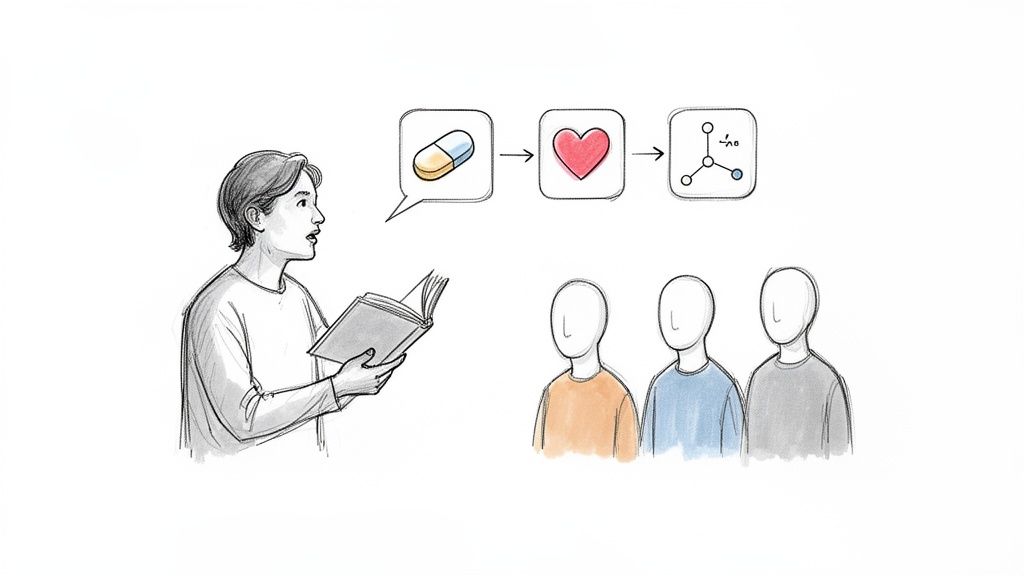
4. Health systems, policy and advocacy
Tests whether you understand medicine beyond one patient, and can argue a balanced view.
Example prompts:
- How would you reduce emergency department wait times?
- Should a country fund health care through a single public payer? Argue both sides, then give your view.
- How would you attract and keep more doctors in rural communities?
What strong answers cover: a specific mechanism instead of a slogan, the trade-offs of your proposal, a concrete patient who is affected, and respect for the view you reject. You are not expected to be a policy expert. Partisan answers lose points.
5. Clinical scenarios
Tests structured thinking under pressure. Rarely tests facts.
Example prompts:
- A 65-year-old man arrives with two hours of crushing chest pain. Walk me through your thinking.
- A 30-year-old woman has had three weeks of tiredness. How do you approach her?
- A parent brings in a feverish child with a new rash. What do you want to know?
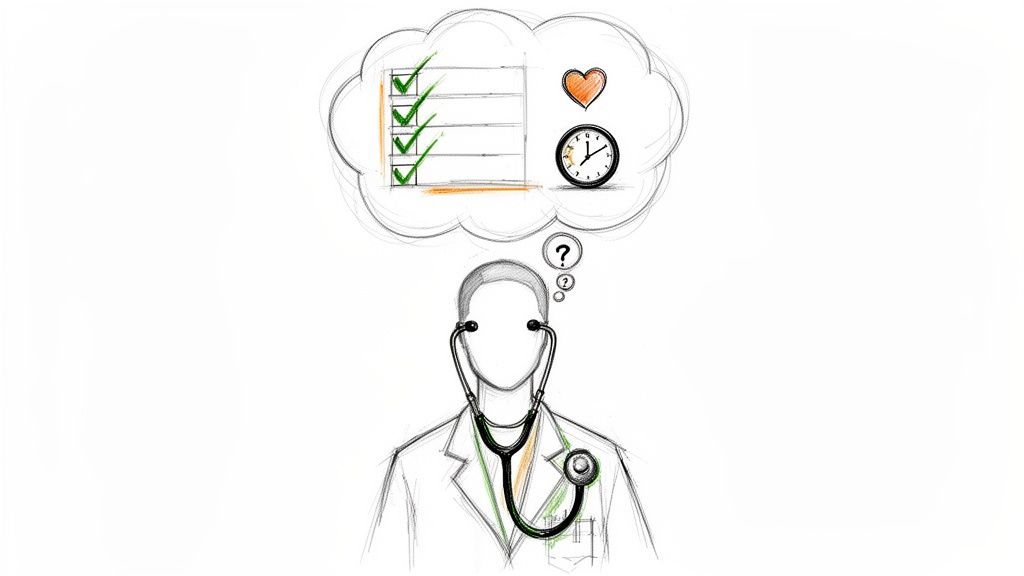
What strong answers cover: a visible structure (history, exam, differential, tests, plan), the dangerous possibilities first, questions you would ask, and honesty about your role: "as a student I would involve my senior." Never bluff a diagnosis.
6. Motivation and personal experience
Tests whether your reasons for medicine are real and reflective.
Example prompts:
- Why do you want to be a doctor?
- Tell me about an experience that changed how you see medicine.
- What would you do if you were not accepted this year?
What strong answers cover: one specific story, what you learned from it, how it connects to the work of a physician, and an honest tone. A list of achievements does not answer the question.
7. Conflict, professionalism and difficult conversations
Tests judgment when someone else is behaving badly or a conversation is tense.
Example prompts:
- A senior colleague makes an offensive joke in a team huddle. No one reacts. What do you do?
- A relative demands to know a patient's test results and is getting angry.
- Your supervisor asks you to do something you believe is unsafe.
What strong answers cover: protecting the patient first, addressing the behavior and not the person, a measured private conversation as the first step, and knowing when to escalate (safety, harassment, anything illegal).
8. Self-awareness and stress
Tests honesty about limits and how you handle pressure.
Example prompts:
- Tell me about a time you made a mistake. What did you do?
- Describe feedback you found hard to hear. What did you change?
- How will you cope with the workload of medical school?
What strong answers cover: a real example with real stakes, the specific change you made afterwards, and a concrete plan for staying well that you already follow. Polished weaknesses ("I work too hard") read as evasion.
9. Bias and discrimination
Tests whether you notice bias and respond calmly and effectively.
Example prompts:
- A classmate says a patient is "probably not smart enough to understand" his care plan because he is a recent immigrant. What do you do?
- You notice that a patient from a particular group is consistently offered fewer treatment options on your ward. What do you do?
What strong answers cover: attention to the person affected first, naming the behavior calmly in the moment if it is safe to, a private follow-up, and a fix for the root cause (an interpreter, a process change).
10. Empathy and perspective-taking
Tests whether you can find the worry behind the stated problem.
Example prompts:
- An elderly patient with chronic back pain says, "I just want to garden again." How do you explore that?
- A parent refuses a recommended vaccine for their child. How do you begin the conversation?
What strong answers cover: open questions, reflecting back what you heard, curiosity about the person's reasons, and silence. You are not trying to solve it in two minutes. You are trying to show you can make someone feel heard.
Eight MMI stations with model answers
Each station below has a prompt, a model response and the points that make it work. Read the prompt, time yourself answering out loud (use the free MMI timer), then read the model answer. Do not memorize the wording.
Station 1. The Ethical Dilemma: Patient Confidentiality vs. Family Wishes
This classic MMI station places you in a scenario where a patient's right to privacy directly conflicts with the concerns or demands of their family. It's a foundational test of your understanding of core medical ethics, specifically patient autonomy. Interviewers use these MMI practice questions with answers to see if you can navigate sensitive situations with empathy, professionalism, and a structured ethical framework.
The core challenge is balancing the patient's legal and ethical right to confidentiality against the family's desire to be informed, which often stems from a place of care and concern. Your ability to de-escalate conflict and uphold your primary duty to the patient is paramount.
Sample Scenario Breakdown
Prompt: An 80-year-old patient with a new diagnosis of terminal cancer explicitly tells you, their physician, not to inform his wife of 50 years. He is worried the news will devastate her. A few moments later, his wife pulls you aside in the hallway and asks you directly what the test results showed. What do you do?
Model Response & Rationale
"This is a very sensitive and difficult situation for everyone involved. My first priority is to honor my patient's autonomy and his direct request for confidentiality. I would gently and empathetically tell his wife that my professional and ethical duty is to my patient, and I cannot share his private medical information without his explicit consent. I would acknowledge her concern and distress, validating her feelings without revealing any details. My next step would be to return to my patient, privately, and revisit the conversation. I would gently explore his reasons for withholding the information, express my concern for the burden he is carrying alone, and discuss the potential benefits of having his wife's support during this incredibly difficult time. I would not pressure him, but rather facilitate a conversation about building a support system, which could include offering to help him tell his wife when he is ready."
Strategic Takeaways
- Acknowledge and Validate: Begin by acknowledging the emotional difficulty of the situation for all parties. This signals empathy.
- State Your Primary Duty: Clearly and calmly state that your primary obligation is to the patient and their confidentiality. This establishes your ethical foundation.
- Offer Support, Not Information: You can be empathetic to the family member without breaking confidentiality. Offer support or suggest resources, but do not disclose patient information.
- Focus on Facilitation: The goal isn't to force the patient to disclose but to create a supportive environment where they might choose to. Your role is to facilitate communication, not make decisions for the patient.
Station 2. The Communication Challenge: Delivering Bad News to a Simulated Patient
This interactive MMI station moves beyond theoretical discussion into practical application. It simulates a real clinical encounter where you must deliver difficult news to a patient actor. Interviewers use these live-action MMI practice questions with answers not just to hear your thought process, but to see your empathetic communication skills in real-time. This station evaluates non-verbal cues, tone, emotional intelligence, and your ability to balance honesty with compassion.
This core competency is critical because it forms the foundation of patient trust and directly impacts clinical outcomes. The challenge is to remain professional and structured while conveying empathy and adapting to the actor's emotional response. Your ability to create a safe, supportive space for the patient is what's being tested.

Sample Scenario Breakdown
Prompt: You are a physician meeting with the parents of a 4-year-old child. Recent developmental screenings and specialist evaluations have confirmed a diagnosis of Autism Spectrum Disorder. The parents are anxious and have expressed hope that their child is just a "late bloomer." You must now enter the room and deliver the diagnosis.
Model Response & Rationale
"(Knocks gently before entering, sits down at eye level, making warm eye contact). 'Thank you for coming in today. Before we discuss the results, I want to check in and see how you are both doing and what's on your mind.' (After listening to their perception). 'I appreciate you sharing that. I have the results of the evaluations, and the findings indicate that your child meets the criteria for Autism Spectrum Disorder. I know this is a lot to take in.' (Pauses to allow silence). 'I want to assure you we are a team in this. My next step is to talk about what this means and connect you with the best resources and support systems to help your child thrive. We can take this one step at a time.'"
Strategic Takeaways
- Set the Stage: Begin by creating a private, calm environment. Sit down, avoid physical barriers like a desk, and ensure you won't be interrupted. This shows respect.
- Assess Perception: Before delivering the news, ask the patient or family what they already understand or are worried about. This helps you tailor your message.
- Deliver Information Clearly: Use clear, direct language, but deliver it with empathy. Pause immediately after to allow the information to be processed. Silence is a powerful tool.
- Acknowledge Emotions: Validate their feelings by saying things like, "I can see this is upsetting" or "This is difficult news to hear." For scenarios like this, mastering how to handle difficult conversations is an indispensable skill.
Practicing these scenarios under timed conditions is essential. You can sharpen your delivery and timing by using tools like an MMI timer during your preparation.
Station 3. The Healthcare Systems Question: Critiquing Current Policies and Proposing Solutions
This MMI station moves beyond individual patient encounters to assess your big-picture understanding of the healthcare landscape. Interviewers present these MMI practice questions with answers to evaluate your awareness of systemic challenges like access, equity, and cost, and your ability to think critically about policy. It's a test of your societal awareness and your potential to be a future leader and advocate in medicine.
The core challenge is to demonstrate a balanced, informed perspective without resorting to overly simplistic or purely ideological arguments. Your ability to analyze a complex issue, consider multiple viewpoints, and propose thoughtful, pragmatic solutions is what interviewers are looking for.
Sample Scenario Breakdown
Prompt: The current "fee-for-service" model, where physicians are paid for each service they provide, is criticized for incentivizing volume over value. Propose one specific change to physician reimbursement that you believe would better promote patient health outcomes, and defend your choice.
Model Response & Rationale
"This is a fundamental challenge in healthcare system design. While fee-for-service ensures physicians are compensated for their work, it can inadvertently prioritize quantity of care over quality. A specific change I would propose is a move toward a blended, value-based payment model. This wouldn't eliminate fee-for-service entirely but would link a significant portion of a physician's compensation to specific patient health outcomes, such as better management of chronic conditions like diabetes, evidenced by lower HbA1c levels, or reduced hospital readmission rates. For example, a primary care practice could receive a bonus for achieving a certain vaccination rate within its patient population. This incentivizes proactive, preventive care rather than just reactive treatment. I recognize the challenge lies in defining and fairly measuring these outcomes, but it shifts the focus from 'doing more' to 'doing what's effective' for the patient."
Strategic Takeaways
- Acknowledge Complexity: Start by showing you understand the nuances. Acknowledge the pros and cons of the existing system before proposing a change.
- Be Specific and Concrete: Avoid vague statements like "we should focus on prevention." Propose a specific mechanism, like "linking compensation to vaccination rates" or "bonuses for improved chronic disease metrics."
- Articulate the Trade-Offs: Every policy has a downside. Briefly mentioning the potential challenges of your proposed solution (e.g., "the difficulty in fairly measuring outcomes") shows maturity and critical thinking.
- Stay Solution-Oriented: The goal isn't just to critique the current system but to demonstrate your ability to think constructively about improvements. Frame your answer around a tangible, positive change.
Station 4. The Interpersonal Conflict Station: Responding to a Colleague's Unprofessional Behavior
This MMI station assesses your professionalism, emotional intelligence, and ability to handle difficult workplace dynamics. You will be presented with a scenario involving a peer, supervisor, or team member behaving unprofessionally, and interviewers want to see how you would respond. These MMI practice questions with answers are crucial for demonstrating that you can maintain a safe and respectful environment, a non-negotiable skill in modern healthcare.
The primary challenge is to find a balanced approach that is neither overly aggressive nor completely passive. Your goal is to address the problematic behavior constructively while preserving professional relationships and prioritizing patient safety or team cohesion. This station tests your ability to act with maturity and assertiveness.
Sample Scenario Breakdown
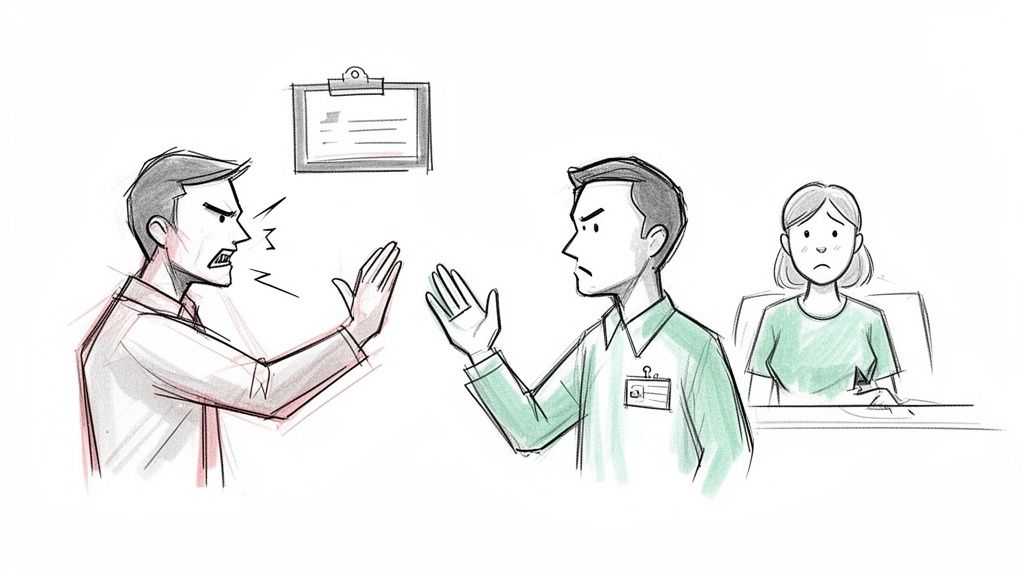
Prompt: You are a junior resident on a team. During a morning huddle, a senior physician you respect makes a racially insensitive joke about a particular patient demographic. The other team members laugh nervously or say nothing. What do you do?
Model Response & Rationale
"This is a very concerning situation, as such comments undermine team psychological safety and patient trust. My immediate response would depend on the context, but I would not let the comment pass. In the moment, if I felt it was appropriate, I might say something brief and professional like, 'I don't think that comment is appropriate for a professional setting.' My primary goal, however, would be to address this privately with the senior physician later. I would find a time to speak with them one-on-one, express my respect for them, and then clearly state what I observed. I would say something like, 'I was uncomfortable with the joke made this morning. Comments like that can negatively impact our team dynamic and how we approach patient care.' I would focus on the impact of the behavior rather than making a personal accusation. If this behavior continued, I would know it is necessary to escalate the issue to a program director or a trusted faculty member."
Strategic Takeaways
- Avoid Extremes: Do not ignore the behavior (passive), but also avoid a public, aggressive confrontation. A measured, private conversation is often the best first step.
- Start with Curiosity and Respect: When approaching a colleague, assume good intent initially. Frame your concern around the impact of their actions, not their character.
- Know When to Escalate: While direct communication is ideal for minor issues, be prepared to escalate for matters involving patient safety, harassment, or illegal behavior.
- Practice Your Delivery: Your tone and body language are critical. You want to appear calm, professional, and open to dialogue, not accusatory or defensive. This is where practicing out loud can be very helpful.
Station 5. The Clinical Reasoning Scenario: Diagnosing and Managing a Complex Case
This station tests your ability to think like a clinician by presenting a case and asking you to work through it logically. While less common in traditional medical school MMIs, it's a staple for PA, pharmacy, and dental interviews. These mmi practice questions with answers are designed to see how you structure your thoughts, prioritize information, and articulate a clinical plan.
The core challenge isn't about having the perfect diagnosis but demonstrating a safe, systematic, and evidence-based approach. Interviewers want to see that you can organize complex information under pressure and communicate your reasoning clearly, which is a critical skill for any healthcare provider.
Sample Scenario Breakdown
Prompt: A 65-year-old man presents to the emergency department with a two-hour history of crushing central chest pain that radiates to his left arm. He is short of breath, pale, and sweaty. Walk me through your thinking and initial management steps.
Model Response & Rationale
"This presentation is highly concerning for a life-threatening condition, and my immediate priority would be to assess the patient and stabilize him. My thinking process would follow a structured approach: initial assessment, forming a differential diagnosis, targeted investigations, and then management. Given the classic symptoms of crushing chest pain radiating to the arm, shortness of breath, and diaphoresis in a 65-year-old male, my primary suspicion is an acute coronary syndrome, specifically a heart attack (myocardial infarction). However, I must also consider other critical causes like a pulmonary embolism or an aortic dissection. I would immediately ensure his airway is clear, check his vital signs, and get IV access. I'd order an ECG, check cardiac enzymes like troponin, and get a chest X-ray. While awaiting results, I would consider administering aspirin, nitroglycerin, and oxygen, assuming no contraindications. My goal is to work quickly and systematically to confirm the diagnosis and initiate time-sensitive treatment."
Strategic Takeaways
- Verbalize a Structure: Start by stating your approach (e.g., "I would use a history, exam, investigations, and management framework"). This shows the interviewer you are organized.
- Prioritize the "Red Flags": Immediately identify the most life-threatening possibilities. This demonstrates sound clinical judgment and a focus on patient safety.
- Think Out Loud: Don't just list tests. Explain why you are ordering them (e.g., "I'd get an ECG to look for ST-segment changes indicative of a heart attack").
- Acknowledge Your Scope: It's okay to say, "As a student, I would consult with my senior resident and the cardiology team." This shows an understanding of teamwork and the limits of your role.
To practice applying these frameworks to a variety of clinical prompts, you can explore the diverse scenarios in our MMI question bank and refine your approach.
Station 6. The Motivation and Self-Awareness Question: Why Medicine? And Who Are You?
This foundational MMI station probes your core motivations and is a critical test of your self-awareness. It presents questions like "Why do you want to be a doctor?" or "Tell me about yourself." While they seem simple, these are pivotal mmi practice questions with answers because they give interviewers a direct window into your character, values, and authenticity.
The challenge is to move beyond generic responses ("I want to help people") and present a compelling, personal narrative. A strong answer connects your unique experiences to the specific values of medicine and the mission of the institution, demonstrating introspection and genuine commitment.
Sample Scenario Breakdown
Prompt: Tell me about a time you knew for certain that a career in medicine was the right path for you.
Model Response & Rationale
"During my time volunteering in a pediatric ward, I was assigned to a 7-year-old boy named Leo, who was very anxious about his upcoming surgery. Instead of just trying to distract him with games, I remembered he loved drawing superheroes. I sat with him and we spent an hour creating a comic book where 'Super Leo' bravely faced his 'surgery challenge.' The next morning, the nurse told me he took the comic with him to the OR. It wasn't about curing his illness, but about connecting with him as a person and easing his fear. That moment crystallized it for me; medicine isn't just about science and procedures, it's about using empathy and creativity to support people through their most vulnerable moments. I knew then that this unique blend of science and human connection was my calling."
Strategic Takeaways
- Tell a Story, Don't Just State Facts: A specific, personal story is far more memorable and impactful than a list of accomplishments or a generic statement of intent.
- Show, Don't Tell: Instead of saying you are compassionate, describe a moment where you acted compassionately. Let the story illustrate your qualities for you.
- Connect to a Deeper "Why": The story should lead to a clear realization. Explain what the experience taught you about medicine and yourself, and why it solidified your motivation.
- Be Authentic: Your journey is unique. Own any detours or late realizations. An honest narrative that reflects genuine self-discovery is more powerful than a fabricated story about always knowing.
Station 7. The Bias and Discrimination Scenario: Recognizing and Responding to Prejudice
This MMI station tests your ability to identify and professionally address instances of bias or discrimination. These scenarios assess your commitment to diversity, equity, and inclusion by placing you in situations where a patient, colleague, or even you yourself exhibit prejudice. These MMI practice questions with answers are designed to see if you can act with moral clarity and professionalism, rather than with aggression or passivity.
The central challenge is to intervene effectively without escalating the situation or shaming the individual. Interviewers want to see that you can protect the vulnerable party, uphold professional standards, and foster an inclusive environment, all while maintaining composure and demonstrating empathy.
Sample Scenario Breakdown
Prompt: You are a medical student on rounds with your attending physician and a fellow student. When discussing a patient who is a recent immigrant and struggling to understand their care plan, your fellow student quietly remarks to you, "He's probably not smart enough to get it anyway." The attending physician doesn't hear the comment. What do you do?
Model Response & Rationale
"This is an unprofessional and harmful comment that I cannot ignore. My immediate priority is to address the comment directly but discreetly, without causing a major scene during rounds. I would turn to my fellow student and say calmly, 'That's not an appropriate or fair assumption to make. There could be many reasons for his difficulty, like language barriers or the stress of being ill.' My goal is to stop the behavior in the moment and label it as unacceptable. After rounds, I would seek a private moment with the student to have a more in-depth conversation. I'd explain how their comment was biased and damaging, not just to the patient but to the trust within our team. I would also reflect on the patient's situation and, when appropriate, suggest to the attending that we consider using a professional medical interpreter to ensure the patient truly understands their care plan, thereby advocating for the patient's needs."
Strategic Takeaways
- Address it Directly, Calmly: Do not ignore bias. Address the comment or action in a direct, calm, and professional manner. The goal is education, not confrontation.
- Prioritize the Affected Person: Your first thought should be the well-being and dignity of the person targeted by the bias. If they are present, your first action might be to support them.
- Separate the Person from the Behavior: Frame your feedback around the specific comment or action being inappropriate, rather than attacking the person's character. This makes them more receptive to feedback.
- Advocate for a Systemic Fix: Beyond the interpersonal response, think about the bigger picture. In this case, advocating for an interpreter addresses the root cause of the patient's communication challenge and promotes equitable care.
Station 8. The Empathy and Perspective-Taking Challenge: Understanding a Patient's Non-Medical Concerns
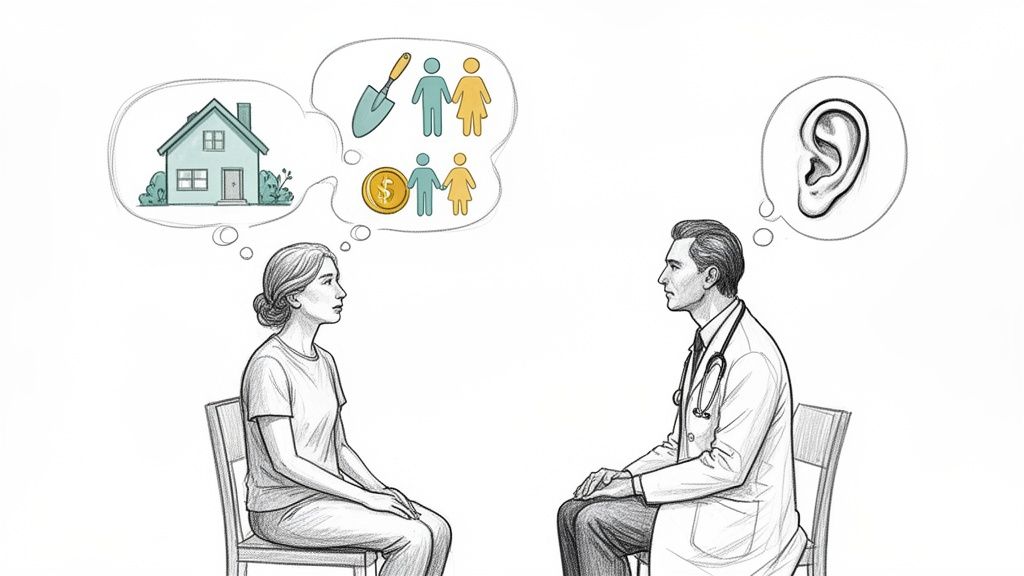
This MMI station tests your ability to look beyond the clinical chart and understand the human being in front of you. It presents a patient whose stated medical issue is often a gateway to a deeper, non-medical concern, such as fear of losing independence, social isolation, or financial strain. These MMI practice questions with answers are designed to see if you can practice patient-centered care by uncovering the values, fears, and life circumstances that truly shape a patient's health experience.
The core challenge is to listen actively and ask thoughtful, open-ended questions that reveal the patient's underlying worries. Your goal is not to "solve" their medical problem in two minutes but to demonstrate that you can build trust and understand what truly matters to them, a key predictor of patient compliance and better health outcomes.
Sample Scenario Breakdown
Prompt: An elderly patient with chronic back pain tells you, "I just want the pain to go away so I can garden again. My garden is my life." Rather than immediately discussing pain medication options, how would you explore this patient's statement further?
Model Response & Rationale
"This is a powerful statement that tells me the patient's concern goes far beyond the physical sensation of pain. I would first validate their feelings and show I've truly heard them. I would say something like, 'Thank you for sharing that with me. It sounds like your garden is incredibly important to you, and the back pain is taking that away.' I would then use open-ended questions to explore this further. For example, 'Could you tell me more about your garden and what it means to you?' This invites them to share their story and helps me understand if gardening represents independence, a connection to a loved one, a source of peace, or a way to stay active. By understanding the 'why' behind their goal, we can work together on a more holistic treatment plan that might include physical therapy focused on gardening movements or connecting them with a community garden, in addition to managing the pain itself."
Strategic Takeaways
- Ask Open-Ended Questions: Avoid "yes" or "no" questions. Instead of "Is gardening hard?", ask "Tell me what happens when you try to work in your garden now?"
- Reflect and Validate: Repeat back what you hear in your own words. "So, it sounds like what you miss most is the feeling of being active and productive." This shows you are listening and helps the patient feel understood.
- Explore Beyond the Symptom: Dig deeper into the patient's motivations and fears. Ask questions like, "What worries you most about not being able to garden?" to uncover the real issue, which could be a fear of becoming dependent on others.
- Listen More, Speak Less: Use silence. After asking a question, give the patient time to think and respond. Rushing to fill the silence can prevent you from hearing the most important information.
MMI station types at a glance
- Ethical dilemma: tests moral reasoning. A strong answer names the conflict, weighs both sides, decides and owns the trade-off.
- Role-play (patient, colleague, relative): tests communication and composure. A strong answer sets the scene, asks first, pauses and acknowledges feeling.
- Health systems and policy: tests awareness of the wider system. A strong answer proposes something specific and names the downside.
- Conflict and professionalism: tests judgment. A strong answer takes a private first step, protects patients and escalates when needed.
- Clinical reasoning: tests structured thinking. A strong answer states a structure, covers red flags first and knows its limits.
- Motivation and self-awareness: tests authenticity. A strong answer gives one real story and what it taught you.
- Bias and discrimination: tests recognition and response. A strong answer protects the affected person, addresses the behavior and fixes the cause.
- Empathy and perspective-taking: tests patient-centered listening. A strong answer uses open questions, reflection and silence.
Traditional and panel interview questions
Not every school uses the MMI. Many use a one-on-one or panel interview built around a handful of questions, and MMIs include some of these as well. Here are the ten you should be able to answer without notes.

1. Why do you want to become a doctor?
Why they ask: Motivation that is specific and real.
What a strong answer covers: one story from shadowing, volunteering or life; what you learned from it; what makes a physician's role the right fit; a link to the school's mission if it is honest.
Common mistake: "I like science and I want to help people" with no story behind it.

2. Tell me about a time you failed. What did you learn?
Why they ask: Resilience and honesty about mistakes.
What a strong answer covers: a failure with real stakes; two or three sentences on what happened and most of your answer on what you changed; a link to how you will work with patients and teams.
Common mistake: A disguised success, or a failure with no change afterwards.

3. Describe a time you worked in a team. What was your role?
Why they ask: How you work with others.
What a strong answer covers: your real role, how you handled a disagreement, how the team's result differed because of what you did, and credit to others.
Common mistake: Describing a team project in which you did everything yourself.
4. What would you do if you saw a colleague making an unethical decision?
Why they ask: Professional integrity and judgment.
What a strong answer covers: protecting patients first, checking what you saw, a direct conversation when it is safe, and using the proper reporting channel when it is not or when harm is possible.
Common mistake: Either "I would ignore it" or "I would report them immediately" with no steps in between.
5. How would you handle being told your diagnostic reasoning was wrong?
Why they ask: Openness to feedback and intellectual humility.
What a strong answer covers: thanking the person, asking for their reasoning, checking the facts, updating the plan, telling the patient if it affects them, and learning from it.
Common mistake: Defending yourself, or treating the correction as a personal attack.
6. How will you handle the stress and long hours of medical school and residency?
Why they ask: Insight into the demands, and whether you already manage stress well.
What a strong answer covers: a realistic view of the workload, habits you already keep (sleep, exercise, people, time off), and when you ask for help.
Common mistake: "I thrive under pressure" with no evidence.

7. What would you do if a patient refused life-saving treatment for religious reasons?
Why they ask: Ethics, respect for autonomy, and communication.
What a strong answer covers: confirming the patient has capacity and understands the risks, exploring their reasons without judgment, offering alternatives, involving appropriate support (such as a chaplain or an ethics service), and respecting a capable adult's decision. Rules differ for children, so say you would check the local policy.
Common mistake: Giving a legal opinion you are not sure about, or overriding the patient.
8. Tell me about a health disparities or social determinants issue you have encountered. What would you do about it?
Why they ask: Awareness of inequity and a willingness to act.
What a strong answer covers: a specific example you have seen or studied, one cause beyond the clinic, and one realistic response that a clinician or a team could take.
Common mistake: Naming a statistic without a person or an action.
9. Describe your experience with someone from a very different background. What did you learn?
Why they ask: Cultural humility and curiosity.
What a strong answer covers: a real encounter, what you assumed, what you learned by listening, and how it changed your behavior.
Common mistake: A story where you are the hero who helped someone.
10. What do you know about the health care system? How would you improve it?
Why they ask: Whether you have thought about the system you want to work in.
What a strong answer covers: one problem you can describe accurately, one specific change, its trade-offs, and who would be affected.
Common mistake: Reciting a talking point or blaming a single group.
How to practice these questions
Reading answers helps you see the shape. Saying answers aloud builds the skill. A good loop is simple: pick a question, set a timer, answer out loud, review it, then repeat the same type a day later.
- Free, now: the MMI timer and free practice station needs no sign-up.
- Browse more questions: the question bank preview shows how the full bank is organised by type.
- Practice with follow-ups: the AI MMI simulator plays the interviewer and asks follow-up questions. Start with the 7-day free trial.
- Plan your weeks: our MMI practice guide has a four-week plan, a mock interview setup and the full list of tips.
- Preparing for a specific program: see Confetto for medical school interviews.
School-specific guides
Formats, timing and question styles differ by school. Use these guides next to the general questions above. Some of these schools use the MMI, others use panel or one-on-one interviews, and each guide says which.
Canada: UBC, McGill, Queen's, Dalhousie, Calgary, Alberta, Saskatchewan, Manitoba, Memorial, Ottawa, Toronto
United States: Stanford, Harvard, UC Davis, Michigan, Minnesota, UMass Chan, NYU Grossman, Arizona Phoenix, Colorado, Rutgers RWJ
United Kingdom: Brighton and Sussex, Exeter, Sheffield, Hull York
Other programs that use MMI formats: PA school, dental school, vet school, pharmacy school, CaRMS residency.
Frequently asked questions
How many MMI questions should I practice?
There is no magic number. Variety and repetition matter more than volume. Cover every question type at least twice, run at least one full timed circuit before your interview, and go back to the types where your answers feel weakest.
Do I need medical knowledge for the MMI?
Rarely. Clinical scenarios test how you think, not whether you can name the right drug. You will not be penalized for saying you would ask a senior colleague. You should know the basic ethical principles and have a general awareness of current health issues in the country where you are applying.
Is there a right answer to an ethical question?
Usually there is more than one defensible answer. Interviewers score your reasoning: whether you saw the conflict, weighed the sides, and chose something you can justify. Ending with "it depends" and no decision is the common way to lose marks.
What if my mind goes blank?
Pause and restate the prompt in your own words. Ask yourself the three questions from the structure above: what is the conflict, who is affected, what would I do first. It is fine to say, "Let me gather my thoughts for a moment." Then give a smaller answer than you planned and let the follow-ups do the rest.
How long should my answer be?
Use most of the time you are given, but you do not need to fill every second. If you have said what you would do and why, stop and be ready for follow-ups. Interviewers often probe with "what if", so leave room.
Which format does my school use?
Check the school's own admissions page, and then read our guide for that school (see the list above). Some schools use the MMI, some use panel interviews, and a few combine formats.
Ready to say these answers out loud? Start with the free practice station, then try Confetto: an AI interviewer that asks follow-up questions, scores your answers against a rubric and shows you what to fix. Start your 7-day free trial.