
Updated · 9 min read
Preparing for the Alabama College of Osteopathic Medicine interview
Key facts (2026-27)
One open-file interview with two trained faculty or staff, held in person in Dothan or on Zoom, and you usually hear back within a few weeks.
- Format
- One 30-minute open-file interview with two faculty
- Where
- In person (Dothan) or virtual (Zoom)
- Stations
- 1 interview, 2 interviewers
- Length
- 30 minutes (AACOM)
Dates for 2026-27
Rolling, by email with login details to schedule your date
Interview invitations
End of July to end of April (ED: in person, mid-September)
Interviews
Within a few weeks (Early Decision: by October 1 per ACOM, October 15, 2026 per AACOM)
Offers and decisions
Checked October 2026 against ACOM: Admissions FAQs, ACOM: Interview and selection, ACOM: Early Decision program and AACOM Choose DO: ACOM. Confirm details in your invitation.
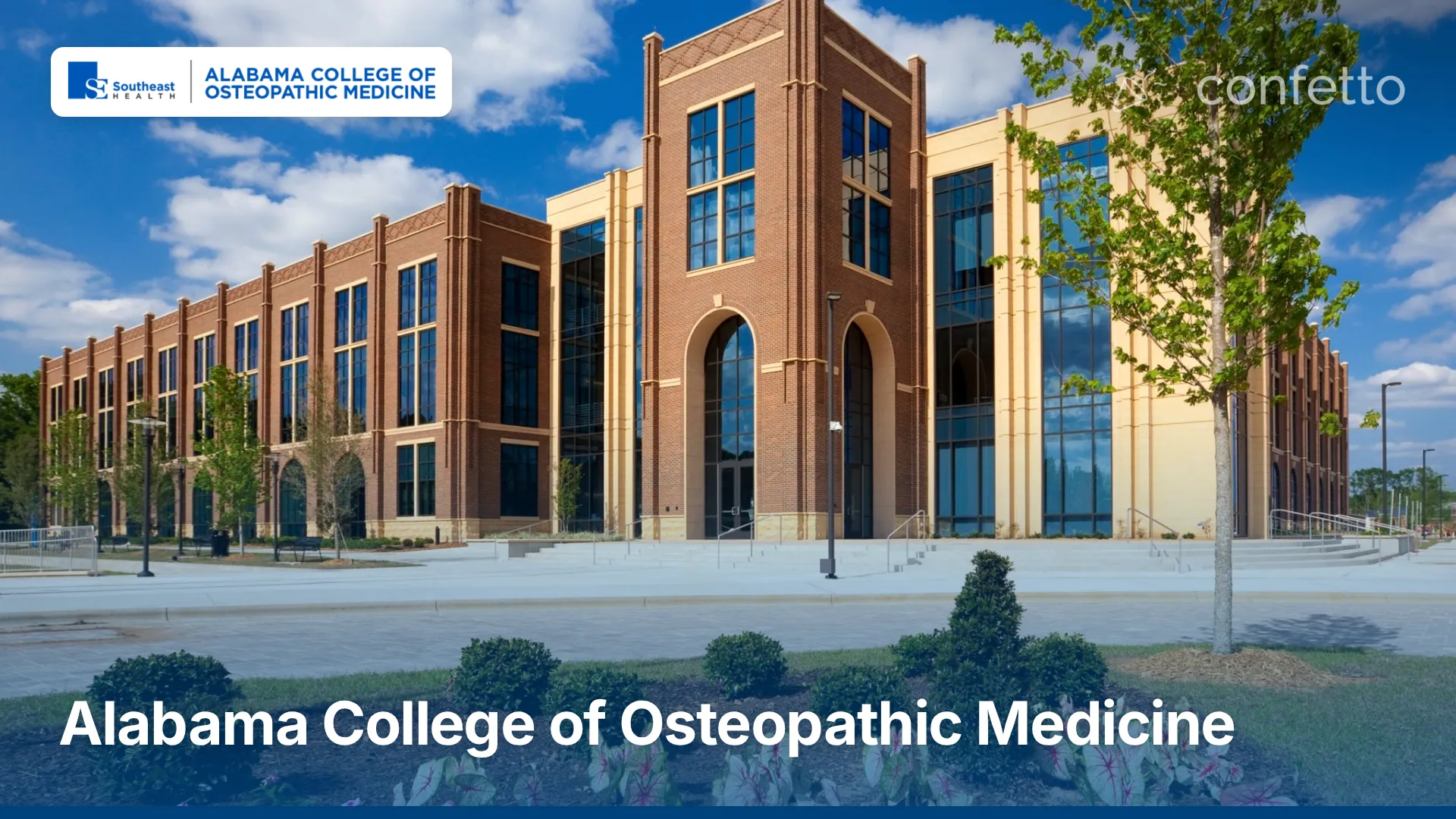
The Alabama College of Osteopathic Medicine (ACOM) in Dothan, Alabama, gives you one 30-minute, open-file interview with two faculty or qualified staff members, either on campus or over Zoom. It's a single interview, not an MMI.
Interviews run on a rolling basis from the end of July through April, and the day adds college and curriculum overviews, a tour and time with current students.
To rehearse a 30-minute open-file conversation, Confetto, an AI mock interviewer for medical school and other healthcare program interviews (MMI, traditional, panel), lets you practice traditional interviews with follow-up questions drawn from your answers.
The interviewers have completed training in interview procedures and rubric scoring, and you usually hear back within a few weeks. As of October 2026, ACOM's admissions pages and AACOM listing don't mention Casper or PREview.
What the ACOM interview looks like
Here's what ACOM says about it, from its Interview and Selection page, Admissions FAQ and AACOM Choose DO listing (checked October 2026):
| Item | What ACOM says |
|---|---|
| Number of interviews | One ("a single, open-file interview") |
| Who interviews you | Two faculty/qualified staff trained in interview procedures and rubric scoring. The FAQ says interviewers come from basic science faculty, clinical faculty, administrators and/or community physicians. |
| Open or closed file | Open file |
| In person or virtual | Both. The FAQ says interviews are currently held in person and via Zoom. |
| When | End of July through the end of April, on a rolling basis (the AACOM listing says August through April) |
| Rest of the day | Faculty and staff presentations and a tour of the facility, plus a chance to meet faculty, staff and students |
| How you're invited | By email, with login credentials to schedule your date |
| After the interview | The Admissions Committee reviews your file with the interviewers' comments, the Dean approves recommendations, and you usually hear within a few weeks |
| Interview length | 30 minutes, per the AACOM listing |
Early Decision
If you apply through ACOM's Early Decision Program, the timeline is different: interviews are in person in mid-September, and ACOM's page says decisions come by October 1. The AACOM listing gives October 15, 2026 for notifying Early Decision applicants.
What isn't published
As of October 2026, neither ACOM's pages nor its AACOM listing say whether the two interviewers see you together or one after the other. Two people in one room is the natural reading of the wording.
If you read SDN interview threads, check each detail against this format and your invitation. Your invitation is the place to confirm details, and the admissions office is at (334) 699-2266.
What the interviewers are scoring
ACOM says the interview's main purpose is to assess your interpersonal skills, how you relate to others, and your motivation for medicine. The same page adds two things most applicants skim past.
The school wants to learn about interests and experiences that aren't obvious from your file, and it's trying to get "a sense of the likelihood" that you'd accept a seat if offered.
That second point matters. If ACOM is one of your top choices, say so and say why.
If it isn't, don't pretend, but be ready to explain concretely what would make you glad to train there.
The selection criteria
The selection criteria on the same page are also worth reading closely. Besides MCAT and grades, the committee looks at your "ability and desire to fulfill the college's commitment to the primary care and underserved needs of Alabama and the region," along with patient experience, physician shadowing, service, leadership and honors.
Expect at least one question that tests whether that commitment is real for you.
ACOM's mission, vision and core values
From ACOM's Mission, Vision, and Core Values page:
Mission: "The Alabama College of Osteopathic Medicine will provide quality, learner-centered osteopathic education, research, and service, while promoting graduate medical education, with emphasis on patient-centered, team-based primary care to serve the medically underserved areas of Alabama, the Tri-State area, and the nation."
Vision: "The Alabama College of Osteopathic Medicine will be regionally and nationally recognized for significantly impacting the physician workforce needs and access to quality medical services."
Core values: InSPIRED, which stands for Integrity, Service, Passion, Innovation, Respect, Excellence and Diversity.
Using the mission in your answers
The phrases that should shape your answers are "team-based primary care" and "medically underserved areas of Alabama." You don't need to recite the mission.
You need one or two stories from your own life that show you've already done something in that direction, such as working alongside nurses or medical assistants, or caring for patients who had trouble getting care.
Don't memorize the seven core values as a list. If an interviewer asks which one matters most to you, pick one and back it with a specific moment.
Facts about ACOM you can actually use
A "Why ACOM?" answer is only as good as its specifics, and they need to be true. These are all on acom.edu:
- First in Alabama. ACOM is the first osteopathic medical school in Alabama (About page).
- Southeast Health. It's the academic arm of Southeast Health, the region's largest health system, which is governed by the Houston County Health Care Authority (Southeast Health page). ACOM says it's the only osteopathic school that's an academic division of a county healthcare authority (About page).
- Ashford clinic. The Southeast Health ACOM Ashford Clinic is a rural clinic about seven miles from campus. ACOM announced it to bring first- and second-year students into patient care before rotations, and it offers internal medicine, pediatrics and osteopathic manipulative medicine (announcement, opening).
- Strategic plan. ACOM's 2026-2031 strategic plan includes improving rural health clinic experiences through more patient encounters, and integrating OPP, lifestyle medicine, nutrition and AI into the curriculum.
- DO letter and shadowing. ACOM requires a physician letter, prefers one from a DO, and strongly recommends shadowing an osteopathic physician (How to Apply, FAQ). So "Why osteopathic medicine?" is close to guaranteed, and a DO you actually shadowed is your best material.
Programs to leave out
As of October 2026, we couldn't find a "Rural Health Scholars" program, a SouthCare Clinic, a Maternal Health Initiative or a Center for Rural Health on ACOM's site. Don't bring up a program in the room unless you've found it on acom.edu yourself, because an interviewer who works there will know.
The mission also mentions the "Tri-State area." As of October 2026, ACOM's mission page doesn't define it, so if you want to use it, ask about it on interview day rather than guessing.
ACOM also says the mission is due for review in fall 2026, so reread the page before your interview.
How to prepare for an open-file interview
Open file means your interviewers can see your application. They'll probably ask about specific entries, and a vague answer about something you wrote is worse than no answer.
A 45-minute drill for the week before:
- Print your AACOMAS experiences section and personal statement.
- Circle the five entries you'd most expect questions on. Include anything with a gap, a short duration or an unusual role.
- For each, say out loud in 60 to 90 seconds what you did, one moment you remember, and what you'd do differently now.
- Have someone read your personal statement and ask two follow-ups on it. "What happened to that patient?" and "Why didn't that make you want to be a nurse or PA?" are the usual ones.
- Check that none of your answers contradict what's on paper, like dates, hours or your role.
A worked "Why ACOM?" outline (fictional example)
This applicant is made up. Use the structure, not the content.
Show the worked example
Fictional applicant: grew up in a small town in southeast Alabama, spent two years as a medical assistant at a family medicine clinic, and shadowed a DO in internal medicine.
- Direct answer (15 seconds). "I want to practice primary care in a town like mine, and ACOM trains students for exactly that, close to where I'd want to work."
- Your evidence (45 seconds). One story from the MA job about a patient whose care depended on the whole clinic team, not only the physician. Say what you did.
- Mission link (30 seconds). Tie the story to "team-based primary care" and "medically underserved areas of Alabama."
- ACOM specifics (20 seconds). Mention that the Ashford clinic puts first- and second-year students in front of rural patients, and why that matters to you.
- Close (10 seconds). Say plainly that ACOM is a top choice, if it is.
That's about two minutes.
If you don't have Alabama roots, skip the hometown line and build step 1 around primary care or underserved patients you've actually worked with. Don't claim ties you don't have.
Practice questions (written by us, not ACOM)
As of October 2026, ACOM's pages don't list its interview questions. We wrote these to match its stated purpose and mission.
They're for practice and don't predict what you'll be asked.
- Why osteopathic medicine? What did you see while shadowing a DO that you wouldn't have seen with an MD?Practice this question now
- Why ACOM, and where does it fall on your list?Practice this question now
- Where do you see yourself practicing, and in what kind of community?Practice this question now
- Tell me about a time you worked on a team where you weren't the one in charge. What did you contribute?Practice this question now
- Walk me through the experience on your application that taught you the most about patients.Practice this question now
- A patient keeps missing appointments because of transportation. What would you want to know before suggesting anything?Practice this question now
- Tell me about a disagreement with a colleague or supervisor and how it ended.Practice this question now
- What's something about you that isn't in your application?Practice this question now
More ACOM practice questions (5)
- Ashford clinic: ACOM's rural Ashford clinic puts first- and second-year students into patient care before rotations. What would you want to learn there?Practice this question now
- Southeast Health: ACOM is the academic arm of the region's largest health system. How could training inside a community health system shape the doctor you become?Practice this question now
- Team-based care: ACOM's mission stresses team-based primary care. How has a nurse or medical assistant changed the way you saw a patient's care?Practice this question now
- Innovation: Innovation is one of ACOM's InSPIRED values. When did you find a better way to do something for a team or for patients?Practice this question now
- Lifestyle medicine: ACOM plans to add lifestyle medicine and nutrition to its curriculum. How would you counsel a patient with diabetes who says healthy food costs too much?Practice this question now
Question 8 comes straight from ACOM's stated goal of learning about interests and experiences beyond your file. Have a real answer ready.
For ten more, see the free Confetto question bank preview.
A timing drill for a 30‑minute interview
The AACOM listing gives 30 minutes for the interview with two interviewers. The fix is a two-minute core answer you can expand when asked.
Show the drill
| Round | Setup | What you're practicing |
|---|---|---|
| 1 | Five questions, 2 minutes each, on a timer, recorded | Direct answer in the first 20 seconds and one specific example |
| 2 | Same five questions, each followed by one follow-up you answer in under a minute | Going deeper without repeating yourself |
| 3 | Two people take turns asking you questions for 20 minutes | Answering to both interviewers, not just the one who asked |
| 4 | A 30-minute unscripted conversation on Zoom that starts from your application | Open-file questions, camera framing and audio for a virtual interview |
The free MMI timer works for rounds 1 and 2 even though ACOM doesn't use MMIs: set it to 2 minutes per answer with a 30-second break.
If you can't find two people for round 3, Confetto's AI mock interviews include traditional and panel formats, ask follow-up questions based on what you said, and give rubric-based feedback.
You can start with a free trial.
Other osteopathic schools
We've also written guides for the LECOM interview and the Sam Houston State University College of Osteopathic Medicine interview. For general panel prep, see how to prepare for a panel interview, and our medical school interview prep page covers traditional and MMI formats.
ACOM interview FAQ
Is the ACOM interview an MMI?
No. ACOM gives one 30-minute, open-file interview with two faculty or qualified staff members.
Is it in person or virtual?
Either, on campus in Dothan or over Zoom.
When does ACOM interview?
On a rolling basis from the end of July through April. You usually hear back within a few weeks.
Does ACOM require Casper?
As of October 2026, ACOM's admissions pages and AACOM listing don't mention Casper or PREview.
Confetto isn't affiliated with the Alabama College of Osteopathic Medicine or Southeast Health.
Details come from ACOM's public pages as of October 2026, and the school can change them, so check your invitation.
Applying to Florida DO schools? See our guide to the NSU Dr. Kiran C. Patel College of Osteopathic Medicine interview, which centers on a full candidate day.