
Updated · 8 min read
Chicago Medical School Interview: Virtual MMI and Questions
Key facts (2026-27)
Every invited applicant does a live virtual MMI, not a recorded one, and only about 5 to 10% of applicants have been invited to interview in recent years.
- Format
- Live virtual MMI (not recorded)
- Where
- Virtual (live, not recorded)
Dates for 2026-27
First invitations in August 2026, after holistic review
Interview invitations
September 2026 to mid-April 2027
Interviews
Rolling
Offers and decisions
Checked October 2026 against Chicago Medical School: How to apply, Chicago Medical School: Common questions and AAMC MSAR 2027 interview report. Confirm details in your invitation.
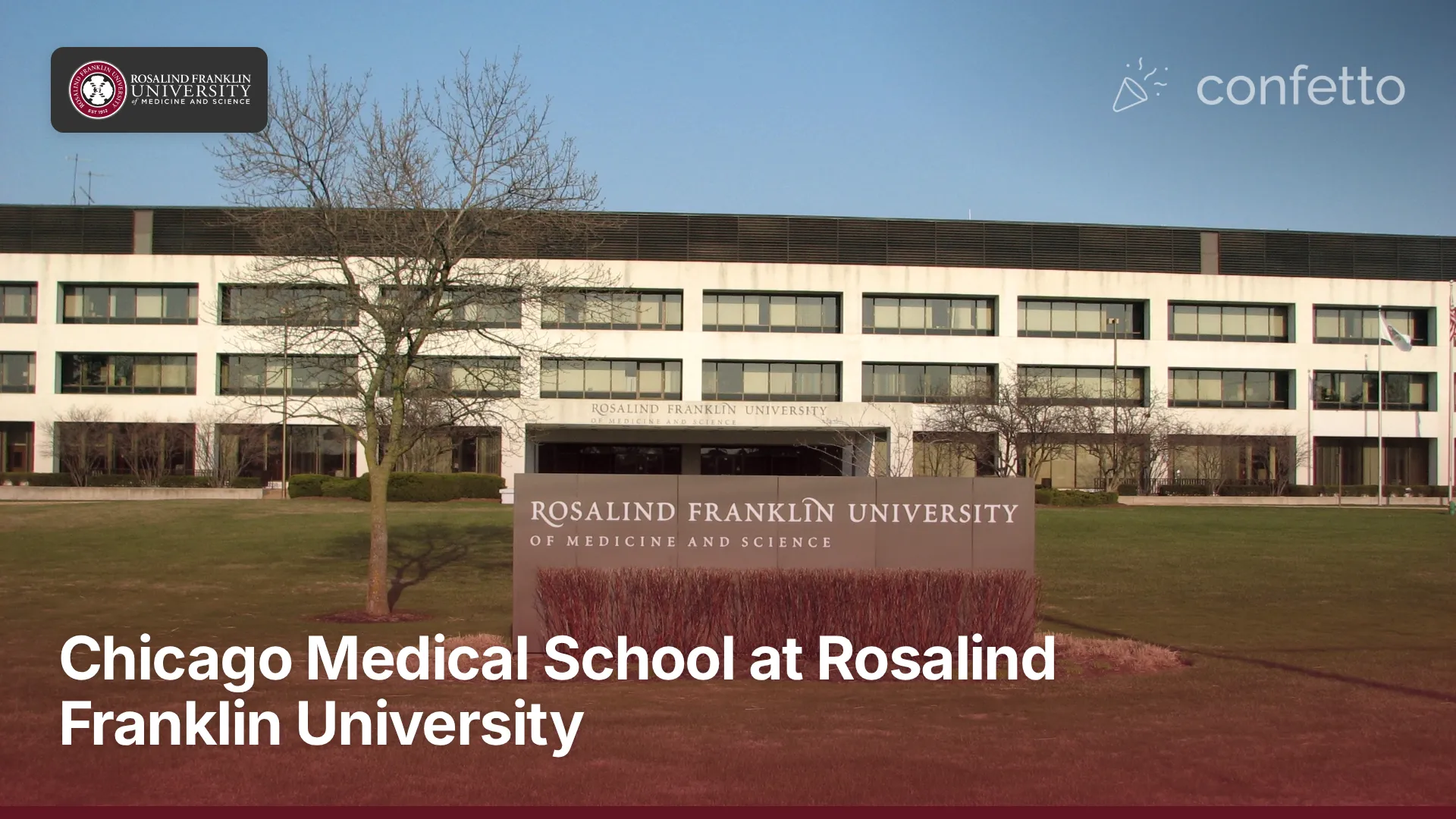
Chicago Medical School (CMS) at Rosalind Franklin University interviews MD applicants with a Multiple Mini Interview (MMI), held virtually and live. The school's How to Apply page puts it this way: "while interviews will be held virtually, they will not be done asynchronously."
No recorded one-way video: you rotate through scenario stations with live interviewers. Interviews run from September to mid-April, and the AAMC's MSAR 2027 report says the first invitations go out in August 2026.
In recent years about 5-10% of applicants have been invited to interview.
To rehearse live scenario stations, Confetto, an AI mock interviewer for medical school and other healthcare program interviews (MMI, traditional, panel), runs MMI practice stations with follow-up questions based on what you said.
Invitations follow a holistic review of your completed application. Here's what the school's pages say for the 2026-27 cycle:
The Chicago Medical School interview format
| Item | What CMS says |
|---|---|
| Interview format | Multiple Mini Interview, virtual, synchronous (not asynchronous) |
| Interview season | September 2026 to mid-April. First invitations in August 2026 (MSAR) |
| Before the day | A confirmation email with a detailed description of the interview day (MSAR) |
| AMCAS deadline | November 1, 2026, 11:59 p.m. EDT (early decision: August 1) |
| Supplemental deadline | December 1, 2026, 11:59 p.m. CST (early decision: August 1, 5:00 p.m. CDT) |
| Supplemental fee | $140, non-refundable, waived automatically for AMCAS Fee Assistance Program recipients |
| Admissions style | Rolling, so the school encourages applying early |
| Situational judgment test | AAMC PREview recommended but not required. Casper isn't listed. |
As of October 2026, CMS's admissions pages and its MSAR entry don't give the number of stations, how long each one runs, sample scenarios or a scoring rubric. Your invitation email, with its description of the interview day, is where the station count and timing will come from.
What the committee looks for
The Application Requirements page does tell you what the committee looks for, and it maps well onto MMI stations. It names three things: students who understand healthcare teams and the physician's role on the team, a record of service and leadership, and "a caring attitude and strong interpersonal communication skills."
The RFU mission statement, word for word
There are two statements worth knowing. The university mission, from RFU's Mission, Vision and Core Values page:
"To improve the wellness of all people through innovative, interprofessional education of health and biomedical professionals and the discovery and implementation of knowledge."
The university's vision is "to lead the nation in developing interprofessional healthcare education and biomedical discovery to advance an equitable, healthy society." Its seven core values are collaboration, excellence, innovation, integrity, justice, respect and scholarship.
The medical school mission
The medical school has its own mission, from the CMS Mission and Vision page:
"Chicago Medical School's mission is to educate a student body of dedicated individuals from a variety of backgrounds and experiences in a community-engaged, interprofessional learning environment. Our graduates become exemplary, compassionate physicians and scientists dedicated to improving the health and wellness of their patients and communities through clinical excellence, scientific discovery, service, and leadership."
Why interprofessional matters
Notice the word that shows up in both: interprofessional. RFU has six colleges and more than 30 graduate health-profession and science programs on one campus, per its interprofessionalism page.
If you have a real story about working alongside a nurse, pharmacist, therapist or social worker, it belongs in your secondaries and in any MMI station about teamwork.
Don't recite the mission at a station. Use it to pick which experiences to bring up.
Why Chicago Medical School? How to answer
CMS sends its supplemental application after AMCAS verifies your primary, and its Common Questions page sets a 150-word limit for each essay.
As of October 2026, the CMS admissions pages we checked don't post the prompts.
The two below are worded the way applicants reported them for the 2026-27 cycle. We couldn't confirm them with the school:
- "Which specific programs, opportunities, or aspects of Chicago Medical School at Rosalind Franklin University motivated you to apply, and how do they align with your career goals?"
- "What interests you about training in the Chicago/North Chicago region, and how might this environment shape your medical education and future career as a physician?"
Check the wording against your own supplemental before you write. It can change between cycles.
How to structure 150 words
At 150 words, you get room for one experience and one or two school specifics, and that's it. A structure that fits:
- One or two sentences on a concrete experience of yours (about 40 words).
- One or two named CMS programs and what you'd actually do in them (about 60 words).
- One sentence connecting them to where you're headed (about 30 words).
The common mistake is listing five programs. Two named specifics with a reason beat five with none.
CMS programs you can name
Here are real CMS programs you can name, all verified on rosalindfranklin.edu:
- Community clinic. The Interprofessional Community Clinic (ICC), a pro bono clinic founded in 2013 by CMS students. It offers free care to uninsured patients on Thursday evenings and is housed in the RFU Health Clinics next to the North Chicago campus.
- Courses. Foundations of Interprofessional Practice, a first-year course, and the four-part Principles of Professionalism, Health Care, and Health Equity course that runs across all four years, per the curriculum page.
- Research fellowships. Summer research fellowships between M1 and M2, which can lead to an "MD with a Distinction in Research," per the CMS Common Questions page.
- Clinical sites. Clinical sites listed on the Clinical Sites page, including the Captain James A. Lovell Federal Health Care Center, John H. Stroger, Jr., Hospital of Cook County, Mount Sinai Hospital and Humboldt Park Health.
What a strong 150-word answer does
For the programs prompt, a strong answer ties one experience of yours to one or two named CMS programs, such as the Interprofessional Community Clinic, and says what you'd do there. For the region prompt, it links that same experience to the range of CMS clinical sites, from Stroger to the Lovell Federal Health Care Center, and to where you plan to practice.
If you name a site, know what it is. A reader who sees "Lovell" should believe you know it serves veterans.
Practice both prompts and see model answers in the app.
A 20-minute drill for any 150-word prompt
- Set a 7-minute timer and write your answer with no word limit. Aim for 250 to 300 words.
- Highlight the one experience that only you could have written. Everything else is a candidate for cutting.
- Cut any sentence that would still be true if you swapped "Chicago Medical School" for another school's name.
- Check each program you name against rosalindfranklin.edu, get under 150 words, and read it aloud.
Keep your final version. If "Why CMS?" comes up in conversation on interview day, it's your answer, already tested.
Answering Why CMS out loud
"Why CMS?" is a question applicants often prepare for, and one some secondaries ask. Written or spoken, it tests two things: whether you looked past the school's name, and whether what you found connects to something you've actually done.
Out loud, use the same three parts in 60 to 90 seconds: one experience of yours, one CMS feature it connects to, and what you'd do with it as a student. If you name the clinic, know that it's run by students from six health programs (clinic page).
Example opening, written by us: "At my clinic job, the person who changed patients' care most was a pharmacist. That's why training alongside six professions drew me to CMS."
CMS MMI practice prompts (written by us, not the school)
As of October 2026, CMS's admissions pages don't post MMI scenarios. We wrote these around the attributes on its Application Requirements page (teamwork and the physician's role on the team, service and leadership, communication and a caring attitude) and around RFU's interprofessional focus.
They're practice material, not a prediction.
- Teamwork. You're a medical student at a free clinic. A pharmacy student quietly tells you the attending's prescription interacts with a medication the patient mentioned only to her. The attending is busy and has snapped at students today. What do you do?Practice this question now
- Physician's role on the team. A nurse on your team keeps giving patients discharge instructions that differ slightly from what the physician said. Patients are confused. How do you raise it?Practice this question now
- Service. Your student-run clinic can afford either a part-time interpreter or twice the number of evening sessions. Argue for one, then give the strongest case for the other.Practice this question now
- Leadership. You chair a volunteer group and one longtime member keeps missing shifts. Others want him removed. Walk through the conversation you'd have with him.Practice this question now
- Communication. A patient with limited English refuses to use a phone interpreter and wants her 12-year-old son to translate. How do you handle the visit?Practice this question now
- Caring attitude. A classmate tells you after an exam that he's thinking of leaving medical school. You have a shift in 20 minutes. What do you do?Practice this question now
- Integrity. You notice a classmate copying a lab partner's data for a graded report. Nobody else saw it. What happens next?Practice this question now
- Justice. A county has one open slot in a diabetes management program and two equally eligible patients. One lives two blocks from the clinic, the other two bus rides away. How should the slot be assigned?Practice this question now
More Chicago Medical School practice questions (4)
- Interprofessional clinic. At RFU's Interprofessional Community Clinic, a physical therapy student thinks your uninsured patient needs follow-up the clinic can't provide. How do you plan the next step together?Practice this question now
- Veterans' care. On a rotation at the Captain James A. Lovell Federal Health Care Center, a veteran says he'll skip his follow-up visits because he doesn't trust the system. What do you do?Practice this question now
- Health equity. CMS teaches health equity in a course that runs through all four years. What is one inequity you've seen up close, and what could a physician do about it?Practice this question now
- Research integrity. During a summer research fellowship between M1 and M2, your results contradict your mentor's hypothesis. What do you do?Practice this question now
For how a strong MMI answer is built, see our MMI practice questions with answers and the MMI questions guide.
A practice run for a virtual MMI
Show the practice run
- Open the free MMI timer. Set 8 stations with 2 minutes of reading and 6 minutes of response. These are our numbers, not the school's; adjust once your invitation arrives.
- Do it on camera, with the laptop and room you'll use on interview day.
- Shuffle the eight prompts above so you can't read ahead. Have a partner ask two follow-ups per station, such as "What if the attending refuses?" or "Who else would you involve?"
- After each station, write one line: did you name the other people affected, and did you commit to a decision? Redo any station where the answer to either is no.
Watch for one shortcut on the teamwork prompts. If your answer to prompt 1 or 2 is "I'd tell the doctor," you've skipped the pharmacy student and the nurse, who are the people RFU trains you to work with. Say how you'd bring them into the conversation.
No practice partner? Confetto's AI mock interviews run MMI stations, ask follow-up questions based on what you said, and give rubric-based feedback. You can start with a free trial. More options are on our medical school interview prep page.
Confetto isn't affiliated with Rosalind Franklin University of Medicine and Science or Chicago Medical School. School facts come from rosalindfranklin.edu and the AAMC MSAR 2027 report, checked October 2026. Secondary prompts are as reported by applicants, not published by the school. Go by your own supplemental and invitation email.
Also applying to Midwestern University in Illinois? See our guide to the Chicago College of Osteopathic Medicine (CCOM) interview and its group panel format.
Chicago Medical School interview FAQ
What is the Chicago Medical School interview format?
A Multiple Mini Interview, held virtually and live. The school says interviews "will not be done asynchronously."
When does Chicago Medical School interview?
From September to mid-April. The first invitations go out in August.
How many applicants are interviewed?
In recent years about 5 to 10% of applicants have been invited to interview.
Does Chicago Medical School require Casper?
Casper isn't listed. AAMC PREview is recommended but not required.