
Updated · 6 min read
Preparing for the Des Moines University College of Osteopathic Medicine interview
Key facts (2026-27)
Every invited applicant has a live 30-minute virtual conversation with a DMU faculty member on Kira Talent, plus a separate dean's overview on Zoom. It isn't an MMI.
- Format
- One live virtual faculty interview (Kira Talent)
- Where
- Virtual
- Platform
- Kira Talent (live interview), Zoom for the overview
- Stations
- 1 interview with a DMU faculty member
- Length
- 30 minutes
- Also required
- Virtual dean's program overview with a student panel (Zoom)
Dates for 2026-27
August to March, on select Mondays, Thursdays and Fridays
Interviews
About four to six weeks after your interview (admit, alternate or release)
Offers and decisions
Checked October 2026 against DMU: Osteopathic medicine Kira interview, AACOM Choose DO: DMU-COM (2026-27) and DMU DO: How to apply. Confirm details in your invitation.
The DMU-COM interview format
The Des Moines University College of Osteopathic Medicine (DMU-COM) interview is virtual, and the part that's evaluated is a live interview with a DMU faculty member. It isn't an MMI.
DMU's DO program FAQ describes the process in two parts: "A virtual dean's overview featuring a presentation about the program and a live Q&A with current students," then "A live virtual interview with a DMU faculty member."
DMU's AACOM listing for the 2026-27 cycle confirms "Virtual interviews only," so you won't be asked to travel to Iowa for it.
The same listing says interviews generally run from August to March, and that you'll hear about the curriculum, clinical rotations, financial aid, student life and counseling, and get time with current students.
Length, platform and days
DMU's applicant interview page says the faculty interview is a 30-minute conversation on the Kira Talent platform, held on select Mondays, Thursdays and Fridays. The dean's overview runs on Zoom on select Mondays and usually falls on a different day from your interview.
DMU doesn't publish how many questions you'll get, so go by whatever your invitation says.
What DMU says the interview looks for
This is the most useful line DMU publishes about its interview, from its AACOM listing: "An interview will explore the applicant's personal characteristics (integrity, professionalism, compassion, work ethic, etc.) as well as the motivation required to pursue a career in medicine."
That gives you a short, concrete target.
Before interview day you want at least one real story for each of the four named traits, plus a clear answer to why you want medicine and why osteopathic medicine in particular.
The FAQ adds that interviews "assess academic preparation, motivation and fit for the program," so expect questions that start from your own application too.
Patient-care experience
DMU also states what it's selecting for overall: candidates with "the greatest potential for success in providing respectful and compassionate care as a future physician," and its admission requirements page says successful applicants typically have meaningful patient-care or shadowing experience, with clinical exposure recommended rather than required. If your patient-contact experience is thin, have an honest answer ready for what you learned from what you did do.
Is PREview or Casper required at DMU?
Neither is required.
- PREview. DMU's DO admissions process page says it encourages applicants to take the AAMC PREview professional readiness exam, and the AACOM listing says PREview is "highly encouraged" but "not a requirement."
- Casper and secondary. Neither page mentions Casper, and DMU-COM has no secondary (supplemental) application per AACOM.
- Letters. DMU also doesn't require a physician letter, according to the AACOM listing. You submit three recommendation letters through AACOMAS.
DMU's mission statement, verbatim
DMU publishes two versions, and they're close. The university mission, on its Mission, Vision and Values page and in the AACOM listing:
"To improve lives in our global community by educating diverse groups of highly competent and compassionate health professionals."
The College of Osteopathic Medicine page gives the college's own version:
"The College of Osteopathic Medicine has a mission to improve lives in our global community by educating diverse groups of highly competent and compassionate osteopathic physicians, health educators, researchers and scholars."
The five values
The university lists five values: Accountability, Collaboration, Honesty, Inclusiveness and Wellness. Notice how much overlap there is between those values and the traits the interview explores.
Honesty maps to integrity, accountability to professionalism and work ethic. You don't need to quote the mission in your answers.
It's more convincing to have a story where you owned a mistake (accountability) or were straight with someone when it cost you something (honesty), and let the interviewer make the connection.
The campus you'll hear about
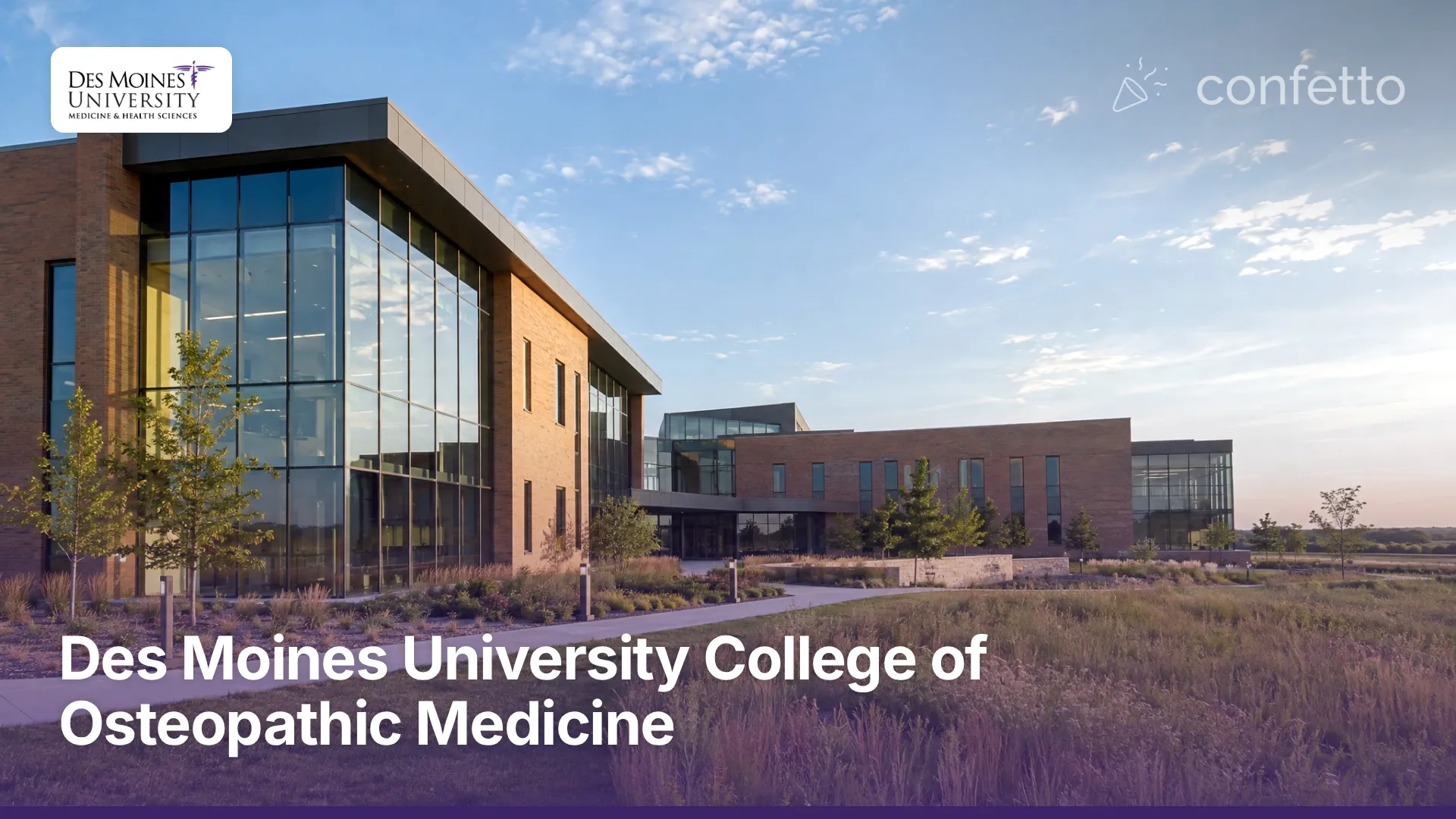
DMU's main campus is now an 88-acre campus at 8025 Grand Avenue in West Des Moines. DMU's page says the DMU Clinic continues to serve the Greater Des Moines community at its separate location, 3200 Grand Avenue, so older articles that place the school at that address are out of date.
Since your interview is virtual, you'll see the campus in the dean's overview rather than in person, so if "why DMU" matters to you, read the COM and campus pages beforehand instead of hoping the presentation covers it.
Class size and stats
For scale: DMU's AACOM listing reports 227 first-year matriculants for 2025-26, 36 of them from Iowa and 191 from out of state.
DMU's admission requirements page says successful applicants typically have a cumulative GPA around 3.7, a science GPA near 3.6 and an MCAT around 507.
With about 84% of the class from outside Iowa, you don't need an Iowa connection, but you should be able to say why you'd move there for four years.
DMU interview questions to practice (written by us, not DMU)
DMU doesn't publish its interview questions. We wrote these to match what DMU says it assesses.
Treat them as practice, not a leak. To rehearse them with a faculty-style interviewer, Confetto, an AI mock interviewer for medical school and other healthcare program interviews (MMI, traditional, panel), runs one-on-one mock interviews with follow-up questions and rubric-based feedback on every answer.
Motivation and fit
- Why DMU? What would be different about your training here compared with the other DO schools you applied to?Practice this question now
- Why osteopathic medicine rather than an MD program?Practice this question now
- Why medicine, and when did you decide?Practice this question now
- Walk me through one patient-contact or shadowing experience on your application and what it changed about how you see medicine.Practice this question now
Integrity
- DMU lists honesty and accountability among its values. When did you tell someone a hard truth or own a mistake even though it cost you something?Practice this question now
- You notice a classmate's lab report copies large sections of yours. What do you do?Practice this question now
Professionalism
- Describe a time you received critical feedback you thought was unfair. How did you respond?Practice this question now
- A resident on your rotation jokes about a patient's weight in the hallway where family members can hear. What do you do?Practice this question now
Compassion
- Tell me about someone you found hard to care for. What did you do about it?Practice this question now
- A patient keeps missing appointments and the clinic wants to discharge them. What would you want to understand first?Practice this question now
Work ethic
- Wellness is one of DMU's five values. When your workload peaks, what slips first, and what do you protect?Practice this question now
- Tell me about a commitment you kept after it stopped being interesting.Practice this question now
For more general prompts, see our medical school interview questions list.
A drill for a one-on-one faculty interview
A single interviewer has time for follow-ups, and follow-ups are where rehearsed answers fall apart. This drill trains for that.
- Build a story grid. Write the four traits DMU names (integrity, professionalism, compassion, work ethic) down the side of a page and your six strongest experiences across the top. Mark which experience proves which trait. Any trait with no mark is a gap to fix before interview day.
- Two-minute cap. Answer questions 1 to 12 aloud with a timer. Anything over two minutes gets cut and re-recorded. The first version usually buries the point in setup.
- Three follow-ups deep. Have a partner pick any answer and ask "why?" or "what would you do differently?" three times in a row. If you run out of true things to say by the second follow-up, the story is too thin or too polished. Pick a messier, more honest one.
- Full run on video. Do one 30-minute session over Zoom from the room you'll use on the day, with a partner mixing questions from all five groups. Check your camera height, lighting and whether you look at the lens or the screen.
A worked example
Here's a fictional example of step 3 working. An applicant answers question 5 with a story about reporting an error in a lab's data log.
First follow-up: "Why did it matter if nobody would have noticed?" Second: "What did it cost you?"
If the honest answer to the second is "nothing," that's a weak integrity story, because integrity is easiest to show when there was a price. A better choice might be the time they told a supervisor they'd missed a deadline before anyone asked.
If you don't have a practice partner, Confetto's AI mock interviews run a traditional one-on-one format, ask follow-up questions, and give rubric-based feedback. You can start with a free trial.
Timeline and decisions
For the 2026-27 cycle, DMU's AACOM listing shows the earliest submission date as May 4, 2026, and an AACOMAS deadline of April 30, 2027, with orientation on July 29, 2027.
It says to submit at least eight weeks before the deadline for best consideration, which works out to March 5, 2027. Treat that as the latest safe date, not a target.
DMU admits on a rolling basis and says early applicants "are more likely to be interviewed than those who apply later."
After the interview
After the interview, DMU emails one of three decisions: admit, alternate or release from consideration. It says the time to a decision "can vary throughout the cycle."
If you accept, DMU requires two nonrefundable $750 deposits, the second due by May 1, per the admissions process page.
Applying to other DO schools? See our guides for KCU-COM and LECOM.
DMU-COM interview FAQ
Is the DMU interview an MMI?
No. It is a 30-minute live virtual interview with a DMU faculty member on the Kira Talent platform, plus a separate virtual dean's overview.
Is the DMU interview virtual?
Yes, virtual only. Interviews generally run from August to March.
Does DMU require Casper or PREview?
Neither is required. DMU encourages applicants to take the AAMC PREview.
Confetto isn't affiliated with Des Moines University. School details here come from DMU's public DO admissions pages and its AACOM listing, checked in October 2026.
Formats can change between cycles, so go by your interview invitation.