
Updated · 8 min read
Drexel Medical School Interview: Virtual MMI and Questions
Key facts (2026-27)
Every 2026-27 interview is a virtual MMI, and Drexel's MSAR entry adds a closed-file group interview with a medical student. Station count and length aren't published.
- Format
- Virtual MMI plus a group interview with a student
- Where
- Virtual
- Also required
- Competency grid (before scheduling the interview)
Dates for 2026-27
From August
Interview invitations
September to April
Interviews
Rolling from October 15 (Early Decision: October 1)
Offers and decisions
Checked October 2026 against Drexel COM: MD application process and AAMC MSAR 2027 interview report. Confirm details in your invitation.
Drexel's MD interview format
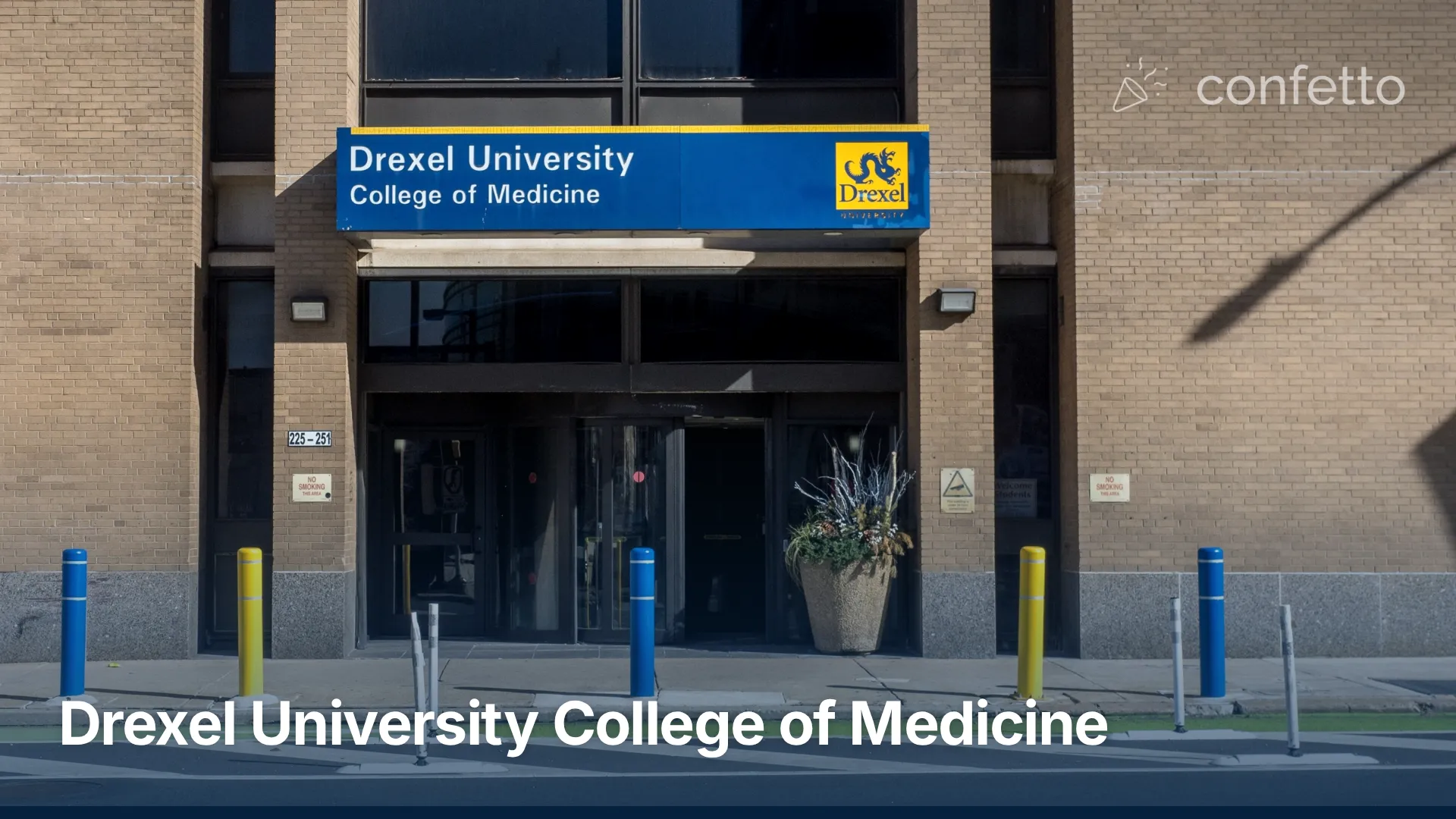
Drexel University College of Medicine interviews MD applicants with a Multiple Mini Interview (MMI), and for the 2026-2027 cycle every interview is virtual. The school's application process page says applicants won't come to campus, interviews run September through April, and no one is accepted without one.
The AAMC's MSAR lists Drexel's format as an MMI plus a closed-file group interview with a student. Drexel's own page doesn't mention the group session, so confirm it in your scheduling instructions.
What Drexel doesn't publish
That's close to everything Drexel publishes about the format. The page doesn't give the number of stations, how long each one lasts, how much reading time you get, or which video platform it uses.
It says instructions for the virtual interview come after you're invited and have scheduled.
So if a guide tells you Drexel runs "8 to 10 stations of 6 to 8 minutes," it's guessing. Your instructions are the only reliable source for your day.
We aren't affiliated with Drexel. Everything here comes from the College of Medicine's public pages, checked in October 2026.
From invitation to interview day
| Step | What Drexel says |
|---|---|
| Invitation | An email from the Office of Admissions. Your status also updates in the online applicant system. |
| Before you can book | Complete the "competency grid," then schedule through the online scheduling system. The page doesn't describe the grid further. |
| Format | MMI, virtual. Instructions arrive after you schedule. |
| Season | September through April |
| Cancelling | At least 72 hours before your date, online or through the interview coordinator listed on the page. The school says other invited applicants are waiting to move to earlier dates. |
| Special programs | Applicants coming through Drexel's special programs get an email with their interview date already set. |
Questions go to medadmis@drexel.edu or 215.991.8202.
Secondary, Casper and PREview
- Who gets it. Every applicant gets Drexel's secondary. You don't earn it by passing a screen.
- When. The link arrives by email after AMCAS verifies your application.
- Fee. The fee is $120 by credit card, waived only if you have an AMCAS fee waiver.
- Deadline. The secondary, fee and all supporting materials are due January 1 for the 2027 application year.
Where Drexel's pages disagree
Two of Drexel's pages disagree on timing. The application process page says the secondary can take up to two weeks after verification, and the FAQ says up to four weeks.
The FAQ also says AMCAS applications are accepted through December 1, while the timetable on the process page runs AMCAS filing to January 1.
If you're applying late, email admissions rather than betting on the later date.
Casper and PREview
Drexel's MD admissions pages don't list Casper or AAMC PREview as a requirement.
Casper does appear on Drexel's BA/BS+MD page, which says every applicant invited to interview for that program must complete it.
Some third-party lists of Casper schools, such as Med School Insiders' 2026 list, include Drexel's MD program too. Since those sources don't agree, check Acuity Insights' official program list and your secondary instructions early, while Casper test dates are still open.
Screening and decisions
Two other details from the process page are worth knowing.
- AI screening. Starting with the 2026-2027 cycle, Drexel uses AI alongside human reviewers in the first screen for interviews, with final screening decisions made by admissions staff.
- Decision dates. And decisions for regular applicants go out from October 15 until the class is filled, while Early Decision applicants hear by October 1.
The Drexel mission statements, verbatim
Drexel publishes two. The College of Medicine's mission page reads:
"Drexel University College of Medicine excels and innovates in education, research and delivery of compassionate care in our culture of belonging, spirited inquiry, collaboration and opportunity."
The MD program mission statement is specific to the MD program and is also printed at the top of the admissions application page:
"Drexel University College of Medicine delivers innovative biomedical education in an environment that embraces inquiry and collaboration, founded on excellence in patient care, and based on a culture of, and respect for diversity. These principles are built upon the College of Medicine's legacy of a firm commitment to meeting the health care needs of the communities in which we live and work."
How to use them
Don't recite either one in an interview. Use them to pick which of your experiences to bring up.
The second sentence of the MD statement points to community health needs, and the admissions pages say the committee uses Mission-Aligned Selection and says it values community service, leadership and clinical experience, and encourages applications from, among others, first-generation, rural, and educationally or economically disadvantaged applicants.
A station about a patient who can't afford a medication is a natural place for a real story from your clinical or service work.
What Drexel says it's looking for
Drexel doesn't publish an MMI scoring rubric. What it does publish, on its admissions recommendations page, is the list of nine personal competencies developed by the AAMC that it expects of applicants:
- Ethical responsibility to self and others
- Reliability and dependability
- Service orientation
- Social skills
- Capacity for improvement
- Resilience and adaptability
- Cultural competence
- Oral communication
- Teamwork
The school doesn't say which of these the MMI measures. Still, it's the closest thing to a rubric Drexel gives you, so it's a sensible map for practice.
When you practice, finish each answer by asking which competency a rater could have scored, and whether you gave them evidence for it or only claimed it.
Drexel MMI practice prompts (written by us, not Drexel)
These are our own prompts, each aimed at one or two competencies from the list above. They don't predict what Drexel will ask.
To run them as timed stations, Confetto, an AI mock interviewer for medical school and other healthcare program interviews (MMI, traditional, panel), has MMI practice with follow-up questions.
- You're volunteering at a free clinic. A regular patient tells you he's been splitting his insulin doses to make them last. He asks you not to mention it to the doctor. What do you do? (ethical responsibility, service orientation)Practice this question now
- Your group's research poster is due Friday. One member has missed two meetings and says a family member is sick. Talk to them. (teamwork, social skills)Practice this question now
- Tell us about a time you got feedback that stung. What did you change afterward? (capacity for improvement)Practice this question now
- A patient's adult son insists on interpreting for his mother, but her answers seem much shorter than what she's saying. How do you handle the visit? (cultural competence, oral communication)Practice this question now
- You promised to cover a friend's volunteer shift, then got an interview invitation for the same morning. What do you do? (reliability and dependability)Practice this question now
- Explain to someone with no science background why a vaccine can cause a sore arm and a mild fever. (oral communication)Practice this question now
- Your group interview includes three other applicants and a medical student. Two people keep talking over the quietest member. What do you do? (teamwork, social skills)Practice this question now
- A patient at a community clinic tells you she missed her follow-up because her bus route changed and the trip now takes two hours. What would you do? (service orientation)Practice this question now
- A classmate keeps redoing a female resident's orders behind her back and jokes that he double-checks her work. How do you respond? (ethical responsibility, cultural competence)Practice this question now
- Should AI help decide who gets into medical school? Drexel says it uses AI alongside human reviewers in its first screen. Make the case for and against. (ethical responsibility)Practice this question now
- Your learning community has a small budget for one service project. Half the group wants a health fair and half wants a tutoring program. How do you help the group decide? (teamwork)Practice this question now
- Tell us about a time a plan you were responsible for fell apart at the last minute. What did you do next? (resilience and adaptability)Practice this question now
For more station types, see our MMI interview questions guide. The free question bank preview has ten more prompts.
A timing drill for a format Drexel doesn't publish
Since you don't know the station length until your instructions arrive, don't train to one rhythm. This drill alternates two lengths so you get used to filling eight minutes and to wrapping up in six.
It's our practice setup, not Drexel's schedule.
| Station | Prompt | Read | Answer | Total |
|---|---|---|---|---|
| 1 | Prompt 1 | 2 min | 6 min | 8 min |
| 2 | Prompt 3 | 2 min | 8 min | 10 min |
| 3 | Prompt 4 | 2 min | 6 min | 8 min |
| 4 | Prompt 2 | 2 min | 8 min | 10 min |
| 5 | Prompt 6 | 2 min | 6 min | 8 min |
| 6 | Prompt 5 | 2 min | 8 min | 10 min |
That's 54 minutes of stations. Add a one-minute break between each (five breaks) and the whole drill takes 59 minutes.
Set up like the real day
Run it on the same laptop, camera and room you'll use on interview day, because a virtual MMI adds problems an in-person one doesn't have: audio lag that cuts off your first words, a camera angle that makes you look away from the interviewer, and notes on the desk that make you look down.
How to use the answer time:
- First 60 to 90 seconds: say what the situation is really about and who's affected.
- Next two to three minutes: what you'd want to know first, then what you'd do, and why.
- Whatever's left: follow-up questions. Have a friend hold theirs until you finish your first answer, then push back once ("What if the patient says no?").
After the drill, note the station where you ran out of things to say and redo only that one.
The free MMI timer can run the read and answer phases so you aren't watching a phone clock. Once your Drexel instructions arrive, reset the timings to match.
What a strong answer does
A strong answer to prompt 1 names the safety risk and the request for secrecy, talks to the patient first, is honest that this can't be kept from the doctor, and reaches a decision in under three minutes. Practice prompt 1 in the app to see model answers.
Specifics for "Why Drexel?"
An MMI may never ask this directly, but a station can open the door, and you'll want something more specific than "the mission." These come from Drexel's own pages.
- History. The school descends from Hahnemann Medical College and the Woman's Medical College of Pennsylvania, which its tradition page calls the first degree-granting medical school for women in the world.
- Curriculum. The Foundations and Frontiers curriculum includes a longitudinal practicum that runs through the 18-month Foundations phase and puts students with patients in community settings, combined with a social justice and health disparities curriculum.
- Learning communities. Students are placed into one of six learning communities, each named after a Philadelphia landmark.
- Two campuses. Drexel has two campuses, Philadelphia and Reading-Tower Health. The application process page says campus preference is requested at application but admission is decided without considering it, so don't build your answer around one campus.
Pick one that connects to something you've done. A list of all four sounds like you read the website the night before.
Practicing with follow-up questions
A timer and prompts cover most of your prep. What's hard to do alone is the follow-up that pokes a hole in your first answer.
Confetto's AI mock interviews run MMI, traditional and panel formats, ask follow-up questions, and give rubric-based feedback. You can start with a free trial.
Guides for other schools are on our medical school page.
Also applying to the Lewis Katz School of Medicine at Temple? See our interview guide for that school.