
Updated · 9 min read
McGovern Medical School Interview: Format and Questions
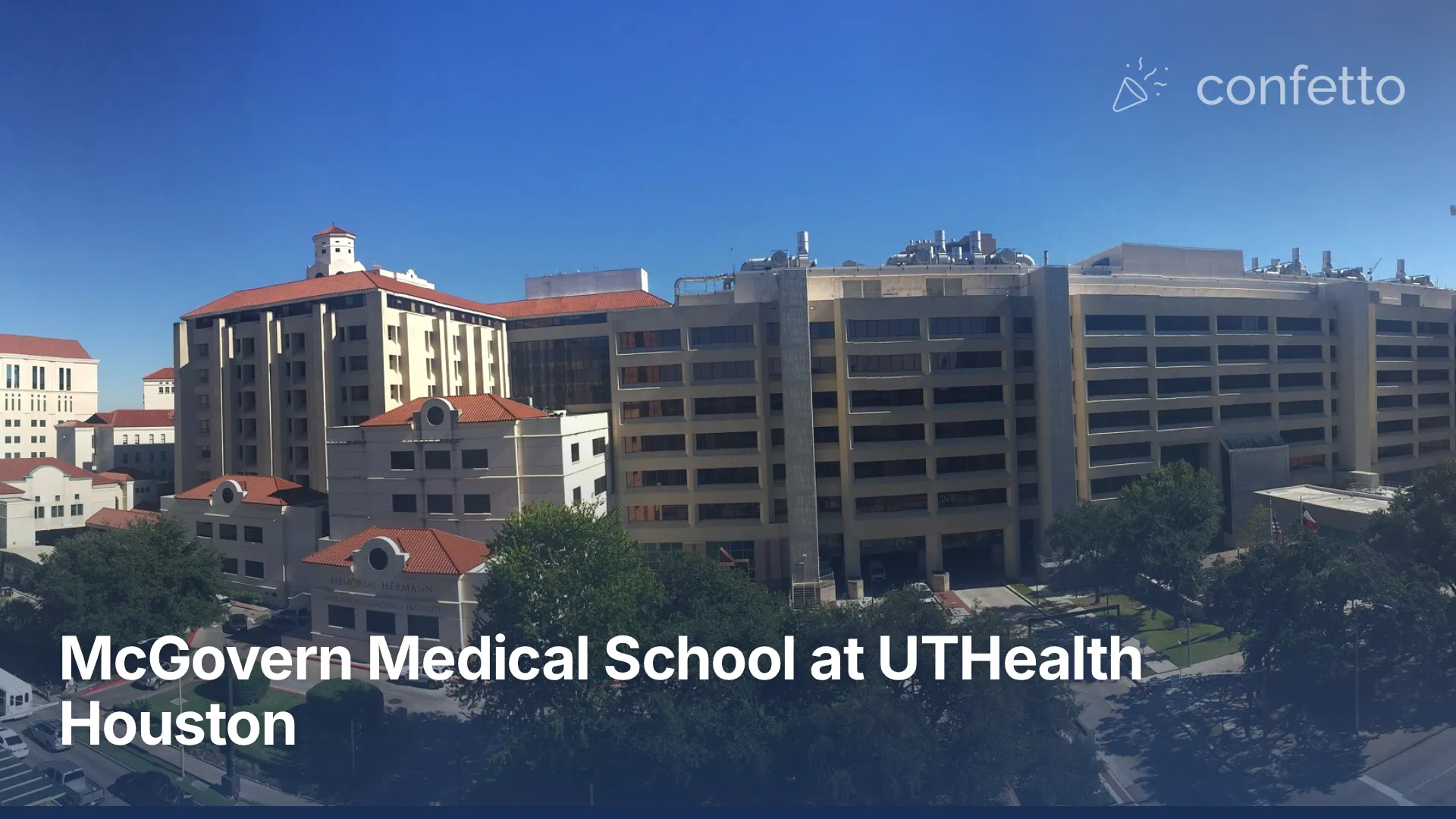
Key facts (2026-27)
If you're invited, you have 5 days from the invitation email to complete McGovern's Kira Talent video, then two virtual one-on-one interviews of about 20 minutes.
- Format
- Kira Talent video, then two one-on-one interviews
- Where
- Virtual
- Platform
- Kira Talent (video step)
- Stations
- 2 interviews: faculty member, resident or 4th-year student
- Length
- About 20 min each (30 min maximum)
- Also required
- Casper (last test date Nov. 12, 2026), Kira Talent video within 5 days of invitation
Dates for 2026-27
From July
Interview invitations
Mid to late August through early to mid January
Interviews
TMDSAS rules. Waitlist offers after the February Match
Offers and decisions
Checked October 2026 against McGovern: Admissions FAQ, McGovern: Application process and AAMC MSAR 2027 interview report. Confirm details in your invitation.
McGovern Medical School at UTHealth Houston interviews M.D. applicants virtually, and you'll typically meet one-on-one with two different interviewers, per the school's admissions FAQ. Its MSAR entry says each interview runs about 20 minutes (30 minutes maximum), with a faculty member, resident or fourth-year student.
It isn't an MMI or a panel. M.D./Ph.D. applicants have additional interviews.
To rehearse two short one-on-ones, Confetto, an AI mock interviewer for medical school and other healthcare program interviews (MMI, traditional, panel), runs traditional mock interviews with rubric-based feedback on every answer.
Interviews typically run mid-to-late August through early-to-mid January. If you're invited, you have to complete a KiraTalent video assessment within 5 days of the invitation email.
The application process page adds that once you pick a date, you'll get details for the day, including Zoom links for a welcome session and a student panel, and that you're expected to take part in the whole day. Our Kira Talent guide covers how the platform works, the tech checklist and how to practice.
The McGovern interview format
We aren't affiliated with McGovern or UTHealth Houston. Everything below comes from the school's and TMDSAS's public pages, checked in October 2026.
If your invitation says something different, follow the invitation.
| Item | What the school says |
|---|---|
| Format | One-on-one interviews with two different interviewers, about 20 minutes each (MSAR) |
| Virtual or in person | Virtual |
| Interview season | Typically mid-to-late August through early-to-mid January |
| Scheduling | The invitation links to a site where you choose a date. Spots are limited and go first come, first served. |
| Video assessment | KiraTalent, due within 5 days of the invitation email |
| Interview day | Zoom links for a welcome and a student panel; plan to attend the whole day |
| Who's eligible to interview | U.S. citizens, permanent residents, or applicants pending permanent residency |
| Email to watch | All invitations and offers come from the admissions office email listed on the application process page. Check spam. |
Do interviewers read your file
As of October 2026, neither McGovern's admissions pages nor its MSAR entry say whether your interviewers have read your file. One detail from the McGovern Societies page: each first-year society is led by a clinical faculty member who, when possible, interviewed its students.
If you read Reddit or SDN threads about McGovern, check each detail against this format and your invitation.
How the interview fits the TMDSAS timeline and the Texas Match
McGovern takes its M.D. applications through TMDSAS, not AMCAS (the M.D./Ph.D. program uses AMCAS). Every applicant also completes a McGovern secondary and the Casper test.
- Casper. The FAQ says the last Casper date accepted for the 2027 cycle is Nov. 12, 2026.
- PREview. PREview is optional, and the school says it won't see PREview scores until all admissions decisions are done.
Casper test dates and requirements vary by school. For the full 2026-27 list of MD and DO schools that use it, with last test dates and deadlines, see which medical schools require Casper.
For the format, scoring and practice scenarios, see our Casper test guide.
TMDSAS dates
These are the TMDSAS medical dates for entry year 2027, from the TMDSAS deadlines page:
| Date | What happens |
|---|---|
| October 1 | TMDSAS application deadline (11:59 p.m. CST, no extensions) |
| October 15 | Medical schools can start making offers; recommended date for letters of evaluation |
| October 15 to January 29 | Pre-match offer window for Texas residents |
| January 29 | Deadline to rank your schools for the Match (5 p.m. CST) |
| February 12 | Match results, and the rolling admissions period begins |
| April 30 | Applicants holding multiple offers must pick one and withdraw from the others |
How the Match affects you
A few things about the Match that change how you think about the interview.
- Who takes part. Per TMDSAS's after-submitting guide, only Texas residents who've interviewed at a TMDSAS school by the ranking deadline take part, and you must rank every school where you interviewed.
- Pre-match offers. You can match at McGovern without a pre-match offer from it.
- Out-of-state applicants. Out-of-state applicants aren't in the Match at all.
- Waitlist. McGovern's FAQ says it uses rolling admissions and picks from its waitlist after the February Match.
The practical point: the Match rank link only appears once a school marks you as interviewed, so a late-season date still has to land before the ranking deadline if you want McGovern on your list.
McGovern's mission statement
The version on the prospective students page reads:
"The mission at McGovern Medical School is to educate a diverse body of future physicians and biomedical scientists for a career dedicated to the highest ideals of their profession; to provide outstanding patient-centered care; and to conduct innovative research that benefits the health and well-being of the population of Texas and beyond."
The school's About Us page uses slightly different wording that adds "advanced healthcare providers" and says "improves" rather than "benefits." The core is the same in both: education, patient-centered care and research aimed at Texas.
Values and attributes
The Why McGovern page names five values: quality, service, professionalism, collaboration and advocacy.
The same prospective students page lists eight attributes of students who thrive there: intellectual capacity, ethical standards, integrity, motivation, interpersonal and communication skills, technical standards, breadth and depth of premedical educational experience, and passion for service to individuals and communities in Texas.
What your interviewers are listening for
McGovern's criteria page is unusually specific about where the interview counts. It names the personal interview as evidence for intellectual capacity and for interpersonal and communication skills ("well-spoken"), and it lists "knowledge displayed at the interview" under breadth of premedical education.
Service to Texas
The criterion to take seriously is Potential for Service to the State of Texas. The page says a state medical school's primary concern is producing doctors who'll serve Texas, and it looks at your goals, the size and location of your hometown, whether you live in a Health Professions Shortage Area, and language skills that fit the area you want to serve.
If you have a real tie to a part of Texas or a patient population there, the interview is where you make it concrete. If you don't, don't invent one.
Talk about what you'd actually do.
After the interview
After the interview, a member of the Admissions Committee reads your whole file and ranks you against other applicants on attributes that include leadership and community service. So the interview doesn't stand alone.
Your answers should match what's in your application.
Why McGovern? How to answer
Some version of "Why do you feel McGovern is the best fit for your medical education, and what would you add to the McGovern community?" circulates widely as a McGovern secondary prompt. As of October 2026, we couldn't find the prompt on McGovern's own pages, so we can't confirm its current wording.
Either way, it's a question you should be ready to answer out loud, and the structure is the same for an essay or an interview.
Use three parts, in this order:
- One thing you've done. A specific experience, not a trait. One or two sentences.
- One or two McGovern facts that connect to it. Pick from the school's own pages, and pick ones that actually link to your experience.
- What you'd add. Something concrete you'd do as a student, tied back to the first part.
Facts you can use
Facts from McGovern's pages that applicants can use:
- Texas Medical Center. It sits in the Texas Medical Center, and its primary teaching hospitals include Memorial Hermann-Texas Medical Center, Children's Memorial Hermann Hospital, Harris Health Lyndon B. Johnson Hospital, the John S. Dunn Behavioral Sciences Center, MD Anderson Cancer Center and TIRR Memorial Hermann (Why McGovern page).
- Doctoring 1. First-semester Doctoring 1 covers history and physical exam skills, and in the second and third semesters students work with a longitudinal preceptor before clerkships (prospective students page).
- Career Focus Tracks. In the fourth year, students choose one of four Career Focus Tracks: Acute Care, Primary Care, Applied Anatomy or Academic.
- Advocacy. One of the school's core values is to advocate for excellent care for the underserved and for reducing health care disparities (About Us page).
What a strong answer does. It ties each McGovern fact to an experience of yours, such as bilingual scribe work in Harris County leading to training at Harris Health's LBJ Hospital, then says what you'd add.
The weak version lists the Texas Medical Center, the hospitals and the tracks without tying any of them to something you've done.
Practice "Why McGovern?" and see model answers in the app.
The two halves of the question
The two halves of the "best fit" question test different things. The first tests whether you know what's specific to McGovern.
The second tests what you'd give, not only what you'd get.
Two more facts from McGovern's pages, useful for either half:
- PLUS. In the pre-clerkship PLUS service-learning program, students stay with the same Houston-area community partner across four experiences over two years (PLUS curriculum page).
- McGovern Societies. First-year students join McGovern Societies of eight to ten classmates, led by a clinical faculty member with student peer mentors, and stay in them through medical school (McGovern Societies page). That's a natural place for the "what would you add" half.
Example opening, written by us: "I've volunteered at one food pantry for three years, and PLUS asks students to stay with one community partner in the same way."
McGovern interview questions to practice (written by us, not McGovern)
As of October 2026, McGovern's pages don't list its interview questions. These are our own prompts, grouped by the school's published criteria.
They don't predict what you'll be asked.
KiraTalent video assessment (practice it as a short timed recording):
- Video prompt: In one recorded answer, why do you want to train in Houston, and who do you hope to serve there?Practice this question now
Motivation and service to Texas:
- Why medicine, and why now rather than five years ago?Practice this question now
- Where in Texas do you see yourself practicing in 15 years, and what would your patients need from you?Practice this question now
- Why McGovern over the other Texas schools you're ranking?Practice this question now
Interpersonal and communication skills:
- Tell me about a time you had to explain something complicated to someone who was frustrated with you.Practice this question now
- Describe a disagreement on a team. What did you do, and what would the other person say you did?Practice this question now
Integrity and ethical standards:
- A classmate asks you to sign them in to a required session they're skipping. What do you do?Practice this question now
- Tell me about a mistake you made that affected someone else. How did you handle it?Practice this question now
Breadth of preparation:
- Pick one activity on your application and tell me something about it that isn't written there.
More McGovern practice questions (5)
- PLUS: In McGovern's PLUS program you stay with one Houston community partner for two years. What kind of partner would you choose, and what would you want to build with them?Practice this question now
- Service to Texas: McGovern weighs whether applicants come from a Health Professions Shortage Area. What would it take for you to practice in one?Practice this question now
- Advocacy: McGovern lists advocating for excellent care for the underserved as a core value. When have you spoken up for someone who couldn't?Practice this question now
- Teaching hospitals: McGovern trains at hospitals from Harris Health's LBJ to MD Anderson. Which patients would you most want to learn from, and why?Practice this question now
- Career Focus Tracks: In fourth year you pick Acute Care, Primary Care, Applied Anatomy or Academic. Which would you choose today, and what could change your mind?Practice this question now
Practice each out loud in one to two minutes, and have a friend ask one follow-up. Don't skip question 8.
McGovern's pages and MSAR entry don't say whether interviewers see your file, so assume any line in your TMDSAS activities could come up and reread yours before the day. For more general questions, see our list of medical school interview questions, and the free question bank preview has ten more.
Before interview day: a checklist
Show the checklist
- Finish the KiraTalent assessment within 5 days of the invite. Set a reminder the moment the email arrives.
- Book your date quickly, since slots are first come, first served.
- Test Zoom, your camera and your audio in the room you'll use.
- Prepare one "why McGovern" answer using the three-part structure above, and keep it under 90 seconds.
- Reread your TMDSAS personal statement and activities.
- Write down two questions for the student panel that you can't answer from the website.
- If you're a Texas resident, note the January 29 ranking deadline.
Practicing with an interviewer who follows up
Going through a list alone won't show you where your answer falls apart under a follow-up question. Confetto's AI mock interviews run traditional, panel and MMI formats, ask follow-ups and give rubric-based feedback.
You can start with a free trial. Since McGovern also asks invited applicants to complete a KiraTalent video assessment, one-way video practice can help you get used to answering a camera with nobody on the other end.
If you're interviewing at other Texas schools, see our guides to UT Southwestern, Dell, UTMB John Sealy and Texas A&M.
Also applying to the University of Houston Tilman J. Fertitta Family College of Medicine? See our interview guide for that school.
McGovern interview FAQ
What is the McGovern interview format?
Two virtual one-on-one interviews of about 20 minutes each (30 minutes maximum), with a faculty member, resident or fourth-year student. It isn't an MMI.
Is there a Kira video assessment?
Yes. If invited, you complete a KiraTalent video assessment within 5 days of the invitation email.
Does McGovern require Casper?
Yes. The last Casper date accepted for the 2027 cycle is November 12, 2026. PREview is optional.
When does McGovern interview?
Typically mid-to-late August through early-to-mid January. You apply through TMDSAS.