
Updated · 7 min read
OU-HCOM Interview: Virtual, Two 30-Minute Interviews
Key facts (2026-27)
Every interview is virtual on Microsoft Teams: two half-hour one-on-one conversations with selection committee members, and you hear back the next day.
- Format
- Two 30-minute one-on-one interviews
- Where
- Virtual (Microsoft Teams)
- Platform
- Microsoft Teams
- Stations
- 2 individual interviews with selection committee members
- Length
- 30 minutes each, day runs 10:30 a.m. to 3:40 p.m. Eastern
- Also required
- Secondary application with at least two essays, including one on what being a DO means to you
Dates for 2026-27
Tuesdays, late August to March (HCOM's page). AACOM lists mid-September to late April
Interviews
Emailed by the end of the Wednesday after your interview
Offers and decisions
Checked October 2026 against OU-HCOM: Interviews and OU-HCOM: Application process. Confirm details in your invitation.
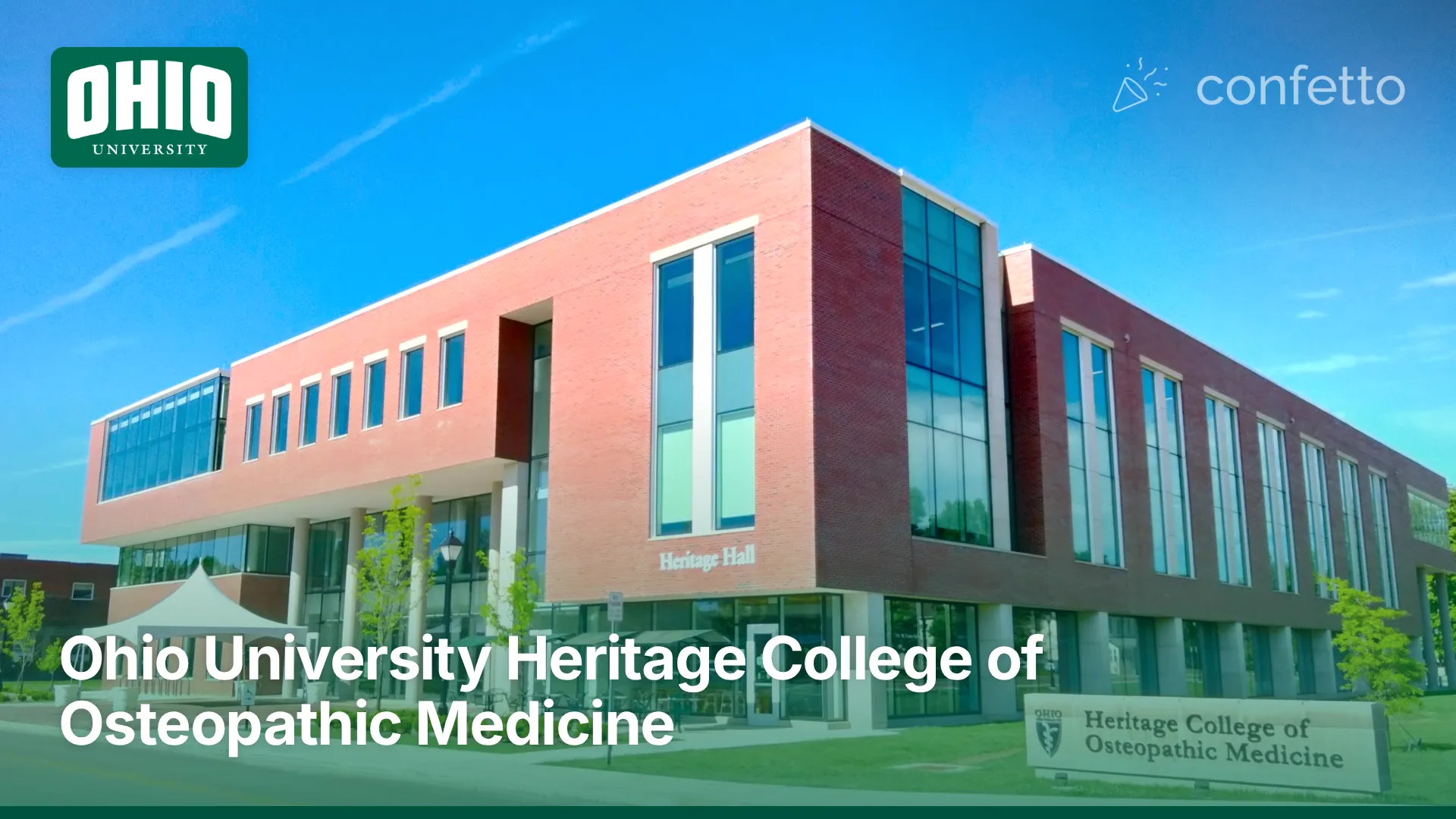
The Ohio University Heritage College of Osteopathic Medicine (OU-HCOM) interview is a traditional, virtual interview: two half-hour individual interviews with members of the selection committee, held over Microsoft Teams. It is not a multiple mini-interview (MMI).
This guide covers what the school publishes about the interview day, the timeline and application requirements, the mission themes OU-HCOM states, two verified Ohio health-policy facts, and practice questions we wrote.
OU-HCOM does not publish what interviewers see of your application or what they ask, so we say so where that applies.
Confetto is not affiliated with Ohio University, and everything below was checked against official sources in October 2026.
The Ohio University Heritage College of Osteopathic Medicine Interview: Format and Experience
OU-HCOM's interview page states that all interviews are conducted 100 percent virtually via Microsoft Teams, on Tuesdays, with a maximum of 40 candidates invited per day. Candidates are scheduled for two half-hour individual interviews with Heritage College selection committee members.
The school describes the interview day as follows, with some variation for each candidate (times are Eastern):
- Overview. 10:30 a.m. to 12 p.m.: introductions, admissions and curriculum overview, and Q&A.
- Student panel. 12 to 12:45 p.m.: medical student panel.
- Lunch. 12:45 to 1 p.m.: break for lunch.
- Interviews. Interviews scheduled between 1 and 3:40 p.m.
The student panel is listed separately from the two individual interviews, and is a chance to learn about the school.
You receive a formal itinerary and instructions a few days before your interview. OU-HCOM does not publish its interview questions or whether interviewers have read your full file, so prepare to discuss anything you submitted.
When decisions come
The selection committee convenes the next morning, on Wednesday. Candidates are admitted, placed on the alternate list or not selected, and decisions are emailed by the end of that Wednesday.
Timeline and Requirements
- Interview season. Interviews run on Tuesdays from late August to March, per OU-HCOM's interview page. AACOM's school profile lists mid-September until late April, so follow your own invitation.
- Deadlines. The application deadline for the entering class of 2027 is February 1, 2027, through AACOMAS. Secondary application materials are due March 15, 2027, and the school says to submit well before deadlines.
- Complete files. Only completed files are considered for interview: a verified AACOMAS application, official and valid MCAT scores, and all secondary materials.
- Secondary essays. The secondary application includes a required essay on what being an osteopathic physician means to you and what you have done to gain knowledge and experience of osteopathic medicine, plus one chosen essay.
- Letters. Letters: either one premedical committee letter, or one letter from a natural science faculty member plus a second from a professor, physician, supervisor or other qualified professional. A letter from a DO or other health care professional is strongly encouraged but not required.
- MCAT. OU-HCOM says applicants with an MCAT score below 500 will likely not be considered for an interview.
Mission & Culture Fit
OU-HCOM's mission statement says the college educates physicians committed to practice in Ohio, emphasizes primary care, engages in focused research, and embraces both Appalachian and urban communities, with a commitment to diversity, public service and improving the health and well-being of underserved populations.
Its tagline is training osteopathic primary care physicians to serve Ohio. The college has three campuses: Athens, Cleveland and Dublin, and offers Rural and Urban Scholars Pathways programs.
Why osteopathic medicine
Because the required essay asks what being an osteopathic physician means to you, expect the same question in conversation: why osteopathic medicine, and what have you done to learn about it? Describe real shadowing, volunteering or reading, and say what you still want to understand.
If you ask about the Cleveland or Dublin campus, note that the school says those campuses require a connection to Northeast Ohio or Central Ohio respectively.
Show that your interest in serving Ohio, including Appalachian and urban communities, comes from something you have done. Do not recite program names you have not researched.
Local Healthcare Landscape & Policy Signals
You do not need statistics for this interview. Two verified policy facts are worth knowing, as long as you can explain what they mean for patients.
- Medicaid expansion. Ohio expanded Medicaid in 2014 under the Affordable Care Act, making most Ohioans aged 19 to 64 with incomes at or below 138 percent of the federal poverty level eligible, according to the Ohio Department of Medicaid.
- Work requirement. Under the 2025 federal budget law, CMS issued an interim final rule on June 1, 2026 requiring certain Medicaid adults to show 80 hours per month of qualifying activity, such as work, community service or half-time school enrollment. States must generally implement this by January 1, 2027.
If a policy question comes up, state the facts you are sure of, explain who is affected and how, and say what you would want to know before taking a position.
OU-HCOM practice questions (written by us)
These are practice questions we wrote, not questions reported by OU-HCOM.
- Why osteopathic medicine, and what have you done to learn about it?Practice this question now
- Why the Heritage College, and which campus, Athens, Cleveland or Dublin, fits the physician you want to become?Practice this question now
- Describe a healthcare experience that shaped your path toward becoming a DO.Practice this question now
- What does it mean to you to practice holistically? Give an example from your own experience.Practice this question now
- How does your interest in training and practicing in Ohio connect to something you have actually done?Practice this question now
- What have you learned about health care in Appalachian Ohio, and what would you need to understand before practicing there?Practice this question now
- OU-HCOM offers Rural and Urban Scholars Pathways. Which setting draws you, and what experience points you there?Practice this question now
- A patient dismisses osteopathic manipulative medicine as ineffective. How do you respond?Practice this question now
- Describe a time you received feedback that changed how you helped someone.Practice this question now
- A patient says the ride home leaves before the appointment ends and asks if they should skip the visit. What do you do?Practice this question now
- If Medicaid eligibility rules add a work-hours requirement, how might that affect patients you have worked with?Practice this question now
- Tell us about an assumption you made in a service role. How did you check it?Practice this question now
Preparation Checklist
Use this focused plan to align your prep with the interview OU-HCOM describes, and let Confetto streamline the heavy lifting.
- Mock interviews. Run AI-powered mock interviews in Confetto that mirror two back-to-back half-hour individual interviews, using a different experience in each so you stay consistent without sounding scripted.
- Your essays. Re-read your AACOMAS and secondary essays, especially the osteopathic essay, and prepare to expand on any sentence in them.
- Explaining OMM. Practice osteopathic communication: explain osteopathic principles and OMM to a skeptical friend in plain language, based only on what you have actually learned.
- Policy prompts. Analyze policy prompts with Confetto's coaching: build concise positions on rural access or Medicaid eligibility without overclaiming.
- Pacing. Track performance analytics on pacing, structure and filler words so you finish strong in the second interview.
- Tech check. Test Microsoft Teams on the device and connection you will use, and keep your itinerary handy.
FAQ
Is the OU-HCOM interview an MMI?
No. OU-HCOM's interview page describes two half-hour individual interviews with selection committee members, conducted virtually via Microsoft Teams. It does not describe stations.
Is the OU-HCOM interview virtual or in person?
Virtual. OU-HCOM says all interviews are conducted 100 percent virtually via Microsoft Teams, and AACOM lists virtual interviews only.
How long is the interview and what does the day look like?
You have two half-hour individual interviews. The day typically starts at 10:30 a.m. Eastern with an overview and Q&A, then a medical student panel and a lunch break, and interviews run between 1 and 3:40 p.m. Eastern.
When will I hear a decision?
The selection committee meets the Wednesday morning after your interview, and decisions are emailed by the end of that day.
How can I show alignment with OU-HCOM's mission?
Connect your experiences to primary care, osteopathic medicine and underserved communities, including Appalachian and urban Ohio, using things you have actually done. Be specific about what you did and what you learned.
Will policy topics come up?
OU-HCOM does not publish its questions. Be ready to discuss any policy topic you raise yourself, such as Medicaid eligibility, and keep the focus on patients.
Key Takeaways
- Format. OU-HCOM interviews are virtual on Microsoft Teams: two half-hour individual interviews with selection committee members. Not an MMI.
- The day. The interview day also includes an overview, a medical student panel and a lunch break, and decisions are emailed the next day.
- Mission. OU-HCOM's mission centers on osteopathic primary care for Ohio, including Appalachian and urban communities and underserved populations.
- Osteopathic essay. Be ready to explain what being an osteopathic physician means to you, as the secondary essay asks.
- Your application. OU-HCOM does not publish questions or file access, so know your own application well.
Call to Action
Ready to turn these insights into confident, school-specific performance?
Use Confetto to run one-on-one mock interviews, practice osteopathic and community-health answers, and get analytics that sharpen your structure and delivery. You can start with a free trial, so your interview answers are ready on the day.
Applying elsewhere in the Midwest? See our guides to the Michigan State University College of Osteopathic Medicine, Xavier University College of Osteopathic Medicine and University of Toledo College of Medicine interviews.