
Updated · 8 min read
Rutgers RWJMS Interview: Virtual Seven-Station MMI
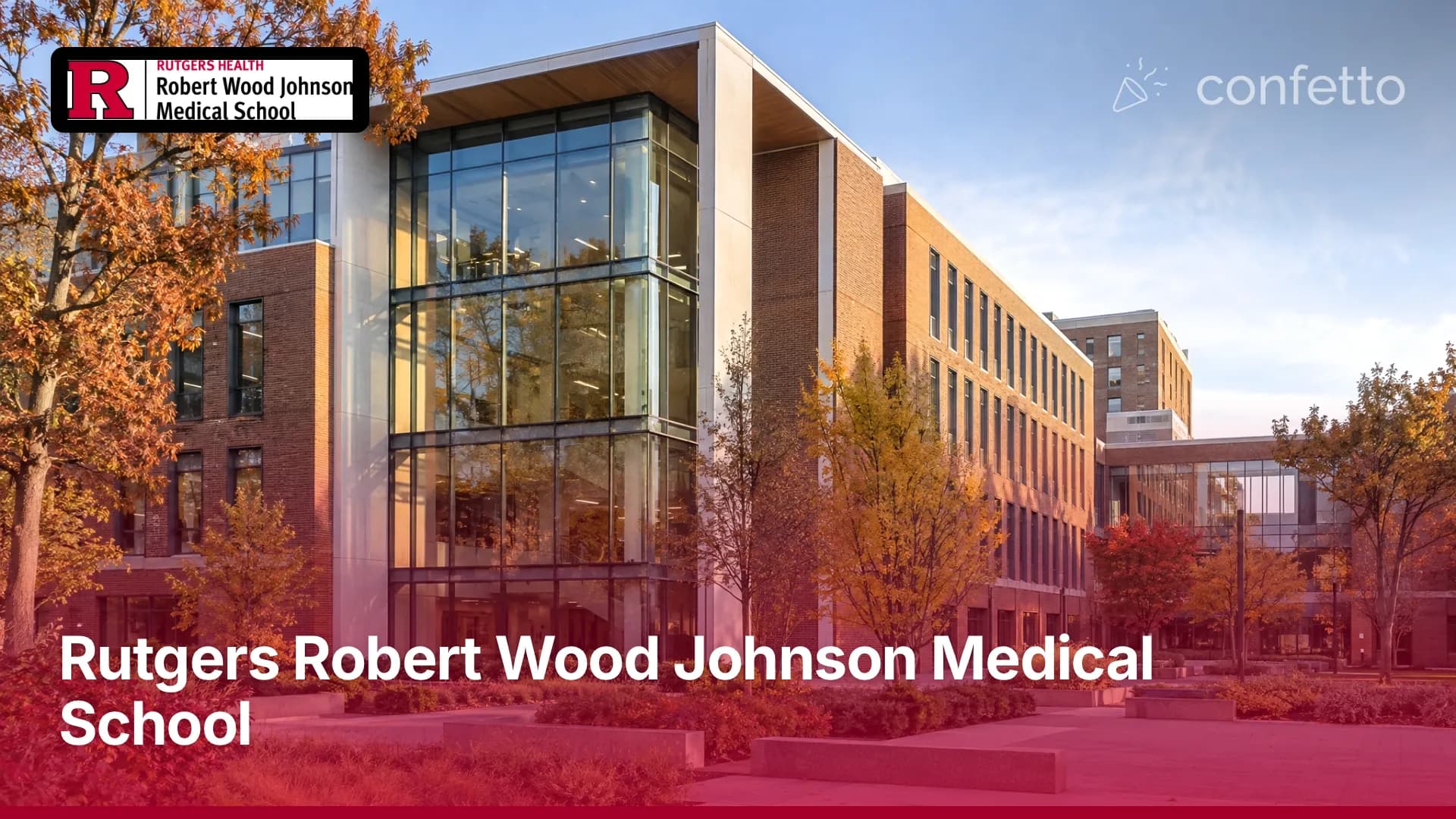
Key facts (2026-27)
Most applicants do a seven-station live video MMI of about 70 minutes, and the MMI interviewers don't see your primary or secondary application.
- Format
- Virtual MMI, 7 stations
- Where
- Virtual (live video). In-person option still being decided
- Stations
- 7 MMI stations with faculty and student interviewers
- Length
- About 1 hour 10 minutes
- Also required
- Casper or AAMC PREview (one required), Student Ambassador session and 45-minute dean Q&A, 1-on-1 interviews too for MD/PhD, BA/MD and early assurance
Dates for 2026-27
Monthly, August to March (MSAR). The school page says from September
Interview invitations
Not yet published for 2026-27
Interviews
Offers at two points: late December and mid-March
Offers and decisions
Checked October 2026 against Rutgers RWJMS: Apply and AAMC MSAR 2027 interview report. Confirm details in your invitation.
Preparing for the Rutgers Robert Wood Johnson Medical School (RWJMS) interview is mostly about preparing for a seven-station Multiple Mini Interview (MMI) over live video. You will not be able to lean on your application to make a point for you, so each station has to stand on your own reasoning.
To test that reasoning out loud first, Confetto, an AI mock interviewer for medical school and other healthcare program interviews (MMI, traditional, panel), runs a seven-station style MMI circuit or single stations with follow-up questions based on what you said.
This guide covers the format as RWJMS and the AAMC describe it, the timeline and requirements the school publishes, the values on its About page, and practice stations we wrote ourselves. RWJMS does not publish its interview questions, so none of the questions below are the school's.
The Rutgers Robert Wood Johnson Medical School Interview: Format and Experience
RWJMS's Applying to RWJMS page says: "All applicants invited for interview will complete a seven-station live video conference multiple mini interview (MMI) hosted by the Admissions Committee." It also says the committee members who take part in the MMI will not have access to primary or secondary applications.
The school's entry in the AAMC MSAR interview procedures report (2027 edition) adds the following:
- Who does what. RWJMS uses an MMI for applicants in the 2027 cycle. Applicants to the MD/PhD, BA/MD and approved early assurance programs additionally take part in 1-on-1 interviews. For the 2028 cycle, the school says all applicants will complete both interview formats.
- Interviewers and length. The MMI is "conducted by both faculty and students" and lasts approximately one hour and ten minutes.
- Invitations. Interview invitations are sent monthly from August through March. (The admissions page says invitations start in September.)
- Virtual or in person. The school has no regional interview option. It is determining whether to use in-person interviews, and says virtual will always be available for applicants who are abroad or face hardship.
RWJMS does not publish station length or how time splits between reading and answering. Your invitation is the place to check.
Interview day
The MSAR entry lists four parts: an introduction to the MMI and the admissions process from the admissions officers, a student ambassador information session (held before the interview day) with Q&A, a 45-minute Q&A with an education dean, and the seven-station MMI. The dean and student sessions are not scored stations, but they are where you pick up the specifics that make a "why RWJMS" answer believable.
Go with two or three real questions.
Tip: Practice articulating your reasoning aloud under time constraints. State what the problem is, name who is affected, pick an option, and say what it costs.
Mission & Culture Fit
RWJMS's About page says the school is "dedicated to transforming care through innovation and excellence in education and research and by addressing the health of our diverse community." It spells out its values with the school's initials:
- R: Respect, dignity, and humanism for the diverse population we serve
- W: Wellness and resilience
- J: Joining learners hand-in-hand with care delivery
- M: Making patients first with safe, compassionate, high-quality care
- S: Science to advance human health
The school has campuses in New Brunswick and Piscataway, and Robert Wood Johnson University Hospital in New Brunswick is its principal teaching hospital.
Using the values in a station
RWJMS does not publish a list of interview themes, so do not recite the acronym in a station.
Use it as a check on your own answers: did you treat the patient with respect, put their safety first, and think about who else is affected? If you are asked why RWJMS, a specific detail from the student session or the dean Q&A helps more than the mission statement.
Timeline & Requirements
These come from the same admissions page:
- AMCAS deadline: December 1.
- Secondary: emailed after RWJMS receives your AMCAS application, with an $80 fee.
- Situational judgment test: you submit either Casper or the AAMC PREview exam.
- MCAT: taken within the three years before you apply and no later than October of the application year.
- Letters: a pre-medical advisory committee evaluation or three academic or professional recommendations.
- Offers: made at two points in the cycle, late December and mid-March. An early interview therefore does not guarantee an early answer.
Casper and PREview
Casper test dates and requirements vary by school. For the full 2026-27 list of MD and DO schools that use it, with last test dates and deadlines, see which medical schools require Casper.
For the format, scoring and practice scenarios, see our Casper test guide.
Rutgers Robert Wood Johnson accepts either Casper or the AAMC PREview exam. Casper vs AAMC PREview explains what each test is and which schools use which.
Local Healthcare Landscape & Policy Signals
RWJMS does not publish a list of New Jersey policy topics it expects you to know. Two facts we could confirm from primary sources:
- Medicaid expansion: KFF's state tracker lists New Jersey as having adopted the ACA Medicaid expansion, implemented January 1, 2014.
- Charity Care: the New Jersey Department of Health describes Charity Care as free or reduced-charge care at acute care hospitals for eligible patients who cannot afford to pay, and says all acute care hospitals in the state must provide it.
If you are asked a policy question, show how you reason about it, name who is affected, and say what you would want to know before taking a position. You do not need to recite statistics.
Rutgers RWJ interview questions to practice
RWJMS does not publish its MMI stations. We wrote these to cover the kinds of scenarios MMIs commonly use.
They are practice material, not the school's questions.
- Ethics: A patient asks you, a medical student, not to tell the team that she stopped taking her blood pressure medication because she cannot afford it. What do you do?Practice this question now
- Communication: Explain to a worried parent why their child with a cold does not need antibiotics, without making them feel dismissed.Practice this question now
- Health access: A patient at a New Brunswick hospital tells you she is skipping a follow-up scan because she thinks she can't pay. She hasn't heard of New Jersey's Charity Care. What do you say?Practice this question now
- Teamwork: A nurse and a pharmacist disagree in front of you about how to explain discharge instructions to a family. One of them asks your opinion. Talk us through it.Practice this question now
- Professionalism: You see a classmate post a photo from the hospital that shows part of a patient chart in the background. What do you do?Practice this question now
- Patients first: You notice a senior resident skipping the hand hygiene step before seeing patients on a busy morning. What do you do?Practice this question now
- Wellness: A friend in your study group says they are sleeping three hours a night to keep up and asks you not to tell anyone. How do you respond?Practice this question now
- Health access: A free clinic has funding for either a part-time interpreter or extended Saturday hours, not both. How would you decide?Practice this question now
- Science: A family member asks why a new drug they read about online isn't available to them yet. Explain how a treatment gets from the lab to patients.Practice this question now
- Personal reflection: Tell us about a time you were wrong about someone. What changed your mind?Practice this question now
- Why RWJMS, and what from the student session or dean Q&A shaped that answer?Practice this question now
Preparation Checklist
Use this quick plan to structure your RWJMS prep with Confetto.
- Full circuits. Run AI-powered mock MMIs with seven stations back to back and receive targeted feedback on clarity and structure. Seven in a row is tiring in a way one station is not.
- Scenario drills. Drill scenarios across ethics, teamwork, communication, access and professionalism, using Confetto's scenario banks to refine concrete, specific answers.
- Analytics. Analyze your responses with performance analytics to track pacing, depth, and whether you commit to a recommendation before the halfway point.
- Role-play. Practice stakeholder communication with role-play modules (patient, family member, interdisciplinary team) so you are ready when a station asks you to talk to someone.
- Frameworks. Build concise frameworks for sensitive topics (confidentiality, bias, reproductive care) and rehearse them until they are second nature.
- Why RWJMS. Prepare a two-sentence "why RWJMS" built on something specific you learned or plan to ask about in the student session. Skip anything you cannot back up.
- Your setup. Use the room, camera and connection you will use on the day, and reread your invitation for timing.
FAQ
Is the RWJMS interview an MMI?
Yes. RWJMS says applicants invited for interview complete a seven-station live video MMI. According to the AAMC MSAR entry, MD/PhD, BA/MD and approved early assurance applicants also take part in 1-on-1 interviews in the 2027 cycle, and for the 2028 cycle all applicants will complete both formats.
Is it virtual or in person?
Virtual. RWJMS says it is determining whether to use in-person interviews, and that virtual will always be available for applicants abroad or facing hardship. There is no regional interview option.
How long is the interview?
The MSAR entry says the MMI lasts approximately one hour and ten minutes. RWJMS does not publish the length of each station.
Do interviewers have my application?
The admissions page says committee members who take part in the MMI will not have access to primary or secondary applications.
Do I need Casper or PREview?
You must submit one of the two: either Casper or the AAMC PREview exam.
When are offers made?
RWJMS says offers are made at two points in the cycle: late December and mid-March.
Key Takeaways
- The RWJMS interview is a seven-station virtual MMI about an hour and ten minutes long, with additional 1-on-1 interviews for some programs and, per the MSAR entry, for all applicants from the 2028 cycle.
- MMI interviewers do not see your application, so every station is a fresh start that rests on your reasoning.
- RWJMS does not publish station length or topics: practice with proportions, commit to an answer early, and expect changed facts in follow-ups.
- Know the school's published values and bring specifics from the student session and dean Q&A.
- Offers come in late December and mid-March, so do not read much into timing.
Call to Action
Ready to turn preparation into confident, compelling interview performance? Use Confetto to rehearse seven-station MMI circuits, drill scenario prompts, and get analytics-driven feedback that sharpens your structure, examples, and delivery.
You can start with a free trial.
Confetto is not affiliated with Rutgers or Robert Wood Johnson Medical School.
School details come from RWJMS's admissions and About pages and the AAMC MSAR interview procedures report, checked October 2026. Formats can change between cycles, so go by your interview invitation.
Also applying to the Cooper Medical School of Rowan University? See our interview guide for that school.
Also applying to the other Rutgers medical school? See our guide to the Rutgers New Jersey Medical School interview.