
Updated · 9 min read
Preparing for the Sam Houston State University College of Osteopathic Medicine interview
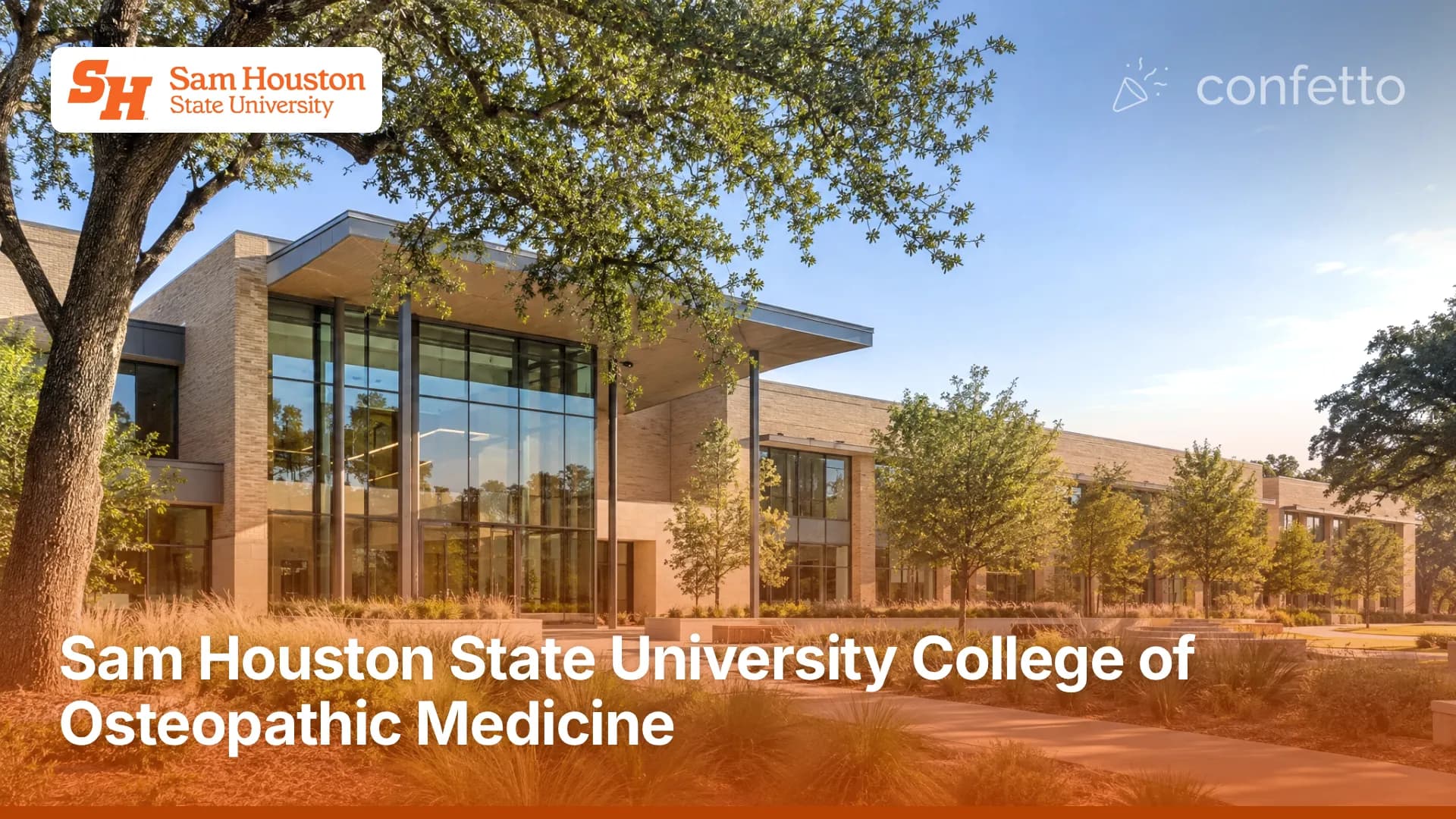
Key facts (2026-27)
AACOM's listing for SHSU-GCOM describes a traditional and a scenario-based one-on-one, a written essay, a student doctor-led group interview and a group activity.
- Format
- Two 15-minute one-on-ones, essay and group interview
- Where
- In person or virtual (set in your invitation)
- Stations
- 2 one-on-ones + essay + group interview + group activity
- Length
- 15 min per one-on-one interview
- Also required
- Supplemental application, Acuity Insights assessments (Casper), before any interview invitation
Dates for 2026-27
July to December, sometimes into January
Interviews
TMDSAS pre-match offers October 15, 2026 to January 29, 2027, Match results February 12, 2027
Offers and decisions
Checked October 2026 against SHSU-COM: Admissions FAQs, SHSU-COM: How to apply, AACOM Choose DO: SHSU-GCOM, TMDSAS: Entry Year 2027 deadlines and TMDSAS: After submitting (pre-match offers). Confirm details in your invitation.
SHSU-COM's interview day, per the school's AACOM Choose DO listing, has two 15-minute one-on-one interviews (one traditional, one scenario-based), a written essay, a student doctor-led group interview and a group activity. The school's admissions FAQ sums it up as two face-to-face interviews and a written assessment, in person or virtual.
For the traditional and scenario-based one-on-ones, Confetto, an AI mock interviewer for medical school and other healthcare program interviews (MMI, traditional, panel), lets you practice both kinds of interview out loud, with rubric-based feedback after every answer.
Interviews run July through December, sometimes into January. You need the supplemental application and a Casper test on file before you can be considered.
SHSU-COM applies through TMDSAS (deadline October 1, 2026) and follows the TMDSAS Match. Pre-match offers run October 15, 2026 to January 29, 2027, and TMDSAS lists Match results on February 12 for 2027 entry (checked October 2026).
What the SHSU-COM interview day includes
SHSU-COM's interview day has two face-to-face interviews and a written assessment, and the school says these may be in person or virtual. The school's admissions FAQ says the rest of the details come after you're invited.
The school's own listing on AACOM's Choose DO Explorer, under the new SHSU-GCOM name, gives more: two 15-minute one-on-one interviews (one traditional, one scenario-based), a written essay, a student doctor-led group interview and a group activity. As of October 2026, neither source says who conducts the one-on-one interviews or what the written essay asks you to do, and TMDSAS's school page doesn't either.
If you read SDN threads about SHSU-COM, check any details against your invitation, which is where the school says the specifics come.
Here's what the school does publish about the interview stage:
| Item | What the school says |
|---|---|
| Is an interview required? | Yes. Invitations come from a holistic review of your full application. |
| When interviews happen | July through December, sometimes into January. The applicant timeline lists July/August as when interviews begin. |
| What the day includes | Two face-to-face interviews and a written assessment. The school's AACOM listing adds a student doctor-led group interview and a group activity, and says each one-on-one interview is 15 minutes. |
| In person or virtual | Either is possible. You'll learn which in your invitation. |
| What you need before an invite | Both the SHSU-COM supplemental application and the Acuity Insights Casper assessment |
Casper comes first
Casper test dates and requirements vary by school. For the full 2026-27 list of MD and DO schools that use it, with last test dates and deadlines, see which medical schools require Casper.
For the format, scoring and practice scenarios, see our Casper test guide.
Sources: the admissions FAQ and the How to Apply page.
Casper is a separate online test you take before any invitation. It isn't the written assessment on interview day.
TMDSAS and the new name
Two more facts worth knowing.
- TMDSAS. SHSU-COM takes applications through TMDSAS, the Texas application service, and follows the TMDSAS Match, with rolling admissions after the Match.
- New name. And the school has a new name: in August 2026 the Texas State University System regents approved the Russell and Glenda Gordy College of Osteopathic Medicine (SHSU announcement). You'll see both names on official pages, and the admissions pages still say SHSU-COM.
The SHSU-COM mission statement
This is the mission as written on the school's Mission and Vision page:
"The mission of the Sam Houston State University College of Osteopathic Medicine (SHSU-COM) is to prepare students for the degree of Doctor of Osteopathic Medicine with an emphasis toward primary care and rural practice, to develop culturally aware, diverse and compassionate physicians, who follow osteopathic principles, that are prepared for graduate medical education, and will serve the people of Texas with professionalism and patient-centered care.
A significant part of the mission of the COM is to increase the physician workforce in the eastern region of Texas and to increase access to primary care. The COM will accomplish this by recruiting qualified applicants from areas to which they would likely want to return and establish their practice."
The school's AACOM listing gives the same mission under the new Gordy name. The vision, on the same Mission and Vision page, is "to provide medical education and service to the eastern region of Texas and be recognized as a leader in improving primary care access and workforce needs in the state."
What it means for your answers
Read the second paragraph of the mission twice. The school says outright that it recruits applicants who are likely to go back home and practice there.
If you're from East Texas or a rural area, that's the most direct link between your application and the mission, and your interviewers have every reason to ask about it.
If you're not, be honest about where you see yourself practicing and why primary care or underserved communities matter to you. Don't claim ties you don't have.
Training and screening
The clinical years follow the same idea. The AACOM listing says rotation placement uses an algorithm and lottery that considers students' hometowns, that clinical training is centered largely in East Texas, and that students complete a dedicated month of rural and underserved care.
The mission matters for more than one answer. The FAQ says the school weighs academic metrics, life experiences, service, cultural awareness, motivation and "alignment with SHSU-COM's mission" equally when screening applications.
What else the school tells applicants to prepare
The How to Apply page includes tips from the admissions office. Three of them bear directly on the interview:
- Osteopathic medicine. Know what osteopathic medicine is. The school says it expects "reasonable knowledge" of the tenets and practice, and suggests research, info sessions or shadowing a D.O. Its What is Osteopathic Medicine page lists the four tenets and says students learn osteopathic manipulative medicine (OMM) in all four years.
- Your why. Be able to say your "why" for medicine in an organized way. The school says that about the personal statement, and it applies just as much when someone asks you face to face.
- Ongoing service. Keep serving. The school says it looks for people who stay involved in community and healthcare service after graduation, so expect questions about what you're doing now, not only in college.
The school also recommends mock interviews and practicing your answers out loud. That's the one piece of interview advice it gives directly.
A worked "Why SHSU-COM?" outline (practice example)
This is a fictional applicant we made up to show the structure. Build yours from your own experiences, and tie each point to a specific phrase in the mission.
Show the worked example
Fictional applicant: grew up in a small town in East Texas, worked two years as a medical scribe at a family medicine clinic, and volunteers at a church-run health fair.
- Opening line (15 seconds). "I want to practice family medicine in a town like the one I grew up in, and SHSU-COM is built around training people to do exactly that."
- Evidence from your life (45 seconds). One story from the scribe job: a patient who drove a long way for a visit, and what it showed about access to a primary care doctor. Say what you did and what you noticed. Leave county-level statistics out unless you can cite a source.
- Mission link (30 seconds). Connect the story to "increase access to primary care" and the school's stated plan to recruit applicants who'll return home to practice. Say plainly that you intend to.
- Osteopathic link (20 seconds). Name one tenet, such as the person being a unit of body, mind and spirit, and point to something you saw that fits it. Keep it concrete.
- Close (10 seconds). One sentence on what you'd contribute as a student, such as continuing the health fair work.
That's about two minutes, which is a comfortable length for a conversational interview. If you can't fill step 3 honestly, don't force it. Talk about primary care or underserved patients in terms you can back up.
Practice questions (written by us, not SHSU-COM)
As of October 2026, the school's admissions pages and AACOM listing don't list interview questions.
We wrote these to match the mission and the school's stated priorities. They're for practice only and don't predict what you'll be asked.
- Why osteopathic medicine, and what have you done to learn what D.O.s actually do?Practice this question now
- Why SHSU-COM rather than another Texas school?Practice this question now
- Where do you see yourself practicing in ten years? What would make you stay there?Practice this question now
- Tell me about a time you worked with someone whose background or beliefs were very different from yours. What did you learn about yourself?Practice this question now
- What community or healthcare service are you doing right now?Practice this question now
- A patient in a small town tells you they skip follow-up visits because the clinic is an hour away. What would you want to understand before suggesting anything?Practice this question now
- Walk me through a mistake you made in a clinical or volunteer setting and what you changed afterward.Practice this question now
- Which of the four osteopathic tenets means the most to you, and why?Practice this question now
More SHSU-COM practice questions (4)
- Hometown rotations: SHSU-COM's rotation lottery considers where students are from. If you trained near home in years 3 and 4, what would you want to learn there, and what would be hard?Practice this question now
- Scenario: During your rural and underserved month, a farmer with chest pain wants to finish the harvest before driving to a hospital. What do you do?Practice this question now
- The mission aims to grow the physician workforce in East Texas. What keeps new doctors from settling in a rural area, and what would keep you?Practice this question now
- Group activity: Your group has one mobile clinic van for three rural counties for a year. How do you decide where it goes and how often?Practice this question now
For ten more questions, see the free Confetto question bank preview.
Preparing for the written assessment
The AACOM listing calls it a written essay. As of October 2026, neither that listing nor the school's FAQ or How to Apply page says what it covers, how long it is, or how it's scored.
Your invitation should have the details, and you can ask Enrollment Services (enrollCOM@shsu.edu, 936.202.5202) if it doesn't.
What you can do without knowing the format is get comfortable writing a clear response under time pressure.
Our suggestion: pick one of the practice questions above, set a timer for 15 minutes, and write a response with a clear position in the first two sentences, one specific example, and a short closing line. Then reread it for typos.
It's a general skill drill, not a guess at the real prompt.
A timing drill for the two interviews
The school's AACOM listing gives 15 minutes per one-on-one interview, so expect only a handful of questions in each. Practice a two-minute core answer that you can expand if the interviewer follows up.
Show the drill
- Open the free MMI timer and set it to 2 minutes per answer with a 30-second break.
- Answer five of the practice questions above out loud, back to back, on camera. Stop when the timer ends even if you're mid-sentence.
- Watch the recording. For each answer, check whether you gave a direct answer in the first 20 seconds and whether you used one specific example.
- Have a friend ask one follow-up after each answer ("What would you do differently?" or "Why does that matter for rural patients?"). Your follow-up answer should be under a minute.
- Do one round on video call and one in person. The school says either format is possible, so practice both.
If you don't have a practice partner, Confetto's AI mock interviews cover traditional and panel formats as well as MMI, with follow-up questions based on what you said and rubric-based feedback afterward. You can start with a free trial.
SHSU-COM interview FAQ
What is the SHSU-COM interview format?
Two 15-minute one-on-one interviews (one traditional, one scenario-based), a written essay, a student doctor-led group interview and a group activity, per its AACOM listing.
Is it in person or virtual?
The school says the interviews and written assessment may be in person or virtual.
Does SHSU-COM require Casper?
Yes. You need the supplemental application and a Casper test on file before you can be considered.
When does SHSU-COM interview?
July through December, sometimes into January. It applies through TMDSAS and follows the TMDSAS Match.
Other Texas schools
If you're interviewing at other Texas schools, we've also written guides for University of the Incarnate Word School of Osteopathic Medicine, Texas A&M University School of Medicine and Paul L. Foster School of Medicine. Our medical school interview prep page covers MMI and traditional formats in general.
Applying to other Texas DO schools? See our guide to the UNT Health Texas College of Osteopathic Medicine interview.
Confetto isn't affiliated with Sam Houston State University or its College of Osteopathic Medicine. Details come from the school's public admissions pages as of October 2026, and the school can change them, so check your invitation.