
Updated · 8 min read
Jefferson Sidney Kimmel Interview: Two One-on-Ones
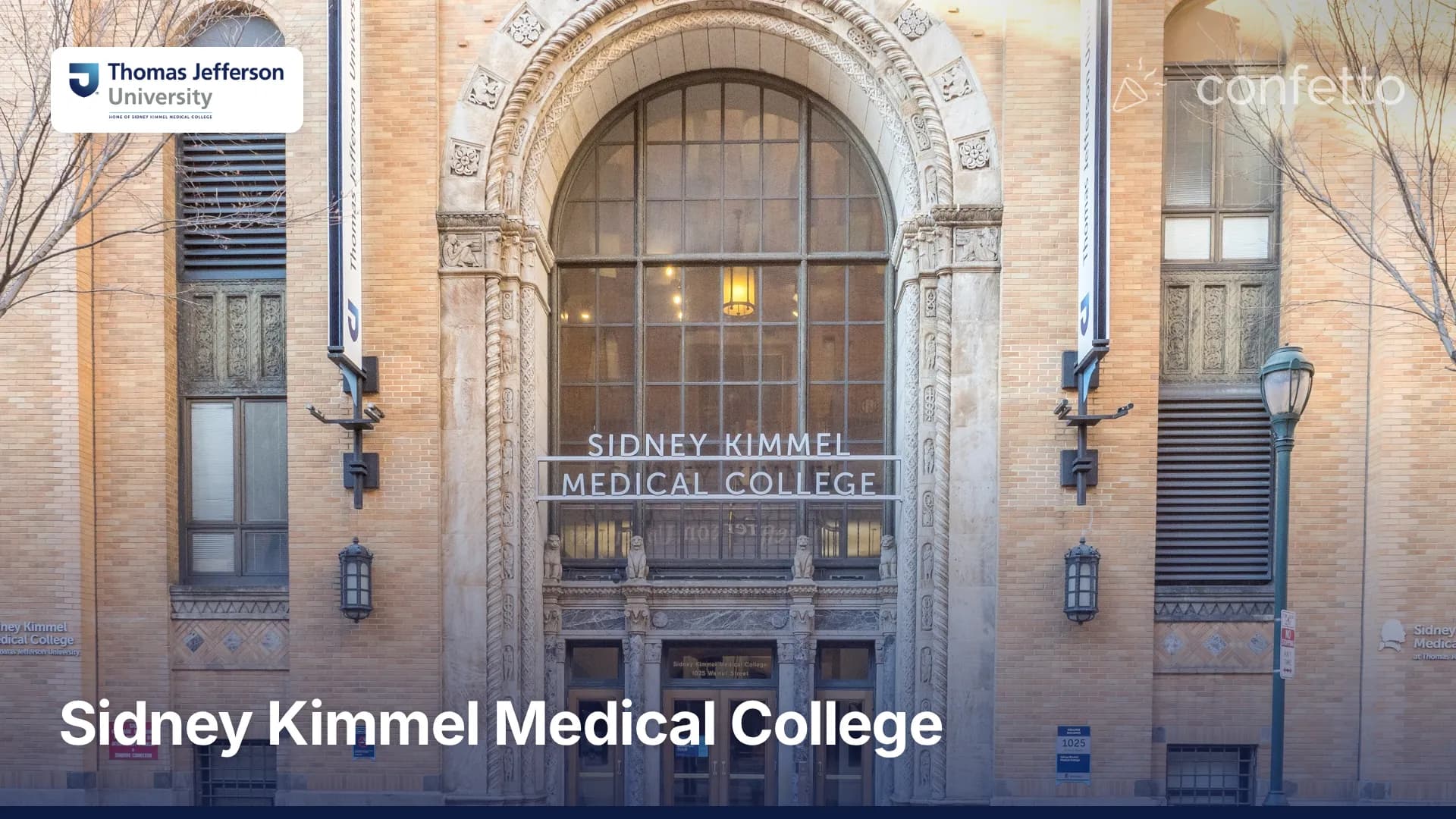
Key facts (2026-27)
All SKMC interviews are in person for 2026-27: one open-file faculty interview and one closed-file student interview on a Wednesday in Philadelphia.
- Format
- Two one-on-one interviews: faculty and student
- Where
- In person, Center City Campus (Philadelphia)
- Stations
- 2 interviews: one medical student, one faculty member
Dates for 2026-27
July to January (MSAR: from mid-July)
Interview invitations
Wednesdays, mid-September 2026 to February 2027 (timeline page says through March)
Interviews
Within 4 to 6 weeks of your interview
Offers and decisions
Checked October 2026 against SKMC: Interview day, SKMC: Admissions FAQ, SKMC: Application timeline and AAMC MSAR 2027 interview report. Confirm details in your invitation.
Yes, Sidney Kimmel Medical College (SKMC) interviews in person in Philadelphia for the 2026/2027 cycle. It is not an MMI: you have two one-on-one interviews, one with a current medical student and one with a faculty member on the Committee on Admissions.
Its AAMC MSAR entry says the faculty interview is open file and the student interview is closed file. For the open-file faculty interview and the closed-file student one, Confetto, an AI mock interviewer for medical school and other healthcare program interviews (MMI, traditional, panel), lets you practice one-on-one interviews with follow-up questions based on what you said.
Interviews run on Wednesdays from mid-September, and SKMC invites about 600 applicants a year. Interviewed applicants hear back within 4 to 6 weeks.
Confetto is not affiliated with Sidney Kimmel Medical College or Thomas Jefferson University. Everything below about SKMC comes from Jefferson's public admissions pages, its 2027 admissions prospectus and the AAMC MSAR report, as checked in October 2026.
Details can change, so go by your invitation email. As of October 2026, SKMC's admissions pages don't list its interview questions, so the practice questions here are written by us, not by the school.
The Sidney Kimmel Medical College at Thomas Jefferson University Interview: Format and Experience
SKMC's Interview Day page says all applicant interviews "will be conducted in-person for the 2026/2027 Admissions Cycle." You interview one-on-one with a current medical student and with a faculty member who serves on the Committee on Admissions.
The AAMC MSAR report adds that the faculty interview is open file and the student interview is closed file.
| Item | What SKMC says |
|---|---|
| Format | Two one-on-one interviews: a current medical student and a faculty member from the Committee on Admissions. Not an MMI. |
| In person or virtual | In person for the 2026/2027 cycle, at 1015 Walnut Street, Philadelphia |
| When | Wednesdays, beginning mid-September. SKMC's pages say through February (Applying page) or March (timeline page). No interviews the week of Thanksgiving or during SKMC's two-week winter break. |
| The day | Starts at 9:00 a.m. with an information session, lunch and tours hosted by current students. Plan to be on campus through 4:30 p.m. SKMC's MSAR entry lists the day as 10 a.m. to 4 p.m., so go by your invitation. |
| Invitations | Sent by email beginning in mid-July (timeline page). The FAQ says between July and January |
| Decisions | Interviewed applicants are notified within 4 to 6 weeks of their interview date |
| Travel help | Limited funds for travel and lodging; SKMC says requests are confidential and do not affect the admission decision |
As of October 2026, SKMC's admissions pages and its MSAR entry don't give the length of each interview. The admissions pages list the MCAT as the required test and don't mention Casper or AAMC PREview.
Open file and closed file
A pattern with this pairing: the faculty member has read your file and the student hasn't. Expect detail questions from the faculty member, and have a short version of your story ready for the student.
SKMC says the interview serves several purposes: information in your application can be verified and clarified, you can explain unique aspects of it, you can get to know the school, and the committee can assess personal qualities.
Expect questions about specific lines in your AMCAS application and secondary, and be ready to explain anything unusual in two or three honest sentences.
Insider Tip: You face a student and a faculty member separately. Practice your core stories so they hold up with either.
Mission & Culture Fit
SKMC's mission, as its About page puts it, focuses on educating physicians who will form and lead the integrated healthcare delivery and research teams of tomorrow, discovering new knowledge from the laboratory to the bedside and into the community, and setting the standard for high-quality, empathetic, compassionate and efficient patient care. Its selection factors page says a diverse and inclusive environment is key to excellence in patient care, education and research.
Qualities the committee looks for
Its 2027 prospectus lists the qualities the Committee on Admissions looks for beyond academics: a service orientation, cultural competence, teamwork skills, strong oral communication, ethical responsibility to self and others, reliability and dependability, resilience and adaptability, and the capacity for improvement.
Treat that list as your guide to which stories to have ready, and show these qualities through specific examples rather than reciting them.
Service and class size
SKMC's selection page also says almost every applicant selected for interview has demonstrated a commitment to community service through volunteer work, and that the committee selects a class of 272 from an applicant pool of approximately 13,700, inviting approximately 600 applicants to interview.
Programs and Student Groups Jefferson Describes
When "Why SKMC?" comes up, use facts the school itself puts forward, tied to something in your own background. One real connection beats a tour of all of them.
- Physician Shortage Area Program (PSAP). Started in 1974 to put more physicians, especially primary care doctors, in rural areas and small towns in Pennsylvania and Delaware. It has up to 24 places in each first-year class. It looks for applicants who grew up in a rural area or small town and plan to practice in one, with priority for students at the PSAP Cooperative colleges. You opt in on the SKMC secondary and send three extra letters by November 15. Jefferson says PSAP graduates are more than eight times as likely as their peers to become rural family physicians.
- Health Mentors Program. An interprofessional program in which small groups of 4 to 6 Jefferson students meet three times over 1.5 years with a community volunteer living with a chronic condition or impairment.
- JeffBEACON. A cocurricular program promoting health equity for disadvantaged urban communities in Philadelphia, with students applying in the fall of their first year.
- JeffHOPE. A student-run free clinic that Jefferson says holds weekly clinics at four homeless shelters and one needle exchange program in Philadelphia.
- Puentes de Salud at Jefferson. A student organization whose stated purpose is the health and wellness of South Philadelphia's Latino immigrant community, with attention to social determinants of health.
- Jefferson Scale of Empathy. Created at SKMC; the prospectus says it has been translated into 59 languages.
Keep your claims to what Jefferson publishes. Do not describe services or clinic details you have not confirmed yourself, and bring up a program only if it matches something you have actually done.
Pennsylvania Context You Can Cite
Pennsylvania's Medicaid expansion under the ACA was implemented on January 1, 2015, according to KFF. Jefferson's own PSAP page says Pennsylvania has the third largest rural population of any state and that almost one-half of its doctors practice in three counties (Philadelphia, Montgomery and Allegheny), which is the problem PSAP was built to address.
Those are the policy and workforce facts verified for this guide. If you cite one in an interview, connect it to a patient or experience of your own rather than reciting a statistic.
Jefferson Sidney Kimmel interview questions to practice
As of October 2026, SKMC's admissions pages don't list its interview questions. We wrote these for a file-based, one-on-one format and the qualities Jefferson lists.
They are for practice and will not predict your day.
- Walk me through why you want to be a physician, starting from the experience that made it real.Practice this question now
- Why Sidney Kimmel, and why not the medical school closest to home?Practice this question now
- Tell me about a time a team you were on was not working. What did you do about it?Practice this question now
- How would you improve trust in medicine among a community you do not belong to?Practice this question now
- A patient with limited English keeps missing appointments. What do you do?Practice this question now
- Describe a time you advocated for someone. What barriers did you face?Practice this question now
- What is something you were wrong about in the last two years, and how did you find out?Practice this question now
- A classmate confides that they have been copying assignment answers. What do you do?Practice this question now
- (Rural applicants) Describe the health care you have seen in your hometown. What would you change first?Practice this question now
More Jefferson Sidney Kimmel practice questions (4)
- Which part of your application would you most want to explain in person, and why?Practice this question now
- You're with a student interviewer who hasn't read your file. Give the two-minute version of who you are and why medicine.Practice this question now
- SKMC's Honor Code says a student who sees a breach and does nothing is also in violation. You see a classmate sign in an absent friend at a required session. What do you do?Practice this question now
- (PSAP applicants) PSAP graduates are expected to practice in a rural area or small town. Where do you see yourself, and what would make you stay?Practice this question now
Preparation Checklist
Use these targeted steps to practice what SKMC values, and let Confetto accelerate your prep.
Show the checklist
- Run AI-powered mock interviews in Confetto that mirror a traditional one-on-one, file-based conversation with follow-up questions.
- Run two mocks back to back, one with a partner playing a faculty member and one playing a medical student, and check that your core stories hold up in both.
- Print your AMCAS application and secondary, circle five entries an interviewer might ask about, and answer each in under 90 seconds.
- Analyze your responses with Confetto's performance analytics to track progress on teamwork examples and how you talk about service and equity.
- Pick one SKMC program or student group that genuinely fits your record and build a short story around it using Confetto's narrative coaching modules.
FAQ
Is the Sidney Kimmel Medical College interview an MMI?
No. SKMC uses two one-on-one interviews, one with a current medical student and one with a faculty member who serves on the Committee on Admissions. As of October 2026, its admissions pages and MSAR entry don't give interview length.
Are SKMC interviews in person or virtual?
In person for the 2026/2027 cycle, at 1015 Walnut Street in Philadelphia. SKMC's Interview Day page says all applicant interviews are conducted in person.
What does the interview day look like?
The day begins at 9:00 a.m. with an information session, lunch and tours hosted by current students, and you interview with a student and a faculty member. SKMC asks you to plan to be on campus through 4:30 p.m. and to watch an introductory video beforehand.
Does SKMC require Casper or PREview?
As of October 2026, SKMC's admissions pages list the MCAT as the required test and don't mention Casper or AAMC PREview.
When will I hear back after interviewing?
SKMC says applicants who interview are notified within 4 to 6 weeks of their interview date.
Key Takeaways
- Format. SKMC's interview is in person for 2026/2027: two one-on-one interviews, one with a current medical student and one with a faculty member. It is not an MMI.
- Open file. As of October 2026, SKMC's pages don't give interview length or questions. The faculty interview is open file, so know every line of your application.
- Qualities. Prepare stories for the qualities SKMC lists: service orientation, cultural competence, teamwork, communication, ethics, resilience and capacity for improvement.
- Why SKMC. Anchor "Why SKMC?" in one real connection to a program Jefferson describes, such as PSAP, the Health Mentors Program, JeffBEACON or JeffHOPE.
- Specific stories. Use specific, experience-driven stories that connect patient needs, systemic barriers and realistic next steps.
Call to Action
Ready to practice like you will perform on interview day? Confetto simulates traditional one-on-one interviews with follow-up questions, coaches you on service and teamwork storytelling, and builds your fluency with targeted analytics.
Start a Confetto session now and walk into the Sidney Kimmel Medical College interview prepared and precise.
Also applying to the Lewis Katz School of Medicine at Temple? See our interview guide for that school.