
Updated · 5 min read
TouroCOM Interview Questions and Format: What to Expect
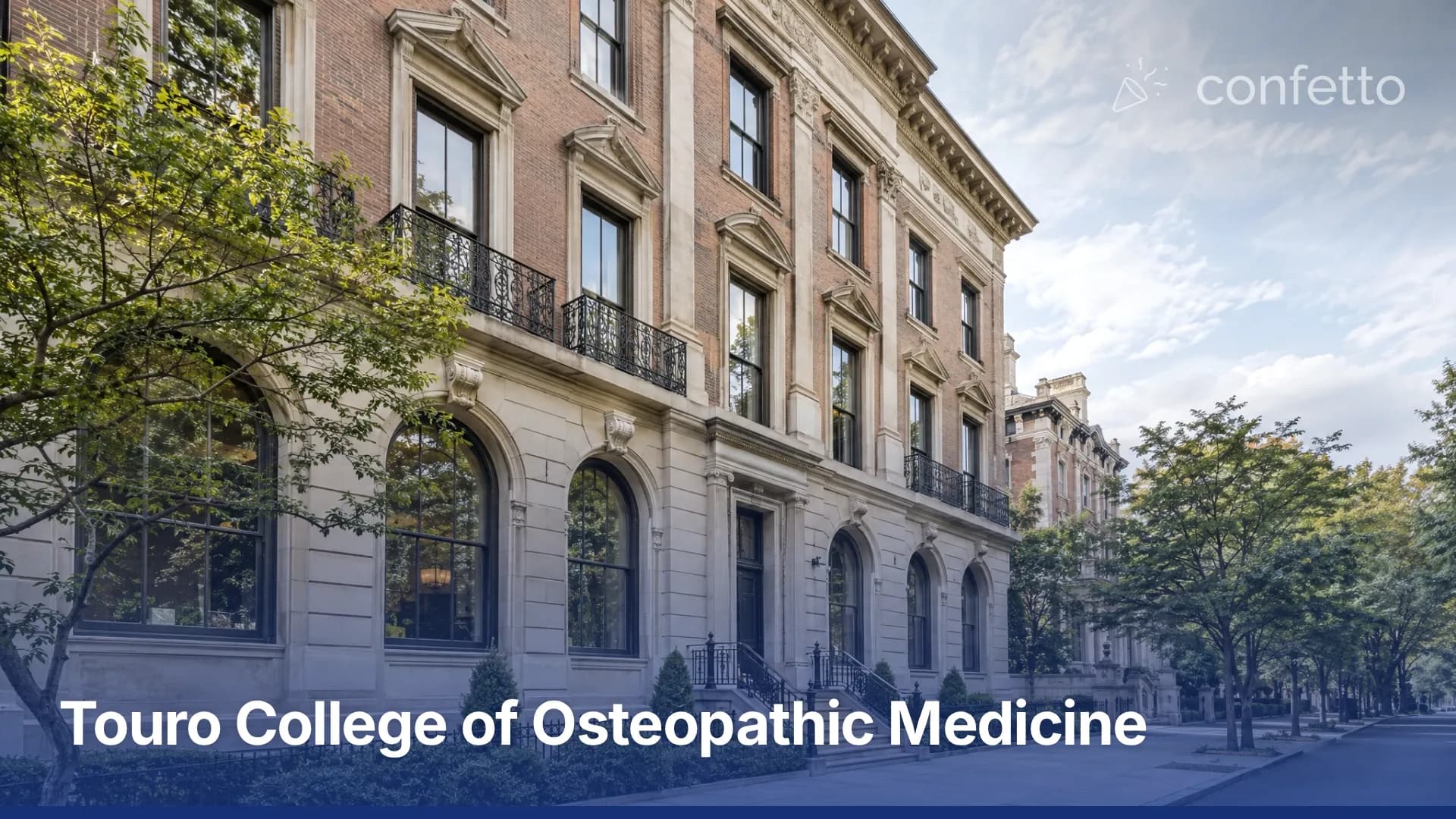
Key facts (2026-27)
For the class starting in 2027, TouroCOM lists a traditional Zoom interview with faculty who have full access to your file. You interview at one campus only.
- Format
- Traditional faculty interview via Zoom
- Where
- Virtual (Zoom)
- Platform
- Zoom
- Stations
- A formal interview with several faculty members
- Also required
- Casper (taken March 19, 2026 to February 9, 2027), Informational presentation on interview day
Dates for 2026-27
Rolling, once your supplemental application is complete
Interview invitations
October to May, rolling (AACOM). TouroCOM's page says September to May
Interviews
Usually within two months of your interview
Offers and decisions
Checked October 2026 against TouroCOM: DO admissions, TouroCOM: Admission requirements and AACOM Choose DO: TouroCOM. Confirm details in your invitation.
TouroCOM interview format: a faculty conversation
Touro College of Osteopathic Medicine describes an informational presentation and a formal interview where you'll meet several faculty members. Its official DO admissions page says interviewers have full access to your application record.
Prepare to discuss what you submitted; the page doesn't describe an MMI circuit or a hands-on OMT interview station.
Remote or in person
That page mixes cycles. Its application information covers 2026-2027, but the sentence promising remote interviews explicitly refers to 2025-2026.
Don't treat it as confirmation of your current interview's location. Check your invitation for the platform or campus, duration and exact arrangements.
For the class starting in 2027, AACOM's Choose DO Explorer profile lists a traditional interview held virtually over Zoom; check your invitation.
Confetto isn't affiliated with Touro College of Osteopathic Medicine. This guide covers TouroCOM, with Harlem and Middletown campuses in New York and a Great Falls campus in Montana.
Don't transfer its arrangements to Touro's California or Nevada schools.
Know which campus you're discussing
The admissions page says you can select a campus in your application; choosing no preference lets TouroCOM assign one. You can interview at only one TouroCOM campus.
Before rehearsal, check the choice you submitted and the campus named in your invitation.
Match your answer to the campus
A reason for applying should make sense for that location. Don't deliver an answer about living in New York to an interviewer for Great Falls.
You don't need to claim you've already found a clinical placement. Explain what interests you about the learning environment you've actually researched and what you'd still need to find out.
If you chose no preference
If you selected no preference, be honest about it. You can explain the features that attracted you to TouroCOM while acknowledging that you need to learn more about the assigned campus.
An invented local connection is harder to discuss than a real unanswered question.
Our full-record interview drill
This is an original preparation exercise based on the school's published file access. It isn't TouroCOM's interview script.
Give a practice partner the application sections you're comfortable sharing, with personal or patient details removed.
- Ask them to choose a claim about your experience, such as leading a project or helping someone understand a task.
- Explain the event in ninety seconds. That's our training limit, not the school's answer timing.
- Have them ask what you personally did and how you know it helped.
- Compare the spoken answer with your written application. Correct any difference in responsibility or outcome.
A fictional example
For a fictional example, an application says you coordinated a volunteer event. Your first spoken answer says you “built the program,” although a supervisor chose the activities and another volunteer arranged the venue.
Try again: explain the timetable and communication you managed, and credit the work you didn't do.
That correction doesn't make the experience worthless. It makes the contribution understandable.
Ask your partner what they think you learned from coordinating people. If all they remember is the event's size, add the decision or mistake that changed your behavior.
Repeat with a hard experience
Repeat with an experience you found difficult. Don't choose a harmless weakness solely because you already have a neat ending.
You should be able to discuss the support you needed and what remains a work in progress.
Explain your interest in osteopathic medicine
TouroCOM's admission requirements describe evaluating your experiences alongside your interest in, and commitment to, practicing osteopathic medicine. Prepare an answer grounded in what you've learned or observed.
Don't assume you must demonstrate a clinical technique in the interview.
Write down one observation from an experience that shaped your interest. Then identify what you still don't understand.
If you haven't observed a technique, don't claim you know how it feels to provide it. Explain the questions you'd want to ask a trained physician rather than presenting yourself as one.
Keep the reason for osteopathic training separate from a claim that one qualification makes a doctor more caring. A comparison that diminishes other physicians won't explain your own decision.
Use the specific experience that made you want to learn more.
Use the teaching model as a preparation question
TouroCOM's school overview describes a flipped classroom, with material learned before class and students' understanding assessed in class. Connect that description to how you prepare for learning, rather than simply saying you like technology.
A study rehearsal
For our rehearsal, read a short source about a topic you're studying and explain one idea without notes. Have your partner ask about the step you skipped.
Go back to the source and check it before trying again. This is a study exercise, not a TouroCOM exam or a claim about a particular module.
A useful question for your interviewer could be how students respond when preparation exposes a gap they can't resolve alone. Ask about the learning process you want to understand, instead of asking for a guaranteed grade.
Keep Casper separate from the interview
TouroCOM lists Casper results as part of its secondary requirements and gives a cycle-specific window for fall 2027 applicants on its requirements page. Earlier-cycle results aren't valid.
Check the school's accepted dates and your registration instructions. The presence of a situational judgment test doesn't establish that the faculty interview is an MMI.
Casper test dates and requirements vary by school. For the full 2026-27 list of MD and DO schools that use it, with last test dates and deadlines, see which medical schools require Casper.
For the format, scoring and practice scenarios, see our Casper test guide.
Original TouroCOM practice questions
These prompts are ours, not previous school questions. To answer them out loud for a faculty interviewer, Confetto, an AI mock interviewer for medical school and other healthcare program interviews (MMI, traditional, panel), runs traditional mock interviews with follow-up questions based on what you said.
- Why TouroCOM? What drew you to this school rather than another osteopathic program?Practice this question now
- Your application describes a leadership role. What decision did you personally make?Practice this question now
- What experience led you to consider osteopathic medicine, and what do you still want to learn?Practice this question now
- How would you prepare for class if you found a gap in your understanding beforehand?Practice this question now
- Which campus have you applied to, and what do you need to learn about studying there?Practice this question now
- TouroCOM trains students in Harlem, in Middletown, New York, and in Great Falls, Montana. How would your plans for clinical training change depending on the community you train in?Practice this question now
- Your interviewers have full access to your application. Which part of it do you expect to be asked about, and what would you add that the page can't show?Practice this question now
- TouroCOM uses a flipped classroom. When have you had to learn material on your own before working through it with others, and how did it go?Practice this question now
- How would you explain osteopathic manipulative treatment to a patient who is nervous about hands-on care?Practice this question now
- Tell me about a time you made a mistake that affected someone else. What did you do next?Practice this question now
- A classmate in your small group keeps showing up unprepared, and it is slowing everyone down. What do you do?Practice this question now
For spoken practice, Confetto's medical school mock interviews offer follow-up questions and rubric-based feedback. Use a round to check that your explanation matches your application and clearly identifies your own work.
Applying to other New York DO schools? See our guide to the D'Youville University College of Osteopathic Medicine interview.
TouroCOM interview FAQ
What is the TouroCOM interview format?
An informational presentation and a formal interview where you meet several faculty members, who have full access to your application. It isn't an MMI.
Is the TouroCOM interview virtual?
For the class starting in 2027, AACOM lists a traditional interview held virtually over Zoom. Check your invitation.
Does TouroCOM require Casper?
TouroCOM lists Casper results as part of its secondary requirements.