
Updated · 3 min read
Touro Nevada Interview: MMI, Traditional and Group Formats
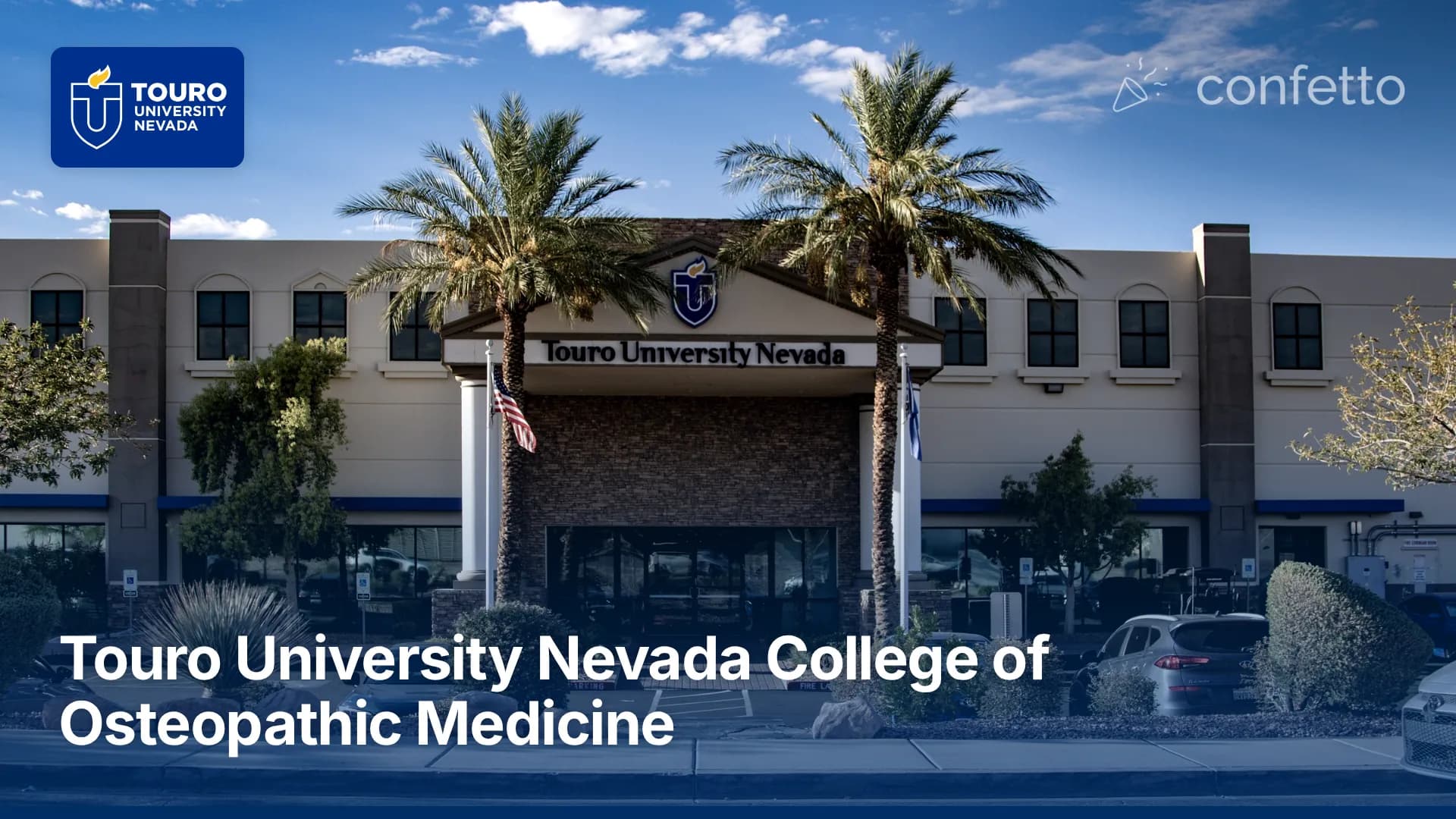
Key facts (2026-27)
AACOM lists three interview formats (MMI, traditional and group) with virtual and in-person interviews, and the school says the format is subject to change.
- Format
- MMI, traditional and group interviews
- Where
- Virtual or in person (Henderson campus)
- Also required
- Secondary application ($100)
Dates for 2026-27
From late August or early September, rolling
Interview invitations
September to May, or until the class is filled
Interviews
You're told on interview day when to expect one
Offers and decisions
Checked October 2026 against Touro Nevada: DO application and FAQ and AACOM Choose DO: Touro Nevada COM. Confirm details in your invitation.
The TUNCOM interview format: what Touro Nevada says
Touro University Nevada College of Osteopathic Medicine (TUNCOM) interviews by invitation only, either virtually or on its Henderson campus, from September until May or until the class fills. Its official AACOM listing names three formats: Multiple Mini Interview (MMI), traditional and group interviews.
So plan for all three unless your invitation says otherwise.
Touro Nevada doesn't publish how the day splits between those formats, how many MMI stations there are, or how long each one runs. Its DO Application and Requirements page says you'll "be given pertinent information about the schedule of events for the interview day" once you're invited, and that the interview format is subject to change.
Here's everything the school's own pages commit to:
| Item | What Touro Nevada says |
|---|---|
| Format | MMI, traditional and group interviews (AACOM listing) |
| Virtual or in person | Both. "Virtual and in-person interviews will be conducted throughout the application cycle." AACOM lists the "option to interview virtually or in-person." |
| How you're invited | By telephone and/or email, after the Admissions Committee reviews your file |
| Interview season | Interview invitations start in late August or early September and go out on a rolling basis. Interviews run from September until May or until the class is filled. |
| Cancellations | Interviews "may be canceled as needed," since admission is rolling |
| Decision timing | You're told on interview day when to expect a decision |
| Casper, PREview or other tests | Not mentioned on Touro Nevada's DO admissions page or its AACOM listing |
What forum reports can't tell you
If you searched for "Touro Nevada SDN," you're probably after the part the school doesn't publish: what the day actually feels like. Forum reports are self-reported, often from past cycles, and TUNCOM says its format can change, so we haven't used them here.
The schedule that comes with your invitation is the only version that counts. Until it arrives, prepare for a traditional sit-down interview, short timed scenarios and a group discussion, because the school's own listing names all three.
From secondary to decision: the TUNCOM timeline
These dates come from Touro Nevada's DO admissions page and its FAQ, and they cover the 2026-27 cycle (the class starting in 2027).
- Secondary. Secondary invitations usually start in early August. You only get one if your AACOMAS application meets the minimums, and the secondary costs $100, non-refundable. AACOM says the fee can be waived with an approved AACOMAS or AAMC fee waiver.
- Processing. After your application is verified and released to Touro Nevada, the school says processing takes about 4 to 6 weeks.
- Interview invitations. Interview invitations go out by email from late August or early September, on a rolling basis.
- After the interview. After the interview, you're told when to expect a decision. If you're waitlisted, the school accepts only academic updates about coursework. Nothing else.
- Deposit. If you're admitted, there's a $2,000 non-refundable deposit. AACOM's listing says deposits are typically due within two weeks of the offer.
Deadlines
Deadlines are the one place the official sources disagree. Touro Nevada's page lists April 30 for AACOMAS and May 28 for the secondary.
The AACOM listing gives April 30, 2027 and June 25, 2027.
Go by the earlier date, and don't wait for either: TUNCOM says review can end "well before the stated deadline(s)" once seats and the waitlist fill, and both sources recommend submitting AACOMAS at least four weeks before the deadline.
What Touro Nevada says it's looking for
The mission statement on the TUNCOM program page says the college prepares "outstanding osteopathic physicians" who are "committed to primary care and the holistic approach to the patient." Primary care is the part to take seriously.
It shows up again in the selection factors Touro Nevada lists on its admissions page and with AACOM:
- Academic competence
- Personal and professional achievements
- Demonstrated leadership skills
- Creative abilities
- Experience in health care
- Likelihood to practice in underserved primary care areas
Expect interviewers to probe that last one in any format. If you're drawn to a specialty, say so honestly, but be ready to talk about who you've actually served and where you could see yourself practicing.
Outcomes worth knowing
Two things from the school's outcomes are useful context. In March 2026 Touro Nevada reported a 100% match/placement rate for its 172 graduating students, with a record 72 staying in Nevada.
That's about 42% of the class. The school also says 37% of those Nevada-bound graduates are going into primary care.
If you want to train and stay in the Southwest, that's a concrete reason to give. If you don't, expect the "why here" question to be harder.
Service and clinics
On service, Touro Nevada's Stallman Touro Clinic at The Shade Tree gives shelter residents basic care, including acute care, management of chronic illness and care for children.
Its student healthcare outreach page lists weekly care at sites including Catholic Charities, Veterans Village and U.S. Vets.
Mention these only if they connect to something you've done. Naming a clinic you haven't looked into won't help much.
Shadowing and letters
Two admissions details feed straight into "why DO." Touro Nevada requires documented physician shadowing, and AACOM notes it accepts only in-person shadowing.
One of your three letters must come from a physician, DO preferred and MD acceptable. Your interviewer may ask about that shadowing, so have one specific moment from it ready, not a summary of hours.
TUNCOM practice questions (written by us, not Touro Nevada)
Touro Nevada doesn't publish its interview questions. We wrote these to cover the three formats its AACOM listing names and the selection factors above.
Traditional interview
- Why osteopathic medicine, and what did you see while shadowing that made the difference clear?Practice this question now
- Why Touro Nevada, and what ties you to Nevada or the Southwest, if anything?Practice this question now
- Tell us about a time you took care of someone who had no one else to help them.Practice this question now
- Where do you see yourself practicing, and who would your patients be?Practice this question now
- Tell us about something you started or led that didn't go the way you planned.Practice this question now
MMI-style scenarios
- You're volunteering at a shelter clinic. A resident asks you to fill out a form for them, but the form asks for information they say is private. What do you do?Practice this question now
- A patient with back pain tells you the last doctor "just handed me pills." They want to know what a DO would do differently. Explain it without medical jargon.Practice this question now
- A friend in your class is falling asleep in lectures and says they're working nights to pay rent. They ask you not to mention it to anyone. What do you do?Practice this question now
- A clinic has one appointment left today. Two people are waiting: a regular patient who needs a refill, and a walk-in with no insurance and a cough that's lasted three weeks. You're asked who should get it. Talk through your answer.Practice this question now
Group discussion
- Your group runs a free clinic that can add one service next year: evening hours, a Spanish-speaking nurse, or a mobile van. Agree on one and explain why.Practice this question now
- Rank four reasons patients skip follow-up visits, then propose one fix for the top reason.Practice this question now
Prompts 10 and 11 need a group, so they're the ones people skip. Don't.
A group round shows how you work with other people, and you can't rehearse that alone.
A one-hour drill for all three formats
Since you don't know the split until your invitation arrives, practice each format in one session. MMI station timing isn't published for TUNCOM, so we used 2 minutes to read and 6 minutes to answer as a middle setting.
Change it once your schedule arrives.
| Block | What you do | Time |
|---|---|---|
| Traditional | A partner asks questions 1 to 5 and asks one follow-up on each answer. Aim for about 2 minutes per answer. | 12 min |
| MMI | Prompts 6 to 9 as four stations: 2 minutes to read, 6 minutes to answer, back to back. Treat each as a new room. | 32 min |
| Group | Prompt 10 or 11 with three to five people on a video call. One person only observes and takes notes. | 12 min |
| Debrief | The observer says who moved the group forward and who got talked over. You note the one answer you'd redo. | 4 min |
That's 12 + 32 + 12 + 4 = 60 minutes, plus a minute or two between stations.
Run it twice before your interview, once in the setup you'll use on the day. If you're interviewing virtually, that means the same room, camera and lighting.
Tools for the drill
For the MMI block, the free Confetto MMI timer can be set to four stations with 2 minutes to read and 6 to answer, so nobody has to watch a clock. If you don't have a partner for the traditional block, Confetto's AI mock interviews cover MMI, traditional and panel formats, ask follow-up questions and give rubric-based feedback.
You can start with a free trial.
For more practice prompts, see our MMI interview questions and medical school interview questions. If you might face more than one interviewer at a time, read our panel interview guide.
Virtual or on campus: practical details
Campus tours
If you'd like to see the Henderson campus before you choose, or you're interviewing virtually and want to see it anyway, Touro Nevada offers an Experience Touro Tour, in person or virtually, where you can take a campus tour and meet the admissions team. Check its Visiting & Directions page for current tour dates.
Admissions contacts
For application status questions, admissions runs a drop-in "Apps & Answers" Zoom session every Wednesday, 12:00 to 1:00 pm Pacific, except holidays and campus closures. You can also email TUN.COM.Admissions@touro.edu or call (702) 777-3240.
Interviewing at other DO schools too? See our guides to KCU and LECOM.
Touro Nevada interview FAQ
What is the TUNCOM interview format?
Its AACOM listing names three formats: MMI, traditional and group interviews. Touro Nevada doesn't publish how the day splits between them.
Is it virtual or in person?
Both. Virtual and in-person interviews run throughout the cycle, on the Henderson campus or online.
When does Touro Nevada interview?
Invitations start in late August or early September, and interviews run from September until May or until the class fills.
Does Touro Nevada require Casper?
Casper and PREview aren't mentioned on its DO admissions page or AACOM listing.
Confetto isn't affiliated with Touro University Nevada. School details here come from Touro Nevada's DO admissions pages and its AACOM listing, checked in October 2026.
Formats can change between cycles, so go by your invitation.
Also interviewing in the Mountain West? See our guide to the Rocky Vista University College of Osteopathic Medicine interview.
Applying to other Southwest DO schools? See our guide to the Burrell College of Health Sciences School of Osteopathic Medicine interview.
Also applying to MD schools in Nevada? See our guides to the University of Nevada, Reno School of Medicine and the Roseman University College of Medicine interviews.