
Updated · 7 min read
Tufts Medical School Interview: Format and Questions
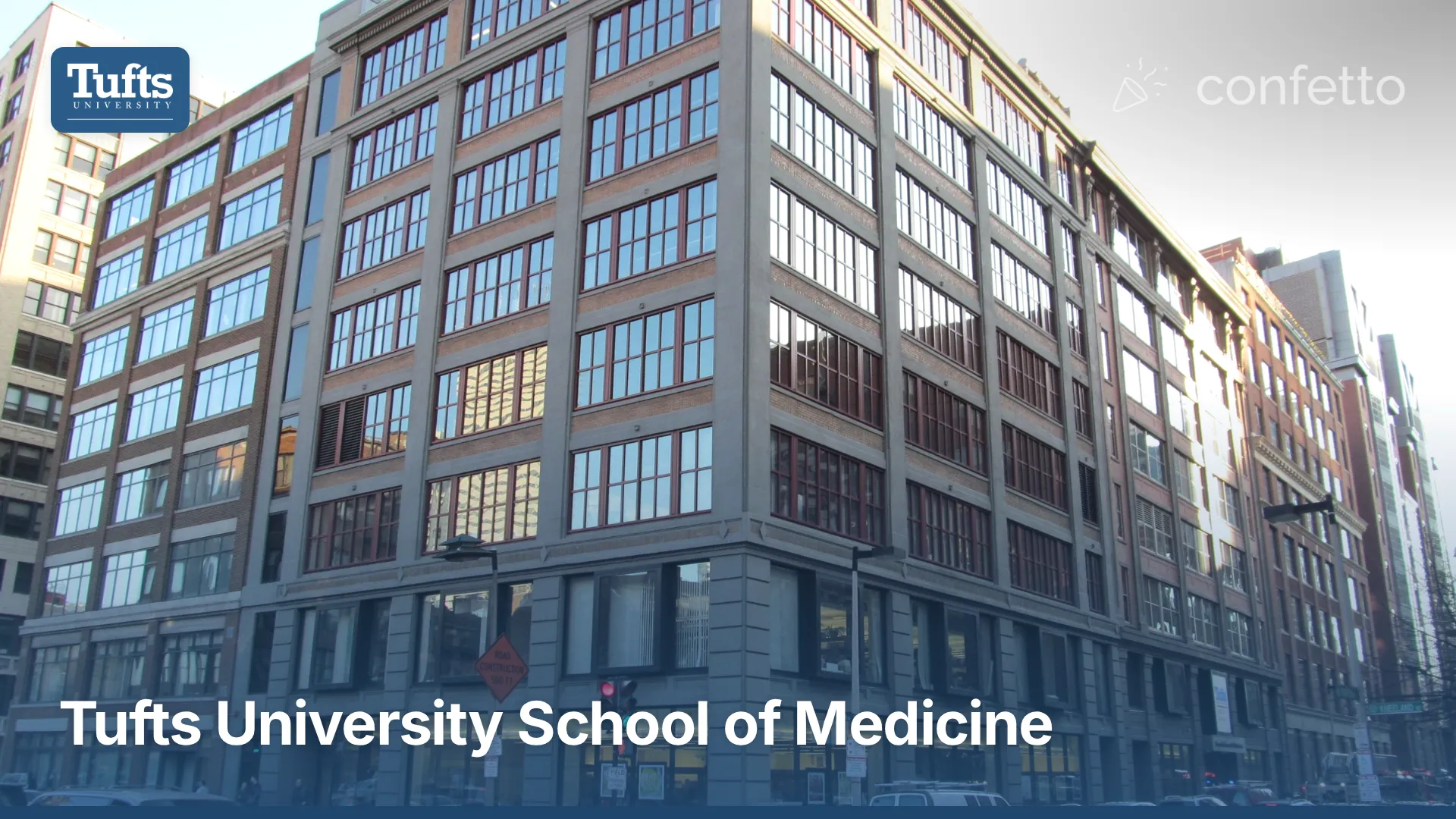
Key facts (2026-27)
Maine Track applicants have a different day: an MMI plus two personal interviews.
- Format
- Two individual interviews with committee members
- Where
- Virtual (Zoom)
- Stations
- 2 interviews with Admissions Committee members
Dates for 2026-27
August 2026 to March 2027
Interview invitations
September 2026 to March 2027
Interviews
Monthly, emailed in the first two weeks of the next month
Offers and decisions
Checked October 2026 against Tufts: Apply to the MD program, Tufts: Interviewed MD applicants and AAMC MSAR 2027 interview report. Confirm details in your invitation.
Preparing for the Tufts University School of Medicine interview
The Tufts med school interview format
The Tufts University School of Medicine interview is a virtual day on Zoom built around two individual interviews with members of the Admissions Committee. Tufts' MD admissions page describes the day as "a full day of speakers, presentations, an opportunity to meet some of our current students, a virtual tour, and two individual interviews with members of the Admissions Committee."
Interviews run between September and March, and you can only get one by invitation.
What Tufts told the AAMC
The AAMC's MSAR Interview Procedures report, where schools describe their own process, matches that and adds a little detail. Tufts told the AAMC that interviews "will be held virtually," that the day includes presentations and Q&A sessions by various deans and departments plus a student panel, and that "All sessions and interviews will be hosted on Zoom."
It also lists invitations starting in August and says regional interviews aren't available.
What isn't published
For the regular Boston MD track, that means two one-on-one conversations, not an MMI. Tufts doesn't publish how long each interview lasts, whether interviewers have read your file, or whether the two interviewers are faculty, students or a mix.
Your invitation is the place to look for those details. Until then, prepare as though both interviewers know your application well.
The Maine Track interview is different
If you apply to the Maine Track as well, expect a different day. In the MSAR report Tufts says "The Maine Track interview day involves an MMI Interview format and two personal interviews."
So Maine Track applicants should prepare for short scenario stations as well as the two conversations.
Review for both tracks
Tufts' Maine Track admissions page adds that Maine Track applicants are reviewed for both the Maine Track and the traditional MD track, and "can be selected to interview at both sites and be considered for admission to both Tracks."
That same page still says Maine Track applicants are interviewed by faculty at Maine Medical Center in Portland and Boston applicants at Tufts in Boston, which reads like older wording next to the all-Zoom statements on the MD page and in the MSAR report. Follow whatever your invitation says.
Tufts also says that not getting into the Maine Track won't hurt your chances for the traditional track.
If you're preparing for the MMI stations, our MMI practice questions with answers and the free MMI timer will get you used to reading a prompt and answering on the clock.
Tufts dates for the interview season
These are from the admissions timeline on Tufts' MD page. Tufts lists them by month without years, so read them as the current cycle's dates.
| Step | When |
|---|---|
| Early Decision AMCAS deadline | August 1 |
| Interview invitations sent | August to March |
| Early Decision secondary deadline | September 1 |
| Interview season | September to March |
| Early Decision applicants notified | By October 1 |
| Regular AMCAS deadline (no extensions) | November 1 |
| Regular secondary deadline | December 30 |
| Everyone has an interview invitation or a letter of regret | By March 31 |
| Admissions from the wait list | May to July |
- Secondary fee. The secondary costs $130 (waived if you have an AMCAS fee waiver).
- Casper and PREview. Tufts' MD pages don't list Casper or PREview as a requirement, so don't take either one just for Tufts.
- Early Decision. If you're weighing Early Decision, see our early decision guide. Tufts' special admissions options page says ED applicants need a convincing reason in their supplemental essays and credentials that exceed those of the current class.
What happens after your interview
Tufts' page for interviewed applicants says the Admissions Committee reviews interviewed applicants monthly, and you'll hear its decision by email "within the first two weeks of the following month." So if you interview on October 20, expect an answer by mid-November.
There are three possible outcomes: an offer, a rejection, or a deferred decision. A deferred decision isn't a no.
Those applicants stay under review through the season, can be offered a place at any point, and are eligible for the wait list, which Tufts says becomes active in the spring.
Tufts School of Medicine mission and values
Tufts publishes these on its vision, mission and values page. Its mission is "to educate a diverse body of students and advance medical knowledge in a dynamic and collaborative environment."
It goes on to say the school wants to develop dedicated clinicians, scientists, public health professionals and educators who will have "a sustained positive impact on the health of individuals, communities, and the world."
The four core values
The four core values, in Tufts' own words:
- Commitment to Excellence: "To cultivate a perpetual spirit of inquiry and creativity, leading to outstanding evidence-based health care, rigorous research and scholarship, and inspired teaching."
- Commitment to Humanism: "To relieve suffering and improve quality of life. To treat all people with compassion, respecting human dignity and autonomy."
- Commitment to Social Responsibility: "To serve and advocate for all people, especially underserved and vulnerable patients and populations, by addressing social determinants of health, health equity, social justice, and stewardship of social resources."
- Commitment to Professionalism: "To act in accordance with the highest standards of integrity, demonstrating personal accountability and resilience, collegiality and teamwork, and the pursuit of lifelong learning."
What the admissions page says
The admissions page itself is plainer. Selection is based on your required premed courses "but also on the applicant's entire academic record and extracurricular experiences," and the committee reads your letters and application "for indications of promise and suitability for a medical career."
Don't recite the values back to your interviewers. They already know them.
What helps is a story that shows one of them without your having to name it.
Map your stories to the four values
You get two interviews, and you don't know what either interviewer will ask. A small set of stories that you can bend to different questions works better than a script for each likely question.
Fill in a table like this before interview day. The example row is fictional.
| Tufts value | Your story (one line) | What it shows | Question it could answer |
|---|---|---|---|
| Excellence | Fictional: a research project where your first hypothesis was wrong and you redesigned the study | Curiosity, honesty about data | "Tell me about a failure" or "Walk me through your research" |
| Humanism | |||
| Social responsibility | |||
| Professionalism |
Two rules make this work.
- Something you did. Each story should be something you did, with a result you can state in a sentence.
- About two minutes. And you should be able to tell any of them in about two minutes, then stop and let the interviewer pick what to follow up on.
If a value has no story behind it, that's worth knowing now rather than in the second interview.
Practice questions for the Tufts interview
Tufts doesn't publish its interview questions. These are ours, written around what Tufts says it values.
Treat them as practice, not a leak. To rehearse two individual interviews in a row, Confetto, an AI mock interviewer for medical school and other healthcare program interviews (MMI, traditional, panel), lets you practice one-on-one interviews out loud with follow-up questions that build on your answers.
- Why Tufts, and what in your application shows that answer is true?Practice this question now
- Tell me about a time you were wrong about something that mattered. What did you do next?Practice this question now
- Describe a patient or person you helped whose situation was shaped by things outside their control. What could you change and what couldn't you?Practice this question now
- Tell me about a time a teammate wasn't pulling their weight.Practice this question now
- What's something you've kept learning about long after you had to?Practice this question now
- If you're applying to the Maine Track: why Maine, and what do you know about practicing medicine in a rural setting?Practice this question now
- Walk me through one experience on your application that you'd describe differently today.Practice this question now
- A patient tells you she skipped her follow-up because she couldn't take another unpaid day off work. How would you respond, and what could the clinic do?Practice this question now
- Tell me about a time you kept your word when it would have been easier not to.Practice this question now
- What does treating someone with dignity look like when you disagree with their choice?Practice this question now
- Tufts trains clinicians, scientists, public health professionals and educators. Which of those roles do you see yourself in, and why?Practice this question now
For question 1, tie your answer to something Tufts actually offers and something you've actually done. Tufts' public health program, for example, names Chinatown and greater Boston as its host communities.
That's useful only if your own work connects to it.
For a wider set of traditional questions, see our medical school interview questions guide.
How to practice for two back-to-back interviews
The hard part of a two-interview day isn't the first conversation. It's sounding just as fresh in the second, after a morning of presentations on Zoom, when the second interviewer asks a question that's close to one you already answered.
Practice for that directly: do two mock interviews in a row, with a short break between them, and have the second one repeat at least two questions from the first. Then check whether your second answers sound recited.
Set up your Zoom space
Set up your Zoom space the way you'll use it on the day. Check your camera height, lighting and audio on the same device, and keep your application open on a second screen or printed beside you so you can glance at dates and names.
Practicing without a partner
If you don't have a partner who can ask unpredictable follow-ups, Confetto runs AI mock interviews in traditional and MMI formats, asks follow-up questions, and gives rubric-based feedback. You can start with a free trial.
If you're also applying to UMass Chan, see our UMass Chan interview guide.
Tufts interview FAQ
What is the Tufts interview format?
A virtual day on Zoom with two individual interviews with members of the Admissions Committee, plus presentations, a student panel and a virtual tour. It isn't an MMI.
When does Tufts interview?
Between September and March, by invitation. Invitations start in August.
Does Tufts require Casper or PREview?
Tufts' MD pages don't list either as a requirement.
Confetto isn't affiliated with Tufts University School of Medicine. Details come from Tufts' public MD admissions pages and the AAMC MSAR report, checked October 2026.
Your interview invitation overrides anything here.
Tufts curriculum facts for a "why Tufts" answer
Tufts teaches basic and clinical sciences inside integrated organ-systems courses, and says all pre-clerkship courses are built to prepare you for clerkships. These are the points from its curriculum page that most often connect to an applicant's own experience. Use one only if you can tie it to something you have done.
- Students are at the bedside in the second month of medical school, practicing patient interviewing.
- The first course, Population Health and Profession of Medicine, has students explore Boston neighborhoods and use data from those communities.
- Two parallel tracks run alongside the organ systems: Foundations of Patient Care and Foundations of Clinical Reasoning.
- Core clerkships start in the spring of year two.
- Every student completes a scholarly project. Besides basic science and clinical research, it can focus on public health, civic engagement or clinical quality improvement.
- Each student is paired with a faculty coach from day one.
The Tufts secondary and combined degrees
Tufts sends a secondary invitation after it receives your AMCAS application and says it does not disqualify anyone at the secondary stage. Your file is not reviewed until the secondary is submitted, AMCAS has verified your application, the minimum letters are in and a valid MCAT is recorded. After you submit, the same secondary site is where you schedule an interview if you are invited.
Combined degree and Maine Track applications are added through that secondary site. Every combined degree applicant is also considered for the traditional MD program, and a combined degree program can admit you only after the School of Medicine Committee on Admissions has approved you.
- Combined degrees offered: MD/PhD (MSTP), MD/MPH and MD/MA.
- The MD/PhD program runs its own interview process. The MD/Master's programs need no additional interview, no extra test beyond the MCAT and no extra fee.
- Maine Track students can't apply to the MD/PhD program because of scheduling conflicts.
- Tufts gives strong preference to US citizens and permanent residents, and admits relatively few international students.
- Tufts' statement on AI says applicants must write their own application content. Spelling and grammar review or help trimming your own writing to a word count is acceptable.
Frequently asked questions
My Tufts application has been complete for months. Am I out of the running for an interview?
No. Tufts keeps complete applications under active consideration until the interview season ends in March, and says it is not uncommon for applicants complete in the fall to be invited in the winter or spring. Everyone hears by March 31.
Does Tufts screen applicants before the secondary?
No. Tufts says it does not disqualify any applicants at the secondary stage. Review starts once your secondary, verified AMCAS application, minimum letters and MCAT score are all in.
Is there a separate interview for Tufts combined degree programs?
Only for the MD/PhD, which runs its own interview process. The MD/MPH and MD/MA need no additional interview, and every combined degree applicant is also considered for the traditional MD program.
Does Tufts start students in clinical work early?
Yes. Tufts says students are at the bedside in the second month of medical school, and core clerkships begin in the spring of year two.
Checked October 2026 against Tufts: Apply to the MD program, Tufts: Secondary application, Tufts: Dual MD programs, Tufts: MD admissions FAQs, Tufts: Professional standards and Tufts: MD curriculum.