
Updated · 8 min read
Preparing for the University of Iowa Carver College of Medicine interview
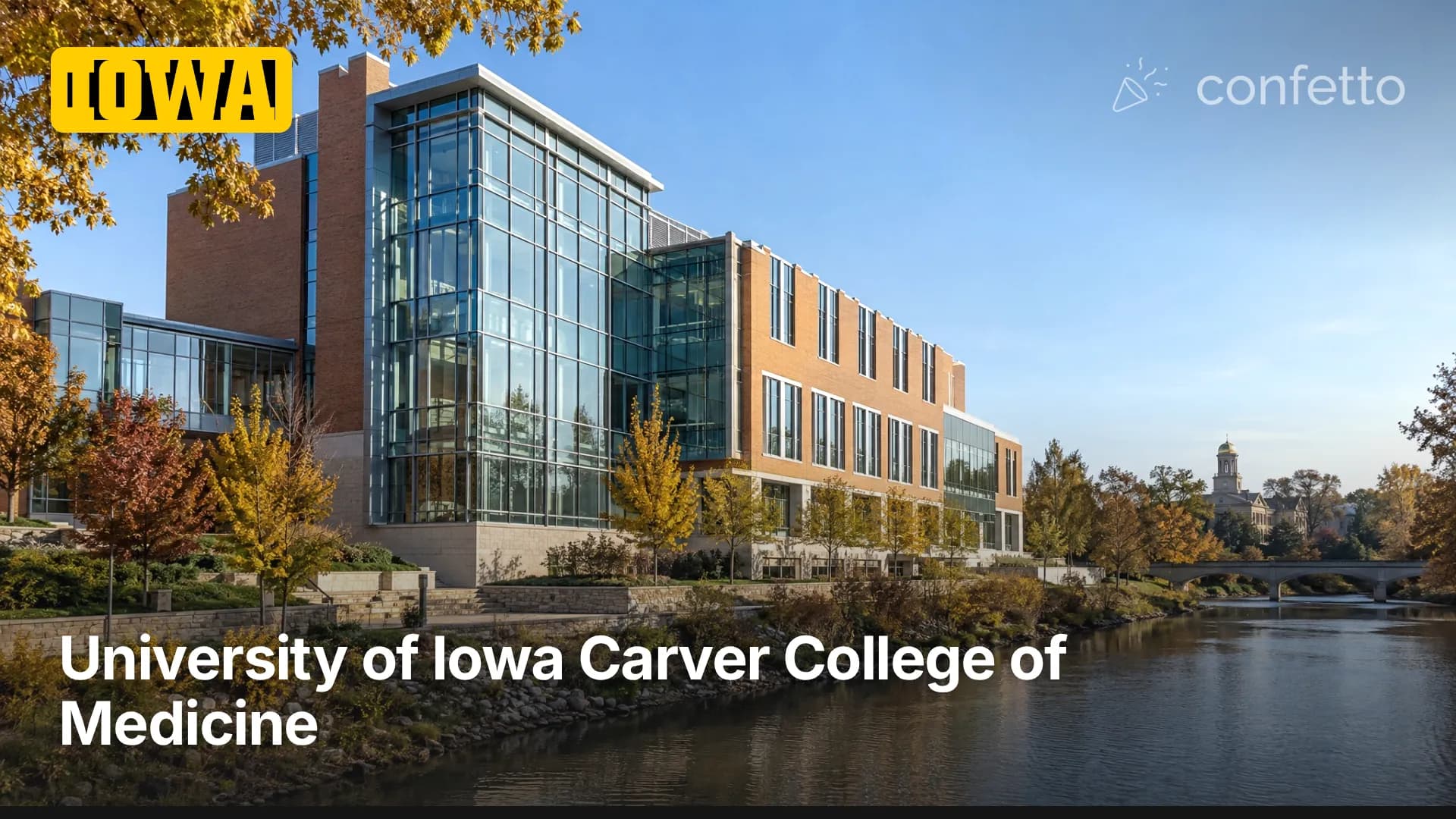
Key facts (2026-27)
You choose in person or virtual, the committee isn't told which, and your interviewers don't see your grades, MCAT or AMCAS application.
- Format
- One 25-min interview with two faculty (closed file)
- Where
- Virtual (Zoom) or in person (your choice)
- Stations
- 1 interview with 2 faculty members
- Length
- 25 min (structured part, then unstructured)
- Also required
- Case-Based Learning exercise on interview day
Dates for 2026-27
From mid-August (MSAR)
Interview invitations
Weekdays, September 2026 to January 2027
Interviews
Rolling, with all final decisions posted by March 15
Offers and decisions
Checked October 2026 against Carver College of Medicine: Interview FAQ, Carver: Virtual interview FAQ, Carver: Dates and deadlines and AAMC MSAR 2027 interview report. Confirm details in your invitation.
The Carver College of Medicine interview format
The University of Iowa Carver College of Medicine (CCOM) MD interview is a single 25-minute interview with two faculty members. It isn't an MMI.
According to Carver's Interview FAQ, the 25 minutes come in two parts: a structured part where "all applicants are asked the same questions that day and interviewers do not ask follow up questions," then an unstructured part where the interviewers can ask about your background and experiences and you're encouraged to ask your own questions.
The rest of the interview day
The interview is one piece of a longer day. Carver's FAQ lists these pieces:
- Orientation. An orientation run by admissions staff, including financial aid information.
- Interview. The 25-minute faculty interview.
- Case-Based Learning. A Case-Based Learning exercise facilitated by fourth-year medical students.
- Lunch. A lunchtime discussion with Medical Student Ambassadors.
- Tour. A tour of the college and the University of Iowa Health Care Medical Center.
You'll get a detailed schedule if you're invited. Interviews run on weekdays from September through January.
In person or virtual: your choice
You pick the format. Carver says the interview format "will not be disclosed to our committee and will not factor into admissions decisions," and its Virtual Interview FAQ says the only difference between the two days is that virtual applicants don't get lunch.
- In person. In person, you report to the Admissions Office on the first floor of the Medical Education and Research Facility at 375 Newton Road in Iowa City, and you'll spend most of the day in that building. Carver asks for professional dress and comfortable shoes for the tour, and guests can't come along.
- Virtual. For virtual days, Carver asks you to use a computer rather than a phone, interview on Zoom, keep the camera at eye level, and avoid having a light behind you.
Your interviewers haven't read your file
Carver's FAQ says the interviewers "do not have access to your academic record, MCAT score(s), or any part of your AMCAS application." They won't open with "tell me about your research in the Smith lab," because they don't know you had one.
That has two practical consequences.
- Stories stand alone. First, every story you tell has to stand on its own. Don't say "as I wrote in my personal statement," and don't assume they know what your clinic or lab or job was. Give a one-sentence setup, then say what you did.
- Opening answer. Second, your opening answer carries more weight than usual. If the first question is some version of "tell us about yourself," that's the only map of your application they'll get, so decide in advance which two or three experiences you want them to remember.
What the faculty interviewers are asked to look for
Carver publishes the three things its Admissions Committee asks interviewers to consider:
- Your interest in a medical career.
- Your own personal characteristics.
- Your experiences and insight into current medical issues.
Current medical issues
"Current medical issues" doesn't mean memorizing statistics. It means you can talk sensibly about two or three issues in health care that you've actually seen up close, say what you think, and admit where you're unsure.
Pick issues you can tie to your own experience, such as access to care in a rural area, staffing shortages you saw as a scribe, or how insurance shaped what a patient in your clinic could afford. If you cite a number, make sure it's one you've checked yourself.
Personal characteristics
For personal characteristics, Carver's Selection Process page lists the qualities the committee seeks in applicants, including commitment to service, maturity, leadership, ability to work under stress, ability to work as a team member, sound decision-making, empathy and compassion. Make sure you have a real story for at least half of them.
How to handle the structured part
In the structured part, there are no follow-up questions. Everyone interviewing that day gets the same questions.
That changes how you should answer.
Make each answer complete
In a normal conversation you can give a short answer and let the interviewer pull out the details. Here, nobody will ask "and what happened next?" or "what did you learn?"
If you leave out the result or the reflection, it simply doesn't get said. So each answer needs to be complete on its own: what the situation was, what you did, how it turned out, and what you took from it.
Keep it to about two minutes. With 25 minutes split across two parts, long answers eat into the unstructured time, which is where you get to ask questions and show some personality.
The unstructured part
The unstructured part is the opposite. Interviewers may follow up on anything you've said, so don't use a story in part one that you can't talk about for another five minutes.
The Case-Based Learning exercise
Carver says only that applicants "participate in a Case-Based Learning exercise facilitated by 4th year medical students." It doesn't publish the case content, the group size, or whether the exercise is scored.
Whatever the case is, the approach is the same: engage with the case, ask good questions, build on what other applicants say rather than competing with them, and be comfortable saying "I don't know that, but here's how I'd find out."
Carver interview questions to practice (written by us, not Carver)
Carver doesn't publish its interview questions. We wrote these around the three areas its interviewers are asked to consider.
For the structured-style ones, practice giving a complete answer with no prompting.
Interest in a medical career
- Tell us about yourself. (Remember they haven't seen your application.)Practice this question now
- Why medicine, and what have you done to test that decision?Practice this question now
- Describe a moment in a clinical setting that changed what you thought being a physician involves.Practice this question now
- Why the University of Iowa?Practice this question now
Personal characteristics
- Tell us about a time you were part of a team that wasn't working. What did you do?Practice this question now
- Describe a decision you made under pressure that you'd make differently now.Practice this question now
- What's a piece of feedback that was hard to hear, and what did you change because of it?Practice this question now
- Tell us about a commitment to service you've kept over a long period.Practice this question now
Current medical issues
- What's a problem in health care you've seen firsthand, and what would you try first to fix it?Practice this question now
- Many rural areas have trouble keeping physicians. Why do you think that is?Practice this question now
- A patient tells you they read something online that contradicts your advice. How do you respond?Practice this question now
- What's a current issue in medicine you've changed your mind about?Practice this question now
- Carver notes that Iowa has more than 360 Health Professional Shortage Areas, mostly rural. What would draw you to rural practice, or keep you from it?Practice this question now
For a wider set, see our medical school interview questions.
A practice plan for a 25-minute, two-part interview
Carver doesn't say how the 25 minutes are split, so this plan assumes roughly equal halves.
| Round | What you do | Time | What to check |
|---|---|---|---|
| 1. Structured block | Partner reads four or five questions from the list above, one after another, with no follow-ups and no reactions | About 12 minutes | Did every answer include a result and a reflection? Did any run past two and a half minutes? |
| 2. Unstructured block | Partner picks two of your answers and follows up on each, then lets you ask questions | About 12 minutes | Could you go deeper on every story? Did you have two real questions ready? |
| 3. Cold-file test | Give your "tell us about yourself" answer to someone who knows nothing about your application | 2 minutes | Ask them to repeat back your three main experiences. If they can't, simplify. |
| 4. Review | Watch the recording | 10 minutes | Note any answer that leaned on context the listener didn't have |
The total for rounds 1 to 3 is about 26 minutes, close to the real interview. Do the full plan twice, a week apart, with different questions each time.
What round 1 catches
Here's a fictional example of what round 1 catches. An applicant answers question 6 with a good story about a shift as an EMT, then ends at "and we got the patient to the hospital."
In Carver's structured part, nobody follows up, so the answer stops before the part that answers the question. The fix is one more sentence: what they'd do differently and why.
If you don't have a practice partner, Confetto's AI mock interviews run a traditional or panel format, ask follow-up questions, and give rubric-based feedback. You can start with a free trial.
Facts to use in a "Why Iowa" answer
A good "why Iowa" answer names something specific about the school and connects it to something you've done. These come from Carver's own pages:
- Curriculum. The MD curriculum runs three strands through all four years: Mechanisms of Health and Disease, Medicine and Society, and Clinical and Professional Skills. Clerkships start after three semesters of preclinical work instead of four, core requirements are done by the end of the fifth semester, and the last three semesters are yours to tailor.
- Distinction tracks. Carver offers six distinction tracks: Global Health; Healthcare Delivery Science, Management, and Policy; Humanities; Research; Service; and Teaching. Students can earn up to two.
- CRISP. The CCOM Rural Iowa Scholars Program (CRISP), started in 2012, prepares students for rural practice and begins the summer before medical school. Carver notes that Iowa has more than 360 Health Professional Shortage Areas, mostly rural.
- Mission and values. The college describes three linked missions on its mission page: education, research and service. Its listed values are innovation, collaboration, accountability, respect and excellence.
Only mention CRISP or a distinction track if it fits your actual interests. Faculty can tell when you've picked a program off the website five minutes ago.
Class size and residency
For scale, Carver's 2026 entering class profile lists 3,902 applications for a class of 142, a mean MCAT of 514, and 114 Iowa residents (about 80% of the class). Iowa residents and nonresidents are considered in separate pools, so if you're from out of state, expect "why Iowa" to matter.
Dates and decisions
Deadlines
For the class entering in 2027, Carver's dates and deadlines page lists a November 1, 2026 AMCAS deadline and a December 15 secondary deadline, with October 15 strongly encouraged. The secondary fee is $60.
Admission is rolling, and Carver says it's in your interest to schedule your interview as soon as you can after the invitation arrives.
Review and offers
- Review. The committee reviews applicants on a rolling basis from October to January, and applicants not reviewed in that phase are reviewed in a "final pool" phase in February.
- Offers. Offers can start as early as October 15, and all final decisions are posted by March 15.
- Where decisions appear. Each decision (accepted, final pool, alternate list or not admitted) is posted on your secondary application.
- Holding your spot. If you're accepted, Carver says it doesn't charge a fee to hold your spot.
Applying to other Midwest schools? See our guides for University of Minnesota and Des Moines University.
Carver College of Medicine interview FAQ
What is the Carver interview format?
A single 25-minute interview with two faculty members: a structured part where everyone gets the same questions, then an unstructured part. It isn't an MMI.
Is it in person or virtual?
Your choice. Carver says the format you pick is not disclosed to the committee and doesn't affect decisions.
What else is on the interview day?
An orientation, a Case-Based Learning exercise led by fourth-year students, a lunchtime discussion with student ambassadors and a tour. Interviews run on weekdays from September through January.
Confetto isn't affiliated with the University of Iowa. School details here come from Carver College of Medicine's public MD admissions pages, checked in October 2026.
Formats can change between cycles, so go by your interview invitation.
Also applying to the Creighton University School of Medicine? See our interview guide for that school.
Also applying to the University of Nebraska? See our guide to the College of Medicine (UNMC) interview.
Applying to other Upper Midwest schools too? See our guide to the University of South Dakota Sanford School of Medicine interview.