
Updated · 7 min read
Preparing for the University of Texas Medical School at San Antonio interview
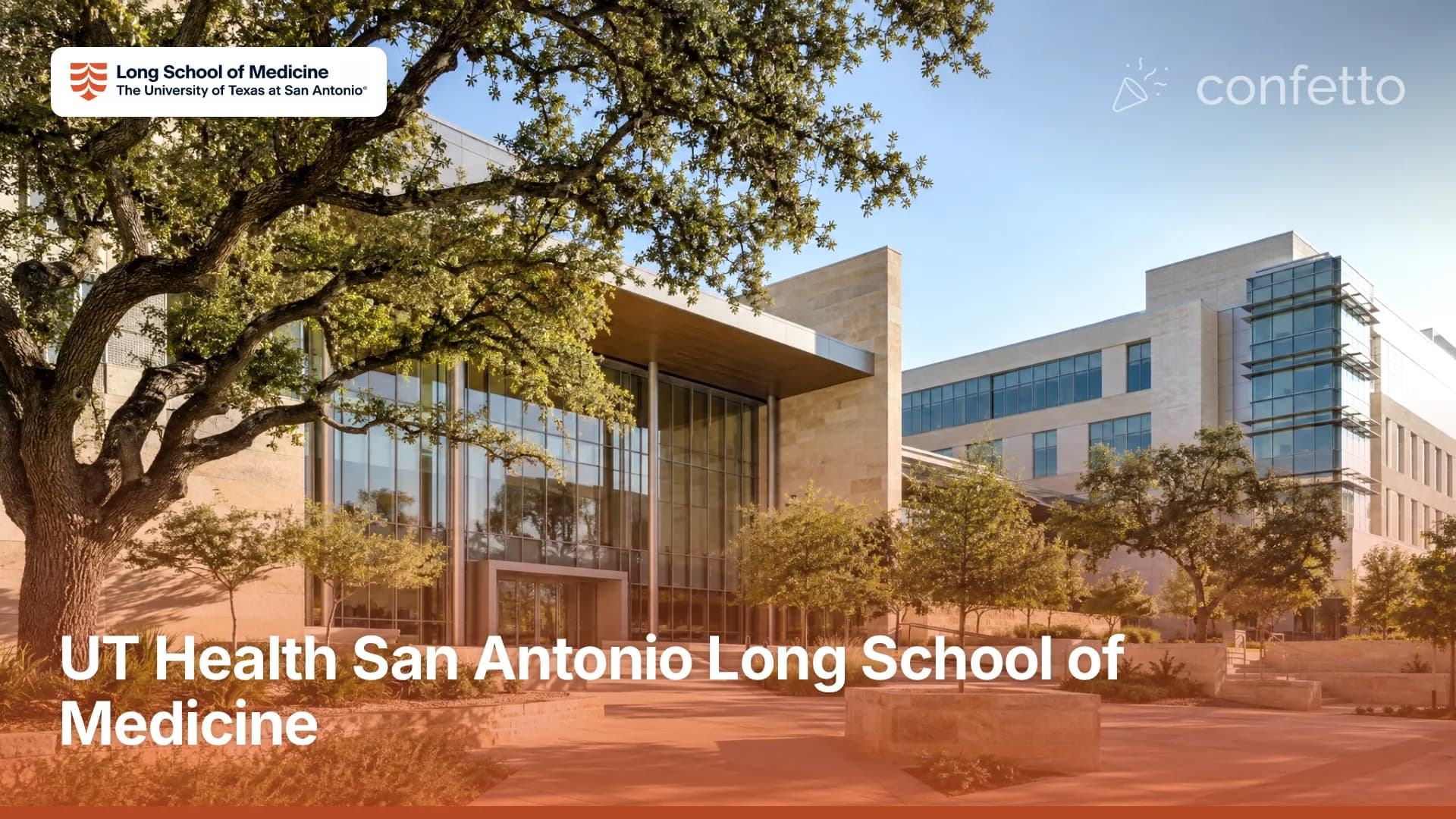
Key facts (2026-27)
About 1,000 applicants interview on Zoom on Fridays with one faculty member and one medical student. There is no secondary, but Casper and a one-way video are required.
- Format
- Two one-on-one interviews: faculty and student
- Where
- Virtual (Zoom)
- Platform
- Zoom
- Stations
- 2 interviews: a faculty committee member and a medical student
- Length
- About 30 minutes each, day runs 8:45 AM to 12:30 PM Central
- Also required
- Casper (required by your interview date), Standard One-Way Video Interview (everyone invited)
Dates for 2026-27
From July 2026
Interview invitations
Fridays, July 31 to December 18, 2026
Interviews
Checked October 2026 against UT Health San Antonio Long SOM: Interview process and AAMC MSAR 2027 interview report. Confirm details in your invitation.
Succeeding in your interview at the University of Texas Medical School at San Antonio requires more than clinical knowledge. The Long School of Medicine expects you to understand South Texas’s healthcare realities, from border health and cultural humility to resource scarcity and policy tradeoffs.
Applicants who can connect clinical reasoning to local context stand out.
This guide translates that context into preparation you can use. You’ll learn how UT Health’s interview works, what the school values, the policy landscape shaping care, current issues in San Antonio, and the kinds of questions you’re likely to field.
Use it to deepen your answers and show you’re ready to serve this community.
The University of Texas Medical School at San Antonio Interview: Format and Experience
The Joe R. and Teresa Lozano Long School of Medicine at UT Health San Antonio uses a traditional interview format, not an MMI. According to the school’s Interview Process page, interviews are held on Zoom on Fridays, and the day begins at 8:45 AM and ends at 12:30 PM Central.
One faculty committee member and one medical student interview you, and you also have plenty of time to interact with current students.
Format highlights:
- Invitation: Roughly 1,000 applicants are selected for interview each cycle. A completed application and an MCAT score are required before an invitation is sent, and the school has no secondary application.
- Casper and one-way video: Casper is not used in screening decisions, but it is required no later than your interview date. Everyone invited to interview must also complete the Standard One-Way Video Interview.
- Interview day: Besides the two interviews, the day covers the school’s community, curriculum, student support and residency match results.
Casper and PREview
Casper test dates and requirements vary by school. For the full 2026-27 list of MD and DO schools that use it, with last test dates and deadlines, see which medical schools require Casper.
For the format, scoring and practice scenarios, see our Casper test guide.
UT Health San Antonio's page names Casper, while the AAMC lists the school as accepting PREview to satisfy a situational judgment test requirement. Confirm with the school, and see Casper vs AAMC PREview for the difference between the tests.
What to prepare
The school does not publish its interview questions, so prepare for a conversational interview about your motivation, experiences and ability to connect with patients. Prepare to explain your interest in serving South Texas communities with specific examples from your own life.
The practice prompts below are ours, not the school’s.
Insider Tip: Take a deliberate breath before answering to avoid knee-jerk responses during high-stakes questions.
Mission & Culture Fit
Mission fit at UT Health San Antonio begins with community commitment. A strong fit answer shows you understand the skills required to serve South Texas: working across language barriers, navigating social determinants of health, and applying culturally responsive care.
Showing respect for patients’ cultural beliefs while guiding them toward evidence-based care is a strong way to show you understand the community.
Check the Long School of Medicine’s website for its current programs and community partnerships, and cite only those you can speak to accurately.
Fit your story to those priorities. Show that you can operate in low-resource settings, communicate across cultures and languages, and think in terms of systems, policy, public health, and the lived environment.
Local Healthcare Landscape & Policy Signals
Understanding Texas’s policy landscape will help you frame solutions that are feasible and grounded.
Texas’s policy landscape shapes care in South Texas: the state has not expanded Medicaid, has one of the highest uninsured rates in the nation, and has long-standing gaps in mental health and rural access. Telehealth is a common tool for extending care to rural areas.
On addiction, Texas is receiving funds from national opioid settlements, and harm reduction approaches remain politically contentious.
Key policy signals and statistics:
- Coverage: Texas has not expanded Medicaid and has among the highest uninsured rates in the U.S.
- Mental health: Texas faces significant gaps in funding and capacity, including for people in the criminal justice system.
- Opioids: Texas is receiving national opioid settlement funds; harm reduction is politically contentious.
When you cite these, pair numbers with concrete interventions and acknowledge political constraints. That balance shows you’re ready for the complexity of Texas medicine.
Current Events & Social Issues to Watch
San Antonio sits at the crossroads of border health, environmental exposure, chronic disease, and carceral medicine. That intersection produces the kinds of questions worth thinking through before interview day.
Border health and chronic disease
Border and infectious disease awareness is relevant in South Texas. Be ready to explain how you would communicate risk and prevention clearly to multilingual populations.
Chronic disease burdens are high and culturally patterned. Diabetes is a major health concern in South Texas.
Practice how you would improve adherence when beliefs intersect with outcomes, such as with a patient who says, “God decides if I lose my foot.” A strong answer shows respect for autonomy paired with motivational interviewing and practical supports.
Environment, incarceration and sexual health
Environmental health disparities are also relevant to urban health in San Antonio.
Mental health intersects with incarceration. Jails often house many people with serious mental illness.
Practice balancing safety, dignity, access, and continuity of care across jail, hospital, and community settings.
Sexual health and infectious disease inequities also demand attention. As with other issues, specific, actionable strategies tied to local partners and resources make for stronger answers.
Practice questions for the UT Health San Antonio interview (written by us)
The Long School of Medicine does not publish its interview questions. We wrote these for its conversational faculty and student interviews.
- Why the Long School of Medicine, and what draws you to train and serve in South Texas?Practice this question now
- Describe a time you advocated for someone vulnerable. How does that relate to serving South Texas?Practice this question now
- Tell us about a time you cared for or worked with someone whose beliefs about health were different from yours. What did you do?Practice this question now
- Tell us about a time you had to communicate across a language barrier. What did you learn?Practice this question now
- Texas has one of the highest uninsured rates in the country. How does that shape the kind of physician you want to be?Practice this question now
- What would a medical student interviewing you learn about you that isn't in your application?Practice this question now
- Walk us through a setback in your path to medicine and how you responded.Practice this question now
- A patient with diabetes tells you, “God decides if I lose my foot.” How would you talk with him about his care?Practice this question now
- Some South Texas colonias lack running water or sewer service. Design a prevention program.Practice this question now
- A VA patient refuses care from your female resident. Handle this.Practice this question now
- How should the health system handle emergency dialysis for undocumented immigrants? Defend or critique.Practice this question now
- Describe how you would approach a rising infectious disease trend in an underserved community.Practice this question now
Preparation Checklist
Use this focused plan to turn context into confident performance, leveraging Confetto’s strengths.
- Mock interviews. Run AI-powered mock interviews that simulate cultural-bridge scenarios (such as a patient who prefers a folk remedy), then review transcripts with Confetto’s feedback to refine structure and tone.
- Ethical scenarios. Practice ethical scenarios, resource allocation, triage under high uninsured rates, using Confetto’s scenario engine to test multiple ethical frameworks and compare outcomes.
- Policy answers. Rehearse policy-anchored answers on telehealth mandates, mental health funding, and opioid settlement tradeoffs; Confetto’s analytics will flag where your answers need more specific examples.
- Trauma-informed communication. Build trauma-informed communication skills with Confetto’s SP-style prompts on high ACE-score communities, refusal-of-care dynamics, and motivational interviewing for chronic disease adherence.
- Mission tie-ins. Use Confetto’s reflection prompts to craft concise tie-ins to the Long School’s programs that you have verified on its website, without sounding rehearsed.
FAQ
How is the UT Health San Antonio interview structured?
It is a traditional virtual interview, not an MMI. Per the school’s Interview Process page, one faculty committee member and one medical student interview you over Zoom, and the interview day runs from 8:45 AM to 12:30 PM Central. Applicants also complete Casper and a one-way video interview.
Do I need to speak Spanish to succeed?
Fluency is not typically listed as a requirement, but Spanish skills are valuable in San Antonio. Demonstrate respect, clear nonverbal communication, use of interpreters, and any functional Spanish you have. The key is safe, patient-centered care across language barriers, not perfect grammar.
What ethical dilemmas are common in this interview?
Prepare for dilemmas around scarcity (caring for patients with limited insurance), cultural beliefs about care (including folk medicine traditions), and public health priorities. You may also face scenarios tied to mental health and harm-reduction responses to fentanyl.
How should I incorporate Texas health policy into my answers?
Anchor your points with locally relevant facts and programs. Examples include Texas’s decision not to expand Medicaid, gaps in mental health capacity, and opioid settlement spending. Tie proposed solutions to initiatives and experiences you can speak to accurately.
Key Takeaways
- Local challenges. Strong answers connect to real South Texas challenges: bilingual communication, cultural humility, ethics, and public health responsiveness.
- Context. Know the context: high uninsured rates in Texas, border and infectious disease awareness, and trauma-informed care.
- Policy. Policy fluency matters: Medicaid non-expansion, telehealth, mental health capacity, and opioid settlement spending.
- Mission fit. Ground your answers in programs you have verified on the school’s website to show mission fit.
- Composure. Take a moment to breathe and deliver measured, empathetic answers under pressure.
Call to Action
Ready to turn this San Antonio-specific insight into standout performance? Train with Confetto’s AI-powered mock interviews, scenario drills, and analytics to practice bilingual communication, scarcity ethics, and policy-aware answers tailored to the Long School of Medicine.
Build the muscle memory now, so you can lead with clarity and community impact on interview day.
Applying to other Texas schools too? See our guide to the Texas Tech University Health Sciences Center School of Medicine interview.
Applying to other Texas schools too? See our guide to the University of Texas Rio Grande Valley School of Medicine interview, which starts with an in-person group interview.