
Updated · 5 min read
Preparing for the University of Toledo College of Medicine interview
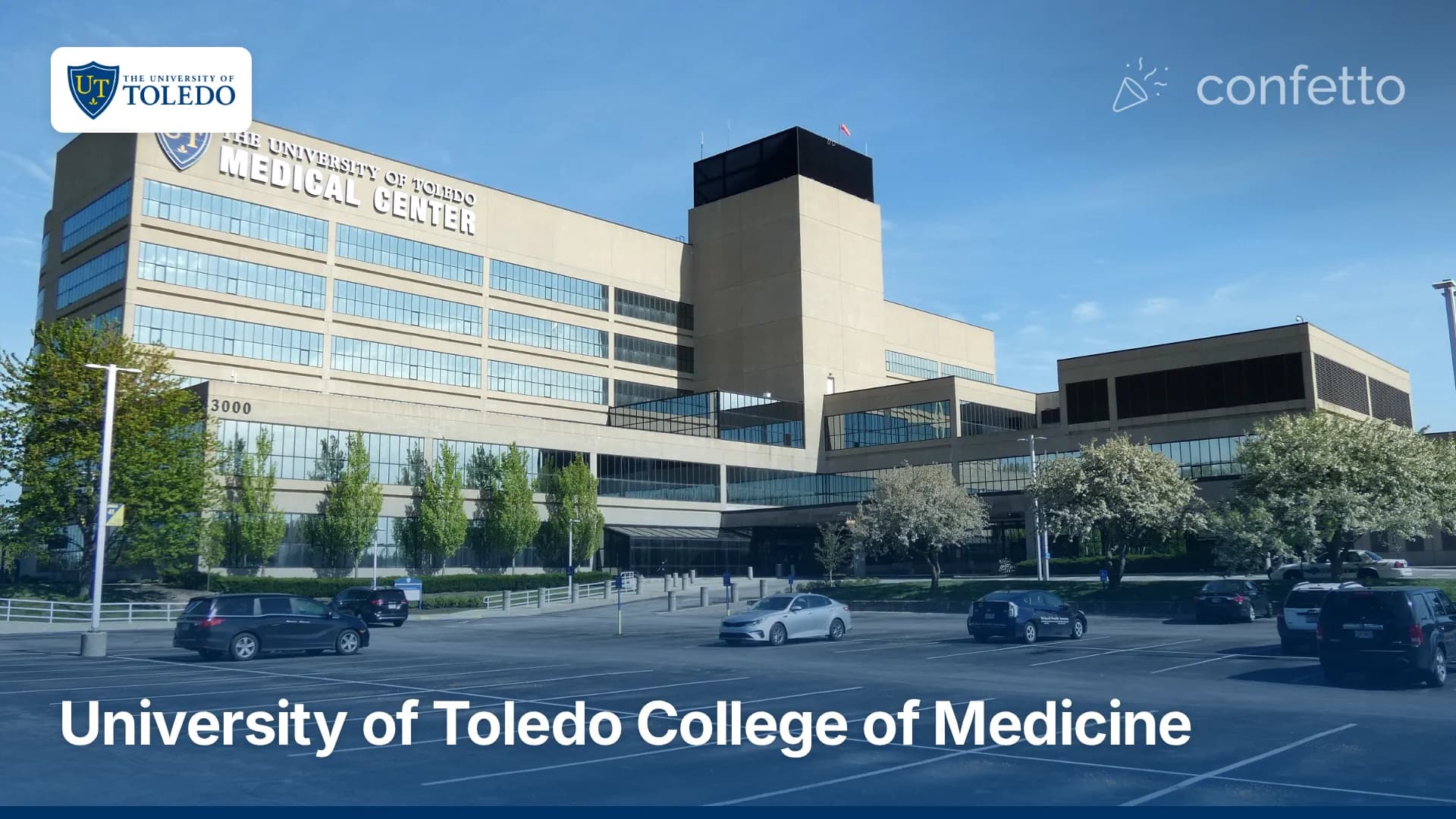
Key facts (2026-27)
Every 2026-27 interview is a live, virtual MMI held from September through April, and interview day includes a 2-hour MMI session.
- Format
- Virtual MMI, live on interview day
- Where
- Virtual
- Length
- 2-hour MMI session, plus a format presentation
Dates for 2026-27
From July 30, 2026 (MSAR)
Interview invitations
September to April
Interviews
Checked October 2026 against UToledo MD: Updates for applicants (2026-27), UToledo MD: Application process and AAMC MSAR 2027 interview report. Confirm details in your invitation.
Every 2026-27 interview at the University of Toledo College of Medicine and Life Sciences is a live, virtual Multiple Mini Interview (MMI), held from September through April. Interview day includes a presentation on the format and a 2-hour MMI session with eight interviewees.
The MSAR lists interview invitations from July 30, 2026. UToledo doesn't publish its station count, so check your invitation for the platform and details.
To get used to a long session of back-to-back stations, Confetto, an AI mock interviewer for medical school and other healthcare program interviews (MMI, traditional, panel), lets you run a full MMI circuit with rubric-based feedback on every station.
The UToledo MMI: format and experience
UTCOM, now called the College of Medicine and Life Sciences, says on its application process page that it uses the MMI. The AAMC MSAR entry, supplied by the school, adds that all interviews will be synchronous, virtual MMIs, and that interviewers include faculty, senior staff, residents, community members and medical students.
Expect scenario stations that probe how you think, communicate, and work with others in real time.
What the stations cover
- Stations. Scenarios testing teamwork, cultural competence, ethics, and problem-solving. Practice prompts (ours, not confirmed UTCOM questions): “Design a mobile clinic for a community affected by opioid addiction.” “How would you respond if a patient refused care from a resident because of a difference in faith?”
- Themes worth preparing. (our suggestions, not a published list): community-driven care, health equity, and adaptability in resource-limited settings.
- Plain words. Because community members interview too, practice explaining medical ideas in plain words.
Clear thinking under pressure, cultural humility, and a concrete grasp of regional needs go a long way. Read UTCOM’s curriculum on its website and be ready to explain how it fits your goals.
Mission and culture fit
Read UTCOM’s mission statement on its website and decide which parts genuinely fit you. Community-driven care, long-term relationships with patients, and solving problems together across clinical settings are all worth reflecting on.
UTCOM trains students in Toledo and Northwest Ohio, so be ready to discuss health equity and service in under-resourced settings.
Experiences to highlight
Highlight experiences that show continuity of care, sustained advocacy, and readiness to work in resource-limited places with humility and creativity. If you have worked in rural medicine, behavioral health, lead mitigation, maternal health equity, or food access, connect it to what’s happening in Toledo and Northwest Ohio.
Ohio and Toledo health context
Knowing Ohio’s policy direction and Toledo’s local challenges helps you speak concretely about where you could contribute. Use current figures from official sources if you cite numbers.
Issues to know
- Medicaid and access. Ohio has expanded Medicaid, but Lucas County still has uninsured and underinsured residents. Community health centers in Toledo serve low-income patients. Behavioral health workforce shortages are a statewide issue, and telehealth and ECHO-style models connect rural providers with specialists.
- Water and lead. Toledo has faced a toxic algae water crisis from Lake Erie, and childhood lead exposure from aging housing remains a concern in Lucas County. Local health departments and community partners lead lead-abatement and healthy housing efforts, and lead pipe replacement is a funded state and federal priority.
- Maternal health. Black women in Ohio face much higher rates of pregnancy-related death than white women. Be ready to discuss community supports such as donor milk, doulas, and home visiting.
- School mental health. Student needs are high, and training teachers in crisis response and mental health first aid is one approach.
- Food access. Parts of Toledo have limited access to fresh food, and urban farms and food-as-medicine programs are potential partners.
- Abortion access. Ohio voters added abortion rights to the state constitution, and legal and access questions continue.
- Immigrant health. Ohio has growing immigrant and refugee communities, including Ukrainian and Somali populations.
Move beyond headlines. Tie each issue to a real training setting (community health centers, school programs, refugee clinics) and describe how you would work in a team to improve access and quality.
Practice questions for the UToledo MMI (written by us, not UTCOM)
These are our own MMI-style prompts built on Toledo and Northwest Ohio themes. UTCOM doesn't publish its stations.
- A mother at a Toledo clinic says her toddler's blood test showed lead, and she can't afford to move out of her rental. What do you say to her, and who else would you involve?Practice this question now
- A patient blames their lung cancer on local air quality. How do you respond?Practice this question now
- A patient tells you she has been stretching her insulin since the only pharmacy near her home in central Toledo closed. How do you respond, and what would you look into?Practice this question now
- How would you improve access to diabetes care in a high-need Toledo neighborhood?Practice this question now
- A Somali patient brings her teenage son to translate during a visit about a sensitive diagnosis. No interpreter is free for an hour. What do you do?Practice this question now
- In 2014, Toledo residents were told not to drink tap water for days because of an algae toxin in Lake Erie. You work at a clinic that week. What are your first three priorities?Practice this question now
- Ohio faces shortages of mental health providers. Propose a medical school curriculum change to address this.Practice this question now
- A resident on your team jokes about a patient with opioid use disorder who came back for the third time this month. How do you respond?Practice this question now
- UTCOM's interviewers include community members. How would you explain to one of them, in plain words, why a one-day blood pressure screening isn't enough without follow-up care?Practice this question now
- Describe a time you advocated for an underserved population. How does this align with UTCOM’s mission?Practice this question now
- Should medical schools prioritize local applicants? Why or why not?Practice this question now
Use these as prompts to build structured, evidence-aware answers that blend systems thinking with empathy and practicality.
Preparation checklist
- Mock circuits. Run mock MMI circuits that include ethics, rural health, and cultural competence scenarios.
- Scenario drills. Drill scenarios on opioid use disorder, lead exposure, maternal health equity, and school mental health, including follow-up questions that test depth.
- Timing. Time yourself so each station answer has a clear structure and ending.
- School notes. Write short notes on UTCOM programs you have verified, and practice mentioning them without sounding scripted.
FAQ
Does UTCOM use MMI or traditional interviews?
MMI. For 2026-27, UToledo says all interviews are synchronous, virtual MMIs, held from September through April. It doesn't publish the number of stations.
When do interview invitations go out?
The MSAR lists invitations from July 30, 2026.
What themes should I prepare?
Community-driven care, health equity, and adaptability in resource-limited settings are sensible. UTCOM does not publish a theme list, so read its mission pages.
Does UTCOM prioritize local applicants?
Check UTCOM’s admission criteria page for any residency preference. Either way, real engagement with Toledo and Ohio communities strengthens your fit.
Also applying to schools in southeast Michigan? See our guide to the Oakland University William Beaumont School of Medicine interview.