
Updated · Published
Average GPA for Dental School: Overall and Science GPA
See the average overall and science GPA for dental school, benchmarks by school tier, GPA data for select U.S. schools, and how to compete with a lower GPA.

So, what’s the magic number? The short answer is that the average GPA for getting into dental school is around a 3.7 for your overall GPA and a 3.6 for your science GPA. Those are the 2025 figures for students who actually enrolled (3.68 overall, 3.60 science), from the American Dental Education Association's report on the 2025 entering class. Applicants as a whole averaged 3.53 overall and 3.42 in science.
Dental school GPA at a glance (ADEA, 2025 entering class):
- Enrollees: 3.68 overall GPA, 3.60 science GPA.
- Applicants: 3.53 overall GPA, 3.42 science GPA.
- 13,657 applicants and 7,073 first-time, first-year enrollees across U.S. dental schools, about 52%.
- Enrollees averaged 20.9 on the DAT Academic Average (old 1 to 30 scale).
- About 2% of enrollees had a total GPA below 3.00.
Source: ADEA, U.S. Dental School Applicants and Enrollees, 2025 Entering Class.
Your GPA gets you an interview invitation, and then the interview counts too. When invitations arrive, Confetto, an AI mock interviewer for medical school and other healthcare program interviews (MMI, traditional, panel), lets you practice dental school interviews out loud and get feedback on each answer. You can also read our dental school interview questions.
But let's be real—"average" can be a misleading word. While these numbers give you a solid benchmark, the competitive landscape shifts quite a bit depending on a school's reputation and ranking.
Can you get into dental school with a 3.0 GPA?
Yes, but it is below average, so the rest of your application has to carry more weight. In ADEA's 2025 entering class, 5.2% of first-year dental students had a total GPA of 3.00 to 3.24, and about 2% were below 3.00. Put against the head counts, roughly 1 in 4 applicants in the 3.00 to 3.24 band enrolled, compared with about 1 in 2 applicants overall.
A strong DAT, an upward grade trend, recent upper-level science courses or a post-bacc, and real clinical hours are what offset a 3.0. Our guide to getting into dental school with a 3.0 GPA has a full plan and a school list.
Understanding the GPA Benchmarks for Dental School
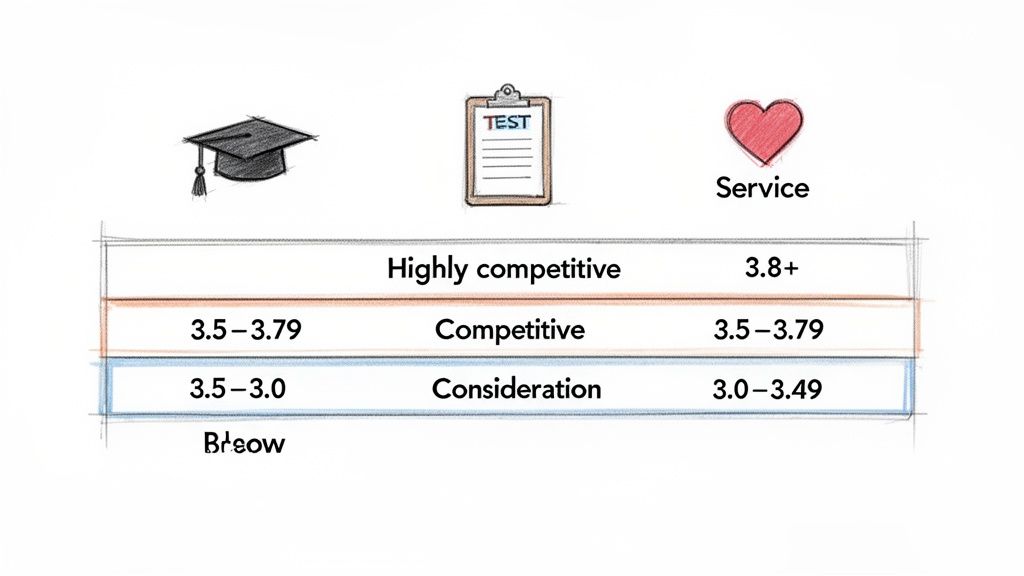
When you start pulling your dental school application together, your Grade Point Average (GPA) is one of the first things an admissions committee will notice. Think of it as the first handshake—it offers a quick summary of your academic work ethic and your ability to handle the tough, science-heavy curriculum ahead. It’s the foundation for the rest of your application.
Admissions committees don't just look at one number, though. They consider both your cumulative GPA, which is the big-picture view of your entire undergraduate career, and your science GPA (often called the BCP GPA for Biology, Chemistry, Physics), which zeroes in on your performance in the core prerequisite courses. Nailing both tells a powerful story of consistency and readiness.
What Is a Competitive GPA for Dental School?
Competitiveness is a spectrum, not a single point. There’s no secret GPA that guarantees an acceptance letter, but data from recent application cycles paints a pretty clear picture.
School by school, the average overall GPA of an entering class runs from about 3.6 to 3.9 in the class profiles listed below, and science GPAs from about 3.5 to 3.9. Individual students range much wider: UCSF's Class of 2029, for example, averaged a 3.78 overall but its overall GPAs went as low as 3.11. For a closer look at these numbers, you can learn about the minimum requirements for different dental schools.
What this wide range really tells you is that while the applicants at top-tier programs often have near-perfect grades, there's absolutely a path forward for students with more moderate academic records. It just means the other parts of your application need to shine that much brighter.
Key Takeaway: Your GPA is more than just a number; it’s the story of your academic journey. A high GPA sends a clear signal that you can thrive in a demanding program, but the first step is knowing exactly where you stand in the applicant pool.
To give you a clearer idea of where you might fit, let's break down the numbers into practical competitiveness tiers. This framework gives you a realistic snapshot of how an admissions committee might see your academic profile.
Dental School GPA Benchmarks at a Glance
This table offers a quick reference to help you gauge how competitive your academic profile is. Use it to understand where you land and what you should be aiming for.
| Competitiveness Tier | Target Overall GPA | Target Science GPA |
|---|---|---|
| Highly Competitive | 3.80+ | 3.70+ |
| Competitive | 3.60 - 3.79 | 3.50 - 3.69 |
| Solid Candidate | 3.40 - 3.59 | 3.30 - 3.49 |
| Minimum Consideration | 3.20 - 3.39 | 3.10 - 3.29 |
These tiers are our own rule of thumb, not ADEA categories. Remember, this is a general guide. A GPA in the "Solid Candidate" or "Minimum Consideration" tier doesn't close any doors, but it does mean you'll need a standout DAT score, compelling experiences, and a fantastic personal statement to balance the scales.
Why Science and Cumulative GPAs Both Matter
When a dental school admissions committee pulls up your transcript, they don't just glance at one final number. They’re looking at your academic story through two different lenses: your cumulative GPA (cGPA) and your science GPA (sGPA). Getting a handle on what each one communicates is the first step to seeing your application the way they do.
Think of your cGPA as the wide-angle shot of your entire college career. It captures everything you took for credit, from that art history elective to your senior seminar. This number offers a broad look at your consistency, your work ethic, and your ability to juggle a diverse academic load over four years. A solid cGPA tells them you're a dedicated, well-rounded student, period.
Your sGPA, on the other hand, is the zoom lens. It zeroes in on your performance in the very science courses that form the foundation of dental medicine. This number gets a ton of scrutiny because it’s seen as the single best predictor of whether you can handle the demanding, fast-paced science curriculum you’ll face from day one of dental school.
Calculating Your Science GPA
You’ll often hear the sGPA called the BCPM GPA. That’s just an acronym for Biology, Chemistry, Physics, and Math. When you fill out your AADSAS application, the American Dental Education Association (ADEA) has specific guidelines for which courses get bundled into this crucial calculation.
So, what exactly counts toward your BCPM?
- Biology: This includes general biology, microbiology, anatomy, physiology, and genetics.
- Chemistry: Prospective dental students must excel in core science subjects. A strong performance in areas like organic and inorganic chemistry courses forms a significant part of the challenging pre-dental curriculum.
- Physics: Every physics course you’ve taken makes the cut.
- Math: Courses like calculus and statistics are standard. Depending on the department it was offered in, even some computer science courses might count.
This focused GPA gives the admissions committee a clear signal: do you have the specific scientific horsepower to succeed in courses like biochemistry, pharmacology, and oral pathology?
A high science GPA sends a powerful message: you have mastered the core concepts necessary to build a successful career in dentistry. It proves you’re not just a good student, but a capable future clinician.
Ultimately, both GPAs tell a critical part of your academic story. Your cGPA speaks to your overall discipline and intellectual curiosity. Your sGPA confirms you have the specialized knowledge to not just survive, but thrive in dental school. A truly compelling application shows strength in both, painting a complete picture of a candidate who is both academically versatile and scientifically ready. An applicant rocking a 3.7 overall GPA alongside a 3.6 science GPA is presenting exactly that kind of balanced, impressive profile.
How Different Dental Schools Weigh Your GPA
Let’s be clear: not all dental schools look at your GPA through the same lens. An applicant with a 3.6 overall GPA might be a superstar at one institution and just another face in the crowd at another. The expectations for the average GPA for dental school shift dramatically based on a program's prestige, research focus, and whether it's public or private.
Think of it like this: your GPA is your entry ticket to the dental school "stadium." While a certain GPA gets you in the door, the most competitive schools have exclusive VIP sections where only the highest academic performers get a seat. This is why understanding the different tiers of dental programs becomes a critical part of your application strategy.
The Ivy League and Top-Tier Private Schools
At the highest echelons of dental education, the academic bar is set incredibly high. These are the programs where nearly every applicant has stellar grades, exceptional DAT scores, and extensive research or leadership experience. For these schools, a high GPA isn't just a goal; it's the baseline expectation.
Elite U.S. dental schools often report entering-class averages around 3.8 to 3.9. For example, Penn Dental Medicine's Class of 2030 averaged a 3.88 overall GPA and UCLA's Class of 2029 a 3.87, while Columbia's recent classes have entered with overall and science GPAs in a range from about 3.7 to 3.9. This reflects an intensely competitive environment where only the top applicants thrive.
Competitive State Universities and Other Private Schools
Moving to the next tier, which includes many excellent state schools and other respected private institutions, the numbers become slightly more attainable but remain very competitive. These programs still seek high academic achievers but may place more emphasis on a holistic review, weighing factors like state residency, unique life experiences, or a strong commitment to service more heavily.
For these schools, a competitive profile often includes:
- Overall GPA: Entering-class averages are often in the 3.6 to 3.8 range (for example, ECU's Class of 2029 averaged 3.62 and the University of Iowa's 2026 entering class 3.81).
- Science GPA: Averages are usually a little lower than the overall figure, around 3.5 to 3.75 in the same profiles.
- State Residency: Public universities almost always have a strong preference for in-state applicants, which can be a huge advantage.
This infographic shows the simple but crucial distinction between the two GPA types admissions committees evaluate.
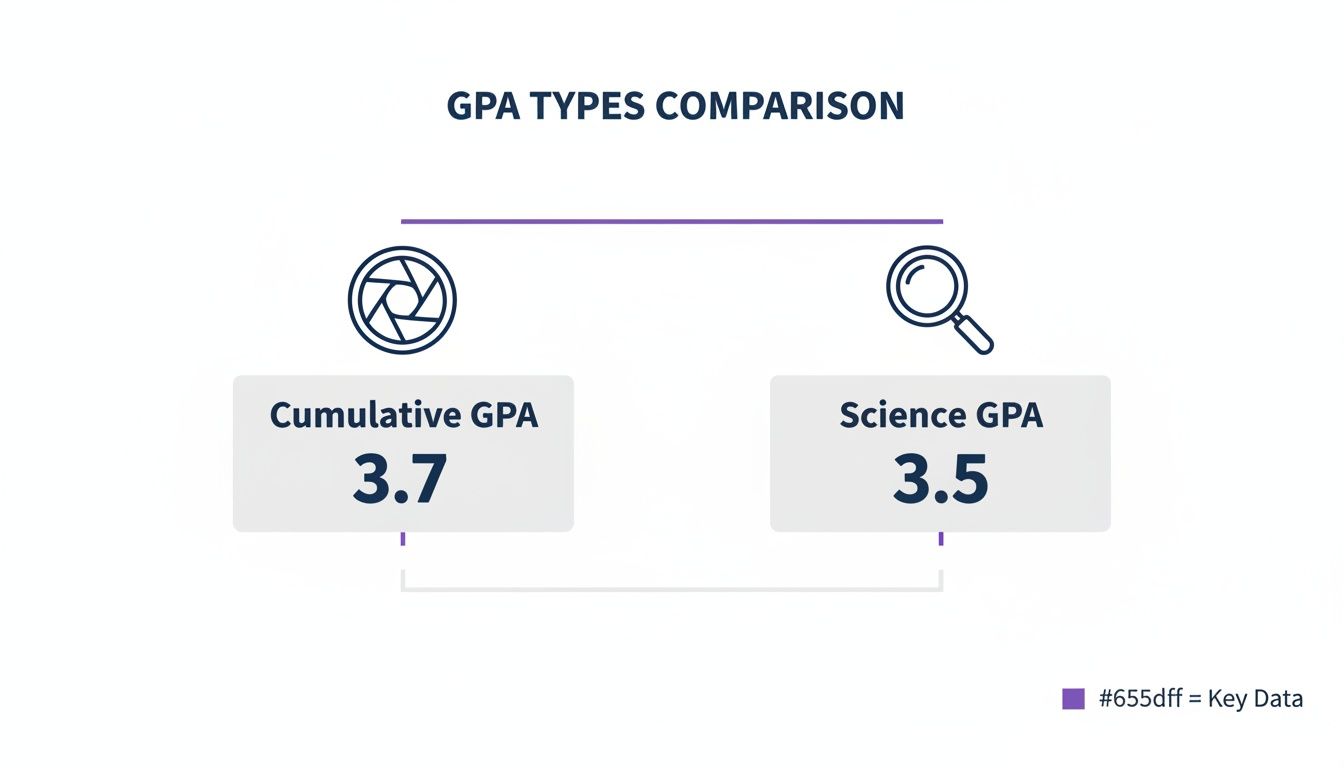
Your cumulative GPA provides the broad overview of your academic career, while your science GPA offers a focused look at your readiness for the core curriculum. A strong performance in both is the ideal.
To give you a clearer picture, here’s a snapshot of class profiles from several dental schools. Each figure comes from the school's own class profile page; schools publish different class years and use different DAT scales, so the class and DAT figures are shown as each school reports them. Profiles change every year, so check the school's page for the latest numbers.
GPA & Admissions Data for Select U.S. Dental Schools
| Dental School | Class | Average Overall GPA | Average Science GPA | DAT Academic Average, as reported |
|---|---|---|---|---|
| University of Florida College of Dentistry | 2026 entering class | 3.91 | 3.87 | 470 (23) |
| Penn Dental Medicine | Class of 2030 | 3.88 | 3.85 | 483.85 |
| UCLA School of Dentistry | Class of 2029 | 3.87 | 3.85 | 23 |
| University of Iowa College of Dentistry | 2026 entering DDS class | 3.81 | 3.75 | 455 |
| UCSF School of Dentistry | Class of 2029 | 3.78 | 3.72 | 23.1 |
| ECU School of Dental Medicine | Class of 2029 | 3.62 | 3.52 | 21.06 (440) |
As you can see, the numbers vary quite a bit. Three-digit DAT scores are on the newer 200 to 600 scale. The key is to build a balanced school list.
Applying to a mix of "reach," "target," and "safer" schools based on their published GPA averages gives you the best chance of finding a program that's the right fit for your academic profile.
Ultimately, your GPA is a starting point for a conversation. It tells one part of your story, but it’s not the whole book. By understanding how different schools interpret this number, you can strategically build an application that maximizes your chances of success. Explore our guides to learn more about navigating every step of the dental school application process.
The Story Your GPA Trend Tells Admissions
Admissions committees don't just look at your final GPA; they read your transcript like a story. That final number is the headline, but the semester-by-semester trend reveals the plot. This narrative—your academic journey—can be just as powerful as the final number itself, offering a glimpse into your resilience, maturity, and readiness for the grind of dental school.
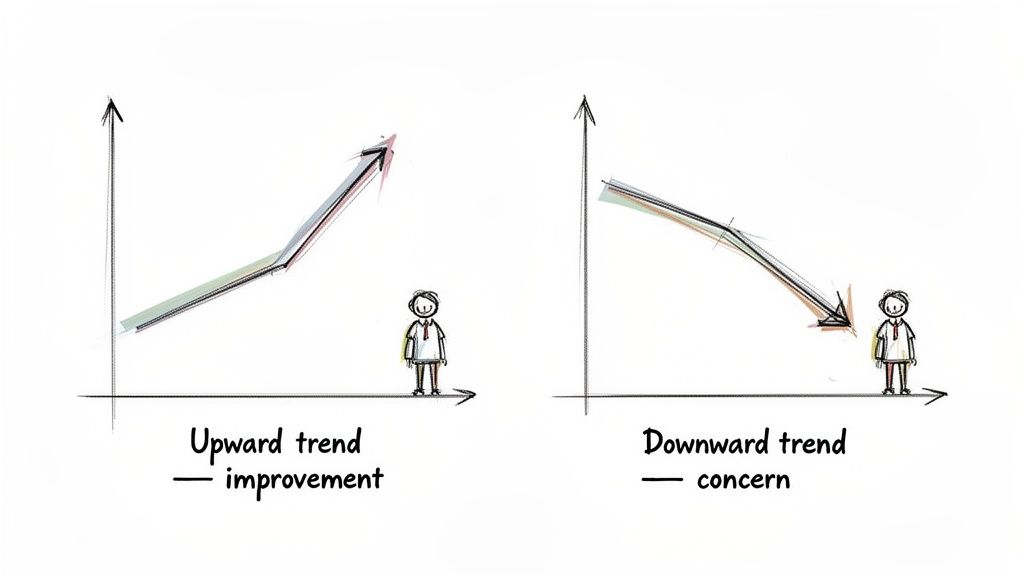
Think of your transcript as a growth chart. An upward trend, where your grades steadily improve from freshman to senior year, tells a compelling story. It says you figured out how to study, you adapted to the rigors of college, and you built momentum right as you were hitting the toughest science courses. If your overall GPA is solid but not stellar, this kind of trajectory can be a massive asset.
An upward trend proves you finish strong. It shows an admissions committee that you don't just face challenges—you rise to meet them. It's the kind of narrative that can absolutely save an application that started with a rocky freshman or sophomore year.
The Impact of Your GPA Trajectory
On the flip side, a downward trend can be a major red flag. If you aced your introductory courses but your grades slipped in upper-level biology and chemistry, it signals that you might struggle with the very science that forms the foundation of a dental education. It’s a story that absolutely requires a good explanation in your application.
Let’s look at two applicants who both have a 3.5 cumulative GPA:
- Applicant A (Upward Trend): Kicked off freshman year with a 3.2 GPA but powered through to a 3.9 in their senior year, crushing advanced science classes. This screams grit and mastery.
- Applicant B (Downward Trend): Started college with a 3.9 GPA but ended senior year with a 3.2, struggling through those upper-division sciences. This raises serious questions about their ability to handle the dental curriculum.
Even with identical GPAs, Applicant A’s story is way more convincing. Their trend shows a growing capacity for academic excellence and a clear readiness for whatever comes next.
As the bar for admissions gets higher every year, this narrative matters even more. Just look at the national data: ADEA reports that enrollees averaged a 3.55 overall GPA in 2015 and a 3.68 in 2025. If you want to prove you belong in that increasingly competitive group, a strong, positive trend is one of your best tools.
Looking Beyond the Numbers with Holistic Review
If your GPA is giving you heartburn, take a deep breath. Yes, the average GPA for dental school is a major metric, but it’s just one chapter of your application story—not the whole book. Admissions committees use a process called holistic review, which means they’re committed to seeing the entire person behind the numbers.
Think of your application like a mosaic. Your GPA might be a large, central tile, but it’s surrounded by dozens of other pieces that create the complete picture of who you are. A GPA that isn't quite perfect can absolutely be balanced out by showing exceptional strength in other areas. The goal is to build such a compelling overall profile that your grades are seen in the context of your broader capabilities and character.
Building Your Holistic Profile
This is where the other pieces of your application get their chance to shine, each telling a different part of your story. A strong performance in these areas can prove you’re ready for the rigors of dental school in ways a transcript alone never could.
These are the key elements that work together to show your true potential:
- A High DAT Score: A stellar Dental Admission Test (DAT) score is one of the most powerful equalizers in this process. It proves you have the academic horsepower to handle the curriculum, directly counterbalancing a lower GPA by showing you’ve mastered the core scientific concepts.
- Meaningful Experiences: Logging extensive shadowing hours, getting hands-on experience as a dental assistant, or dedicating yourself to volunteer work shows real commitment. These experiences tell adcoms that you have a realistic grasp of the profession and a genuine passion for patient care.
- Personal Statement and Storytelling: Your essays are your chance to connect all the dots for the admissions committee. This is where you can provide context for any academic rough patches, highlight your resilience, and showcase the unique perspective you’ll bring to their incoming class.
The holistic review process recognizes that a great future dentist is more than just a good student. They are a compassionate caregiver, a meticulous craftsperson, and a resilient problem-solver. Your experiences are the evidence.
Ultimately, your application is a testament to your entire journey, not just your grades. Showing your personality and drive through interviews is another huge piece of the puzzle. You can get a leg up by understanding the different interview formats, and our guide on how to prepare for MMI interviews is a great place to start. When you build a truly well-rounded application, your unique strengths will shine through, creating a narrative of dedication that resonates far beyond a single number on a transcript.
Actionable Strategies for a Lower GPA
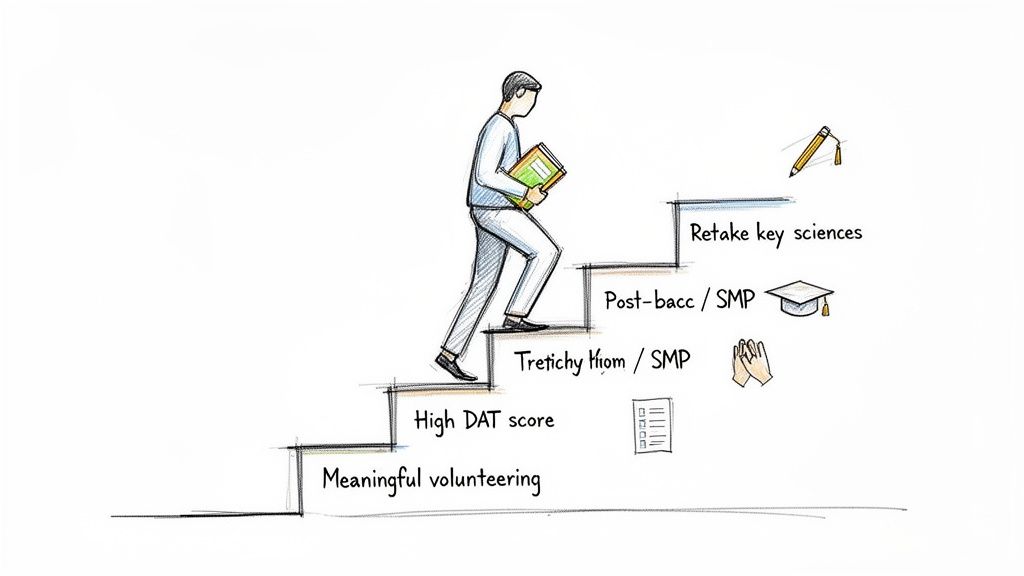
If your GPA feels like the weak link in your application, don’t panic. A number below the average GPA for dental school isn’t a dealbreaker; it’s a signal to get strategic. You have a real opportunity to strengthen your profile and prove your academic abilities through focused, deliberate action.
This is your chance to build a compelling comeback story.
The most direct way to neutralize a lower GPA is to create a new, more impressive academic record. This isn't about erasing the past—it's about showing admissions committees that you can handle a tough science curriculum now. That’s what they really care about.
Build a New Academic Record
Post-baccalaureate programs and Special Master's Programs (SMPs) are designed for exactly this situation. These are typically one- to two-year programs, packed with the kind of graduate-level science courses that mirror the difficulty of dental school itself.
- Post-Baccalaureate Programs: These let you retake prerequisites or tackle new upper-level science classes to give your science GPA a serious boost. Nailing these courses shows you’ve mastered foundational concepts you may have once struggled with.
- Special Master's Programs (SMPs): Often even more rigorous, SMPs immerse you in graduate-level biomedical sciences. A high GPA in an SMP sends an undeniable message: you are more than ready for the dental school curriculum.
An exceptional performance in a post-bacc or SMP essentially creates a new, more relevant GPA for admissions committees to consider. It proves your past academic struggles don't define your future potential.
If you’re heading back to the classroom, it's also a great time to refine your study habits. Exploring practical advice like these 10 tips to turn grades around can make a huge difference.
Leverage Other Application Strengths
Beyond coursework, you need to use the rest of your application to counterbalance your GPA. A well-rounded profile proves you bring much more to the table than just grades.
Your Dental Admission Test (DAT) score is your most powerful tool here. A high score, especially in the science sections, is direct proof of the academic aptitude your GPA might not fully reflect. It shows you have the core knowledge needed to succeed from day one.
Finally, use your personal statement to frame your journey. Don't make excuses for poor grades. Instead, provide context for any significant challenges you faced and—most importantly—show what you learned from those setbacks.
Owning your story turns a potential weakness into a testament to your resilience and growth. For more advice on crafting a compelling application, check out our other resources.
Once your application earns an interview, our guide to dental school interview questions shows how schools run them.
Your GPA Questions, Answered
Navigating the details of your transcript can feel like a maze, but most pre-dental students run into the same handful of questions. Getting clear on these points is the first step toward building a smart application strategy.
What's the Deal with a "W" on My Transcript?
This is a big one. Does a single Withdrawal, or a "W," sink your application? Rarely. Admissions committees know that life happens. A single "W" with a solid reason behind it is almost never a deal-breaker.
But they do look for patterns. Multiple withdrawals, especially in core science courses, can start to look like a red flag. It might suggest you're struggling with a heavy academic load. If it comes up in an interview, just be ready to explain the circumstances honestly and professionally.
How Do Admissions Committees View Community College Credits?
Another common question is about transfer credits, particularly from community colleges. For your introductory prerequisites, these courses are generally accepted without any trouble at all.
What really matters, though, is what you do after you transfer. The key is to prove you can crush difficult, upper-level science courses at a four-year university. That performance is what truly signals you're ready for the academic rigor of dental school.
Should I Take a Harder Class for a 'B' or an Easier One for an 'A'?
Students often wrestle with this one: is it better to get a 'B' in a tough honors organic chemistry class or an 'A' in the standard version?
In nearly every case, you should go for the 'A'. Your science GPA is a hard, calculated number, and the formula doesn't have a column for "course difficulty." While taking on a challenge is admirable, a 'B' will pull down your sGPA, no matter how tough the class was.
The best strategy? Sign up for the most challenging courses where you are genuinely confident you can earn top marks. This shows admissions committees the perfect combination they're looking for: ambition and academic mastery.
Ace your dental school interview with Confetto, the AI-powered platform that provides instant, actionable feedback. Practice with realistic MMI and panel interview simulations to build the confidence you need to get accepted. Start your free trial at https://confetto.ai today.
Worried about a lower GPA? Read can you get into dental school with a 3.0 GPA for what ADEA data shows and how to explain your numbers in an interview.
Interviewing at a specific dental school? Read our guides to the UCSF, NYU, University of Michigan, UIC, University of Iowa and University of the Pacific Dugoni interviews.