
How to Prepare for MMI Interviews: Proven Strategies to Shine
Discover how to prepare for mmi interviews with a proven framework, practice prompts, and expert tips to stand out in your medical school interview.
Cracking the MMI isn't about memorizing perfect answers. It’s about building a versatile skill set that lets you think on your feet, communicate clearly, and show the person behind the application. A winning strategy means really getting the MMI format, learning to break down any question that comes your way, and putting in the hours with structured, timed practice to build real confidence.
Your Proven Framework for MMI Interview Success
The Multiple Mini Interview (MMI) can feel like the last, most mysterious hurdle before medical school. It’s not a traditional interview where you just recount your experiences. Instead, it’s designed to see how you reason, communicate, and empathize in the moment. That dynamic format trips a lot of people up, but with the right plan, you can make it a huge advantage.
The goal here is to trade that uncertainty for a clear, actionable roadmap. We’ll do that by focusing on five key areas:
- Get the Format: First, you have to know the rules of the game—the timing of each station, the different types of questions, and the core competencies they’re actually testing.
- Deconstruct the Questions: You need a quick method for figuring out the central conflict in any prompt, whether it’s an ethical dilemma, a policy debate, or a surprise role-playing scenario.
- Build Your Communication Strategy: Develop a flexible framework for structuring your answers. It should highlight your critical thinking and empathy without making you sound like a robot reading a script.
- Practice with Structure: Reading prompts isn't enough. You have to engage in timed mock interviews that feel like the real thing. This is where you master your pacing and delivery.
- Execute with Confidence: On interview day, it’s all about managing your nerves and treating each new station as a fresh start and a new opportunity to connect.
Your 4-Week MMI Preparation Timeline
A good schedule is your best friend. It keeps you from getting overwhelmed and ensures you cover all your bases methodically. When you’re prepping for MMI interviews—a staple of medical school admissions—it pays to borrow from the best. Incorporating effective study methods for medical students can make your prep time far more productive. The idea is to build a solid foundation of knowledge before you dive into the deep end with advanced practice.
The biggest mistake applicants make is thinking the MMI is about finding the one "right" answer. It's not. Interviewers want to see your thought process, your ability to weigh different perspectives, and your empathy. They care about the how, not just the what.
A structured timeline, like the one below, keeps your preparation focused and builds momentum as you get closer to the big day.
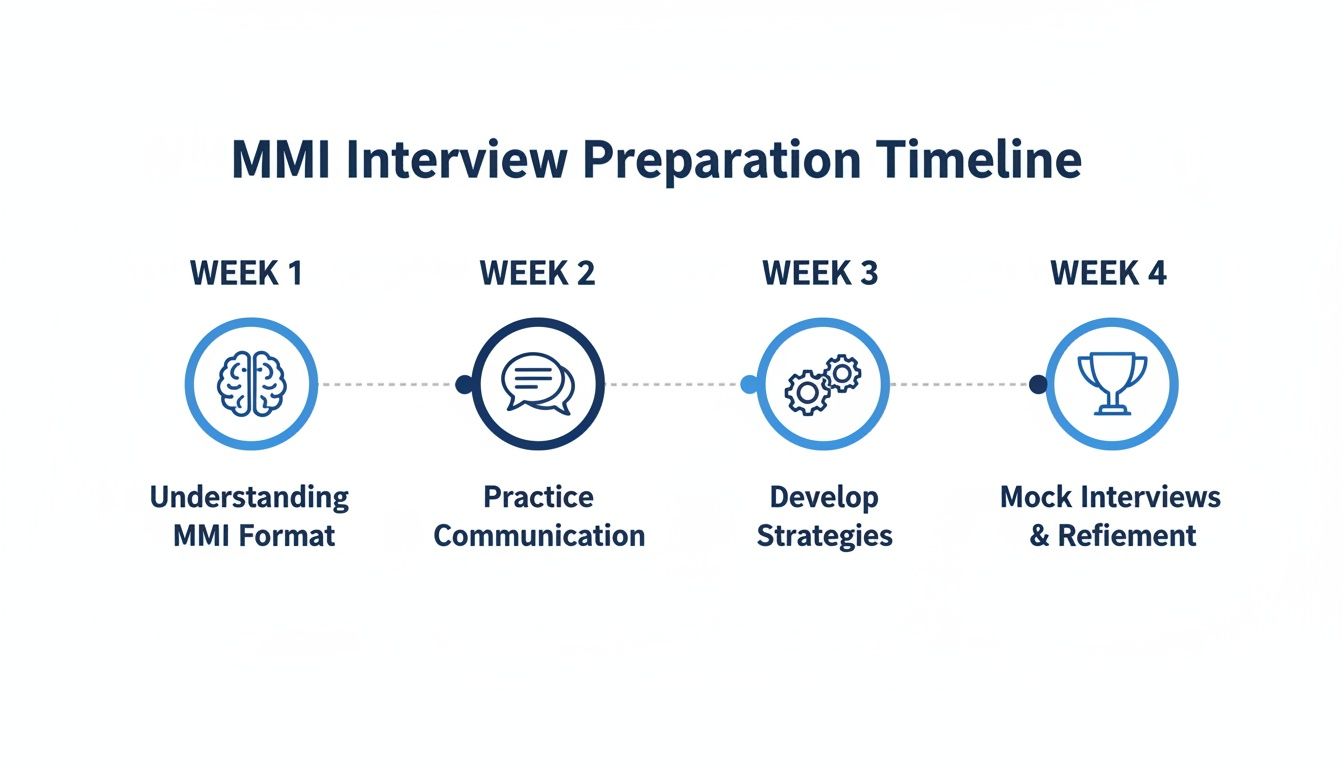
This plan guides you from foundational learning to mastering your performance under pressure. Below is a more detailed breakdown you can adapt.
Your 4-Week MMI Preparation Timeline
This schedule guides your preparation from foundational knowledge to mock interview mastery, ensuring you build skills progressively.
| Week | Focus Area | Key Activities | Time Commitment (per week) |
|---|---|---|---|
| 1 | Foundations & Format | - Read MMI guides and school-specific materials. - Watch example videos to understand the flow. - Brainstorm personal stories for key competencies (e.g., teamwork, resilience). - Start practicing one untimed prompt daily. |
4-6 hours |
| 2 | Frameworks & Content | - Develop structured approaches for different question types (ethical, policy, personal). - Review key healthcare topics and ethical principles (e.g., autonomy, justice). - Begin timed practice with a partner or using an AI platform. |
6-8 hours |
| 3 | Practice & Refinement | - Complete at least two full-length mock MMIs. - Record yourself and analyze your performance. - Focus on pacing, non-verbal communication, and incorporating feedback. - Drill difficult or unexpected question types. |
8-10 hours |
| 4 | Mastery & Mindset | - Do one final full-length mock MMI under realistic conditions. - Review common pitfalls and develop strategies to avoid them. - Prepare questions to ask interviewers. - Focus on rest, confidence-building, and logistics for interview day. |
4-5 hours |
As you can see, the focus evolves each week. You start by absorbing information, then actively build your skills, and finish with high-stakes practice that leaves you feeling ready and confident for your interview.
Understanding What the MMI Actually Tests
First things first: the MMI isn't a knowledge test. It's a performance. Admissions committees aren't trying to quiz you on medical ethics trivia or healthcare policy minutiae. They want to see who you are under pressure. How do you think, communicate, and connect with others when the clock is ticking?
The entire format—a series of short, disconnected stations—is designed to strip away your perfectly polished, pre-rehearsed stories. There’s no hiding. This structure forces your authentic thought process, communication style, and capacity for empathy out into the open, in real-time.
The Core Competencies on Display
Every MMI prompt, no matter how wild it seems, is a finely tuned instrument for measuring specific non-cognitive skills. These are the qualities that written exams just can't capture: your listening ability, professionalism, ethics, empathy, integrity, and cultural sensitivity. Your job is to make these traits visible through your words and actions.
- Critical Thinking and Problem-Solving: Can you cut through the noise and find the central issue in a messy situation? Can you juggle competing priorities and talk through a logical plan? They want to see you navigate the gray areas, not just leap to a simple black-or-white answer.
- Ethical and Moral Reasoning: This isn't about reciting the "four pillars" of medical ethics. It's about showing you can spot principles like autonomy, beneficence, and justice in a real-world mess. Interviewers are looking for your ability to acknowledge the complexity and respectfully justify your thought process.
- Empathy and Communication: How do you make people feel? In role-playing stations, it's all about your body language, tone, and whether you genuinely listen. Your ability to validate someone's feelings and speak with compassion is often the main thing being graded.
- Professionalism and Self-Awareness: Do you stay composed when things get tense? Can you step back, consider different viewpoints, and even acknowledge your own potential biases? This signals the maturity needed for the immense responsibilities of medicine.
Deconstructing Different MMI Station Types
While the core skills being tested are consistent, the stations themselves come in a few different flavors. Knowing what kind of station you’ve walked into helps you switch gears and adapt your approach on the fly. Keep in mind that many prompts are hybrids, designed to test multiple skills at once. A role-play with a frustrated patient, for instance, is testing your communication and your ethical backbone.
Here are the most common formats you’ll run into:
1. The Classic Ethical Dilemma
This is the bread-and-butter MMI station. You're presented with a scenario where there’s no easy out, often pitting patient wishes against professional duties or hospital policy. Your job isn't to solve it perfectly, but to talk through your reasoning, considering every stakeholder and possible outcome.
Example: You’re a family doctor. Your 16-year-old patient wants birth control, but begs you not to tell her parents, who you also know. What do you do? Here, they’re testing your grasp of consent laws for minors, patient confidentiality, and your ability to handle a very delicate conversation.
2. The Role-Playing Scenario
Get ready to interact with an actor. They might be playing a patient, a colleague, or a worried family member. These stations are a direct test of your interpersonal skills. The focus is almost entirely on how you communicate. Your empathy, patience, and ability to calm a tense situation matter far more than any specific "decision" you make.
3. The Teamwork Task
You’ll be paired up with another applicant to tackle a task, like building something with weird materials or solving a puzzle together. The evaluators are watching you like hawks to see how you collaborate. Do you bulldoze your partner? Do you hang back and say nothing? Or do you facilitate cooperation and make your partner feel heard?
4. The Policy Question
These prompts drop you into a current healthcare debate—think single-payer healthcare, vaccine mandates, or the shortage of doctors in rural areas. They aren't looking for a policy expert. They want to see if you can build a balanced, thoughtful argument that acknowledges the pros and cons. To get a feel for the sheer variety, you can explore a wide range of MMI interview questions that span all of these formats.
Developing Your MMI Response Strategy
The best MMI performances look effortless, but they’re almost never improvised. They’re the result of a solid, well-practiced strategy that can be adapted to any prompt, no matter how wild the curveball.
Having a reliable framework means you can stop worrying about how to answer and focus on the content of your answer. This isn’t about memorizing a script. It’s about building a mental checklist to ensure you hit all the marks an evaluator is trained to look for. It’s the difference between a scattered, rambling response and a clear, thoughtful analysis.

Making Every Second Count in Your Two-Minute Prep
Those two minutes you get outside the station door are pure gold. Panicking is the most common way to waste them. Instead, you need a disciplined process to break down the prompt and sketch out your response.
Here’s a practical way to approach it:
- Pinpoint the Core Conflict: What’s the central tension here? Is it a clash between patient autonomy and a physician's duty to prevent harm? A resource allocation dilemma? A communication breakdown? Nailing this down gives your entire answer a laser focus.
- Map Out the Stakeholders: Who is affected by this decision? Think beyond the obvious. In a clinical scenario, the list could include the patient, their family, you, the hospital administration, other patients, and maybe even the broader community. Jotting them down ensures you don’t miss a key perspective.
- Brainstorm the Big Ideas: What major concepts are in play? Think about ethical principles like autonomy, justice, and beneficence. Consider professional duties like confidentiality and non-maleficence. Don't forget practical issues like communication and resource constraints. These become the building blocks for your answer.
This quick analysis turns an intimidating prompt into a manageable set of talking points.
How to Structure a Balanced and Thoughtful Answer
Once you're inside the room, your job is to walk the interviewer through your thought process. A good structure makes this feel logical and ensures you’re actively demonstrating competencies like critical thinking and empathy.
Here’s a flexible framework you can adapt to almost any station:
- Acknowledge the Gray Area: Start by summarizing the prompt in your own words and state why it’s a tough spot. Saying something like, "This is a challenging situation because it pits the patient's immediate wishes against potential long-term safety concerns," shows you immediately grasp the nuance.
- Walk Through Different Viewpoints: Use that stakeholder list you made. For example, you could say, "From the patient's perspective, they feel..." and then pivot with, "However, from the family's viewpoint, their main concern is..." This is a direct way to show empathy and balanced reasoning.
- Propose a First Step and Justify It: State your immediate action. Crucially, this is often about gathering more information or opening a dialogue—not making a final, irreversible decision. Always justify your action by tying it back to a core ethical principle or professional duty.
- Consider the Ripple Effects: Briefly touch on other options and why you chose not to take them right away. Acknowledging the potential downstream consequences of your decision—both good and bad—demonstrates foresight and maturity.
The goal isn't a perfect monologue. The best MMI responses are conversations that reveal how you think. It's okay to pause, reflect, and even say, "That's a great question, let me think about that for a moment."
Annotated Example: Strong vs. Weak Response
Let's apply this to a classic prompt: A patient with a history of alcohol abuse is next on the liver transplant list. Another patient, a non-drinker, is further down the list. A liver becomes available. Who should get it?
Weak Response:
"The non-drinker should get the liver. The other patient brought this on himself and might just damage the new liver anyway. It's a waste of a precious organ. It’s only fair that the person who didn't cause their own illness gets the transplant."
- Why it's weak: This answer is purely judgmental. It leaps to a conclusion without exploring the issue and ignores medical ethics and established policy. It signals a major lack of critical thinking and empathy.
Strong Response:
"This is an incredibly difficult ethical problem that balances medical utility against core principles of fairness and non-judgment. My immediate thought is that this is precisely why we have established hospital and national transplant allocation policies—to handle these situations objectively and equitably.
From one perspective, giving the liver to the patient without a history of alcohol abuse seems to maximize the organ's benefit. However, a foundational principle of medicine is to treat patients without judgment. Withholding a life-saving treatment based on past behaviors could feel punitive. We also don’t have the full context—has the first patient completed rehab? What is their support system like?
My first step would be to confirm the established protocol with the transplant committee. Assuming the patient met all medical and psychological criteria to be on the list in the first place, my duty is to advocate for them, regardless of their history. The system is designed to be equitable, and my personal feelings shouldn't override that."
- Why it's strong: This response immediately acknowledges complexity, avoids personal bias, and references official policy (demonstrating professionalism). It explores multiple viewpoints and lands on a clear, ethical course of action. It shows a sophisticated grasp of the real-world issues.
Practicing with a wide variety of prompts from a comprehensive MMI interview question bank is the best way to get comfortable with this kind of structured, thoughtful approach.
Mastering Your Performance Through Practice
Knowing how to break down an MMI prompt is one thing. Delivering a composed, thoughtful response under a ticking clock? That's another beast entirely. The only way to bridge that gap between theory and performance is through consistent, high-quality practice. This is where you move beyond just understanding the MMI and start mastering the art of the interview itself.
The goal here isn't to just churn through prompts until you’re exhausted. It's about building a smart practice regimen that feels like the real deal, builds your mental stamina, and gives you feedback you can actually use. This is how a strategic framework stops being a concept and becomes your natural, confident communication style.
Designing a High-Impact Practice Regimen
To really get ready, you need a mix of practice methods. Just reading prompts silently in your head is a recipe for disaster—it does nothing to prepare you for the pressure of thinking on your feet and speaking clearly. A balanced plan incorporates different formats to build a complete skill set.
Think about layering your practice in stages:
- Untimed Solo Practice: Start by just talking through prompts out loud, no timer. The goal is simple: get comfortable articulating your structure. Can you naturally acknowledge the complexity, explore the stakeholders, and justify your reasoning?
- Timed Solo Practice: Once the structure feels less awkward, bring in the clock. Using a dedicated tool like an MMI interview timer helps you internalize that crucial two-minute prep and six- to eight-minute response rhythm. This is where you master your pacing.
- Peer-to-Peer Mock Interviews: This is a game-changer. Find other applicants and take turns being the interviewer and the interviewee. You'll get exposed to different communication styles and receive invaluable feedback from someone who truly gets what's at stake.
- Full Mock Circuits: In the final weeks leading up to your interview, you have to simulate the real thing. Run through a full circuit of 8-10 stations back-to-back. This builds the focus and endurance you'll need to stay sharp from the first station to the last.
This progression slowly dials up the pressure, letting you build skills methodically instead of getting overwhelmed right out of the gate.
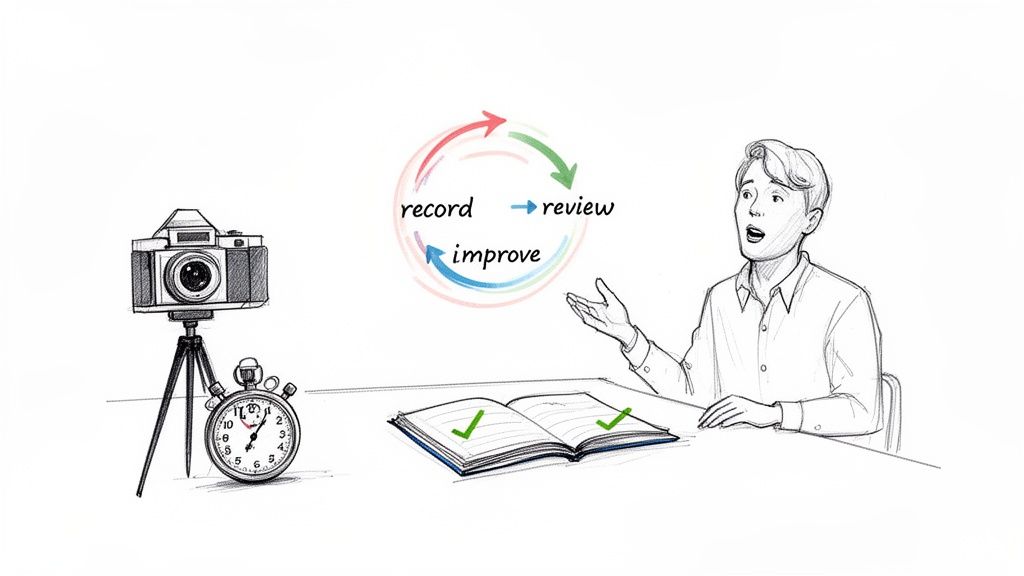
Recording and Analyzing Your Performance
The single most powerful tool for improvement is probably already in your pocket: your smartphone.
Recording your practice sessions gives you objective data on your performance that is impossible to gauge in the moment. When you watch yourself back, you become your own coach. It can feel a little cringey at first, but the insights are undeniable.
Pay close attention to these key metrics:
- Pacing and Filler Words: Do you talk a mile a minute when you're nervous? Do you lean on crutches like "um," "like," or "you know"? Spotting these habits is the first step to squashing them.
- Body Language and Tone: Do you look engaged and empathetic? Or do you come across as defensive or jittery? Your non-verbals often speak louder than your words, especially in those tricky role-playing stations.
- Clarity and Structure: Was your thought process actually easy to follow? Did you signpost your argument, or did you jump between ideas without a clear path?
This self-analysis is where you polish the small details that add up to a professional and confident presence.
The Power of Feedback
While self-review is critical, we all have blind spots. That’s why you need outside perspectives from peers or mentors. But when you ask for feedback, don't let them off the hook with a generic, "That was good." It's useless.
"Your practice sessions are not just about answering questions; they're about demonstrating your readiness for the profession. Research shows a direct link between MMI scores and medical school acceptance, with the 'rank of readiness' being a top predictor of admission."
This readiness is exactly what structured practice builds. It's not just a feeling; it's a measurable skill. To get the most out of your feedback sessions, ask your practice partners to comment on the same things the evaluators are scoring.
Give them specific questions to answer:
- Did I show empathy for all the stakeholders involved?
- Was my critical reasoning clear and logical?
- Did I communicate professionally, even when the topic was sensitive?
- Did I actually address the core ethical conflict in the prompt?
Using a structured feedback model ensures you're improving the exact skills that matter. By combining timed drills, self-review, and targeted feedback, you don't just prepare for MMI interviews—you build the unshakeable confidence that defines a standout performance.
Effective MMI Practice Methods Compared
Choosing the right mix of practice methods can feel overwhelming. This table breaks down the pros, cons, and best use cases for each to help you build a comprehensive and effective training plan.
| Practice Method | Pros | Cons | Best For |
|---|---|---|---|
| Solo Practice (Untimed) | Low-pressure environment to build foundational skills and verbalize thoughts. | Lacks time pressure and external feedback, can reinforce bad habits if unchecked. | Early-stage prep, getting comfortable with the MMI structure and articulating complex ideas out loud. |
| Solo Practice (Timed) | Simulates real-world time constraints, builds pacing and stamina. | No external feedback to identify blind spots in communication or reasoning. | Mid-stage prep, mastering time management and building endurance for the full interview circuit. |
| Peer-to-Peer Practice | Provides real-time feedback, exposes you to different perspectives. | Quality of feedback can be inconsistent; may require scheduling coordination. | Mid-to-late stage prep, refining communication skills and getting accustomed to being evaluated. |
| Professional Coaching | Expert feedback from experienced interviewers, highly personalized advice. | Can be expensive, may not be accessible to all applicants. | Fine-tuning performance, addressing specific weaknesses, and getting a final confidence boost. |
| AI Mock Interviews | On-demand, 24/7 access to practice, provides objective performance data. | Lacks the nuance of human interaction and emotional feedback. | Consistent drilling, identifying patterns in filler words/pacing, and practicing a high volume of prompts. |
Ultimately, a winning strategy combines several of these methods. Start solo to build your base, then integrate peer and AI practice to simulate the real environment and gather data-driven feedback. A little professional coaching can provide that final polish right before interview day.
Common MMI Pitfalls and How to Avoid Them
Knowing what to do in your MMI is one thing, but knowing what not to do is just as important. I’ve seen countless well-prepared applicants stumble over common traps that undermine an otherwise strong performance. Once you learn to spot these pitfalls, you can navigate your interview day with a lot more confidence.
The key is remembering that evaluators are there to see how you think, not just what you conclude. Seemingly small mistakes can send the wrong signal about your empathy, critical thinking, or professionalism. Let’s walk through the missteps I see most often and how you can sidestep them.
Pitfall 1: The Rehearsed Monologue
This is probably the biggest and most frequent mistake. An applicant has practiced a specific answer so many times that they deliver a flawless—but completely robotic—speech. It sounds canned because it is, and it totally misses the point of the MMI.
Interviewers want to see you think on your feet, not hit "play" on a pre-recorded script. A rehearsed monologue shuts down any real engagement and signals that you can’t adapt or think critically under pressure. It's a massive red flag.
How to Avoid It:
Forget memorizing answers. Focus on internalizing a flexible framework instead. Your real practice should involve applying your structure to a wide range of new and unfamiliar prompts. The goal isn’t to have the perfect answer ready to go, but to have a reliable method for building a great answer on the spot.
Pitfall 2: The Rigid Ethical Judgment
Many MMI ethical dilemmas are intentionally gray. There’s no clean, right-or-wrong answer. A huge pitfall is jumping straight to a rigid, black-and-white conclusion without ever exploring the nuances of the problem. This can make you seem judgmental and seriously lacking in empathy.
Scenario: An applicant is asked about a patient with a history of substance abuse who needs a liver transplant. They immediately state, "The patient who doesn't drink should get the liver. The other one wasted their chance." This kind of response shows a complete lack of empathy and a failure to consider the complexities of addiction or healthcare allocation.
A snap judgment like that tells evaluators you struggle with ambiguity and might not approach patients with the non-judgmental care that’s absolutely required of a physician.
How to Avoid It:
Always start by acknowledging the complexity. Use phrases like, "This is a really challenging scenario because..." or "There are a few competing ethical principles at play here." Take the time to explore the perspectives of everyone involved before you even think about proposing a course of action.
Pitfall 3: Misinterpreting the Prompt
Under the stress of the clock, it’s surprisingly easy to misread the prompt or misunderstand its core conflict. You might latch onto a minor detail and completely miss the central ethical or communication challenge you're supposed to be addressing.
This leads to an answer that, while maybe well-structured, is completely irrelevant to what the station was designed to test. It flags a lack of attention to detail and an inability to prioritize under pressure.
How to Avoid It:
Use that two-minute prep time wisely. Read the prompt twice. Before you start outlining, ask yourself:
- What’s the central conflict here?
- Who are the key people involved and what are their stakes?
- What specific skill is this station trying to assess?
A great trick is to briefly summarize the prompt in your own words at the start of your response. It confirms your understanding with the evaluator right away.
Pitfall 4: Forgetting the Human Element
In role-playing stations, some applicants get so focused on "solving the problem" that they forget they’re interacting with a person. They talk at the actor instead of with them, showing zero empathy or active listening. I see the same thing in teamwork stations, where one person dominates the conversation and ignores their partner’s input.
This is a critical mistake, since these stations are explicitly designed to test your interpersonal skills. An evaluator will absolutely notice if you steamroll others or can't connect with someone in distress.
How to Avoid It:
In any interactive station, your first priority is always connection.
- Role-Playing: Make eye contact. Use a calm, measured tone. Validate the actor's feelings with simple phrases like, "I can see this is incredibly upsetting for you."
- Teamwork Tasks: Actively pull your partner in. Ask, "What are your thoughts on this?" Then, build on their suggestions to show you’re a collaborator, not a dictator.
Your Strategy for a Successful Interview Day
All the hours you’ve spent preparing come down to this one day. Success is no longer just about what you know—it’s about managing your mindset and logistics so you can perform under pressure. A calm, confident presence can be just as impactful as a perfect answer.

Whether your MMI is online or on campus, the core principles of preparation are the same. Get everything squared away the night before to sidestep any last-minute panic.
- For Virtual Interviews: Do a full tech check. Test your camera, mic, and internet connection. Make sure your background is clean, professional, and free of any potential distractions.
- For In-Person Interviews: Lay out your professional attire, pack your bag with essentials like a water bottle and notepad, and double-check your travel route and timing.
A little organization goes a long way. If you're looking for ways to stay organized, it’s worth reading up on utilizing notes effectively to boost confidence and impress during an interview.
Cultivating a Confident Mindset
The real MMI challenge isn’t just about answering tough questions; it’s about mental endurance. Staying focused and composed across a series of intense, varied stations requires a specific game plan.
Your number one goal is to reset completely between each station. It's almost inevitable that one station will feel like it went poorly. You have to leave that feeling at the door before walking into the next room. Each evaluator is new, which means every station is a fresh start. Take a deep breath, clear your head, and focus only on the scenario in front of you.
This kind of mental prep is critical, especially since research suggests not all applicants start on an even playing field. Studies have shown that rural applicants, for example, can face a structural disadvantage in MMI assessments. This might be due to less access to prep resources or unfamiliarity with the specific communication styles often rewarded in these interviews. Understanding these performance disparities gives you a fuller picture of the MMI landscape.
The most powerful tool you have on interview day is your presence. Listen with intent, connect genuinely with your interviewer or the actor in the scenario, and let your personality come through. All your preparation has built the foundation; now, it’s time to trust yourself.
Your MMI Preparation Questions Answered
Even with the best prep plan, you're going to have questions. It’s only natural. Let's tackle some of the most common ones we hear from applicants trying to get a handle on MMI preparation.
How Many Hours Should I Actually Study for the MMI?
There’s no magic number here, but the sweet spot for most successful applicants seems to be around 30-50 hours, spread out over four to six weeks.
The key is consistency, not cramming. A few focused hours each week are far more effective than a frantic, last-minute push. Spend your initial time getting the lay of the land—understanding the MMI format, the core competencies, and how you’ll structure your thinking. Then, pivot hard to active practice. The bulk of your time should be spent in mock interviews, getting feedback, and refining your approach based on what you learn.
Should I Practice with Friends or Use an AI Tool?
Honestly? You need both.
Practicing with friends, mentors, or family is irreplaceable for getting comfortable thinking on your feet and having a real conversation. It’s where you learn to sound natural, not robotic. This is crucial for building rapport and getting immediate feedback on your communication style and body language.
But dedicated AI practice platforms bring something different to the table. They offer round-the-clock access, a massive bank of prompts you haven’t seen before, and standardized scoring rubrics. This gives you objective, data-driven feedback that a friend might miss. Combining human feedback with AI-driven analysis is the best way to get a complete picture of your performance.
The single most common mistake is treating the MMI like a final exam. Candidates walk in with a rehearsed speech, ready to deliver the "perfect" answer. But evaluators don't want a monologue; they want to see your mind at work. They're looking for applicants who can explore gray areas, acknowledge complexity, and show genuine empathy.
What's the Biggest Mistake Applicants Make?
Without a doubt, it’s failing to show a collaborative thought process. Too many applicants deliver a rigid, one-sided monologue, as if they're giving a lecture. This signals an inability to self-reflect or consider other points of view.
Interviewers are far more impressed by someone who can grapple with nuance.
They want to hear you think things through out loud. A candidate who says, "On one hand, I see this perspective... but on the other, we have to consider..." is demonstrating the kind of flexible, critical thinking that makes a great physician. Your job isn't to present a polished final answer; it's to walk them through how you arrived at it.
Ready to turn that practice into real confidence? Confetto’s AI platform simulates realistic MMI scenarios and gives you instant, actionable feedback on everything from your critical thinking to your communication style. Stop guessing and start improving with a free trial.