
Updated · Published
GPA for Medical School: Overall vs. Science (BCPM) GPA
What is a good GPA for medical school? See average overall and science (BCPM) GPAs, MD vs. DO differences, how GPA pairs with the MCAT, and low-GPA fixes.

A good science (BCPM) GPA for medical school is about 3.7 or higher. MD matriculants average about a 3.8 overall GPA and a 3.7 science GPA (AAMC), and DO matriculants about 3.6 and 3.5 (AACOM). In the 2025 AMCAS cycle, enrollees averaged 3.81 overall, against 3.68 for all applicants (AAMC FACTS).
When you're trying to figure out the GPA for medical school, the short answer is you'll want to be comfortably above a 3.5 to be seen as a competitive applicant. But let's be real—the students who get multiple acceptance letters are often rocking a GPA closer to 3.7 or higher, especially in their science classes.
Your grades and MCAT get you an interview invitation, and then the interview counts too. When invitations arrive, Confetto, an AI mock interviewer for medical school and other healthcare program interviews (MMI, traditional, panel), lets you practice medical school interviews out loud and see rubric-based feedback on every answer. You can also start with our medical school interview prep plan.
What GPA Do You Actually Need for Medical School?

Think of your GPA as the ticket that gets you into the stadium. It doesn't guarantee you'll win the game, but without it, you can't even get through the gate. For medical school admissions, your GPA is one of the first things committees look at to gauge if you can handle their demanding curriculum. It's a quick, data-driven snapshot of your consistency, work ethic, and ability to master tough subjects over years of study.
A high GPA sends a strong signal that you have the discipline to succeed. But it’s not just one number they care about. Admissions committees dig into two key figures: your Overall GPA and your Science GPA, which you'll often see called the BCPM GPA (Biology, Chemistry, Physics, and Math).
The BCPM GPA is a huge deal. It’s a direct reflection of how you performed in the very courses that form the foundation of medical school. Nailing these classes tells the committee you're ready for the scientific rigor that's coming your way.
Understanding the National Averages
To get a feel for where you need to be, it’s helpful to look at the stats. Recent data from the AAMC shows that the average GPA for students who actually matriculated (enrolled) into U.S. medical schools has recently been about 3.8 overall (3.81 for the 2025-26 entering class). Science (BCPM) GPAs run slightly lower than non-science GPAs.
Of course, these numbers swing wildly depending on the school. The most selective programs tend to enroll classes with average GPAs near the top of the scale, while other fantastic programs have averages noticeably lower. Each school publishes its own figures in its MSAR profile. You can always dive into detailed medical school admissions statistics to compare specific programs.
Your GPA is more than just a number; it’s a narrative of your academic journey. An upward trend can be just as powerful as a consistently high GPA, as it demonstrates resilience, adaptability, and a growing commitment to your studies.
Medical School Matriculant GPA Benchmarks at a Glance
To give you a quick reference for where you stand, this table breaks down the typical GPA benchmarks for different types of U.S. medical programs.
| School Type | Average Overall GPA | Average Science (BCPM) GPA |
|---|---|---|
| Most selective MD Programs | Higher than the national average (check each school's MSAR profile) | Higher than the national average |
| All MD Programs | About 3.8 (AAMC) | About 3.7 (AAMC) |
| DO Programs | About 3.6 (AACOM) | About 3.5 (AACOM) |
This table gives you a clear snapshot of the competitive landscape. Use these numbers as guideposts, not as rigid cutoffs. They're here to help you build a smart, balanced list of schools that truly align with your academic profile.
Understanding the Two GPAs That Matter Most
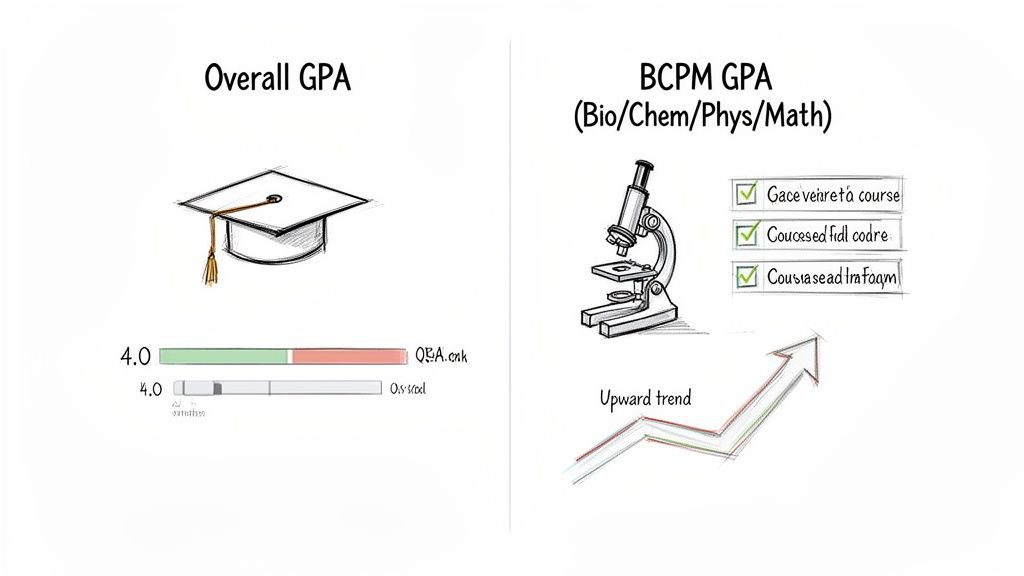
When an admissions committee (AdCom) looks at your transcript, they don't just see one number. They see a story told by two very different, but equally critical, metrics. Getting a handle on your Overall GPA versus your Science GPA is the first step to building an application that gets noticed.
Think of your Overall GPA as the wide-angle shot of your academic life. It captures everything—from that brutal organic chemistry final to the art history elective you took for fun. This number gives AdComs a baseline for your work ethic, intellectual curiosity, and your ability to juggle a diverse course load.
But your Science GPA, also known as the BCPM GPA, is the close-up. It’s a laser-focused look at your performance in the exact subjects that form the bedrock of medical school. This is the single best predictor AdComs have for whether you can handle the firehose of information coming your way in year one.
What Is the BCPM GPA
So, what exactly is this all-important BCPM GPA? It's your grade point average calculated from a specific bucket of science and math courses. The acronym stands for the four core disciplines that medical schools care about most:
- Biology: This isn't just Bio 101. It includes everything from genetics and microbiology to anatomy and physiology.
- Chemistry: General chemistry, organic chemistry (O-chem), and biochemistry all fall under this umbrella.
- Physics: Every single physics course you’ve taken counts here.
- Math: Any class from the math department—calculus, statistics, even applied math—gets factored in.
A high BCPM GPA is non-negotiable for a competitive application. It directly answers the AdCom’s biggest question: "Does this student have the raw academic horsepower to succeed in our curriculum?" A strong showing in these courses is the most powerful evidence you can offer.
Not sure which courses count toward the BCPM? See our guide to required classes for medical school.
The Power of an Upward Grade Trend
Your GPA isn't a static number frozen in time; it's a narrative of your academic journey. AdComs love a good story, and a positive grade trend can be incredibly compelling. A student who stumbled with a 3.2 GPA freshman year but pulled it together to earn a 3.9 GPA in their junior and senior years often looks more impressive than someone with a flat 3.6 GPA all the way through.
Why? Because an upward trend signals growth, resilience, and maturity. It tells the committee that you figured out how to study, bounced back from early setbacks, and learned to master increasingly difficult material. It shows you don’t give up.
An upward grade trend tells a story of growth. It shows an admissions committee that you can adapt, overcome obstacles, and elevate your performance when it matters most—qualities essential for any future physician.
This narrative of improvement is your secret weapon, especially if you had a rocky start in college. It lets you reframe a lower overall GPA, proving that your most recent performance is the truest reflection of who you are as a student now. When AdComs are weighing the GPA for medical school, that context can make all the difference.
How GPA Expectations Vary Across Different Programs
Not every medical school looks at your GPA the same way. A 3.6 might put you in a great spot for one program but leave you below the median at another. Figuring out these differences is crucial for building a smart, strategic school list that actually boosts your odds of getting in. The GPA you need for medical school really depends on the type of program, its core mission, and its overall admissions philosophy.
In the United States, the road generally forks into two main paths: allopathic (MD) and osteopathic (DO) schools. Each has its own way of sizing up candidates, which directly shapes how they weigh your grades against the rest of your application.
MD Programs Versus DO Programs
Allopathic (MD) programs, especially the big-name research institutions, tend to put a heavy premium on high stats. For these schools, a top-tier GPA and MCAT score are often the first hurdles you have to clear just to get a serious look. While they absolutely practice holistic review, the sheer number of applicants with stellar numbers means that academics often act as an initial filter. The average GPA for students starting at MD schools is around 3.8, and for the most selective programs, that average is often higher still.
Osteopathic (DO) programs, on the other hand, are well-known for leaning more heavily into a holistic review right from the start. Strong grades are still a must—the average DO matriculant GPA is about 3.6—but these schools often give more weight to life experiences, a deep commitment to service, and a real understanding of osteopathic principles. This can open doors for applicants whose GPAs aren't perfect but who shine with exceptional extracurriculars, a powerful personal story, or a strong upward grade trend.
Key Takeaway: Think of it this way: an MD school might run an initial sort on applications based on GPA and MCAT, while a DO school is more likely to look at your GPA, experiences, and personal statement all in one go. Neither way is better, but knowing the difference helps you aim for the right programs.
The Role of Demographics and School Mission
Admissions data also shows that average GPAs and acceptance rates can differ across various applicant demographics. This isn't a simple numbers game; it reflects the complex mix of socioeconomic backgrounds, educational opportunities, and a genuine commitment from many schools to build a diverse class that looks like the patient populations they’ll one day serve.
For instance, AAMC data show that average matriculant GPAs differ somewhat across racial and ethnic groups, yet applicants from all groups are admitted. This is a clear signal that holistic review is more than just a buzzword. You can dive deeper into this data with a full breakdown of medical school acceptance rates.
Beyond that, a school’s specific mission is a huge driver of its admissions criteria.
- Rural Health Focus: A program dedicated to serving rural communities might give a leg up to applicants from those areas or those with a demonstrated passion for primary care, potentially allowing for more flexibility on GPA.
- Research Powerhouses: Institutions known for their groundbreaking research will be on the lookout for applicants with serious lab experience and high science GPAs to match.
- Service-Oriented Schools: Programs built around a mission of community service will place a heavy emphasis on your volunteering and clinical hours.
When you do your homework and dig into the unique character of each program, you can find the places where your entire profile—not just your GPA—is going to resonate. Our guide on how to choose a medical school program offers more advice on aligning your application with the right schools. This strategic approach ensures you’re not just applying everywhere, but applying to the right places for you.
The Critical Balance Between Your GPA and MCAT Score
Your GPA and MCAT score are the two academic pillars of your medical school application. But they don't exist in a vacuum. Think of them as sitting on opposite ends of a seesaw—a higher score on one side can help lift a lower score on the other, creating the kind of balance that reassures admissions committees.
This interplay is critical. A less-than-perfect GPA doesn’t automatically slam the door on your dream school, especially if you can prove your academic horsepower with a stellar MCAT score. The MCAT is the great equalizer, a standardized metric that shows how your knowledge stacks up against tens of thousands of other applicants nationwide.
Likewise, a phenomenal GPA, particularly a strong science GPA, can provide some cushion if your MCAT score is a bit below a school's median. It proves you have the long-term discipline and study habits to grind through a four-year curriculum, which is a different skill set than excelling on a single, high-stakes exam.
Finding Your Strategic Sweet Spot
The key is understanding how these two numbers are viewed together. A high GPA paired with a high MCAT score is the gold standard, of course, making you a competitive applicant just about anywhere. But most applicants have a profile with varying strengths. Your goal is to present a combined academic picture that meets a certain threshold of competency.
For example, an applicant with a 3.5 GPA and a 505 MCAT might struggle to get noticed. But if that same applicant retakes the exam and scores a 515, their application is suddenly seen in a whole new light. That high MCAT score validates their potential and tells committees their GPA might not tell the whole story. To get there, it’s essential to practice with a high-quality MCAT question bank that mirrors the real exam.
The chart below illustrates that successful applicants come from all sorts of academic starting points.

This visualization reinforces the idea that a holistic review considers more than just raw numbers. While GPAs vary across different groups, students from all backgrounds gain acceptance to medical school.
Admissions committees use the MCAT/GPA combination as a primary tool to predict your likelihood of succeeding in the rigorous medical school curriculum. A strong performance in one can help mitigate concerns about the other, but a significant weakness in both is a major red flag.
Data-Driven Acceptance Rates
To make this relationship crystal clear, let’s look at the numbers. The Association of American Medical Colleges (AAMC) provides invaluable data showing acceptance rates based on specific GPA and MCAT combinations. This is your best tool for setting realistic targets.
By finding your GPA on the chart, you can see what MCAT score is needed to become a competitive applicant. This empowers you to build a strategic and data-informed study plan.
The following table shows the percentage of applicants who were accepted to at least one U.S. MD-granting medical school for each GPA and MCAT combination. The figures come from AAMC Table A-23 and combine the 2021-22 through 2023-24 cycles (the 3.80+ row is AAMC's "greater than 3.79" band). Newer AAMC releases will differ slightly.
| MCAT and GPA Combinations for Medical School Acceptance |
| :--- | :--- | :--- | :--- | :--- | :--- |
| GPA Range | MCAT Score 502-505 | MCAT Score 506-509 | MCAT Score 510-513 | MCAT Score 514-517 | MCAT Score >517 |
| 3.80+ | 40.2% | 52.4% | 66.7% | 75.3% | 82.9% |
| 3.60-3.79 | 32.0% | 40.4% | 56.7% | 65.4% | 72.4% |
| 3.40-3.59 | 27.9% | 33.7% | 45.3% | 56.3% | 61.4% |
| 3.20-3.39 | 26.2% | 31.7% | 41.0% | 47.8% | 56.5% |
| 3.00-3.19 | 21.9% | 28.5% | 34.2% | 42.4% | 42.6% |
Notice the clear pattern. For an applicant with a 3.5 GPA, jumping from the 506-509 MCAT bracket to the 510-513 bracket boosts their acceptance rate from 33.7% to 45.3%. That’s the seesaw effect in action. Understanding this balance is fundamental to crafting a winning application strategy when figuring out the ideal GPA for medical school.
Actionable Strategies for a Low GPA
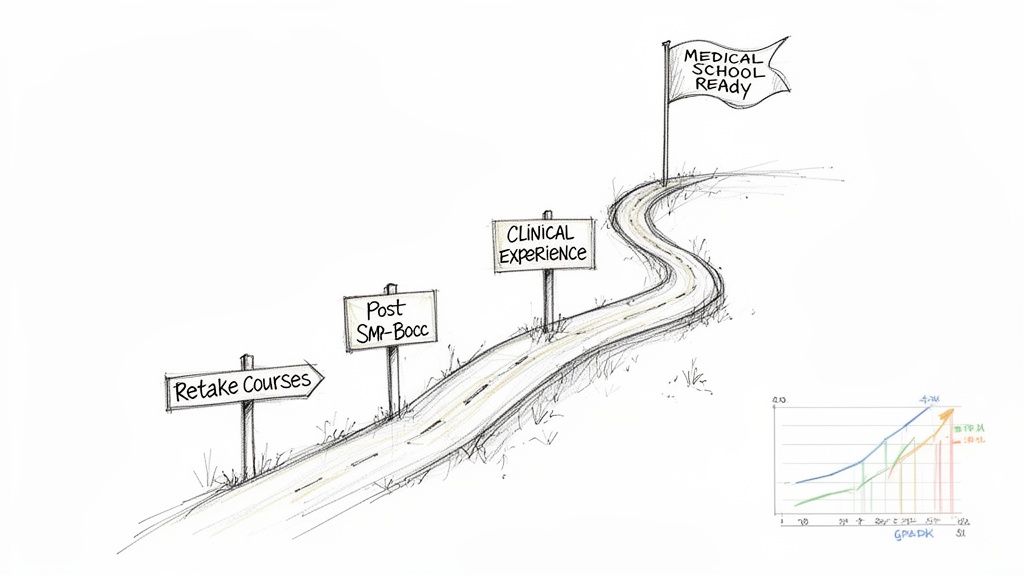
Finding out your GPA doesn't quite hit the mark for medical school can feel like a gut punch. Let’s be real—it's disheartening. But it's a setback, not a disqualifier.
Your undergraduate transcript is just one chapter in your academic story, and you have the power to write the next one. With the right strategy, you can build a new academic narrative that proves you’re ready for the rigors ahead.
Think of your low GPA as a weak spot in a foundation. You can't just hide the cracks. Your job is to build a stronger, more impressive structure right on top of it. This process, often called academic enhancement, shows admissions committees that your past struggles don’t define your future potential. More importantly, it demonstrates grit, maturity, and the capacity to handle brutally difficult coursework.
Two high-impact pathways can get you there: Post-Baccalaureate programs and Special Master's Programs. Each serves a different purpose, and picking the right one comes down to your specific academic profile and goals.
Post-Baccalaureate Programs
A Post-Baccalaureate program, or "post-bacc," is designed for one main reason: to give you a fresh shot at taking or retaking undergraduate-level science courses and crushing them. This is your chance to directly tackle a weak BCPM GPA by proving you can master the foundational sciences.
There are a couple of ways to do this:
- DIY Post-Bacc: This is the self-starter route. You enroll at a local university as a non-degree-seeking student and hand-pick upper-level science courses. It’s flexible and usually more affordable, but it comes with less structure and formal advising.
- Formal Post-Bacc: These are structured, certificate-granting programs built specifically for pre-meds. They offer a dedicated curriculum, built-in advising, and often have linkage agreements with certain medical schools.
A post-bacc is like renovating a single, critical room in your house. If your BCPM GPA is the main problem, this targeted approach lets you fix it directly. It shows clear, measurable improvement in the exact area that worries admissions committees the most.
A strong performance in a post-bacc program (think a 3.8 GPA or higher) creates a compelling upward trend that can absolutely outweigh earlier missteps. It tells a story of focused redemption and proves you have the academic horsepower.
Special Master’s Programs
Now, if your overall GPA is the issue and you need to prove you can handle graduate-level science, a Special Master's Program (SMP) is often the best move. These are typically one- or two-year programs, often housed within a medical school itself, where you take classes right alongside first-year med students.
The curriculum is intense—we’re talking biochemistry, pharmacology, and physiology at a med school pace. Succeeding in an SMP is arguably the most powerful evidence you can offer that you are ready for the academic demands of medical school. It shows you can thrive in that fast-paced, high-stakes environment.
Of course, beyond these programs, shoring up your fundamental study habits is key. Improving how you learn with engaging techniques can make all the difference. You can dive deeper into proven active learning strategies for students to sharpen your skills.
Choosing Your Path
So, post-bacc or SMP? The choice really hinges on an honest look at your transcript.
- Choose a Post-Bacc if: Your main weakness is a low BCPM GPA (generally below 3.4), but your overall GPA is otherwise decent. You need to bolster that science foundation before even thinking about graduate-level work.
- Choose an SMP if: Your GPA is more borderline across the board (hovering around 3.0-3.4), and you need to prove you can handle a med school-level curriculum. This is the high-risk, high-reward option. A great performance can open doors, but a poor one can effectively close them for good.
Both paths require a serious investment of time and money, but they provide a clear route to strengthening your application. By demonstrating new academic success, you can reshape your narrative from one of past struggles to one of present-day capability and future promise.
How to Frame Your GPA in Applications and Interviews
Every transcript tells a story. Your job is to shape that narrative with confidence and self-awareness, whether your GPA is stellar, shows a dramatic comeback, or has a few blemishes. This isn't about making excuses; it's about providing context and proving you've grown.
Your application essays—both the personal statement and the secondaries—are your first chance to frame your academic journey. If you have a dip in your grades or a lower GPA, addressing it head-on is almost always the right move. Don't hide from it. Own it, briefly explain what was going on without blaming anyone, and then pivot quickly to what you learned from the experience.
This isn’t the place for a long saga about a bad breakup or a single tough professor. Keep it concise and mature. The goal is to show the admissions committee that you're resilient, accountable, and now possess stronger academic skills because of those challenges.
Addressing Your GPA in Writing
When you write about academic stumbles, the focus has to be on the transformation. What specific study habits did you change? How did you learn to manage your time better? Did you finally seek out a tutor or find a mentor? Effectively telling this story, especially with a low GPA, means you have to improve your academic writing to be clear, direct, and convincing.
Your narrative should follow a simple but powerful arc:
- Acknowledge the Issue: "During my sophomore year, my grades in organic chemistry didn't reflect my full potential."
- Provide Brief Context: "I was juggling a heavy course load with a significant family emergency, and my time management skills weren't developed enough to handle the pressure."
- Show What You Did About It: "I immediately sought help from the academic resource center, formed a study group, and learned to prioritize my responsibilities more effectively."
- Highlight the Positive Outcome: "As my transcript shows, my grades improved significantly in all subsequent science courses, and I earned a 4.0 in biochemistry the following semester."
Answering Tough Interview Questions
The interview is where this narrative really comes to life. It’s almost guaranteed that an interviewer will point to a 'C' on your transcript and ask, "So, what happened here?" This is your moment to shine, not to shrink.
Answering a question about a low grade isn't a test of your past; it's a test of your present maturity, self-awareness, and professionalism. The committee wants to see how you handle discussing a setback.
Your verbal explanation should mirror your written one: take ownership, be concise, and focus on your growth. Never, ever blame the professor or the course. Instead, frame it as a learning opportunity that made you a stronger candidate today.
Rehearsing this answer is key to delivering it with confidence. This is where dedicated practice is invaluable. Using a platform for a medical school mock interview can help you polish your story until it sounds authentic and poised, not defensive or robotic. By practicing your delivery, you can turn a potential weakness into a compelling story of resilience that actually strengthens your application.
Frequently Asked Questions About Medical School GPAs
The nuances of the med school GPA can feel overwhelming. Let's tackle some of the most common questions applicants have, giving you the direct answers you need to move forward with your strategy.
What is a good science GPA for med school?
About 3.7 or higher for MD schools, where matriculants average about 3.7 in BCPM courses (biology, chemistry, physics and math). DO matriculants average about 3.5. A science GPA below your overall GPA is common, so an upward trend in recent science courses matters.
Is a 3.7 GPA From an Ivy League School Viewed Differently?
Yes, context is everything. Admissions committees know that a 3.7 from a notoriously tough school or major carries more weight than a 3.9 from a less challenging program. They've seen thousands of transcripts and have a good sense of the "degree of difficulty."
But what often matters more is the story your transcript tells. An upward trend from a 3.4 to a 4.0 at any solid university can be far more compelling than a flat 3.7. It shows resilience, grit, and that you figured out how to master difficult material—all qualities of a great future physician.
How Do Study Abroad Grades Affect My Application GPA?
This really depends on the type of program you did. If your study abroad was run through a U.S. institution, those grades will almost always show up on that school's transcript and get baked into your official AMCAS/AACOMAS GPA.
If you enrolled directly in a foreign university, the grades usually aren't factored into the calculated GPA. You still have to report all the coursework, of course, and send the foreign transcript. Adcoms will review it qualitatively to get a sense of how you performed.
A single "W" is rarely a deal-breaker, especially early in your college career. Committees are more concerned with a pattern of withdrawals, which might suggest an inability to handle a tough course load.
Can I Get into Medical School With a GPA Under 3.0?
It’s incredibly tough, but not impossible. An applicant with a sub-3.0 GPA needs to build an otherwise stellar application to prove they are ready for the academic marathon of medical school.
You essentially have to create a powerful narrative of transformation. You need to convince an admissions committee that your past struggles don't define your future potential. To pull this off, you'll almost certainly need:
- A top-tier MCAT score (think 515+).
- Serious academic redemption through a post-bacc or SMP with a near-perfect GPA.
- Deep, meaningful clinical and research experiences that show your commitment is unwavering.
How Do Withdrawals on My Transcript Impact My Chances?
A single "W" is rarely a big deal, especially if it happened in your freshman or sophomore year. Life happens, and admissions committees get that.
What does raise a red flag is a pattern of withdrawals, particularly in core science courses. It can signal that you struggle to handle a challenging course load or tend to bail when things get difficult. If you have several W's, be ready to address them head-on in your application. Explain what you learned from the experience and how you developed better academic strategies as a result.
Are you ready to turn interview anxiety into confidence? Confetto is your AI-powered partner for acing medical school interviews. Practice unlimited MMI, panel, and traditional interviews 24/7 and get instant, actionable feedback on everything from your communication skills to your body language. Start your free trial and see how thousands of applicants are gaining their competitive edge at https://confetto.ai.