
Ace Your Medical School Mock Interview With This Guide
Nervous about your medical school mock interview? This guide breaks down the MMI, panel, and traditional formats with actionable strategies to help you succeed.
A medical school mock interview is your single most important dress rehearsal. It’s a simulated practice run designed to mimic the pressure and style of the real thing, giving you a chance to sharpen your answers, calm your nerves, and get honest feedback before your performance actually counts.
Why a Mock Interview Is Your Most Powerful Tool
The path to medical school is a long haul. You’ve put in years of hard work—acing exams, volunteering, doing research, and carefully crafting every word of your application. But all that effort funnels down to one critical moment: the interview.
This is your chance to come alive off the page. The interview is where the admissions committee finally gets to see the person behind the grades and essays—the empathy, resilience, and critical thinking that a transcript just can’t show.

Just getting an interview invitation flips the odds in your favor. While only about 41–43% of all applicants end up with an acceptance, landing an interview makes your chances much closer to a coin toss. It’s the final gatekeeper, which makes your performance in that brief conversation incredibly important. If you want to dig into the numbers, AcceptMed has a great analysis of application data.
"The interview isn't just another hoop to jump through; it's the final and most significant gate. It's where admissions committees decide if the person on paper matches the physician they envision."
A mock interview is what connects all your preparation to your actual performance. It forces you to move beyond just thinking about your answers and start actually saying them out loud, under pressure.
From Theory to Practice
It’s one thing to read about interview strategies, but it's a completely different challenge to execute them smoothly when you’re on the spot. A mock interview forces you to apply those concepts in real time.
You’ll learn how to structure an answer on the fly, manage the clock, and keep your cool when a tough question comes out of nowhere. This is how you build real, durable confidence.
Identifying Blind Spots
We all have verbal tics and communication habits we don’t even notice. Maybe you rely on filler words like "um" or "like" more than you think, which can make you sound less polished.
Other common blind spots include:
- Rambling Answers: Taking too long to get to the point, losing your interviewer's attention.
- Poor Non-Verbal Cues: Fidgeting, avoiding eye contact, or slouching without realizing it.
- Weak Storytelling: Recounting an experience without connecting it back to the core qualities of a good physician.
A mock interview—especially one recorded or run by an AI simulator—gives you objective feedback on these issues. You get concrete data on your pacing, word choice, and delivery that a well-meaning friend might not catch. This feedback lets you target your weaknesses and turn them into strengths before the big day, so there are no surprises—only opportunities to shine.
Know Your Arena: A Guide to the Different Interview Formats
The first step in building a smart practice plan is understanding the different ways medical schools will test you. Admissions committees aren't just throwing random questions at you; they use specific interview formats to see how you tick. Your mock interview strategy needs to be just as specific.
Most schools stick to one of three main formats: the Multiple Mini Interview (MMI), the classic one-on-one, or the panel interview. Each one is designed to highlight different strengths, shifting the focus from collaborative problem-solving to your personal story. Nailing them requires more than just solid answers—it demands a game plan tailored to the format you’re walking into.
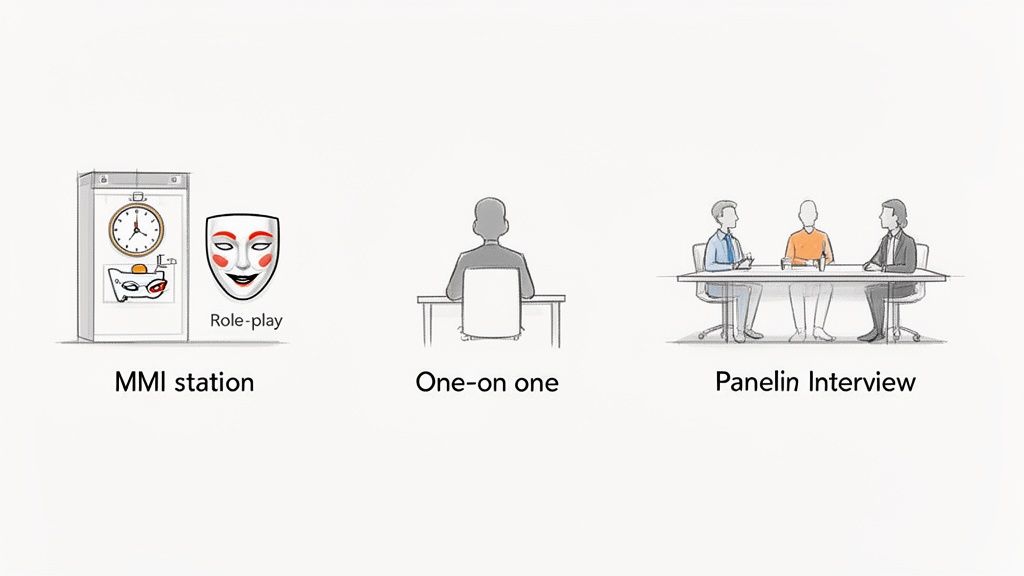
Think of it this way: the dynamic, scenario-based MMI is a sprint, the intimate one-on-one is a deep conversation, and the formal panel is a presentation. Your prep has to reflect these fundamental differences.
The Multiple Mini Interview (MMI)
Forget a friendly chat. The MMI is more like an obstacle course for your brain. You’ll rotate through a circuit of timed "stations," each with a unique prompt. The rhythm is fast: you'll get about two minutes to read the scenario before jumping into a room for a six-to-eight-minute interaction.
These stations are built to see how you think on your feet. You might encounter:
- Ethical Puzzles: You could be asked to weigh the ethics of organ allocation or a patient’s right to refuse life-saving treatment.
- Role-Playing Scenarios: These stations drop you into a situation with an actor. Your job might be to break bad news, mediate a conflict, or de-escalate a tense situation.
- Teamwork Tasks: You may be paired with another applicant to tackle a problem, like building something with weird materials, while an evaluator quietly watches how you collaborate.
The secret to the MMI isn't finding the "right" answer—it's showing your work. Evaluators want to see your thought process. Practice breaking down prompts, exploring different perspectives, and explaining your reasoning clearly, even when the clock is ticking. For a deeper dive, check out our guide with a list of common MMI interview questions and strategies for handling them.
The Traditional One-on-One Interview
This is the classic interview format you’ve probably seen in movies. It's a focused, personal conversation with a single interviewer—usually a faculty member, physician, or admissions officer—that lasts anywhere from 30 to 60 minutes. The real goal here is simple: to get to know you.
Expect questions that dig into your story and what drives you. You’ll need to reflect on your experiences, explain why you’re drawn to medicine, and make a compelling case for why you belong at their specific program. Authenticity is everything.
Answering staples like "Why our school?" or "Tell me about yourself" requires more than just a canned response. Your mock interviews should be spent honing a narrative that genuinely connects your journey to that school's mission, research focus, or community values. You have to prove you’ve done your homework and that your interest is real.
The Panel Interview
Take a traditional interview and add a few more sets of eyes—that’s the panel interview. You'll face multiple interviewers at once, often a mix of faculty, current students, and even community members. This setup is a pressure test for your ability to connect with a diverse audience while staying composed.
The main challenge is commanding the room. When you answer, make a point to connect with each person on the panel, not just the one who asked the question. It’s a small thing, but it shows you can communicate effectively with a group—a critical skill for any doctor.
Being able to build rapport with multiple people at once is a core skill tested in panel interviews. Your practice should mimic this. Try presenting your answers to a small group of friends or family to get comfortable managing divided attention.
The rise of virtual interviews has added a new layer to all these formats. A multi-year analysis found that applicants who interviewed virtually had a 48% 'offer of acceptance efficiency' compared to 44% for those on-campus. Because MMIs and virtual panels demand quick thinking and clear communication under pressure, practicing with similar constraints is more important than ever.
Setting Up Your Practice Arena
The whole point of a mock interview is to make it feel real. To get the most out of every single session, you need an environment that simulates the pressure and professionalism of the actual event. This is about more than just finding a quiet room—it's about building your own personal simulation center.
For most applicants now, that means mastering the virtual setup. With so many schools using remote interviews, your digital presence is your first impression. A grainy camera, weird lighting, or a chaotic background can send the wrong message before you even say a word.
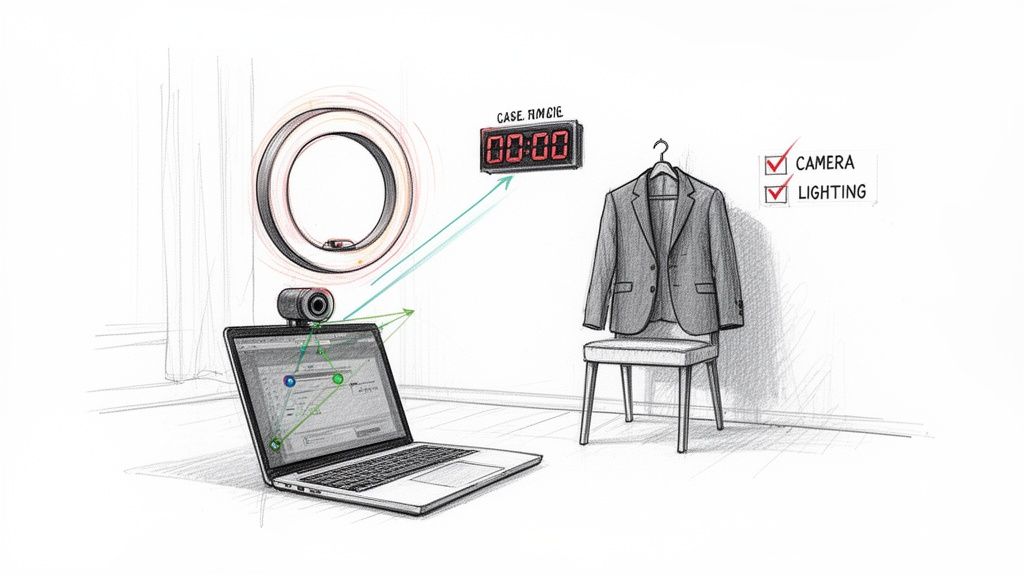
Treat your practice space like a stage where you’re the main event. Every detail helps build the muscle memory you'll need for a polished, confident delivery on interview day.
Crafting a Professional Virtual Environment
Think of your virtual setup as your new handshake. It needs to be firm, confident, and professional. Before you even get to the questions, nail down your tech and surroundings.
First, your camera. Get it to eye level. This creates a natural, direct line of sight with your interviewer. Stacking a few books under your laptop is a simple, no-cost trick that works perfectly. You want them to feel like you're talking to them, not down at your keyboard.
Next up is lighting. Natural light is always best, so try to set up facing a window. If that’s not an option, a simple ring light is a game-changer. It gets rid of shadows and makes sure your expressions are clear and easy to read.
Finally, think about your background and audio. A neutral, uncluttered wall is your best bet—take down any distracting posters or clear away the clutter. And for audio, getting it right is non-negotiable. There are tons of guides that offer simple steps to improve audio quality online with basic gear. Your message has to land clearly.
Replicating Real-World Constraints
A great mock interview isn’t just about the tech. You have to simulate the psychological squeeze of the real thing. That means adding rules and constraints that mimic the actual interview format.
- Dress the Part: Seriously, wear the exact suit or outfit you plan to wear on the big day. It’s a small thing, but it has a huge psychological effect. It flips a switch in your brain from "casual practice" to "serious rehearsal."
- Source High-Quality Questions: Don't just google "med school interview questions." Find prompts that are specific to the formats you’ll be facing (MMI, panel, etc.). AI-powered platforms are fantastic for this, with massive libraries of MMI scenarios and ethical dilemmas.
- Embrace the Clock: Time pressure is what makes med school interviews so tough, especially the MMI. Strict timing forces you to be concise, structured, and sharp. Using a dedicated tool like an online MMI timer helps you perfectly simulate the station rotations and response windows.
A mock interview without a timer is just a conversation. The pressure of the clock is what separates casual practice from a true performance rehearsal. Get comfortable with that pressure now, so it doesn’t rattle you on game day.
By sticking to these rules every time, each practice run becomes exponentially more valuable. You’re not just memorizing answers; you’re conditioning yourself to perform under pressure.
The Advantage of AI Simulators
Practicing with advisors or friends is great, but let's be real—lining up schedules is a nightmare. This is where AI-driven simulators give you a massive leg up.
AI platforms offer practice on demand. You can run through an MMI circuit or a traditional interview whenever you have a free 30 minutes, no scheduling headaches required. This makes high-frequency, low-stakes practice possible, which is the secret to building real fluency and confidence.
Plus, an AI interviewer enforces time limits with perfect consistency and can generate an endless supply of new questions. This keeps you from just memorizing answers and forces you to actually practice your thinking process. It puts you in control of your prep, turning any quiet space into a powerful practice arena.
Nailing Your Delivery and Using Feedback to Get Better
Once you have your practice setup sorted, the real work begins. Answering the questions is just one part of the equation; how you answer them is often what separates a good applicant from a great one. It’s all about learning to structure your thoughts clearly under pressure and then using sharp feedback to polish every single aspect of your performance.
This is the part where you move from just knowing the material to communicating it with confidence and poise. You’re turning knowledge into a compelling story that actually connects with your interviewers.
Structuring Your Responses for Maximum Impact
When you're hit with a complex ethical dilemma or a deep personal question, it's incredibly easy to ramble. Having a mental framework is the secret to delivering a concise, logical, and memorable response. Different questions call for different structures.
For personal stories—especially when asked about challenges, growth, or accomplishments—the STAR method is your best friend. It gives you a simple narrative arc that keeps you focused.
- Situation: Briefly set the scene. ("While volunteering at a free clinic...")
- Task: What was your specific job or goal? ("...I was responsible for explaining medication side effects to a patient who didn't speak English.")
- Action: What exact steps did you take? ("I grabbed a translation app and drew simple diagrams to try and bridge the communication gap.")
- Result: What was the outcome and what did you learn? ("The patient nodded and showed they understood. It really drove home for me how crucial patient-centered communication is, no matter the barriers.")
For ethical scenarios, your thought process matters more than finding a single "right" answer. Show them how you think. Break it down: identify the core conflict, walk through the perspectives of everyone involved, weigh potential actions and their consequences, and then articulate your reasoned decision. This demonstrates maturity and a thoughtful, deliberate approach.
The Power of Recording and Self-Review
Here’s a non-negotiable tip for serious applicants: record your medical school mock interview sessions. It is the single most effective way to improve your delivery. It gives you an objective look at your performance that your own memory just can’t replicate.
Watching yourself on video can feel cringey at first, but it's where the most significant growth happens. In fact, research on med students prepping for residency interviews backs this up. One study found that students who reviewed recordings of their mock interviews saw a median 3-point improvement in their confidence scores. Those who just did traditional mocks without video feedback? Only a 1-point gain. If you're interested, you can read the full research on video-based feedback.
When you rewatch your recordings, don't just critique your answers. Look at your non-verbals. Are you making steady eye contact with the camera? Is your posture open and confident? Are your hand gestures adding to your point, or are you just fidgeting nervously? These details have a massive impact on the impression you leave.
Separating Content from Delivery in Your Feedback
To really improve, you have to analyze feedback by separating two key things: what you said (your content) and how you said it (your delivery). Both are critical, but you fix them in different ways.
A practice partner might say, "Your answer on healthcare policy felt a bit weak." That’s content feedback. The fix? Go brush up on that topic.
But if they say, "You used 'like' ten times and were talking a mile a minute," that’s delivery feedback. And this is where getting objective data is a game-changer.
Using AI for Unbiased Delivery Metrics
This is where AI-driven mock interview tools really shine. A friend can give you a general vibe about your pacing or filler words, but an AI simulator gives you the hard data. It can tell you:
- Your exact words-per-minute count.
- The precise number of filler words you used (um, uh, like, so).
- The percentage of time you held eye contact.
- A breakdown of your tone of voice.
This kind of quantitative feedback is unbiased and incredibly actionable. Seeing that you average 180 words per minute when the ideal is closer to 150 gives you a concrete goal. Knowing you said "um" 12 times in a two-minute answer makes the problem impossible to ignore. This data-driven approach creates a tight feedback loop, letting you make measurable improvements with every practice session. When you combine human feedback on your stories with AI feedback on your delivery, you get the complete picture of your performance.
Turning Feedback Into a Concrete Improvement Plan
Getting feedback after a mock interview is just the start. Raw critique—whether from a pre-health advisor or an AI simulator—is useless until you turn it into a clear, actionable plan. This is where the real work, and the real progress, begins.
The first step can be a little uncomfortable, but it’s absolutely crucial: record and review your sessions. Watching yourself on camera gives you an unfiltered look at your own performance. You'll finally see the nervous fidgets, the moments your eye contact drops, and the subtle shifts in tone that you would otherwise completely miss.
This self-review is your most powerful diagnostic tool. It moves you from feeling like you did okay to knowing exactly where you shined and where you stumbled.
Deconstructing Your Performance
Once you’ve braced yourself for the playback, it’s time to get analytical. Don’t just watch your mock interview; dissect it. Transcribing your answers, either by hand or with an automated tool, can be incredibly revealing. Reading your own words on a page helps you spot rambling answers, weak transitions, and crutch words you didn't even know you had.
As you gather this data, a practical guide on how to analyze interview data can be a game-changer. A systematic approach is what allows you to move beyond gut feelings and into evidence-based adjustments that actually work.
Your goal isn't just to find mistakes but to identify patterns. Are you consistently rushing through MMI ethical scenarios? Do your answers about personal experiences lack a clear narrative? Finding these themes is the key to targeted improvement.
With your notes and transcripts in hand, start categorizing the feedback. This keeps you from feeling overwhelmed and helps you focus your energy where it will have the biggest impact.
Your categories might look something like this:
- Content Weaknesses: Lacking depth on healthcare policy or struggling to articulate your research.
- Structural Issues: Forgetting to use the STAR method for personal stories, leading to disorganized answers.
- Delivery Problems: Speaking too quickly (e.g., over 190 words per minute), using filler words like "um" and "like," or having poor non-verbal cues.
- Timing Challenges: Consistently running out of time in MMI stations or, just as bad, finishing way too early.
This diagram shows the simple but powerful loop of responding to a prompt, recording it, and then analyzing your performance.
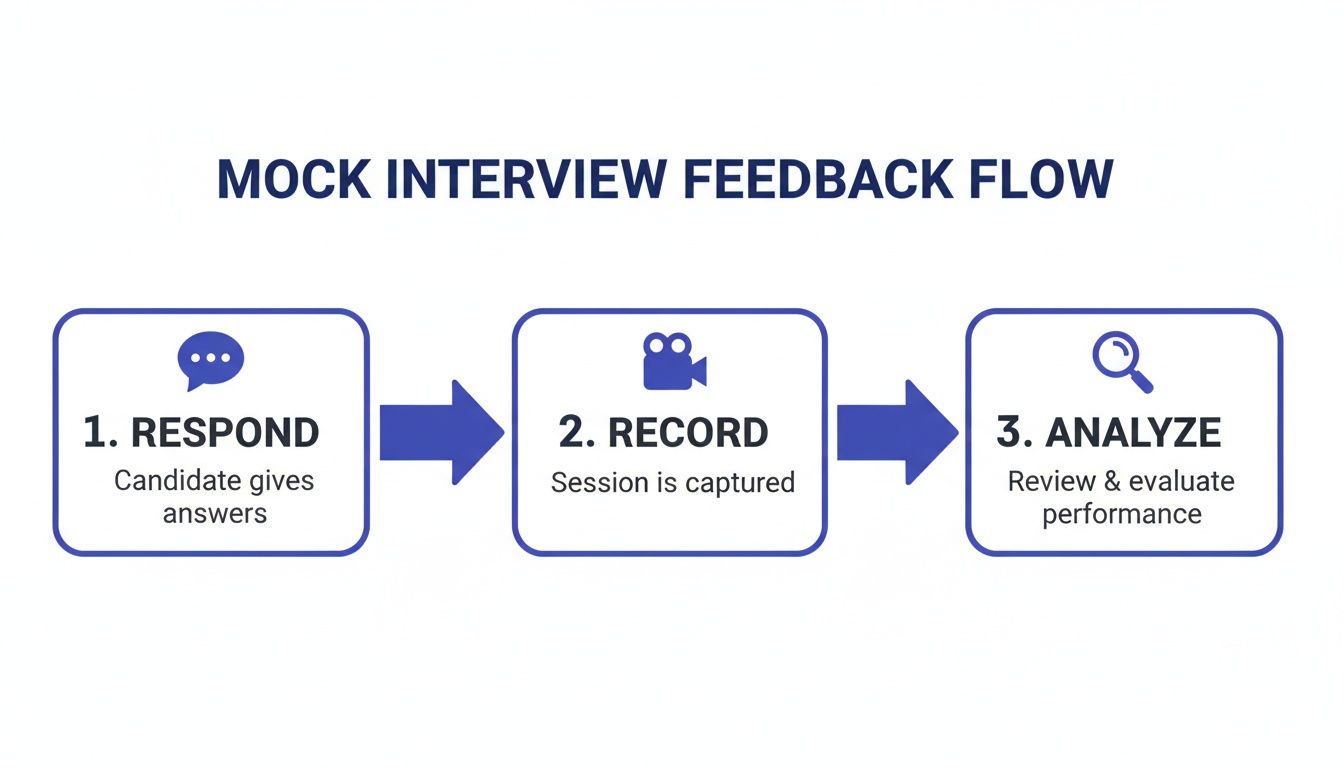
Each step feeds directly into the next, creating a cycle of continuous, targeted improvement.
From Analysis to Actionable Drills
With your weaknesses identified and sorted, you can now build specific drills to fix them. A vague goal like "get better at interviews" is useless. Instead, you need a targeted practice routine based on your analysis. This is how you guarantee that every practice session makes you tangibly better.
Here’s what that looks like in practice:
| Identified Weakness | Targeted Drill |
|---|---|
| Rambling answers | Practice answering three "Why medicine?" variations, forcing yourself to finish each response in under 90 seconds. Record and transcribe to check for conciseness. |
| Poor MMI timing | Run a circuit of five MMI stations every morning with a timer. Focus only on hitting the two-minute prep and eight-minute response windows, even if the answer quality isn't perfect at first. |
| Overuse of filler words | Record yourself talking about a simple topic for one minute. Re-record it, aiming to cut your "um" count in half. Repeat until the habit starts to fade. |
This systematic approach turns abstract feedback into a concrete training regimen. It builds genuine, evidence-based confidence because you’re not just hoping you'll improve—you're actively working on a plan designed to make it happen. You're building the skills and muscle memory needed to walk into your real interview prepared, polished, and ready to perform.
Your Top Mock Interview Questions, Answered
Even with a solid game plan, it’s normal to have a few nagging questions. Let’s clear up some of the most common things applicants wonder about so you can practice with total confidence.
How Many Mock Interviews Should I Actually Do?
There’s no magic number here—it’s all about quality over quantity. The point isn't to memorize a script; it's to get so comfortable with the format that you can be adaptable and think on your feet.
As a rule of thumb, aim for 5-10 high-quality sessions.
Your first mock is a diagnostic—it’s just there to give you a baseline. From there, use the feedback to run shorter, focused drills on your weak spots, whether that’s MMI timing or getting your personal stories down to a compelling two minutes. Finally, run a couple of full-length simulations to build stamina. You'll know you've hit the sweet spot when the whole process starts to feel natural.
Is It Better to Practice with a Person or an AI Simulator?
Honestly? You need both. A hybrid approach is, by far, the most effective strategy because each tool gives you something different.
A human advisor—a pre-health mentor, a career coach, even a trusted professor—provides the perspective an algorithm can't. They can tell you if your stories are truly connecting, if your tone feels genuine, and what kind of overall impression you’re making. That human gut-check is invaluable.
But AI simulators are absolute workhorses for the other stuff:
- Accessibility: You can practice at 2 AM if you want. There are no scheduling conflicts, which means you can get in a high volume of reps.
- Consistency: An AI is a perfect timekeeper. It will enforce the rules with ruthless accuracy every single time, which is exactly what you need for MMI prep.
- Objective Data: You get unbiased, hard numbers on your filler words, speaking pace, and eye contact—metrics a person just can't track accurately.
Think of it this way: Use AI for the heavy lifting and the data-driven reps. Save your human mocks for fine-tuning the qualitative feedback and getting a final polish.
What Are the Biggest Mistakes Applicants Make in Mocks?
The most common mistake, hands down, is not taking the simulation seriously. If you show up in a hoodie, don’t silence your phone, or ignore the timer, you’re only cheating yourself. The entire value of a mock interview comes from replicating the pressure of the real deal.
Another huge error is obsessing over the content of an answer while completely forgetting about the delivery. Admissions committees aren't just listening to what you say; they're evaluating how you say it. Your confidence, your clarity, and your non-verbal cues are just as important.
Answering the question correctly is table stakes. The real test is whether you can communicate that answer with the poise and professionalism of a future physician.
How Do I Prepare for School-Specific Questions?
This is where you prove your interest isn't just superficial. You have to go way beyond a quick scan of the school’s homepage. A great starting point is to work through a medical school interview question bank that includes prompts for specific schools.
Get into the details. Find the specific research labs, community clinics, or unique curriculum tracks that genuinely excite you and align with your own story.
Instead of saying, "I'm interested in your research," you need to be able to say something like, "I was fascinated by Dr. Smith's work on neuro-inflammation, as it directly connects with my undergraduate research in immunology." That level of specificity shows you've done your homework and can truly see yourself thriving in their community.
Ready to turn practice into performance? Confetto provides an AI-powered platform with a massive library of questions and instant, data-driven feedback to help you ace your interview. Start your free trial at https://confetto.ai and build the confidence you need for interview day.