
Updated · Published
How Long Is the MCAT? Test Day Schedule and Breaks
How long the MCAT takes: 6 hours 15 minutes of testing, about 7.5 hours seated with breaks, section times and question counts, plus pacing tips for test day.

The MCAT takes about 7.5 hours from the moment you sit down: 6 hours 15 minutes of testing across four sections and 230 questions, plus three optional breaks (50 minutes) and about 22 minutes of check-in screens, tutorial, void question and survey. That adds up to 7 hours 27 minutes seated, per the AAMC's What's on the MCAT Exam? (checked October 2026). Arrive at least 30 minutes early for check-in.
After test day, the next big step is the interview, and Confetto, an AI mock interviewer for medical school and other healthcare program interviews (MMI, traditional, panel), lets you practice medical school interviews out loud with follow-up questions.
Your MCAT Test Day Timeline at a Glance
Getting a handle on the entire MCAT day is just as important as knowing the content. Think of it less like a sprint and more like an endurance race. While the exam itself is a marathon of critical thinking, the day includes built-in breaks and procedures that add up. It’s not just about acing the questions; it's about managing your energy from check-in to the final click.
This visual breaks down how your day is structured, showing the balance between pure testing time and those crucial breaks.
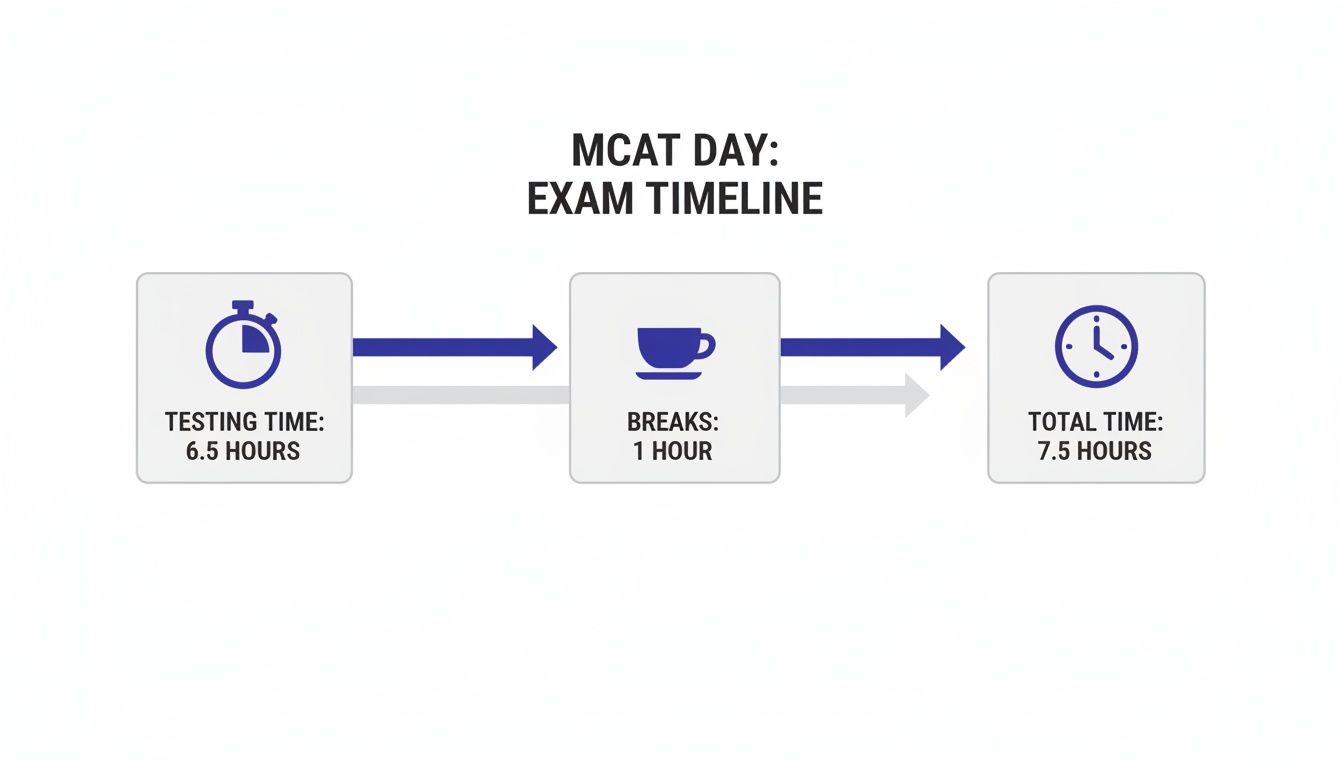
As you can see, those breaks aren't just an afterthought—they're a significant part of the schedule designed to help you recharge and maintain focus.
The Full Commitment: It's More Than Just Seat Time
While the official timer for the exam sections totals 6 hours and 15 minutes, your total "seated" time at the test center stretches to 7 hours and 27 minutes with breaks and instructions. Realistically, when you account for travel, check-in, and check-out, you’re looking at a 9- to 10-hour commitment.
Preparing for a day this long is a skill in itself. The best way to build the stamina you'll need is to simulate the full 7.5-hour experience during your practice tests. It trains your brain and body to stay sharp from the first question to the very last.
To give you a quick, digestible summary of the day's components, here's a simple breakdown.
MCAT Test Day At a Glance
| Component | Duration |
|---|---|
| Testing Time | 6 hours, 15 minutes |
| Scheduled Breaks | 50 minutes |
| Tutorials & Admin | 22 minutes |
| Total Seated Time | 7 hours, 27 minutes |
This table gives you the hard numbers, but mastering your pacing requires a deeper dive into what happens during each block of time. If you're looking for more pre-med strategies, explore our comprehensive resource hub.
Breaking Down the MCAT: A Section-by-Section Guide to Timing and Questions
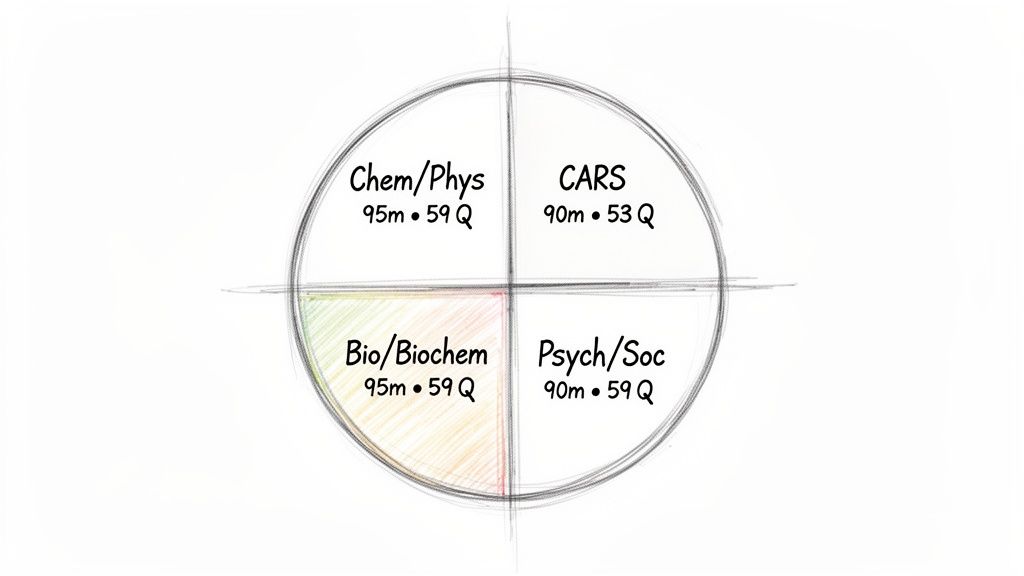
Think of the MCAT less like a single, marathon sprint and more like a four-quarter game. Each "quarter," or section, comes with its own rules, clock, and style of play. Mastering the timing and question count for each part is the absolute first step to building a solid, sustainable pacing strategy for test day.
The exam starts with a heavy science focus, kicking off with Chemical and Physical Foundations of Biological Systems, then shifting gears to the unique challenge of Critical Analysis and Reasoning Skills (CARS). After a much-needed longer break, you’ll dive back in for Biological and Biochemical Foundations of Living Systems before finishing with Psychological, Social, and Biological Foundations of Behavior.
The First Half: Chemistry and Critical Reasoning
The first two sections really set the tone for your entire test day. They demand very different kinds of thinking, testing your scientific recall and application in one breath and your pure reasoning skills in the next.
- Chemical and Physical Foundations of Biological Systems (Chem/Phys): This is where you start. You get 95 minutes to tackle 59 questions. Success here depends on your ability to quickly apply fundamental physics and general chemistry principles to living systems. It’s all about connections.
- Critical Analysis and Reasoning Skills (CARS): Next up, you have 90 minutes for 53 questions. CARS is the outlier. It doesn't test any prior knowledge—just your raw ability to dissect dense, often tricky passages and analyze the arguments within them.
To get a clearer picture of how this breaks down, let's look at the numbers.
MCAT Section Timing and Question Count
Here’s a simple table laying out exactly what to expect from each of the four content sections of the MCAT.
| Section Name | Time Allotted | Number of Questions |
|---|---|---|
| Chemical and Physical Foundations of Biological Systems | 95 Minutes | 59 Questions |
| Critical Analysis and Reasoning Skills (CARS) | 90 Minutes | 53 Questions |
| Biological and Biochemical Foundations of Living Systems | 95 Minutes | 59 Questions |
| Psychological, Social, and Biological Foundations of Behavior | 95 Minutes | 59 Questions |
Knowing these numbers helps you calculate your average time per question—a critical metric for practice. For the three science sections, you're looking at roughly 96 seconds per question. For CARS, you have a little more breathing room at about 102 seconds per question to account for the dense reading.
The Second Half: Biology and Behavioral Sciences
After the long midway break, you pivot to the intricate world of living organisms and human behavior. This is where your mental stamina truly gets put to the test as you push through the final two blocks.
- Biological and Biochemical Foundations of Living Systems (Bio/Biochem): Just like the first section, you get 95 minutes for 59 questions. This beast covers everything from the molecular level up to complex organ systems.
- Psychological, Social, and Biological Foundations of Behavior (Psych/Soc): The home stretch. This last section mirrors the others in format, giving you 95 minutes for 59 questions on introductory psychology and sociology.
Nailing the pacing on these sections is just as important as knowing the content. Using a top-tier MCAT question bank is a great way to simulate test-day conditions and build that essential timing intuition.
Navigating Your Test Day from Arrival to Submission
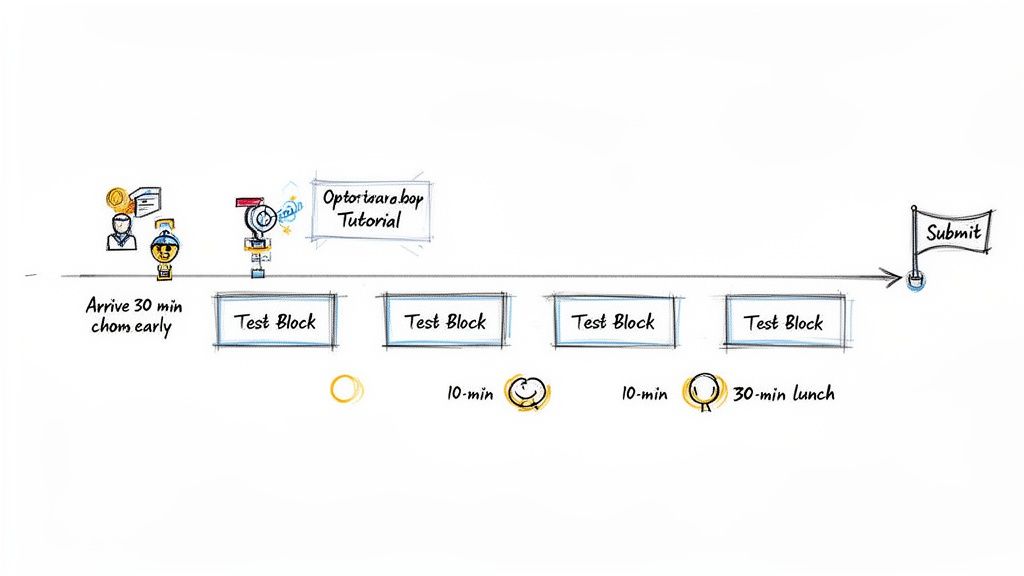
Knowing the section times is one thing, but picturing how the entire day unfolds is another. The MCAT is a marathon, and your test day is more than just sitting down for the exam—it’s a carefully choreographed sequence of events designed for security and fairness. Let's walk through what to expect, from the moment you arrive until you finally click "submit."
Think of the entire experience as a race day. You don't just show up at the starting line. You have to check in, warm up, and get in the zone. That's why you need to plan on arriving at your Pearson VUE testing center at least 30 minutes before your scheduled start time. This buffer is essential. Trust me, you’ll need it.
The Check-In and Security Protocol
Once you walk through the door, you’ll show a valid photo ID and be directed to stash your personal items—phone, wallet, snacks—in a secure locker. From there, the test administrators will walk you through a security check that includes a palm vein scan.
This isn't a one-and-done security measure. This biometric scan is your digital signature for the day. You’ll use it every single time you enter or leave the testing room, even just for a quick bathroom break.
After you're cleared, you'll be shown to your testing station. Before the clock starts on the first section, you have a couple of brief administrative tasks to complete:
- AAMC Candidate Rules Agreement: A 5-minute review of the test-day rules and regulations.
- Optional Tutorial: A 10-minute walkthrough of the exam software. Even if you've done practice tests, this is a great, low-stakes way to get comfortable with the interface and calm your nerves.
Mapping Out the Testing Blocks and Breaks
The main event is structured around four intense testing blocks, with crucial breaks in between. These breaks are your pit stops—they’re non-negotiable for refueling your body and resetting your mind.
Here's the play-by-play for the day:
- Chem/Phys Section: 95 minutes
- Optional Break: 10 minutes
- CARS Section: 90 minutes
- Optional Lunch Break: 30 minutes
- Bio/Biochem Section: 95 minutes
- Optional Break: 10 minutes
- Psych/Soc Section: 95 minutes
A crucial heads-up: The timer for your break doesn't start until after you’ve gone through the security check-out process. Factoring in the palm scan and signing out might eat up a minute, so plan accordingly. Use every second of these breaks to stretch, eat, and clear your head.
Once you’ve conquered that final section, you're almost done. The system will present you with an option to void your exam (don't worry, you'll be prepared and won't need it!), followed by a brief survey. Adding it all up, from check-in to final submission, you see that the question "how long is the MCAT" is really about endurance just as much as it is about knowledge.
The Story Behind the MCAT's Length
If the current MCAT feels like a marathon, that's by design. Its length isn't some arbitrary number; it's the result of a deliberate, strategic evolution. The exam you’re facing today is a completely different beast than the one your older siblings or mentors might have taken, thanks to a massive overhaul in 2015 that reshaped its entire structure.
Before that pivotal year, the MCAT was a paper-and-pencil test that could drag on for a grueling 8-9 hours. The Association of American Medical Colleges (AAMC) made the switch to the current computer-based format to better mirror the skills you'll actually need in medical school. You can dig into the full timeline and see the major milestones on the Medical College Admission Test history page.
This snapshot from Wikipedia lays out the key dates and shows just how much the exam has adapted over time to keep pace with modern medical education.
More Than Just a Time Limit
So, what prompted such a big change? The 2015 update was about far more than just moving the test onto a computer. It introduced the Psychological, Social, and Biological Foundations of Behavior section and redesigned the other three to reward integrated reasoning over brute-force memorization.
The AAMC’s goal was clear: to craft an exam that reflects the kind of interdisciplinary problem-solving you’ll do every day in medical school and as a physician. The length is a direct consequence of that comprehensive vision.
This shift means the current exam’s duration is built to test two things at once: your scientific knowledge and your ability to apply it, under pressure, for a long stretch. Think of it as a simulation of the mental stamina required for a demanding medical career.
Here’s a quick rundown of the before-and-after:
- Format: Flipped from old-school paper-and-pencil to a fully computer-based test.
- Content: A whole new section—Psych/Soc—was added to bring in the behavioral sciences.
- Focus: The emphasis moved away from just remembering facts to critically analyzing information and applying it to real-world scenarios.
Knowing this history helps reframe the question from a simple "how long is the MCAT?" to understanding why it's that long. It's a carefully calibrated measure of your readiness for the challenges ahead.
Mastering Your Pacing and Stamina for Exam Day
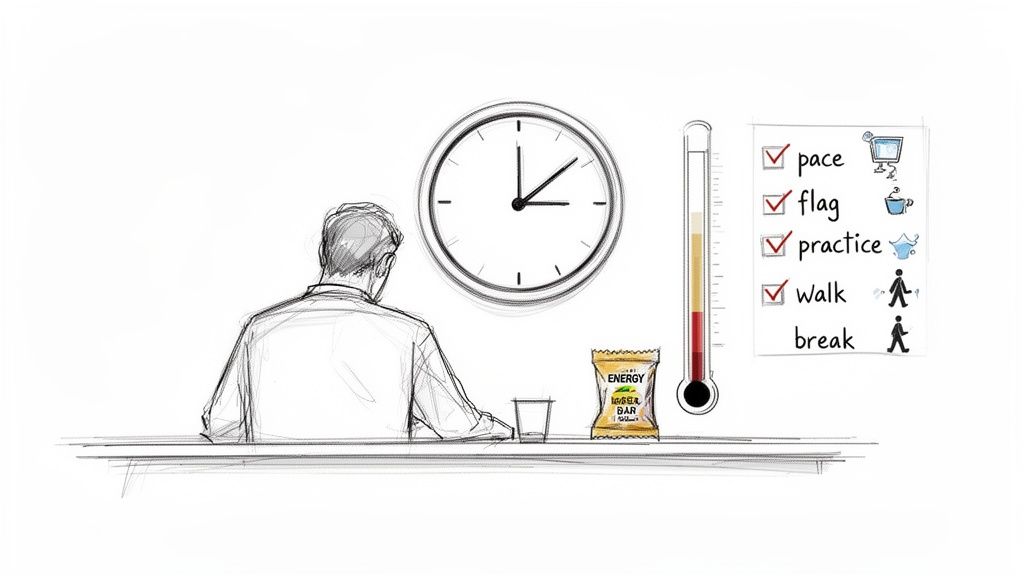
Knowing the MCAT schedule is step one. Actually mastering it is what unlocks a great score. Think of the exam as a mental marathon, not a sprint. The ability to perform at your peak for over six hours is a skill you have to train just as hard as any science concept.
The single best way to build this kind of endurance? Simulate the real thing. This means taking full-length practice exams under conditions that feel just like test day. It’s not just about getting questions right; it’s about training your brain to know what 95 minutes of intense focus feels like, back-to-back.
Developing Your Race Day Strategy
Your goal is to walk into the testing center so prepared that the real MCAT feels like just another practice run. This requires a conscious strategy for managing your time, energy, and focus from the very first question to the last.
A huge part of this is learning to let a tough question go. It feels counterintuitive, but spending too much time on one problem can completely derail your pacing for an entire section. Get comfortable using the "flag for review" feature and moving on. You can always come back.
Here are a few proven techniques to build your test-day resilience:
- Practice Full-Length Exams Weekly: In the last six weeks of your prep, schedule one full-length AAMC practice test each week. Start it at the same time as your actual exam and take your breaks just as you would on the real day.
- Analyze Your Pacing: After every practice test, review your timing. Where did you rush? Where did you get bogged down? Identifying your patterns is the first step to fixing them.
- Strategize Your Breaks: Don't just wing it. Plan exactly what you'll eat and drink during your breaks. Have a routine ready, whether it's a few quick stretches or a mindfulness exercise to reset your focus.
Remember, the MCAT is designed to test your mental endurance just as much as your scientific knowledge. How sharp you are in hour six is every bit as important as how you perform in hour one.
Fine-Tuning Your Approach
As your test date gets closer, your focus should naturally shift from content gaps to tactical execution. For instance, in the science sections, you have roughly 96 seconds per question. Timing yourself on practice sets helps internalize this rhythm until it becomes second nature.
Even tools designed for other purposes can help. For example, an MMI timer used for medical school interviews can be repurposed to practice staying on track with timed question blocks, building that crucial sense of pace.
Ultimately, understanding the MCAT's length is about preparing your mind and body for its demands. By simulating the full experience, you're training yourself to not just start strong, but finish strong, too.
Frequently Asked Questions About MCAT Timing
How long is the MCAT if it starts at 8 a.m.?
If you sit down at 8:00 a.m. and take every break, you will finish at about 3:30 p.m., since the full schedule is 7 hours 27 minutes. Check in by 7:30 a.m.
How many questions are on the MCAT?
230: 59 in Chemical and Physical Foundations (95 minutes), 53 in CARS (90 minutes), 59 in Biological and Biochemical Foundations (95 minutes) and 59 in Psychological, Social, and Biological Foundations (95 minutes).
Are the MCAT breaks optional?
Yes. There is an optional 10-minute break after the first section, a 30-minute break after CARS and a 10-minute break after the third section. Take them anyway: skipping a break saves no testing time and leaves you more tired for the last sections.
Does unused time carry over to the next section?
No. Time left at the end of a section can only be used to review that section. Once you end it, the next section starts with its own full timer.
Can I get extra time on the MCAT?
Yes, with approved accommodations. Test-takers with a documented disability apply through the AAMC well before test day. If approved, accommodations can include:
- 1.5x or 2x the standard testing time
- Additional or longer breaks
- Other aids based on your specific needs
Planning the rest of your application? See the classes medical schools require, what GPA you need and what percent of applicants get in.
Getting these rules straight demystifies the process, letting you focus on what really matters—showing them what you know.
Preparing for med school interviews is just as critical as acing the MCAT. Confetto offers an AI-powered platform to help you master the MMI, panel, and traditional interview formats with realistic simulations and instant, actionable feedback. Build your confidence and perfect your delivery by practicing with us at https://confetto.ai.