
How to Improve Interview Communication Skills and Succeed
Learn how to improve interview communication skills with actionable strategies for verbal delivery, nonverbal cues, and strategic AI-powered practice sessions.
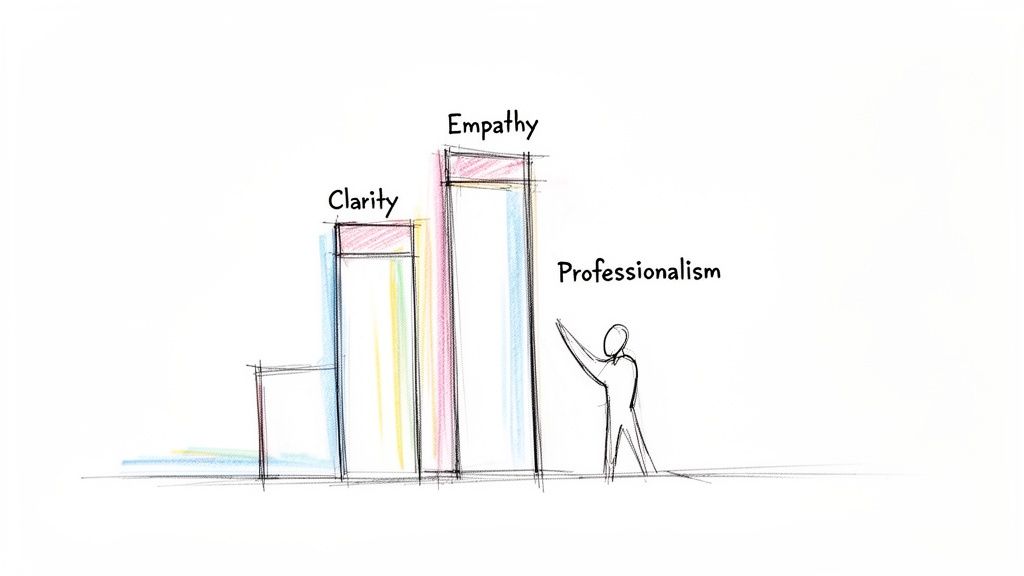
If you want to get better at communicating in your interviews, you need to zero in on three core skills: clarity in your answers, empathy in how you deliver them, and professionalism in your overall presence. This isn't about generic practice. It’s about breaking down the skill into manageable pieces and using targeted drills with real feedback to fix what’s not working.
Understanding the Foundations of Interview Communication
Nailing your communication in a high-stakes healthcare interview isn't about memorizing scripts or finding the "perfect" answer. It's about building a genuine connection with your interviewers while showing them you're competent and can handle the pressure.
Think of it less as a performance and more as a structured, professional conversation.
The applicants who really stand out are the ones who balance key competencies. Admissions committees are looking for more than just smarts; they want future colleagues who can communicate with both compassion and precision. The same principles that matter in your personal life—like learning how to communicate better in relationships—are foundational here, too.
The Three Pillars of Effective Communication
To build a strong foundation, we need to deconstruct what "good communication" actually means in this context. Focusing on these three domains helps you target your practice and understand what interviewers are really looking for.
Clarity: Can you structure your thoughts logically and say them concisely? This means no jargon, no filler words, and a narrative that’s easy to follow.
Empathy: This is all about showing you understand other people’s perspectives, especially in tricky ethical dilemmas or patient scenarios. It’s about proving you can connect on a human level, not just an intellectual one.
Professionalism: This covers everything from your nonverbal cues—your posture, your eye contact—to your tone of voice and how well you listen. It signals respect for the interview, the interviewers, and your future profession.
Many applicants stumble on the empathy component because it's notoriously difficult to fake. Research actually backs this up, showing that while medical students are often great at introductions and being responsive, they fall short when it comes to demonstrating genuine empathy and support.
This is exactly why structured, domain-specific practice is so critical. Data suggests it can accelerate skill development by 40-50% compared to just winging it with unstructured run-throughs.
The goal isn't to become a different person for the interview. It's to become the most effective and authentic communicator you can be. That means leaning into your natural strengths and systematically addressing your weaknesses through deliberate practice.
Generic practice usually fails because you don't get targeted feedback. You can rehearse an answer a dozen times but never realize you're talking too fast, avoiding eye contact, or coming across as robotic instead of empathetic.
A structured approach, on the other hand, lets you isolate one skill at a time. You can drill it with specific prompts, get concrete feedback, and see measurable improvement. This turns a huge, daunting task into a series of small, manageable steps, setting you up for a confident and compelling interview.
To help you get started, here's a quick breakdown of these core skills, the common ways applicants miss the mark, and a simple tip you can use right now to improve.
Key Communication Domains and Quick Improvement Tips
| Communication Domain | Common Pitfall | Quick Improvement Tip |
|---|---|---|
| Clarity | Rambling or getting lost in details without a clear point. | Use the "PREP" Method: State your Point, give a Reason, provide an Example, then restate your Point. |
| Empathy | Stating an empathetic principle ("I would be empathetic") instead of showing it. | Use Feeling Words: Instead of saying "That's tough," try "That sounds incredibly stressful" or "I can see how that would feel isolating." |
| Professionalism | Poor eye contact, fidgeting, or using a flat, monotone voice. | Record Yourself: Do a 2-minute mock answer and watch it back. Focus only on your body language and tone—ignore the words. |
By breaking down your communication this way, you can move from just "practicing" to actively building the specific skills that will make a real difference on interview day.
Refining Your Verbal Delivery and Content
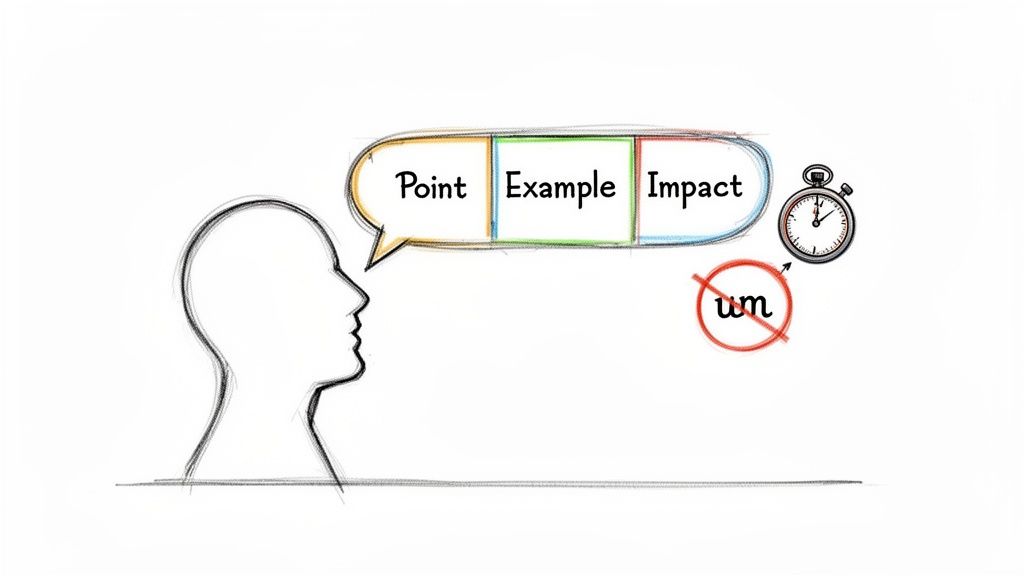
Strong content is only half the battle. Your delivery is what makes that content land with impact. Polished verbal communication signals maturity and thoughtfulness, turning a good answer into a great one. This means mastering the structure of your responses, controlling your speech, and making every word count.
When applicants get nervous, they tend to ramble, burying their core message in a sea of details. The solution isn't just knowing what you want to say—it's having a simple, repeatable framework that brings order to your thoughts, especially when the pressure is on.
Structuring Your Stories for Impact
Every answer you give, especially in response to behavioral or ethical questions, should tell a concise story. A powerful way to structure these stories is to build them around a clear narrative arc.
- Set the Scene: Briefly provide the context. What was the situation or the dilemma? Keep this part tight—just enough to orient the listener.
- Describe Your Action: This is the heart of your answer. Detail the specific steps you took and, more importantly, why you took them. This is your chance to reveal your thought process.
- Explain the Outcome or Reflection: Wrap up by explaining what happened as a result of your actions. What did you learn from the experience? How has it shaped your approach since?
This simple structure transforms a basic anecdote into a compelling demonstration of your skills and values. When you practice, don't just think about what to say; think about how you’ll package it for maximum clarity.
The most memorable candidates don't just list accomplishments; they narrate their experiences. They guide the interviewer through their reasoning, showing maturity and self-awareness in every answer.
Eliminating Fillers and Mastering Pace
Filler words—the dreaded "ums," "ahs," and "likes"—are confidence killers. They can make you sound hesitant and unprepared, even if you know your material cold. The best way to get rid of them is to replace them with something far more powerful: a strategic pause.
A brief, two-second silence before you answer a complex question gives you a moment to gather your thoughts. To the interviewer, it projects thoughtfulness and control, not uncertainty.
Here’s a practical drill to try right now:
- Set a Timer: Record yourself answering a question for exactly one minute. Feel free to grab one from our guide on common healthcare interview questions and answers.
- Transcribe and Analyze: Listen back and count every single filler word. Also, note your pacing. Were you rushing, or was your speech measured and conversational?
- Repeat and Refine: Do it again, but this time, focus only on replacing every filler word with a deliberate pause.
This kind of focused practice rapidly improves your delivery. A study on communication training found that healthcare professionals gained significant confidence after just one session of structured role-play. This hands-on simulation is proven to transform communication skills quickly. Read about how structured practice boosts confidence. Consistent, targeted drills are how you build the muscle memory for clear, polished communication.
Mastering Nonverbal Cues and Body Language
What you say in an interview is critical, but how you say it—without a single word—often leaves a more lasting impression. Your body language broadcasts confidence, engagement, and professionalism before you even start your answer. When you get these nonverbal signals right, your physical presence powerfully reinforces your verbal message.
Think about it: most of our communication is nonverbal. That means interviewers are constantly, and often subconsciously, gathering information from your posture, eye contact, and gestures. Any misalignment between your words and your body sends a mixed signal. For example, you can talk all day about your passion for patient care, but if you’re slouched with your arms crossed, the message just doesn't land.
Projecting Confidence Through Posture
The way you carry yourself is the bedrock of strong nonverbal communication. It starts with adopting an open and engaged posture. Sit upright, with your shoulders relaxed and back, not hunched over or slumped in your chair.
An open posture is key. Keeping your arms uncrossed and resting them naturally on the table or your lap signals that you're receptive and approachable. It's a simple tweak that makes a huge difference, making you appear more collaborative and sure of yourself. Try to avoid fidgeting—tapping your feet, clicking a pen, or twisting in your chair. These nervous habits can distract your interviewer and suggest you lack composure.
Remember, the goal is to appear calm and collected, even if you’re fighting nerves on the inside. An engaged posture actually helps trick your brain into feeling more confident, creating a positive feedback loop that lifts your entire performance.
Using Eye Contact and Gestures
Building rapport depends heavily on maintaining natural, consistent eye contact. It shows you're actively listening and are fully present in the conversation. You don't want to stare them down, of course. Aim for a comfortable gaze that you hold for a few seconds at a time, especially when the interviewer is speaking.
Hand gestures, when used well, are tools to add energy and dimension to your stories. Use them purposefully to emphasize key points. A good rule of thumb is to keep your gestures within the frame of your torso—anything too wide or erratic becomes distracting rather than effective. For a deeper dive, check out these essential interview body language tips to really fine-tune your approach.
Adapting Nonverbals for Virtual Interviews
In a virtual interview, your nonverbal cues get magnified. Your on-screen presence is the only physical impression you can make, so deliberate practice here is even more important.
- Camera at Eye Level: Position your camera so you're looking straight ahead. Looking down into a laptop camera can make you seem disengaged, while looking up at it can feel unnatural and awkward.
- Frame Yourself Well: Make sure you are framed from the chest up. This lets interviewers see your posture and any hand gestures you use, which creates a much more dynamic and engaging presence.
- Look at the Lens: This is a big one. When you’re speaking, make a conscious effort to look directly into the camera lens, not at your own face on the screen. It’s the digital equivalent of direct eye contact, and it’s critical for building a strong connection.
Building a Strategic Practice Routine with AI
The secret to real improvement in your interview skills isn't just about putting in the hours. It’s about smart, targeted practice. While running through questions with a friend is helpful, building a routine with an AI tool gives you the kind of instant, objective feedback that used to require an expensive coach. This approach turns vague goals like "be more confident" into real numbers you can actually track and improve.
The whole idea is pretty straightforward: record yourself in a mock interview, look at the data, pick one specific thing to get better at, and then drill that skill in your next session. This creates a tight loop of practice, analysis, and refinement. You stop just "getting reps in" and start making every single session count.
The Record-Analyze-Improve Cycle
First things first, record yourself answering a prompt. Pull from a big question library to simulate a real MMI or panel interview. Don't aim for a perfect performance on this first take—the goal is just to get a baseline. Where are you starting from?
Once that's done, it's time to dig into the data. Modern AI platforms give you a ton of information that goes way beyond just the words you used. You get hard metrics on things like:
- Rubric Scores: See how you stack up on objective ratings for core competencies like empathy, communication, and professionalism.
- Filler Word Count: Get a precise count of every "um," "ah," and "like" that's creeping into your answers.
- Pacing and Tone: Find out if you're rushing through your points or if your delivery sounds flat.
This process highlights the key nonverbal cues that AI tools are particularly good at helping you analyze and master.
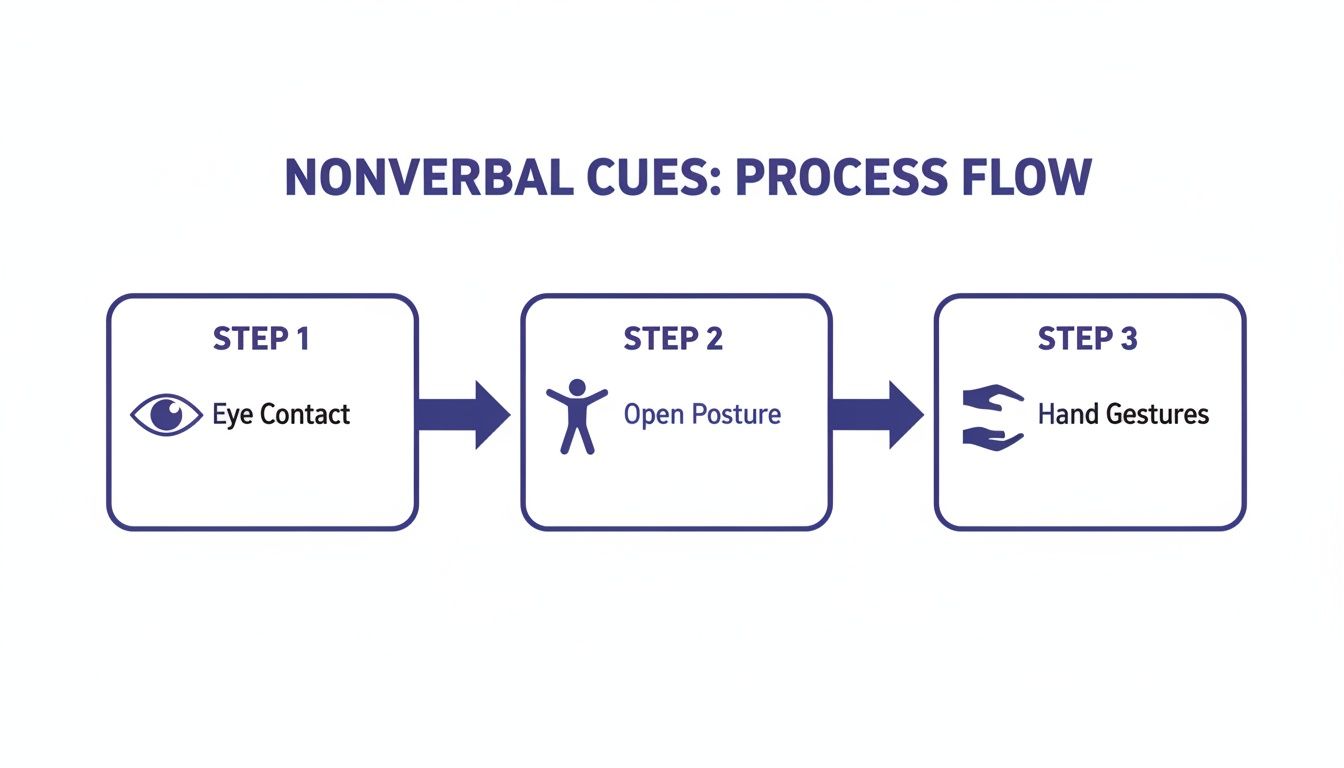
As you can see, mastering your eye contact, maintaining an open posture, and using purposeful hand gestures all work together to project confidence before you even say a word.
Now for the most important part: from all that data, pick one thing to focus on. Seriously, just one. Maybe your filler word count was higher than you thought, or your empathy score needs a boost. Whatever it is, dedicate your next mock interview to consciously improving that single metric. This focused approach is what keeps you from feeling overwhelmed and leads to much faster, more durable progress.
Structuring Your Weekly Practice
A solid practice routine needs both variety and focus. You don't want to get bored answering the same questions, but you absolutely need repetition to build new habits. AI tools make this easy by giving you a massive library of prompts to work with.
A structured weekly plan can make a huge difference. By assigning a specific focus to each day, you can methodically work on different aspects of your communication, from content and structure to delivery and nonverbals. Using an AI tool helps keep this process objective and data-driven.
Here’s a sample plan to give you an idea of what this looks like in practice.
Sample Weekly Interview Practice Plan Using AI
| Day | Focus Area | Activity (Using AI Prompts) | Goal |
|---|---|---|---|
| Mon | Baseline & Structure | Answer 2 ethical dilemma MMI prompts. Review AI feedback on structure and clarity. | Establish a baseline rubric score. Identify one structural weakness to target. |
| Tues | Content & Empathy | Tackle 2 "Why Medicine?" or personal motivation prompts. Focus on storytelling. | Improve empathy score by 5%. Weave in one specific personal anecdote. |
| Wed | Pacing & Filler Words | Record answers to 3 rapid-fire policy questions. Analyze pacing and word economy. | Reduce filler word count by 20%. Maintain a talking speed of 140-160 WPM. |
| Thurs | Nonverbal Cues | Practice a role-playing scenario (e.g., breaking bad news). Watch the video back. | Maintain consistent eye contact 80% of the time. Use 3-5 purposeful hand gestures. |
| Fri | Full Simulation | Complete a 4-station mock MMI. Review all feedback metrics together. | Integrate the week's skills. Aim for a 10% overall score improvement from Monday. |
By the end of the week, you not only have a better feel for your progress but also hard data to prove it. This cycle of targeted drills is what builds real, lasting confidence.
The biggest gains come from a deliberate, structured process. It’s not about how many hours you practice, but about the quality of feedback you get and how you apply it to the next rep.
This method isn't just theory; the data backs it up. One study showed that medical students who used AI simulations scored significantly higher on communication skills (28.1 points) compared to a control group (27.1 points). Even more telling, the students who started with lower scores saw the biggest jumps, proving that AI-powered feedback is incredibly effective at helping people level up.
If you really want to get granular, using the best transcription software for interviews can help you quickly turn your recorded answers into text. This makes it much easier to analyze your word choice and sentence structure with a critical eye.
Ultimately, by embracing a strategic, data-informed practice routine, you stop guessing and start building a clear path toward a confident, polished interview performance. You can check out the full suite of AI-powered feedback features that make this kind of targeted improvement a reality.
How to Avoid Common Interview Communication Mistakes
It happens to the best of us. Even the most buttoned-up applicants can fall into a few common communication traps during a high-stakes interview. The good news? Once you know what they are, you can spot them in your own prep and fix them before they ever see the light of day.
So many applicants get laser-focused on delivering the "right" answer that they end up sounding scripted, robotic, and just… off. The goal isn't to recite a perfect monologue; it's to have a thoughtful, authentic conversation. When an answer sounds too polished, it can kill any real connection with your interviewer.
The Over-Rehearsed Answer
This is the classic mistake. You’ve practiced a response so many times that it comes out flat, totally lacking the spark of a genuine conversation. This is especially common with pillar questions like "Tell me about yourself" or "Why this school?"
Here's what that can sound like:
Before: "I have always been passionate about medicine since I was a child. I excelled in my science courses, volunteered at a hospital for 200 hours, and conducted research in a biochemistry lab, all of which has prepared me for a rigorous medical education."
Technically, this isn't wrong. But it's generic. It's a checklist of accomplishments that reveals nothing about who you are or what truly drives you. Dozens of other applicants will give a nearly identical answer.
Let's try that again, but with a real story:
After: "My path to medicine really started in an unexpected place—working at a local library. I saw how language barriers prevented families from accessing basic community resources, which sparked my interest in health literacy. This led me to volunteer as a translator at a free clinic, where I saw firsthand how clear communication can directly impact patient outcomes."
See the difference? This version is personal and memorable. It tells a story that connects experiences to a core value, offering a glimpse of the person behind the resume.
Mismanaging Your Time
In formats like the Multiple Mini-Interview (MMI), managing the clock is a communication skill in itself. Each station is a sprint, usually lasting around eight minutes. A frequent blunder is spending way too much time on the preamble and not enough on the core of your response.
If you don't pace yourself, you'll either rush through your main point or, even worse, get cut off before you make it. It sends a signal to the interviewer that you might struggle to be concise and organized under pressure.
One of the most common yet avoidable mistakes is failing to listen. When you're nervous, it's easy to start formulating your response while the interviewer is still speaking, causing you to miss a key detail or the actual question being asked.
Active listening isn't just a nice-to-have; it's non-negotiable. After a prompt is given, take a beat. Pause and fully process what was asked before you launch into your answer. This simple habit ensures your response is relevant and directly addresses the question. Answering the wrong question, no matter how eloquently, is an immediate red flag.
To sharpen your interview communication, try focusing on these three areas:
- Practice Spontaneity: Instead of memorizing answers word-for-word, practice talking about your key experiences and ideas using different phrasing each time. The goal is to be flexible, not scripted.
- Use a Timer: When you're prepping for an MMI, always practice with a timer. Get a real feel for what two, five, and eight minutes feel like. You’ll be surprised how fast it goes.
- Listen First, Speak Second: Make it a conscious habit. Take a small, deliberate breath after a question is asked and before you begin to speak. That tiny pause can make all the difference.
Your Top Interview Communication Questions, Answered
Even with the best prep plan, nagging questions always pop up. Getting those sorted out builds confidence and helps you focus your practice where it really counts. Let's tackle some of the most common ones we hear from applicants.
How Often Should I Practice?
This is probably the number one question we get. While there's no single magic number, consistency always beats cramming.
Aim for three to four focused sessions a week, each lasting about 30-45 minutes. This schedule is sustainable, prevents burnout, and gives your brain time to actually absorb and hardwire new communication skills.
How Do I Deal with Nerves?
First, know that feeling anxious is totally normal—a little adrenaline can even sharpen your focus. The trick isn't to eliminate nerves but to manage them.
The single best way to do this is through repeated, realistic practice. When you simulate the interview environment over and over, you desensitize yourself to the pressure. What once felt like a high-stakes performance starts to feel like a familiar routine.
Pro tip for managing nerves in the moment: Try "box breathing." Inhale for four seconds, hold for four, exhale for four, and hold again for four. A single minute of this before your interview can slow your heart rate and clear your head.
Should I Change My Style for an MMI vs. a Panel Interview?
Great question. The core principles—clarity, empathy, professionalism—are universal. But how you apply them needs to shift based on the format.
- For MMIs: It's all about structure and time management. The stations are short, so you have to be ruthlessly concise. Your goal is to deliver a complete, well-reasoned thought process in under six minutes, period.
- For Panel Interviews: Here, the game shifts to building rapport over a longer stretch. You have more room to let your personality show and engage in a real conversation. Connecting your personal story to the school's mission becomes far more critical.
What's the First Thing I Should Work On?
If you're wondering where to start, focus on verbal clarity. For most applicants, the biggest and fastest gains come from cleaning up your delivery.
Concentrate on eliminating filler words (the "ums" and "ahs") and structuring your answers with a clear beginning, middle, and end. Once your core delivery is clean and easy to follow, you can start layering in the more nuanced skills, like demonstrating empathy or mastering nonverbal cues.
Think of it this way: a study found that 73% of employers prioritize strong written communication skills. The exact same logic applies to speaking. Articulating your thoughts clearly is the foundation—get that right, and everything else you do will have a much bigger impact.
Ready to turn practice into measurable improvement? Confetto provides instant, data-driven feedback on everything from your pacing and filler words to your rubric scores for empathy and professionalism. Stop guessing and start building confidence with our AI-powered interview prep platform. Try it free at https://confetto.ai.