
Updated · Published
Medical School Acceptance Rates: What Percent Get In?
What percent of med school applicants get in? Compare the national matriculation rate with single-school acceptance rates, in-state odds, and list strategy.

About 44% of applicants get into at least one U.S. MD school, but the average MD program accepts only around 4% of its applicants (a third-party estimate). That gap is why your list needs reach schools plus targets where your GPA and MCAT sit near the school's median.
Key numbers for the 2025 cycle (AAMC):
- 54,699 people applied to U.S. MD schools and 23,440 matriculated, about 43% (AAMC FACTS).
- On AMCAS alone, 53,260 applied, 22,665 were accepted and 21,466 enrolled.
- About 76.5% of applicants were applying for the first time, so the national rate mostly describes first-time applicants. The AAMC doesn't publish a separate first-try rate.
- Applicants averaged a 3.68 GPA and a 509 MCAT. Matriculants averaged a 3.81 GPA and a 512 MCAT.
Sources: AAMC, 2025 enrollment and the AAMC FACTS tables.
Your grades and MCAT get you an interview invitation, and then the interview counts too. When invitations arrive, practice medical school interviews with Confetto, or start with our medical school interview prep plan.
When you start looking into medical school acceptance rates, you’ll quickly run into what feels like a contradiction. On one hand, you hear that roughly 44% of all applicants get into at least one U.S. medical school. On the other, you see schools with acceptance rates in the low single digits.
So, what’s the real story? Both numbers are true, but they measure completely different things. Understanding the distinction is the first step toward building a smart, realistic application strategy. And because the interview stands between an invitation and an acceptance, Confetto, an AI mock interviewer for medical school and other healthcare program interviews (MMI, traditional, panel), lets you rehearse traditional and MMI interviews out loud with rubric-based feedback on every answer.
What Is The Real Medical School Acceptance Rate?
That encouraging 44% figure is the national matriculation rate. Think of it as a bird's-eye view of the entire applicant pool. If 100 people apply to med school anywhere in the country this year, about 44 of them will successfully enroll somewhere. It's solid proof that getting in is an achievable goal for a huge number of applicants.
But that number doesn't tell you how hard it is to get into any one specific school. That's where the individual school acceptance rate comes in, and it's a much more sobering figure. This is the number that really matters when you build your school list—the percentage of applicants a single medical school accepts out of its massive application pool.
Matriculation vs. Acceptance: The Difference That Defines Your Strategy
Confusing these two numbers is one of the most common mistakes premeds make. The matriculation rate tells you about the overall system's capacity, while a school's acceptance rate tells you about its individual selectivity.
Let's put some numbers on it to see why this matters so much.
National Matriculation Rate vs. Average School Acceptance Rate
This table breaks down the difference between the big-picture national number and the school-specific one you'll face.
| Statistic Type | Approximate Percentage | What It Really Means For Applicants |
|---|---|---|
| National Matriculation Rate | ~44% | This is the share of applicants who enroll in at least one U.S. MD school. It's a measure of system-wide success, not individual school odds. |
| Average MD School Acceptance Rate | ~4% (third-party estimate) | This is the brutal reality at the school level. The average MD program accepts only a tiny fraction of its applicants. Explore more data on medical school admissions. |
Seeing a figure like 4% isn't meant to scare you off. It's meant to make you strategic. It’s the reason why a well-balanced school list—mixing "reach" schools with "target" programs where your stats are a strong fit—is non-negotiable.
The national matriculation rate tells you the dream is possible. The individual school acceptance rate tells you how to chase that dream without wasting your time or money.
How to Use Acceptance Rates as a Tool, Not a Barrier
Instead of seeing a 3% acceptance rate as a wall, see it as a data point. It’s a tool for managing risk and assessing where you are most competitive.
When your MCAT and GPA are right around a school's median, even that tiny acceptance rate becomes a calculated risk instead of a complete long shot. Your stats get your application read, but they don't get you in.
Ultimately, the goal is to get past the numbers game. Once your application proves you meet a school's benchmarks, you earn the chance to tell your story. The interview is where you stop being a statistic and prove you have the communication skills, empathy, and passion to be a physician. That's how you beat the odds and turn a low probability into an acceptance letter.
If You Got an Interview: Interview-to-Acceptance Rates
Once you have an interview, your odds are much higher than the overall acceptance rate at any one school. In Texas, where the application service publishes every stage, 58% of applicants who interviewed for 2025 entry were accepted by at least one school. At one very selective private school the share is lower: Harvard Medical School made offers to 28% of the applicants it interviewed for its 2026 entering class. For more schools, see our medical school interview to acceptance ratio page.
| Interviewees | Accepted / interviewed | Share |
|---|---|---|
| Texas MD and DO schools, all (TMDSAS, 2025) | 2,592 / 4,488 | 58% |
| Texas residents (TMDSAS) | 2,307 / 3,659 | 63% |
| Out-of-state (TMDSAS) | 285 / 829 | 34% |
| Harvard, private MD (2026) | 215 / 757 | 28% |
Sources: TMDSAS medical statistics dashboard, entry year 2025, read October 16, 2026 (each applicant counts once, accepted means an offer from at least one TMDSAS school). Harvard Medical School Admissions at a Glance, entering class of 2026 (offers of admission divided by applicants interviewed). Percentages calculated by Confetto from those counts.
The AAMC does not publish a national interview-to-acceptance rate. Its MSAR lists how many applicants each MD school interviewed, so look up your own schools there.
Out-of-state interviews at public schools turn into offers at about half the in-state rate, so prepare for them as hard as for your first choice. From here, the interview is the step you can still change. Build your medical school interview prep plan, and check when interviews and decisions happen at your schools.
How Schools Actually Calculate Their Acceptance Rates
Every statistic tells a story, and acceptance rates are no different. Before you lean on those percentages, you’ve got to know how they’re put together.
Consider School A: it might see 12,000 applications flood in and then invite 600 students to interview.
Admissions Funnel Breakdown
- Total Applicants: Every completed application sitting in the system.
- Interviewees: A smaller group asked to visit campus or join virtually.
- Accepted Students: Those who receive formal offers—though not everyone says yes.
- Matriculants: The students who actually enroll and start classes.
This is literally a funnel—wide at the top, pinching down as candidates move through each stage.
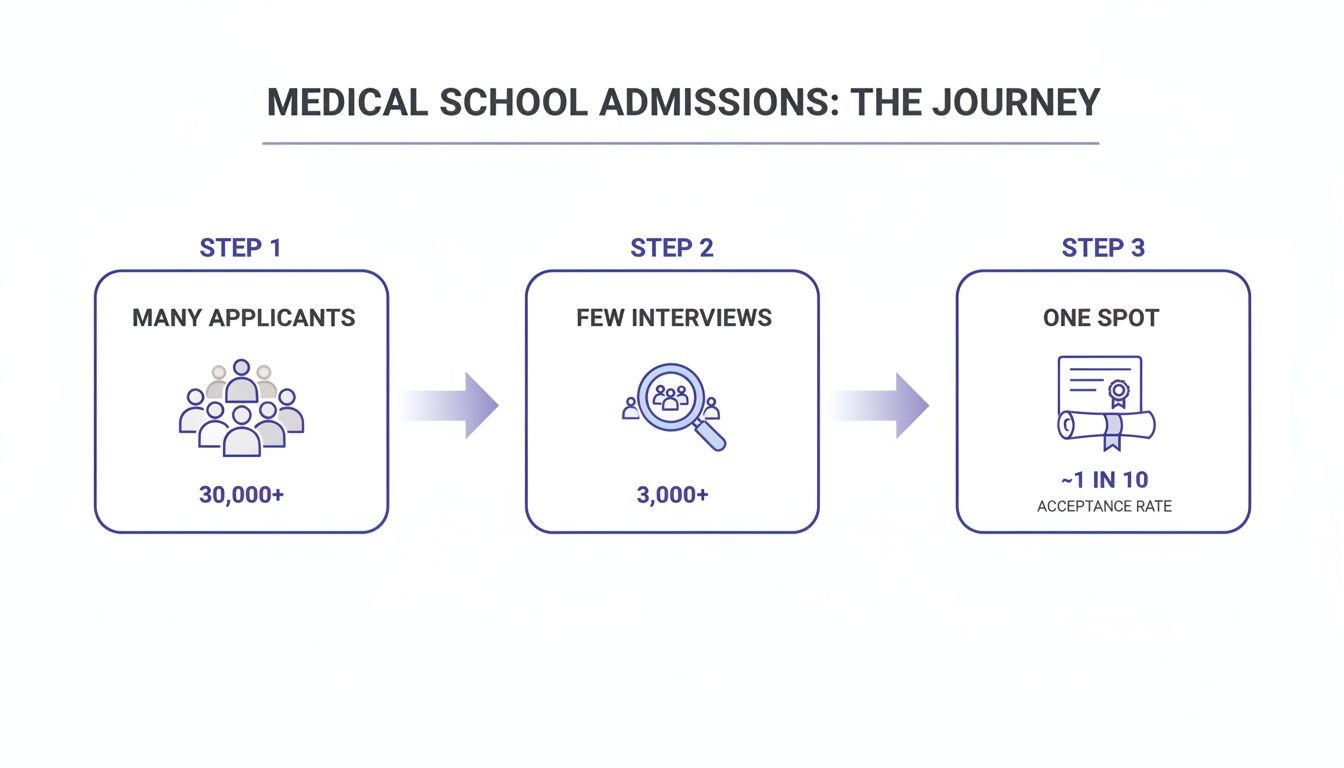
That graphic makes it clear: thousands of applications narrow to hundreds of interviews, then to one final seat.
Distinguishing National Data And School Rates
At a national level, the AAMC publishes overall acceptance figures for every U.S. program. Individual schools, however, often calculate rates using their own submission-versus-offer math.
- Applicants covers all submitted files.
- Offers Extended counts formal acceptances before yield.
- Matriculants are who enroll—this number anchors the final percentage.
Knowing these definitions lets you read any acceptance rate with precision.
Dig into the fine print, and you’ll uncover interview-to-offer ratios and yield metrics that schools don’t always shout about.
Comparing National And School Benchmarks
| Data Source | Basis | Example Rate |
|---|---|---|
| AAMC National | Matriculants / Applicants | 44% |
| Example School | Offers Made / Applications | 4.5% |
Putting these side by side highlights why the national rate can paint an overly rosy picture when your target school is far more selective.
Imagine School X gets 8,000 applications, interviews 400, extends 100 offers, and enrolls 80 students. Its acceptance rate is 100 ÷ 8,000 = 1.25%, while its yield rate (80 ÷ 100) hits 80%.
Reading Between The Lines
When you see a single-digit acceptance rate, check how the school defined it: some divide offers by applications, others divide matriculants by applications. To get deeper:
- Find total applications in the school’s report.
- Note interviewees and offers extended.
- Calculate yield: matriculants ÷ offers.
- Compare year-to-year yield trends for more insight.
With these figures, you can spot where most candidates fall off and where you need to strengthen your profile.
Applying Acceptance Rate Insights
Understanding the math empowers your strategy—don’t just chase numbers, use them.
A clear grasp of acceptance metrics turns data into a powerful planning tool.
- Research each school’s application funnel.
- Align your GPA and MCAT with published medians.
- Estimate interview invites using yield ratios.
- Adjust your school list to balance risk and reward.
This granular approach turns raw percentages into a roadmap, making every application count.
Key Takeaways
- The admissions funnel shows where most applicants are filtered out.
- National and school rates aren’t interchangeable—compare wisely.
- Yield calculations help you predict interview and offer volumes.
- Applying precise metrics sharpens your school-list strategy.
Why Acceptance Rates Change From Year To Year
Medical school acceptance rates aren’t fixed numbers etched in stone. It’s better to think of them as dynamic markers, constantly shifting to reflect the balance between the supply of applicants and the number of available classroom seats. Several powerful forces can make this number swing, making one application cycle feel dramatically different from the next.
One of the biggest drivers is simply the total number of people applying. When application volumes surge, the denominator in the acceptance rate equation gets bigger, automatically pushing the percentage down—even if schools have the same number of spots open.
These surges aren't always predictable. A prime example is the so-called "Fauci effect," where the high visibility of public health leaders during the pandemic inspired a whole new wave of applicants. That influx dramatically increased competition almost overnight, showing how external events can reshape the admissions landscape with very little warning.
The Two Sides of the Equation
To get why acceptance rates fluctuate, you have to look at the two key factors: the size of the applicant pool and the number of available seats.
- Applicant Pool Growth: This is the more volatile side of the equation. Economic downturns, influential media coverage, or major societal events can cause application numbers to spike or dip unexpectedly.
- Available Seat Growth: This factor is far more stable. Opening a new medical school or expanding a class size is a slow, expensive, and heavily regulated process. Because of that, the number of seats grows at a much slower, more predictable pace than the applicant pool.
Because the number of medical school seats increases very slowly while the number of applicants can surge unexpectedly, competition is almost always intensifying. An increase in matriculants doesn't always mean it's easier to get in.
This imbalance creates a weird paradox: even in years when a record number of students start medical school, the actual acceptance rate can hit a new low. Look at the numbers for allopathic medical schools. In the 2021–22 cycle, a record 62,443 applicants (22,666 of whom matriculated) drove the share of applicants who enrolled down to just 36.30%. Yet the 2024–25 cycle saw 44.58% of applicants matriculate, with a then-record 23,156 matriculants. In 2025, the AAMC reported 54,699 applicants and a larger class of 23,440, or about 43%.
This highlights the core tension in admissions. More spots are slowly becoming available, but unpredictable surges in applications keep the competition fierce. You can explore more detailed statistics on acceptance rate trends.
What This Means For Your Strategy
So, what do you do with this information? First, recognize that acceptance rates are a moving target. A single year's data gives you a snapshot, not a permanent law, and that insight is crucial for building a resilient application strategy.
If you find yourself applying during a cycle with a known application surge, it becomes even more important to build a balanced school list. That means including a healthy mix of "target" and "safer" schools where your stats are truly competitive, rather than pinning all your hopes on top-tier "reach" programs.
Understanding these trends can also help you make smarter decisions about your timeline. If you feel your application could be stronger, seeing that you’re in a particularly competitive cycle might just reinforce the strategic value of a gap year. Taking that extra year to get more clinical experience, dive into research, or boost your MCAT score can position you to stand out in a crowded field, no matter how the national numbers shift. The goal is always to submit your strongest possible application when you're truly ready, not to rush into a potentially unfavorable cycle.
How Your Background Impacts Acceptance Rates
The national medical school acceptance rate gives you a decent big-picture view, but it's just an average. And averages, by their nature, smooth over the details that really matter. In the real world of admissions, your personal background—especially where you live and your racial or ethnic identity—plays a surprisingly big role in your odds at different schools.
This isn't about getting discouraged by the numbers. It’s about being smart and strategic. When you look at the data with a clear-eyed perspective, you can build a targeted school list that plays to your strengths and acknowledges the realities of the admissions landscape.
The In-State vs. Out-of-State Advantage
One of the biggest factors shaping your chances, particularly at public medical schools, is your state of residency. State-funded universities have a core mission: to train doctors who will, ideally, stick around and serve the local population. Because of this, they roll out the welcome mat for in-state applicants.
For you, this means a public medical school in your home state is often your best statistical bet. These schools almost always have far higher acceptance rates for residents than for non-residents.
- In-State Applicants: You’re competing against a smaller, geographically defined pool for a set number of protected seats.
- Out-of-State Applicants: You’re often up against a massive national and even international pool, all fighting for a tiny sliver of available spots.
Think about it this way: a state school might post an overall acceptance rate of 7%. But dig a little deeper, and you could find an in-state rate of 15% and a brutal out-of-state rate of just 2%. This is exactly why making your public, in-state schools the foundation of your application strategy is so critical. Private medical schools, on the other hand, generally don't show such a strong preference, making them more of an even playing field for everyone, regardless of residency.
Understanding Racial and Ethnic Disparities
The admissions data also brings some tough realities to light, showing significant disparities in acceptance rates among different racial and ethnic groups. It’s important to acknowledge these numbers to understand the systemic challenges that still exist in the application process. This data can help applicants from all backgrounds contextualize their own journey and build a school list that includes institutions genuinely committed to diversity and equity.
Facing these numbers directly is the first step toward a more informed strategy. The data doesn't define your potential, but it can and should shape your approach to building a realistic and successful application.
Recent AAMC data paints a clear picture of these disparities, which can be a vital tool for strategic planning. Here’s a high-level look at how acceptance and matriculation rates vary.
Medical School Acceptance Rates By Race And Ethnicity
| Racial/Ethnic Group | Applicants Accepted (%) | Acceptees Who Matriculated (%) |
|---|---|---|
| White | 47.3% | 95.4% |
| Asian | 48.3% | 96.9% |
| Hispanic, Latino, or of Spanish Origin | 49.1% | 95.7% |
| Black or African American | 41.1% | 96.0% |
| American Indian or Alaska Native | 45.6% | 87.8% |
Source: AAMC FACTS Table A-12 (applicants, acceptees and matriculants by race/ethnicity, 2023-2024 cycle); percentages calculated from the AAMC counts. Groups are self-identified and overlap with other categories, so treat them as approximate; check the latest AAMC release for newer figures.
These statistics highlight that the path to medical school isn't the same for everyone. Acceptance rates vary by about 8 percentage points across these groups, from 41.1% to 49.1%. For example, Black or African American applicants were accepted at 41.1%, a 6.2-point difference compared to White applicants at 47.3%. You can explore the complete dataset and discover more insights about medical school admissions by demographic group.
For applicants from underrepresented groups, these numbers underscore the importance of finding schools with missions that actively foster diversity and provide strong support systems. For every applicant, they offer a clearer, more realistic picture of the competitive terrain.
Turning Data Into An Actionable Strategy
So, what do you do with this sensitive but crucial information? You turn it into action. It all starts with honest self-assessment and laser-focused research.
- Prioritize In-State Public Schools: Build your school list on a foundation of your state's public medical schools. This is where your odds are often statistically highest.
- Research School Missions: Don't just skim the homepage. Dig into institutions that explicitly state a commitment to diversity. Look at their student body demographics, find their diversity initiatives, and check out their student organizations. This is especially important for underrepresented applicants looking for a supportive environment.
- Analyze School-Specific Data: An overall acceptance rate is just a starting point. Use resources like the MSAR (Medical School Admission Requirements) to find breakdowns by residency and other demographic data to get a true sense of where you stand.
- Leverage Your Story: Your background isn't just a box to check; it's a central part of your story. In your essays and interviews, connect your personal experiences—whether they relate to your hometown, your culture, or your identity—to why you want to be a doctor. This is how you transform your application from a pile of stats into a compelling, human narrative.
Building A Smarter Medical School List
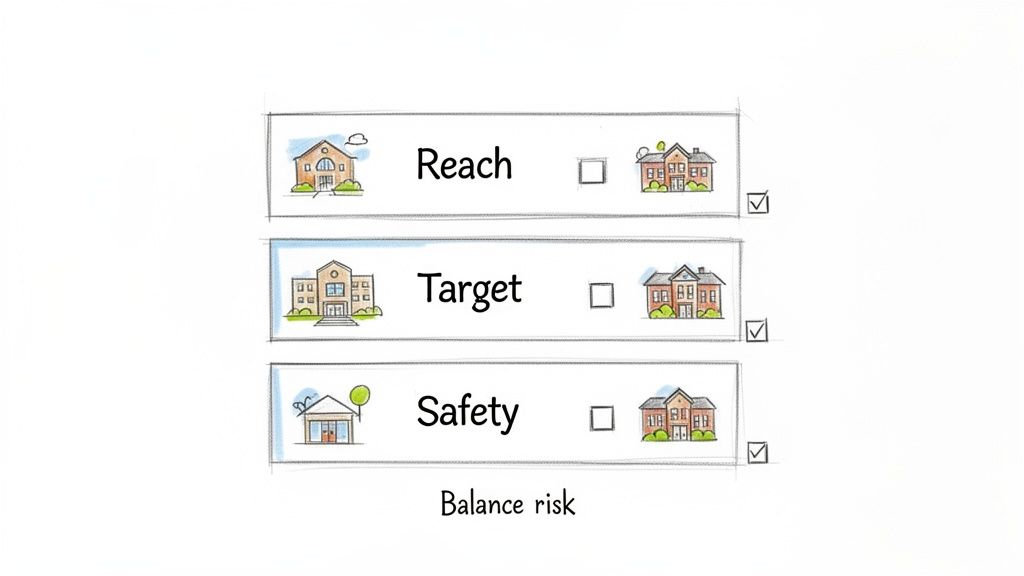
Think of your school list as a well-balanced investment portfolio. You wouldn't put all your money into high-risk stocks, and you shouldn't put all your hopes into reach schools. A strategic list turns raw acceptance rate data into a practical roadmap, balancing your ambition with a dose of reality.
This classic framework helps you manage risk and maximize your chances of getting that acceptance letter.
- Reach Schools: These are the tough climbs. Your stats might be a little below their median MCAT and GPA, and their low acceptance rates make them a long shot for anyone.
- Target Schools: This is your sweet spot. Your profile aligns well with their published medians, and their moderate acceptance rates mean you're a competitive applicant.
- Safety Schools: Here, your stats are comfortably above the school's medians. While no school is a true "safety," these programs offer you the best statistical odds, especially if you're a strong mission fit.
Finding Reliable Acceptance Rate Data
To build your list, you need good intel. Forget guessing—the best place to start is with the data that schools publish themselves, often in their MSAR profiles or on admissions webpages. This is where you can directly compare your GPA and MCAT to a program's real-world medians.
Here’s a general sketch of what these categories might look like. These are illustrative round numbers for planning, not AAMC or school data, so check each school’s own published figures:
| School Type | Average Acceptance Rate | Median MCAT | Median GPA |
|---|---|---|---|
| Reach | 4% | 519 | 3.9 |
| Target | 10% | 512 | 3.7 |
| Safety | 20% | 508 | 3.5 |
Categorizing Schools by Risk
With your data in hand, it's time to start sorting. This isn’t a perfect science, but a simple framework can bring a lot of clarity to the chaos of application season.
- Reach if your stats are below the school’s median and its acceptance rate is under 5%.
- Target when your GPA and MCAT are right around the medians and rates hover in the 8–12% range.
- Safety if your profile is clearly above their medians and the acceptance rate is over 15%.
Think of acceptance rates like a compass. They won’t walk the path for you, but they can definitely keep you from getting lost in the competitive wilderness.
Don't fall into the trap of applying only to the toughest schools. A well-rounded list might include 3 reach schools, 5 target schools, and 2 safety schools to give you a solid mix of opportunity and security.
It's Not Just About the Numbers: Balancing Stats and Fit
While statistics give you a starting point, they don't tell the whole story. The best school list is one where you can genuinely see yourself thriving. A school is only a good fit if its mission, culture, and curriculum align with your own goals and values.
- Look into research: Do their faculty's interests line up with yours?
- Consider the environment: Think about location, community partnerships, and the types of clinical rotations you’ll experience.
- Evaluate support systems: How do they support student wellness, diversity, and career advising? You'll need it.
Ultimately, this kind of realistic self-assessment is what guides your preparation, including how you practice for interviews on Confetto. For a deeper dive, explore the guidance in our Medical School programs.
Using Acceptance Rates to Manage Application Risk
Think of acceptance rates as a weather forecast for your application season. A low percentage is a warning: a storm is coming, and you'd better be prepared with stronger essays and more interview practice. A higher rate, on the other hand, might signal a chance to let your unique story shine.
- Check each school’s recent acceptance trends. Are they getting more or less competitive?
- Map your own profile against each category to see where your competitive gaps are.
- Adjust your school list based on these insights—maybe you need another target school or a different kind of safety.
- Prioritize your mock interview prep on Confetto to mimic the format of the schools in each category.
This process transforms abstract percentages into a concrete action plan. For a reach school with an acceptance rate below 5%, you’ll want to ramp up intense interview simulations. For a target school hovering around 10%, you can focus on polishing your essays and drilling common MMI questions.
Each application is its own expedition. Reach schools are like Mt. Everest—the conditions are tough, and only the best-prepared succeed. Target schools are challenging peaks that test your skills, and safety schools are the hills where you build confidence.
- Let the risk level of each category guide your mock-interview focus.
- Use Confetto’s analytics to track how you're improving on key skills like empathy, communication, and critical thinking.
Building your medical school list is part data science, part art. By balancing hard numbers with a genuine assessment of fit, you create a strategy that maximizes your opportunities while staying true to your ambitions.
Moving From Applicant to Accepted Student

Securing an interview invitation is a massive win. It means you’ve made it through the brutal statistical gauntlet of the medical school admissions process. Your GPA, MCAT score, and experiences were strong enough to get your application pulled from the pile.
Now, the game completely changes.
From this moment on, the interview becomes the single most critical factor in whether you get an acceptance. Everyone else invited to interview day is, on paper, just as qualified as you are. The admissions committee has already stamped your file: you meet their academic and experiential standards.
What they need to figure out now is who you are as a person. This is your chance to transform your application from a collection of data points into a compelling human story.
Turning Statistics into a Story
Your numbers got you here, but your narrative gets you accepted. The interview is where you finally connect the dots for the admissions committee, showing them the real person behind the grades and achievements.
If your statement is still a draft, our medical school personal statement guide can help you tell that story.
A stellar interview can absolutely make the difference, especially if your stats are sitting just below a school’s published median.
Think of it this way: your application is the script, but the interview is the live performance. It’s your one shot to demonstrate the empathy, resilience, and communication skills that no personal statement can ever fully capture. This is where you articulate your journey with clarity and confidence, proving you have the maturity and insight to succeed not just in medical school, but as a future physician.
The moment you get that interview invite, your focus needs to shift. Stop obsessing over acceptance rates and start thinking about connection. You are no longer one of thousands of applicants; you are one of a select few with a genuine shot at earning a seat.
Preparing for the Final Hurdle
Great interview preparation is about much more than just memorizing answers to common questions. It’s about deep self-reflection that allows you to talk about your motivations, strengths, and unique perspective with genuine authenticity. This is where you weave your past experiences into your future goals in medicine.
Your prep should be dialed in on a few key areas:
- Articulating Your "Why": Be ready to explain what drives you toward medicine with specific, personal stories. What were the moments that solidified this was the only path for you?
- Demonstrating Key Competencies: Have examples ready that showcase the AAMC Core Competencies, like teamwork, resilience, critical thinking, and self-awareness. Don't just say you have them; show them through your experiences.
- Showing School-Specific Interest: Prove you've done your homework. Talk about specific programs, research opportunities, or faculty members at that particular school that genuinely excite you and align with your passions.
This level of detailed preparation is what builds the confidence you need to walk in and excel. For applicants looking to really sharpen their performance, practicing with a realistic simulator can be a game-changer. You can hone these skills with targeted exercises like a medical school mock interview, which helps turn all that prep into a polished, confident delivery.
Your goal is to walk out of that interview leaving the committee with no doubt that you are the right fit for their program and a future credit to the medical profession.
To check where your own numbers sit, see what GPA you need for medical school and the classes medical schools require. If you have one clear first choice, see which medical schools offer early decision.
Frequently Asked Questions
Let's cut through the noise. When you're staring down the barrel of the medical school application process, acceptance rates can feel like a complicated code. Here are some straightforward answers to the questions we hear most often.
What percent of med school applicants get in on the first try?
The AAMC doesn't report a first-try rate. About 76.5% of 2025 applicants were first-time applicants, and about 43% of all applicants matriculated, so most of that 43% got in on their first application. Reapplicants are reviewed as new applicants and need to show growth.
What Is a Good Medical School Acceptance Rate?
Honestly, there’s no single “good” rate for a school. That number is more a measure of how competitive the school is, not how good its education is. A much more useful number for you is the national matriculation rate, which has recently run between about 43% and 45% of applicants. Think about that: nearly half of everyone who applies gets into at least one medical school.
The real question is, what’s a "good" school for you? That's a school where your GPA and MCAT scores are in the same ballpark as their median for accepted students. Use acceptance rates to build a smart, balanced list of schools—don't let them be the only factor you consider.
Do DO Schools Have Higher Acceptance Rates Than MD Schools?
In general, yes. Osteopathic (DO) medical schools often have higher acceptance rates than their allopathic (MD) counterparts. You'll also notice that the average GPA and MCAT scores for students who get into DO schools are a bit different.
This makes DO programs a fantastic and totally viable path for a wide range of qualified applicants. The competition is still fierce, no doubt about it, but the statistical entry points can be more accessible. It's another excellent route to becoming a physician.
Your strategy should focus on fit and competitiveness, not just prestige. A school's acceptance rate is a tool to gauge your chances, but its mission, location, and curriculum are what determine if it's the right place for you.
How Much Should Acceptance Rates Influence My School Choice?
They should be a major factor, but not the only one. Think of acceptance rates as a reality check. They’re your tool for building a strategic mix of schools where you have a genuine shot.
But just as important are the things that will shape your four years there—the curriculum, the research opportunities, the school's mission. After all, getting in is just the first hurdle. Once you’re accepted, you have to thrive, and finding effective study tips for medical students is a good place to start preparing for that next chapter.
A balanced strategy uses rates to apply smartly but relies on other factors to choose wisely. This same strategic mindset is key for interviews, too, as we break down in our guide to common healthcare interview questions and answers.
At Confetto, we believe that confident preparation is the key to standing out. Our AI-powered platform provides realistic mock interviews and instant, actionable feedback, helping you turn practice into a powerful performance on interview day. Start your free trial today and take the guesswork out of interview prep.