
Your Guide to PA School Requirements
Master the PA school requirements for your application. This guide covers GPA, GRE, clinical hours, CASPA, and interview prep to help you succeed.

Getting into PA school isn't about checking off a list of tasks. It's about building a compelling case for yourself. Think of it less like a sprint and more like assembling a detailed portfolio that proves you have what it takes—not just the brains for the science, but the heart for the people.
Admissions committees are looking for candidates who are the whole package. They want to see that you can handle a tough, science-heavy curriculum, but they also need to know you have the empathy and resilience required for compassionate patient care.
This guide will break down every piece of the puzzle, turning what feels like a mountain of requirements into a clear, strategic roadmap. Let's start with the big picture: the four pillars that hold up every successful PA school application.

The Four Pillars of a Strong Application
Every competitive applicant builds their story on a foundation of four key components. It's not enough to be strong in one or two; you need to show you’ve put in the work across the board.
- Academics (GPA and Prerequisites): This is the bedrock. It's the hard proof that you have the academic horsepower to thrive in a demanding graduate program.
- Standardized Tests (GRE/PA-CAT): These scores are the great equalizer, giving schools a standardized way to compare your critical thinking and analytical skills against a national pool of applicants.
- Healthcare and Patient Care Experience: This is where the rubber meets the road. It’s your chance to prove you’ve seen the realities of medicine up close and that your commitment to patient care is real and tested.
- Personal Narrative (CASPA & Letters): This is your story. Your personal statement, supplemental essays, and letters of recommendation are what tie everything together, explaining the why behind your journey to become a PA.
These pillars don't stand alone. They support each other, creating a holistic picture of who you are and why you're a perfect fit for the profession.
The Four Pillars of PA School Admissions
This table breaks down how each pillar contributes to your overall application.
| Requirement Category | What It Entails | Why It Matters |
|---|---|---|
| Academics | A strong GPA (especially in sciences) and completing all prerequisite courses like Anatomy, Chemistry, and Biology. | It demonstrates your ability to succeed in a fast-paced, scientifically rigorous graduate program. |
| Standardized Tests | Competitive scores on exams like the GRE or PA-CAT, depending on the program's specific requirements. | This provides an objective measure of your academic potential and readiness for graduate-level study. |
| Clinical Experience | Hundreds or even thousands of hours of direct patient care (PCE) and general healthcare experience (HCE). | It proves you have a realistic understanding of healthcare and possess the hands-on skills to care for patients. |
| Personal Narrative | A well-written personal statement, strong letters of recommendation, and thoughtful supplemental essays. | This articulates your motivation, highlights your unique strengths, and showcases your suitability for the profession. |
As you pull your application together, it helps to keep an eye on the future. Thinking about where this path can lead—like the expanding field of telemedicine physician assistant jobs—can give you a powerful sense of purpose that shines through in your essays. Knowing your long-term goals makes your immediate "why" that much stronger.
You can learn more about how to build each of these pillars with our PA school admission support.
Building a Strong Academic Foundation
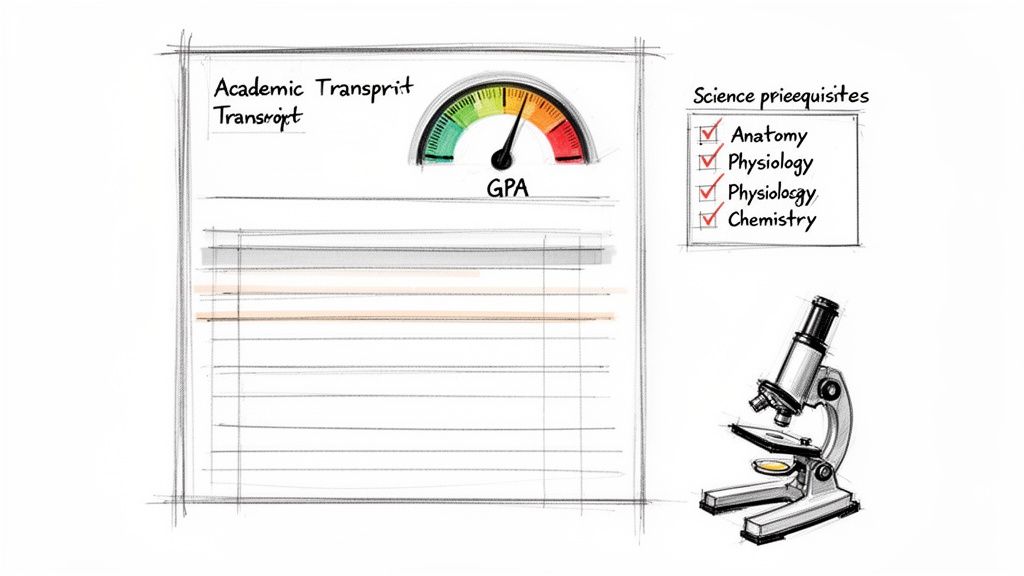
Let’s be direct: your transcript is the foundation of your entire PA school application. It’s the concrete, undeniable proof that you can handle a curriculum that’s both incredibly fast and heavy on science. Think of it like building a house—if the foundation is shaky, everything you build on top of it feels unstable. Admissions committees pore over your grades to predict one thing: your likelihood of success in their program.
This isn't just about a single number, either. Adcoms slice and dice your GPA in a few key ways to get the full story of your academic journey and your true potential.
Cracking the GPA Code
Admissions teams don’t just glance at your final GPA. They dig deeper, analyzing different parts of your academic record to see the whole narrative. Knowing what they’re looking for helps you play to your strengths.
- Cumulative GPA: This is the big-picture number, the average of every single grade from your undergraduate career. It gives them a broad sense of your consistency and work ethic across the board.
- Science GPA (sGPA): Many argue this is the most critical metric of all. It zeroes in on your performance in Biology, Chemistry, Physics, and Math (BCPM) courses—the exact subjects that form the core of PA school. It’s a direct reflection of your aptitude where it matters most.
- Last 60 Credits GPA: This calculation focuses on your more recent classes, usually from your junior and senior years. A strong upward trend here is powerful. It can show maturity and prove that you figured things out, making it a huge asset for anyone who had a rocky start.
A GPA tells the story of your academic grit. If you want to get into the nitty-gritty of how these scores are calculated, our guide on weighted vs. unweighted GPA breaks it all down.
Meeting the GPA Threshold
Getting into PA school is no joke—it's intensely competitive, and programs expect a rock-solid academic history. While most schools list a minimum cumulative GPA of 3.0 on a 4.0 scale, the reality on the ground is that successful applicants often have a 3.5 or higher.
To put it in perspective, many programs require not just a 3.0 overall GPA but also a 3.0 prerequisite GPA, and they often won’t accept grades below a C in those key science courses. Looking at the data, the average cumulative GPA for PA program matriculants is roughly 3.7 (about 3.68 in the 2024–25 cycle, per PAEA data)—well above the stated minimum.
Your GPA is the first gatekeeper. A high GPA won’t guarantee you a spot, but a low one can get your application screened out before a human ever sees it. Your strategy should always be to aim well above the minimum.
Mastering Prerequisite Courses
Beyond your GPA, ticking off the prerequisite courses is absolutely non-negotiable. These pa school requirements ensure that every student walks in the door with the same fundamental scientific knowledge. While the exact lists can vary a bit from school to school, you can bet on seeing these on almost every list:
- General Biology with lab (2 semesters): The foundation for understanding how living things work.
- General Chemistry with lab (2 semesters): Absolutely essential for grasping biochemical reactions.
- Anatomy & Physiology with lab (1-2 semesters): The undisputed cornerstone of any medical education.
- Microbiology with lab (1 semester): Critical for understanding infectious diseases.
- Organic Chemistry with lab (1 semester): Gives you a much deeper grasp of molecular structures.
- Biochemistry (1 semester): The course that connects the dots between biology and chemistry.
You’ll also find that many programs require or strongly recommend courses like genetics, statistics, psychology, and medical terminology. It is mission-critical to check the specific requirements for every single program you intend to apply to.
Addressing a Low GPA
If your GPA isn’t where you want it to be, don’t panic. It’s not the end of the road. There are concrete, strategic moves you can make to bolster your academic profile and prove you’re up for the challenge. One of the most direct ways is to retake any prerequisite courses where you earned a C or lower and crush it with an A.
Another powerful strategy is to enroll in a post-baccalaureate program or simply take more upper-level science courses. Earning A's in tough classes like Immunology, Pathophysiology, or Advanced Pharmacology sends an unmistakable message to admissions committees: you have the drive and the academic horsepower to thrive in their program.
Navigating Standardized Tests Like the GRE
Alright, let's talk about the GRE. Along with your GPA, standardized tests like the Graduate Record Examinations (GRE) are another major piece of the academic puzzle for many PA schools.
The easiest way to think about the GRE is as a universal translator. It gives admissions committees a single, standardized way to compare your critical thinking and analytical reasoning skills against thousands of other applicants. It doesn't matter where you went to school or how tough your professors graded—the GRE is meant to be a level playing field.
While more and more programs are dropping the GRE requirement, it's still a common fixture on the list of pa school requirements. For the schools that still ask for it, the score serves as a data point—a predictor of how well you might handle the firehose of information in a demanding graduate curriculum. Your job is to see this not as just another box to check, but as a real chance to make your application stronger.
Understanding the GRE and What Matters
The GRE is split into three different sections, and you really need to perform well across the board. A lopsided score can be just as problematic as a low overall score.
- Verbal Reasoning: This is all about how you analyze and interpret dense written material. Can you pull out key information, understand the relationships between complex ideas, and navigate sophisticated vocabulary? It’s basically a test of your high-level reading comprehension.
- Quantitative Reasoning: This part tests your ability to solve problems using fundamental math concepts—think arithmetic, algebra, geometry, and data analysis. It’s designed to show how comfortable you are with numbers, charts, and using mathematical models to find answers.
- Analytical Writing: Here, you'll crank out two essays. One asks you to analyze an issue and the other to analyze an argument. The goal is to see if you can articulate a complex idea clearly, back it up with solid reasoning, and write a focused, coherent piece of text.
A huge mistake applicants make is obsessing over their combined Verbal and Quantitative score while neglecting the essay section. A low Analytical Writing score can be a major red flag, signaling that you might struggle with the heavy writing demands of graduate-level coursework.
Setting Your Score Goals
So, what's a "good" GRE score? That’s the million-dollar question, and the honest answer is always: it depends entirely on the program. There is no single magic number that works everywhere.
But we can get a pretty clear idea of what "competitive" looks like by digging into what schools are actually asking for. Most programs that require the GRE want scores from within the last 5 years. Some will give you clear benchmarks. You might see a school recommend a combined verbal and quantitative score of 300+ and an analytical writing score of 4.0+. Another might list hard minimums, like 146 Verbal, 144 Quantitative, and 3.0 Writing, while saying they prefer applicants with a combined score over 290.
These numbers aren't just pulled out of thin air. Check each program’s own published benchmarks, since they differ. For a closer look at these kinds of specific benchmarks, you can explore the admission details provided by various institutions.
Creating Your Test Strategy
Don't just wing the GRE. You need a plan. This isn't a test you can cram for over a weekend and expect to do well.
First, go through every single program on your list and find the average GRE scores of their accepted students. That data is your north star—it will help you set a realistic target score.
Next, map out a study timeline. You should give yourself at least three to four months of consistent prep before you plan to take the test. That's enough time to work on your weak spots, take a bunch of full-length practice tests to build up your stamina, and really get the hang of the test's unique format and pacing.
Finally, be smart about when you schedule your exam. Plan to take the GRE at least one or two months before your first application deadline. This gives you a critical buffer. If you get your score back and it’s not where you want it to be, you’ll have time to hit the books again and retake the test without derailing your entire application timeline. A little foresight here can turn the GRE from a massive source of stress into just another calculated step toward your goal.
If your grades are the foundation of your PA school application, then your hands-on experience is the frame, the walls, and the roof. This is where your application comes alive, proving you understand the demanding, rewarding, and sometimes messy reality of patient care. It’s easily the most critical non-academic piece of your entire profile.
Admissions committees look at your healthcare experience to gauge your maturity, commitment, and genuine feel for the PA role. They want to see you’ve been on the front lines, witnessed the challenges, and built your decision to pursue this career on a solid base of real-world knowledge. Not just theory.
Understanding PCE and HCE
The world of clinical experience gets broken down into two main categories, and knowing the difference is absolutely essential for building a strong application. These are Patient Care Experience (PCE) and Healthcare Experience (HCE).
Patient Care Experience (PCE): This is the gold standard. PCE involves direct, hands-on responsibility for a patient's care. Think of roles where you are actively involved in assessment, treatment, or diagnostics. You're doing things for the patient.
Healthcare Experience (HCE): This is broader. HCE includes roles where you are in a healthcare setting but may not have direct responsibility for patient treatment. This could be anything from administrative tasks and cleaning equipment to observing care from the sidelines.
While both types of experience are valuable, PA programs place a much, much higher premium on PCE. It’s the clearest indicator that you have the skills and temperament to succeed as a Physician Assistant.
PCE is about doing, while HCE is often about observing or assisting from a distance. An EMT performing an assessment is PCE; a hospital volunteer delivering flowers is HCE. Both are good, but only one truly demonstrates clinical capability.
Valued Roles and How to Find Them
To rack up the kind of high-quality PCE that gets you noticed, you need roles that put you in direct contact with patients. Some of the most common and respected positions include:
- Emergency Medical Technician (EMT): Excellent for developing assessment skills under intense pressure.
- Certified Nursing Assistant (CNA): Gives you foundational experience in direct patient care in hospitals or long-term care facilities.
- Medical Assistant (MA): Offers a great mix of administrative and clinical duties, usually in a clinic setting.
- Phlebotomist: Hones a specific, valuable clinical skill and involves constant patient interaction.
- Physical Therapy Aide: Involves helping patients with exercises and mobility, offering direct therapeutic interaction.
Finding these roles almost always requires specific certifications. Check out local community colleges or vocational schools that offer accelerated programs for EMT or CNA credentials. Once you're certified, you can find positions in hospitals, private practices, urgent care centers, and nursing homes.
How Many Hours Do You Really Need?
The number of required hours varies wildly between programs, but the trend is clear: more is almost always better. While some schools might list a minimum of 500 hours, students who actually get in typically report far more, often thousands of hours of patient care.
Think of this experiential requirement as a serious filter for admissions committees. For example, many programs have specific mandates for hours in certain settings. Some might require 50-100 hours spread across both inpatient and outpatient environments, while others could mandate 60 hours split between at least three different settings. This isn't just a box to check; competitive applicants typically exceed the minimums by a wide margin. You can learn more by checking program-specific requirements on university admission pages.
The table below breaks down the PCE vs. HCE distinction even further, giving you a clearer picture of what schools are looking for.
Patient Care (PCE) vs. Healthcare Experience (HCE)
This table compares direct, hands-on patient care roles with other valuable healthcare environment experiences for your PA school application.
| Type of Experience | Definition | Common Roles | Typical Value in Application |
|---|---|---|---|
| Patient Care (PCE) | Direct, hands-on care where you have responsibility for patient assessment, diagnosis, or treatment. | EMT, Paramedic, CNA, Medical Assistant, Phlebotomist, ER Tech | Very High - The absolute core of your clinical profile. |
| Healthcare (HCE) | Working in a healthcare setting, but without direct responsibility for patient care. | Scribe, Volunteer, Pharmacy Tech, Patient Transporter, Clinical Research (non-patient facing) | Moderate - Adds context and shows commitment, but is secondary to PCE. |
Ultimately, while HCE shows you're familiar with the healthcare environment, PCE proves you can handle the responsibilities that come with it. Focus your efforts on getting as much quality PCE as possible.
Documenting Your Experience for CASPA
Just getting the hours isn't enough; you have to document and describe them meticulously in your CASPA application. For each experience, you'll need to list your title, the facility, your supervisor’s contact information, and the total number of hours you worked.
Most importantly, you need to write a crisp, detailed description of your duties. Use action verbs and focus squarely on your direct patient care responsibilities. Instead of saying, "Helped nurses," write something like, "Recorded vital signs, assisted with patient mobility, and documented intake/output for a 20-bed medical-surgical unit." This small change transforms a simple job into a compelling narrative of your clinical competence and readiness for the rigors of pa school requirements.
Crafting Your CASPA Application and Personal Statement
Think of your CASPA application as the complete story of you—not just a collection of grades and hours, but the narrative that ties your entire journey together. This is the one place where your academic record, hands-on clinical work, and personal drive all converge. Nailing the details here isn't just a box to check; it's how you make your case to admissions committees.
If the CASPA portal is the stage, your personal statement is the spotlight. Every entry you make, from meticulously transcribed coursework to your choice of recommenders, sets the scene. But it's your essay that truly explains the why—the motivation that’s pushing you to become a PA in the first place.
Decoding the CASPA Application
The Centralized Application Service for Physician Assistants (CASPA) is meant to simplify things, but its level of detail demands your full attention. You'll input everything: personal info, every course from every college you've ever attended, every single hour of healthcare experience, and all your volunteer activities. Precision is everything. A small mistake or discrepancy can unfortunately raise a red flag.
When you're putting together your application and personal statement, you're building a complete picture of who you are. To make sure every element is polished, you might look into resources that help you build a strong professional medical profile.
This whole process really boils down to a simple flow: get the experience, document it carefully, and then present it in your application.
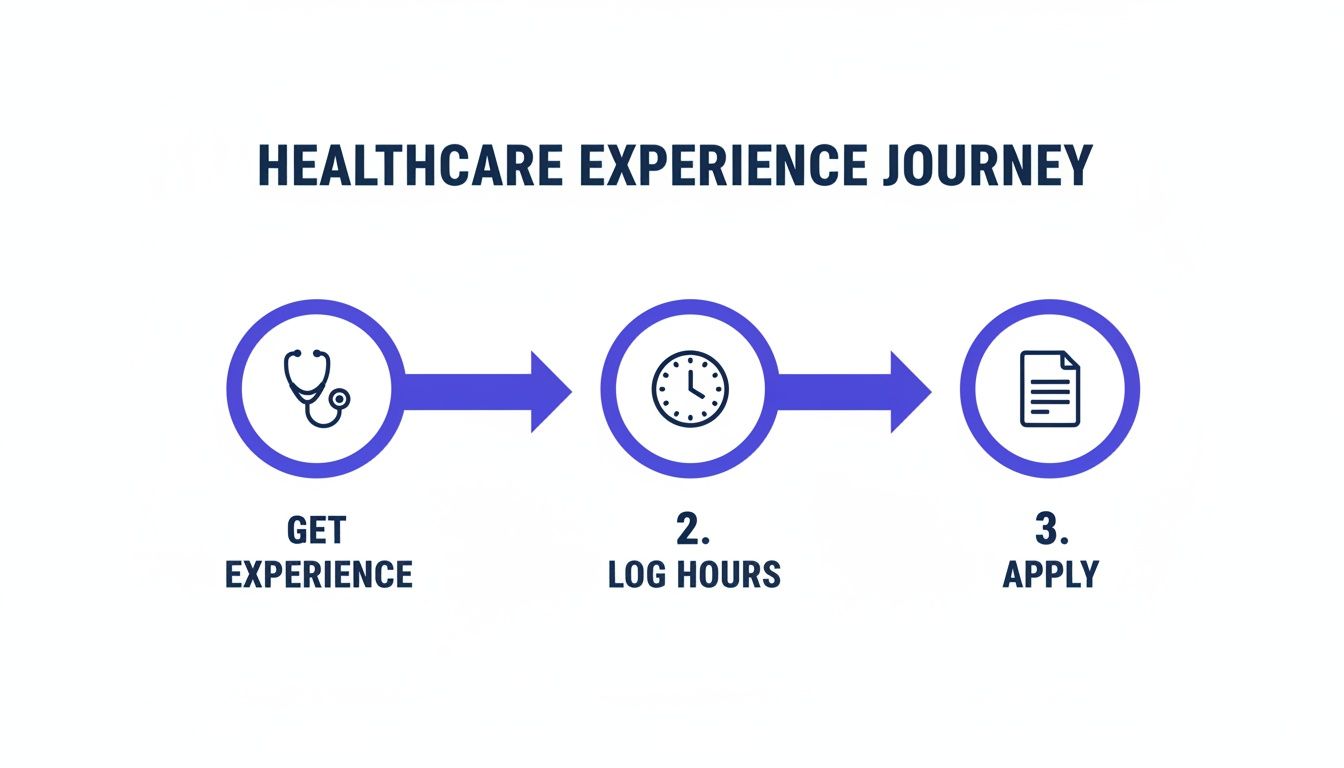
This highlights a critical point: your hard-earned experience is only as powerful as your ability to articulate its impact on your application.
Writing a Powerful Personal Statement
Your personal statement is your one shot to speak directly to the admissions committee in your own voice. With a 5,000-character limit (spaces included!), every single word counts. This isn't the space to just list what's on your resume; it’s where you connect all the dots and give those experiences meaning.
The mission is to answer one core question: "Why do you want to be a PA?" A great essay will weave your experiences into a compelling story that shows your commitment, rather than just telling them about it.
Here’s a simple framework to structure your story:
- The Hook: Kick things off with a personal story or a specific moment that first ignited your interest in medicine.
- The Journey: Show how you followed that spark. Talk about what you learned from your clinical hours, shadowing, and volunteering.
- The "Why PA": This is crucial. Get specific about why the PA profession—not another role in healthcare—is the right fit for your goals and values.
- The Future: Wrap it up by explaining how your unique background and skills will make you a capable and compassionate PA.
A huge mistake applicants make is writing a generic "why I love medicine" essay. Your statement has to be laser-focused on the PA role. Show them you understand its collaborative nature and patient-first philosophy. Prove you've done your research.
Securing Strong Letters of Recommendation
Your letters of recommendation are the outside proof that you are who you say you are. They provide that critical third-party validation of your skills, work ethic, and character. Many PA schools want two or three letters, and who you ask is a major strategic decision. You want people who can speak to different parts of your profile.
A great combination often looks like this:
- A Professor: Ideally from a science course, this person can vouch for your academic horsepower and readiness for a tough graduate program.
- A Clinical Supervisor: This needs to be a PA, doctor, or another healthcare professional who saw you in action with patients and can speak to your clinical skills.
- Someone Else Who Knows You Well: Think of a research mentor, another supervisor from a different job, or a volunteer coordinator who saw your commitment firsthand.
Asking is just the first step. You need to equip your recommenders for success. Give them a packet with your resume, your personal statement, and a list of the schools you're targeting. Don’t be afraid to gently remind them of a specific project you nailed or a challenging situation you handled well. This helps them write a letter full of concrete examples, not just generic praise.
And please, give them at least a month's notice. A rushed letter is rarely a strong one. Ample time allows them to write a thoughtful endorsement that can truly elevate your entire application.
Preparing for Your PA School Interview
Getting your CASPA application submitted is a massive achievement, but you're not at the finish line just yet. The interview is that final, high-stakes step where you go from being a name on a page to a three-dimensional, memorable person. It’s your one real shot to demonstrate the kind of empathy, communication skills, and professionalism that a transcript just can’t convey.Think of your application as the script and the interview as your live performance. The admissions committee has already decided you meet the academic and experiential pa school requirements on paper. Now, they need to see if your personality and values truly align with their program and the profession itself.
Understanding Common Interview Formats
PA schools use a few different interview styles to see how candidates think and act from multiple angles. Knowing what to expect is the first step toward walking in with confidence, ready for whatever they throw your way.
For a full practice run with scored sample answers, plus the interview formats nine PA programs publish, see our PA school mock interview guide.
- One-on-One Interview: This is the classic, conversational format with a single faculty member or admissions officer. The goal here is simple: to get to know you as a person and dig a little deeper into the experiences you listed in your application.
- Panel Interview: Get ready to face a small group—often a mix of faculty, alumni, and even current students. Questions can come from anyone on the panel, testing your ability to think on your feet and build rapport with several people at once.
- Multiple Mini Interview (MMI): The MMI is a series of short, timed stations, each with a different scenario or question. One station might present an ethical dilemma, the next a teamwork challenge, and another a standard personal question. This format is all about testing your critical thinking and problem-solving skills in real-time.
The key to any format is authenticity. Committees can spot a rehearsed, robotic answer from a mile away. Your goal isn't to be perfect; it's to be genuine, thoughtful, and engaged in a real conversation.
Mastering Different Question Types
Your interview will likely be a blend of questions designed to probe your motivation, ethics, and self-awareness. You should be ready to talk about a whole range of topics, from your personal journey to tricky professional situations.
For instance, you'll definitely get behavioral questions like, "Tell me about a time you worked on a team." They also want to get to the core of your drive with questions such as, "Why do you specifically want to be a PA?"
Beyond those, get ready for situational and ethical curveballs. They might ask, "Your supervising physician asks you to do something you believe is unethical. What do you do?" There's no single "right" answer here; what they really want to see is your thought process. For a deeper look at what to expect, you can explore common healthcare interview questions and answers to round out your prep.
Honestly, the best way to get ready is to practice answering these questions out loud. Record yourself or talk it through with a friend. This helps build the muscle memory you need to articulate your thoughts clearly and confidently when it really counts.
Common Questions About PA School Requirements
Navigating the PA school application process can feel like a maze, and it’s natural for the same questions to pop up again and again. Getting clear answers to these common sticking points is the best way to build a solid application strategy and sidestep any rookie mistakes. Let’s tackle some of the most frequent concerns we hear from pre-PA students.
How Important Is Shadowing a PA?
Think of it this way: shadowing is your proof. Even when it’s not an explicit requirement, it’s the single most effective way to show an admissions committee you truly understand what a PA does day in and day out. It demonstrates a genuine, well-researched commitment to the profession, not just a passing interest.
Aim for at least 40-50 hours, and if you can get experience in a couple of different specialties, even better. Those hours aren’t just a box to check—they become the powerful, real-world stories you’ll use in your personal statement and interviews to prove you know what you’re signing up for.
Can I Apply with a C in a Prerequisite Course?
Technically, some programs might let it slide. Realistically, it’s a major red flag in a competitive applicant pool. Most schools expect to see a B- or better, especially in foundational science courses like anatomy, physiology, or chemistry. These classes are the bedrock of the PA curriculum, and a C suggests you might struggle with the program's rigor.
Retaking the course is almost always your best move. It's a two-for-one deal: you prove you can master the material while simultaneously boosting your science GPA. That single action strengthens two of the most critical parts of your application.
What Is the Best Time to Submit My CASPA Application?
As early as humanly possible. This isn't an exaggeration. The overwhelming majority of PA schools use a rolling admissions process, which means they review applications and hand out interview invites as soon as they come in. If you wait until the final deadline, you’re competing for the few remaining spots against a mountain of other applications.
Getting your application in within the first few weeks of the CASPA cycle opening (usually late April) gives you a massive strategic advantage. You’ll be in a much smaller, less crowded pool of applicants vying for the most available interview slots and seats in the class.
Once your application is in, the final hurdle is the interview. Confetto can give you the practice you need to feel confident and prepared. Its AI platform simulates realistic MMI, panel, and one-on-one interviews, providing instant, actionable feedback so you can turn practice into a polished performance. Start your free trial at https://confetto.ai.