
Weighted vs Unweighted GPA A Guide for Healthcare Program Applicants
Understand the weighted vs unweighted GPA difference and how admissions committees evaluate your scores for medical school and other healthcare programs.
The real difference between a weighted vs unweighted GPA boils down to one simple factor: course difficulty.
Think of it this way: an unweighted GPA is the classic 4.0 scale. It's a straightforward average where every class is treated the same. Your A in regular biology counts just as much as your A in AP Biology. On the other hand, a weighted GPA gives you extra credit for taking on tougher courses like AP, IB, or Honors. This often pushes the scale up to a 5.0, rewarding you for challenging yourself academically.
Understanding the Core Differences
Your Grade Point Average (GPA) is often the first thing admissions committees see—a quick snapshot of your academic hustle. But not all GPAs tell the same story. The distinction between weighted and unweighted scores paints a much richer picture of your academic journey, and for pre-health applicants, knowing how to frame this is critical.
The unweighted GPA is your baseline. It operates on that familiar 4.0 scale: an A is a 4.0, a B is a 3.0, and so on. It’s a clean, simple measure of your overall consistency and gives schools a standardized way to compare applicants from different high schools.
Then you have the weighted GPA, which is all about context. It acknowledges that not all courses are created equal. Schools that use this system add bonus points for advanced classes. So, that A in an AP class might actually be worth a 5.0 instead of a 4.0, which better reflects the rigor of your workload.
A Visual Breakdown
This infographic cuts right to the chase, showing the main contrast between the two GPA types by focusing on the scale and what each one really represents.
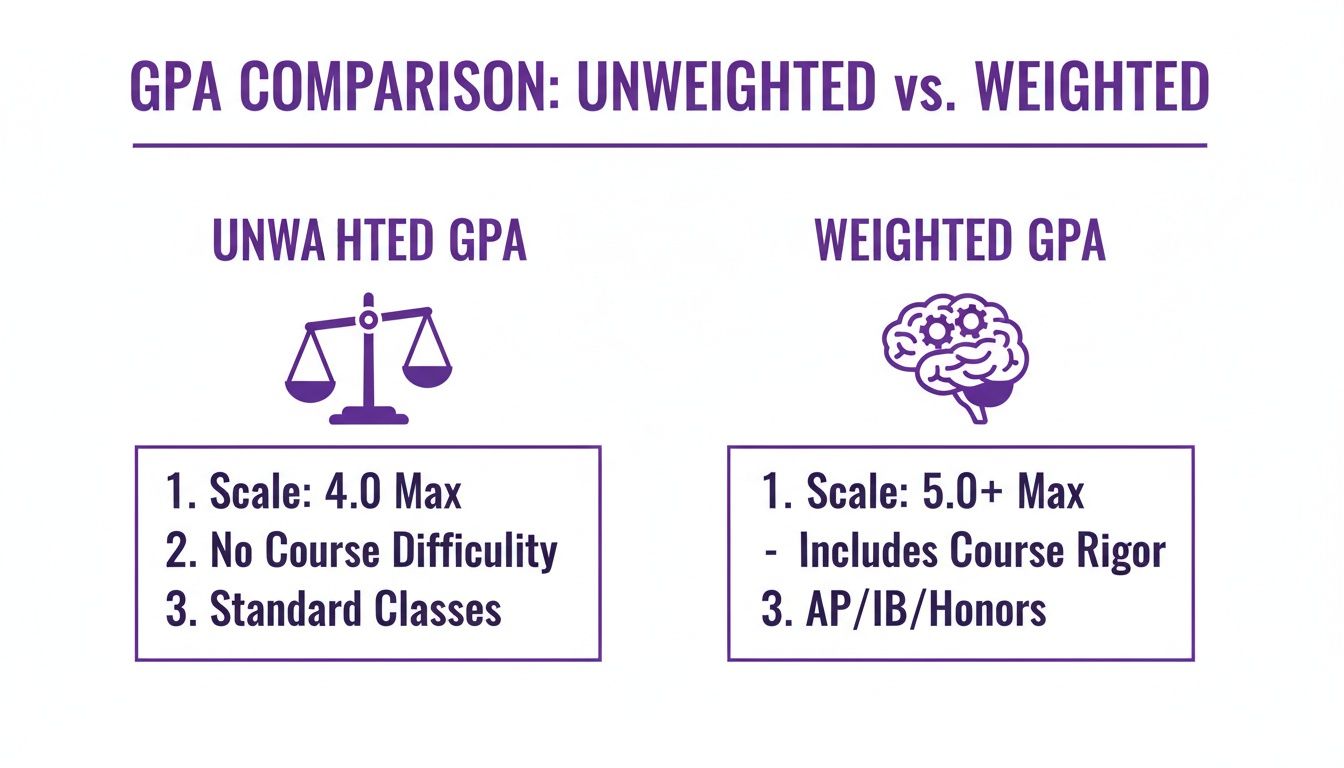
As the image shows, the unweighted scale gives a uniform look at your performance, while the weighted scale tells a story about your academic ambition. It shows you didn’t just get good grades—you got them in the toughest classes available.
From what we've seen in admissions data, an unweighted GPA above 3.5 is a major benchmark. It signals you're earning more A's than B's on a straight 4.0 scale, making you a much more competitive applicant for top-tier programs.
Quick Comparison Weighted vs Unweighted GPA
To make it even clearer, here’s a side-by-side look at how weighted and unweighted GPAs stack up, focusing on what they measure and how admissions committees view them.
| Attribute | Unweighted GPA | Weighted GPA |
|---|---|---|
| Scale | Typically 0.0 to 4.0 | Often extends to 5.0 or higher |
| Course Value | All courses are treated equally | Advanced courses (AP, IB, Honors) receive extra points |
| Primary Focus | Measures overall academic consistency | Highlights academic rigor and challenge |
| Common Use | Standardized baseline for comparison | Signals an applicant's readiness for difficult college-level work |
This table gets to the heart of it, but the real takeaway is that both numbers matter.
Key Insight: Admissions committees look at both. Your unweighted GPA shows your foundational academic performance, while your weighted GPA demonstrates your drive to tackle challenging material—a crucial trait for success in demanding healthcare programs. To see how this applies to specific fields, check out our guide on the average GPA for dental school.
How to Calculate Your Weighted and Unweighted GPA
Knowing the difference between a weighted and unweighted GPA is one thing, but actually running the numbers yourself is another. When you know how to calculate both, you can track your progress accurately and start seeing your academic record the same way an admissions officer does.
Let's walk through the exact steps for each calculation.
Calculating Your Unweighted GPA
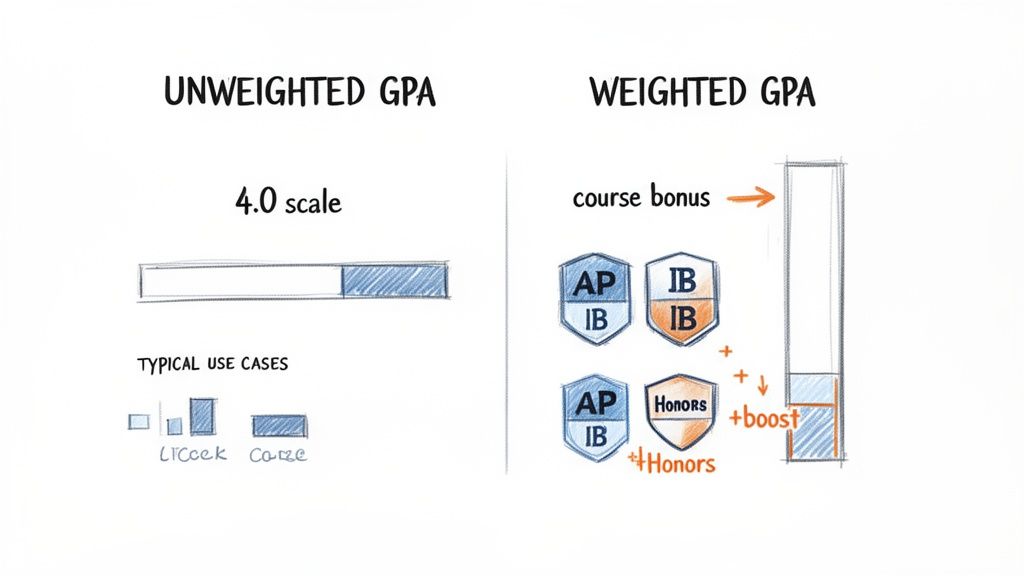
The unweighted GPA is the most straightforward calculation out there. It’s simple because it treats every course equally on a standard 4.0 scale. Whether you took regular biology or AP Biology, an A is always worth 4.0 points. No bonuses, no exceptions.
Here’s the simple formula you'll use:
Unweighted GPA = (Total Grade Points) / (Total Credit Hours Attempted)
Let's break this down with a sample semester:
| Course | Grade | Grade Points (4.0 Scale) | Credit Hours | Total Points |
|---|---|---|---|---|
| English 101 | A | 4.0 | 3 | 12.0 |
| Biology | B | 3.0 | 4 | 12.0 |
| Algebra II | A | 4.0 | 3 | 12.0 |
| US History | B | 3.0 | 3 | 9.0 |
| Totals | 13 | 45.0 |
Now, just plug the totals into the formula: 45.0 Total Points / 13 Credit Hours = 3.46 Unweighted GPA. This number gives you a clean, baseline measure of your academic performance without factoring in course difficulty.
Calculating Your Weighted GPA
The weighted GPA calculation adds a layer of nuance by rewarding you for academic rigor. High schools and colleges all have their own systems, but the common approach is to add bonus points for advanced courses.
A typical weighting system might look something like this:
- AP/IB Courses: Add +1.0 to the standard grade point.
- Honors Courses: Add +0.5 to the standard grade point.
This is where your hard work in challenging classes really pays off. For healthcare program admissions, a strong weighted GPA can seriously elevate your profile, pushing your score well past the traditional 4.0 ceiling. An A in AP Chemistry, for instance, might earn 5.0 points, turning a strong student into a standout applicant with a 4.5+ GPA. You can learn more about how weighted GPAs impact admissions on auamed.org.
Let's re-run the numbers with the same grades, but this time with advanced courses mixed in:
| Course | Grade | Grade Points (Weighted) | Credit Hours | Total Points |
|---|---|---|---|---|
| AP English Lit | A | 5.0 (4.0 + 1.0) | 3 | 15.0 |
| Honors Biology | B | 3.5 (3.0 + 0.5) | 4 | 14.0 |
| Algebra II | A | 4.0 (Standard) | 3 | 12.0 |
| AP US History | B | 4.0 (3.0 + 1.0) | 3 | 12.0 |
| Totals | 13 | 53.0 |
Applying the same formula gets us a very different result: 53.0 Total Points / 13 Credit Hours = 4.08 Weighted GPA.
The Takeaway: Notice how the exact same letter grades result in a 3.46 unweighted GPA but a 4.08 weighted GPA. This stark difference immediately highlights your commitment to challenging coursework—a key trait that admissions committees for medical, dental, and PA programs are actively looking for.
How Admissions Committees Interpret Your GPA
When you submit your application to a competitive healthcare program, your GPA isn't just a number that gets a quick glance. Admissions committees use a holistic review process, digging past the raw score to understand the story of your academic journey. They rarely take a GPA at face value, knowing full well that every high school and university grades differently.
To level the playing field, most competitive programs in medicine, dentistry, and pharmacy will actually recalculate your GPA themselves. They need a standardized way to compare applicants from thousands of different institutions. This is why the difference between your weighted and unweighted GPA becomes such a critical part of your academic narrative.
Unweighted GPA: The Baseline for Performance
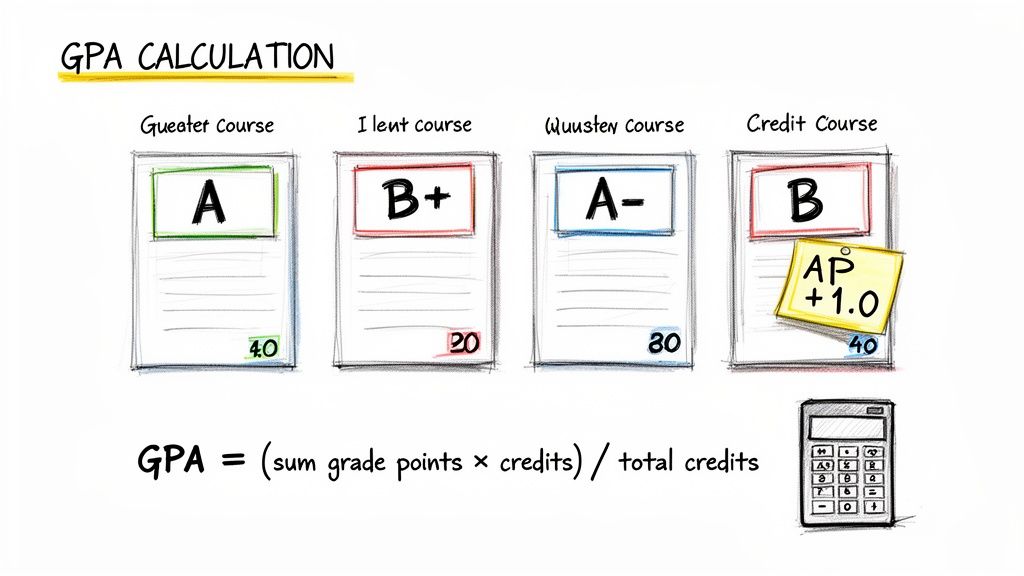
Think of your unweighted GPA as the universal baseline for your academic performance. It’s a clean, straightforward measure of your consistency and ability to master core material. A high unweighted GPA proves you can reliably earn top marks across the board—a non-negotiable skill for the rigors of any healthcare curriculum.
But an unweighted GPA never tells the whole story. An admissions officer who sees a perfect 4.0 will immediately look deeper. They’ll scan your transcript to see how you earned it, which is where your course selection and weighted GPA come into play.
Weighted GPA: A Signal of Academic Rigor
This is where your weighted GPA shines. It’s the single best indicator of your academic ambition and willingness to challenge yourself. When an admissions committee sees a high weighted GPA, they see an applicant who actively sought out the toughest courses available—AP, IB, or honors classes—and succeeded.
It signals that you aren't afraid of a demanding workload, a crucial trait for any future doctor, dentist, or pharmacist. Beyond just the number, they scrutinize your curriculum's rigor. Understanding how to approach your AP scores adds another layer of context, reinforcing the story your weighted GPA tells and proving you’re ready for college-level science from day one.
From an Admissions Officer's Perspective: "We see two applicants. One has a 4.0 unweighted GPA from standard-level courses. The other has a 3.7 unweighted GPA but a 4.5 weighted GPA from a schedule packed with AP sciences and math. We are often more impressed by the second applicant because they have already proven they can handle a curriculum similar in difficulty to what they will face in medical or dental school."
The BCPM GPA: The Most Critical Metric
For anyone on a pre-health track, there’s one more layer: the BCPM GPA. This includes all your Biology, Chemistry, Physics, and Math courses, and for programs like medical school, it's often the most important academic metric they look at. While both a weighted and unweighted GPA for medical school matter, your performance in these core science classes is seen as a direct predictor of your ability to handle their foundational curriculum.
Admissions committees calculate your BCPM GPA separately to get a clear picture of your aptitude for the sciences. A high overall GPA is great, but a high BCPM GPA is essential for most top-tier programs. It tells them you have the specific scientific foundation needed to succeed.
To put it all together, here’s a breakdown of how admissions committees for top healthcare programs tend to view each component of your GPA.
Admissions Committee GPA Interpretation
This table illustrates how admissions committees for healthcare programs typically prioritize and interpret different aspects of an applicant's GPA.
| GPA Type | Primary Role in Admissions | What It Signals to Committees | Example Scenario |
|---|---|---|---|
| Unweighted GPA | Establishes a baseline of academic consistency and raw performance. | Ability to earn high marks and maintain academic discipline. | A student with a 3.9 unweighted GPA has demonstrated consistent A-level work. |
| Weighted GPA | Highlights academic rigor and an applicant's readiness for challenges. | Intellectual curiosity and a willingness to tackle difficult coursework. | A 4.6 weighted GPA shows the student excelled in numerous AP or honors classes. |
| BCPM GPA | Assesses specific aptitude in core pre-health science subjects. | Predicts success in the foundational science curriculum of a healthcare program. | An applicant with a 3.8 BCPM GPA is seen as well-prepared for first-year med school science. |
Ultimately, committees look at these numbers together to build a complete profile. The unweighted GPA shows your floor, the weighted GPA shows your ceiling, and the BCPM GPA shows your strength in the subjects that matter most.
Reporting Your GPA on Healthcare Applications
When you're dealing with centralized application services like AMCAS (for medical schools), AACOMAS (for osteopathic), or AADSAS (for dental), precision is the name of the game. These platforms require you to enter every single course and grade exactly as it appears on your official transcript. This is not the place for rounding up or making your best guess.
The reason for this rigidity is simple: these services perform their own independent GPA calculations. They will meticulously check every entry against your official transcripts and recalculate your GPA using their own standardized formula. This process ensures every applicant is judged on a level playing field, no matter how their undergraduate school handles unique grading or weighting policies.

Navigating Common Application Scenarios
A frequent point of confusion is what to do when your transcript shows both a weighted and unweighted GPA. In this case, the rule is straightforward: report the unweighted GPA unless the application specifically gives you an option for both. Don't worry—the application services will note the rigor of your coursework when they do their own evaluation.
What about Pass/Fail grades? Generally, a "Pass" will fulfill a prerequisite but is not factored into the GPA calculation by services like AMCAS. A "Fail," on the other hand, is almost always calculated as an F and will bring your GPA down. Always double-check the specific policies for each service you're using, as there can be slight differences.
Critical Reminder: Accuracy is everything. Any mismatch between what you report and what's on your transcript can delay your application or even get it flagged for an integrity violation. Check every single entry before you submit.
Best Practices for GPA Reporting
To avoid the common traps that trip up applicants, it helps to follow a clear set of guidelines. Think of this as your pre-flight checklist before you send your academic history off for verification.
Here are the essential do's and don'ts for getting this section right:
Do:
- Enter Grades Exactly as They Appear: If your transcript says "A-," you must enter "A-." Don't simplify it to an "A" or try to round up.
- List Every Single Course: This means everything—withdrawals, repeated courses, and even college-level classes you took back in high school. If it's on a college transcript, it needs to be on your application.
- Use Designated Sections for Explanations: If your school has a strange grading system or you need to provide context for a rough semester, use the optional essays or additional information sections. The coursework grid is just for the data.
- Order Official Transcripts Early: Get your transcripts requested from every single post-secondary institution you've attended. Do it well in advance so they arrive long before any deadlines.
Don't:
- Calculate Your Own GPA: Never enter a GPA you calculated yourself. Report the cumulative GPA printed on your transcript. If your school doesn't calculate one, leave the field blank. The service will do the official math.
- Convert Grades to a 4.0 Scale: If your school uses a 100-point system or something else entirely, report the grades as they are. AMCAS and the other services have their own conversion tables.
- Assume All Services Are the Same: While they feel similar, each application service (AMCAS, AACOMAS, AADSAS, etc.) has its own instruction manual for a reason. Read it carefully.
Strategically Discussing Your GPA in Interviews
Your application got you in the door, but the interview is where you give your story life. When an interviewer asks about your academic record, they aren't just looking at the numbers. They're probing for self-awareness, resilience, and maturity. The way you frame the conversation around your weighted vs. unweighted GPA can turn a point of scrutiny into a showcase of your best qualities.
Whether your GPA is a highlight or a point of concern, your job is to own the narrative. Don't make excuses. Instead, provide context and demonstrate growth. This transforms simple data points into a compelling story about your readiness for a demanding healthcare career, proving you’ve reflected on your journey and are prepared for what’s next.
Framing a High Weighted GPA
If you have a high weighted GPA but a more modest unweighted one, you have a perfect opportunity to highlight your ambition. An interviewer might ask, "Can you walk me through your academic performance?" This is your cue. Frame your tough course load as a deliberate choice to seek out challenges—a quality that rigorous healthcare programs value highly.
Here’s a solid way to structure your response:
- Acknowledge the numbers: Start by stating your GPAs clearly. "My final unweighted GPA was a 3.6, while my weighted GPA came in at a 4.4."
- Explain your strategy: Immediately follow up with your reasoning. "I made a conscious decision to take the most rigorous science and math curriculum my school offered, including multiple AP and IB courses, because I wanted to prepare myself as thoroughly as possible for a demanding pre-health track."
- Connect it to your goals: Tie this choice directly to your future aspirations. "While it meant my unweighted GPA wasn't a perfect 4.0, I believe the depth of knowledge and the strong study habits I developed in those challenging courses gave me a solid foundation for the rigors of medical school."
This kind of response reframes a lower unweighted score not as a weakness, but as the natural outcome of a strategic decision to prioritize academic rigor over an easier path to a higher number.
Addressing a Lower GPA or an Upward Trend
If your GPA is lower than you’d like, or if you had a rocky start, the interview is your chance to demonstrate real growth and resilience. Honesty and accountability are your best assets here. Avoid blaming professors, tough circumstances, or "weeder" classes. Focus entirely on what you learned from the experience.
For instance, if asked about a C in organic chemistry, a powerful response would center on the concrete steps you took to improve.
"My performance in Organic Chemistry I was a significant learning experience for me. I initially underestimated the level of daily preparation required, and my old study habits just weren't effective for that type of material. After receiving that grade, I completely changed my approach. I started attending every office hour, formed a study group, and adopted a new method of problem-solving. As a result, I earned an A in Organic Chemistry II the following semester, which I feel better reflects my true academic capabilities."
This answer succeeds because it turns a negative into a positive by highlighting three key things:
- Ownership: You take full responsibility for the initial stumble.
- Problem-Solving: You identified the specific issue and implemented a concrete solution.
- Positive Outcome: You show clear, verifiable evidence of improvement and growth.
For applicants looking for more examples, our guide on nursing school interview tips offers additional strategies for discussing your academic history. Beyond just discussing your GPA, it's essential to prepare for the broader context of healthcare admissions, including common nursing interview questions and answers, to effectively present your candidacy. Ultimately, your ability to discuss your GPA thoughtfully shows that you are a mature, reflective candidate ready for the next phase of your education.
Answering Your Key Questions About GPA
Even the most buttoned-up applicants have questions about how their weighted vs. unweighted GPA will be interpreted. As you get ready to hit submit on applications for incredibly demanding healthcare programs, getting clear on these details is non-negotiable.
This is your final check-in. We're tackling the most common questions we hear from aspiring medical, dental, and PA students so you can present your academic record with total confidence.
Do Medical Schools Prefer a High Weighted or Unweighted GPA?
Here's the straight answer: medical schools and other competitive programs don't prefer one over the other. They use both to build a complete, nuanced picture of your academic horsepower.
Think of your unweighted GPA as the clean, standardized baseline. It answers one simple question: did you consistently earn high marks? It's all about academic consistency.
But your weighted GPA adds the critical context. It tells the admissions committee that you actively sought out challenges and shows how you performed in a tough, college-level curriculum. A high unweighted GPA is great, but a high weighted GPA proves you earned it while tackling the hardest courses your school offered.
The Verdict: A top-tier applicant has both. A high unweighted GPA (think 3.8+) shows mastery, while a high weighted GPA (4.3+) signals ambition. If forced to choose, a slightly lower unweighted GPA paired with a much higher weighted one often looks better than a perfect 4.0 earned in standard-level classes. It shows you'd rather be challenged than play it safe.
What if My School Does Not Offer Weighted Grades?
This is a common scenario, so don't sweat it. Admissions committees are experts at reading transcripts. They review thousands of them from every imaginable type of institution, and they will have access to your high school or college's profile. That profile explains the school's grading policies, including whether or not it weights grades.
If your school doesn't use a weighted system, the committee simply looks at the rigor of your curriculum directly. They will see the AP, IB, or advanced honors courses on your transcript and evaluate your performance in them. Your only job is to take the most challenging courses available and crush them. The admissions officers will handle the rest.
How Do Pass/Fail Grades from COVID-19 Affect My GPA?
Most centralized application services and admissions committees have very clear policies for Pass/Fail (P/F) grades, especially those from the peak of the COVID-19 pandemic in 2020. Generally, a "Pass" grade fulfills a prerequisite requirement but is not factored into your GPA calculation.
On the flip side, a "Fail" is almost always treated as an F and will drag your GPA down. While P/F grades from that unique period won't hurt your numerical average, be aware that some of the most selective programs have stated a preference for actual letter grades in core science prerequisites. Always check the specific admissions websites for the schools you're targeting.
Should I Retake a Course to Improve My GPA?
Retaking a course can be a smart strategic move, but it's not a magic eraser. Application services like AMCAS require you to report all attempts, and both grades will be included in their GPA calculation. The original low grade doesn't just disappear.
That said, earning an A in a retake absolutely demonstrates mastery and perseverance. For many applicants, however, a better strategy is to create a strong upward trend by excelling in subsequent, higher-level science courses. This shows genuine academic growth and proves you have what it takes to succeed, all without spending time redoing intro-level material.
Ready to turn your academic story into a compelling interview performance? Confetto provides AI-powered mock interviews that simulate the real thing, giving you instant, actionable feedback on everything from your communication style to the strength of your answers. Practice anytime, anywhere, and walk into your interviews with confidence. Start your free trial at https://confetto.ai.