
8 Actionable Nursing School Interview Tips for Success in 2026
Ace your admissions interview with these 8 essential nursing school interview tips. Learn how to master STAR, ethical dilemmas, and mock practice. Read now!

The nursing school interview is more than just a formality; it's a critical assessment of your empathy, critical thinking, and suitability for a demanding profession. While your GPA and personal statement got you this far, your performance in the interview can ultimately determine your acceptance. Many aspiring nurses with stellar applications falter at this stage, not from a lack of passion, but from a lack of specific, actionable strategy.
This guide moves beyond generic advice like 'be yourself' and provides a concrete framework to prepare effectively. We'll break down the specific techniques you need, from mastering behavioral questions with the STAR method to navigating complex ethical dilemmas and using structured practice to build unshakeable confidence. By implementing these eight nursing school interview tips, you will not only answer questions effectively but also demonstrate the professional presence and self-awareness that admissions committees are actively seeking. Many of these foundational communication skills are transferable across healthcare roles. For example, you can find valuable general interview preparation advice in this detailed CNA interview preparation guide. The goal is to equip you to showcase your potential as a compassionate and competent future nurse.
1. Research the Nursing Program and Institution Thoroughly
Demonstrating deep knowledge of the nursing program you're interviewing for is one of the most effective nursing school interview tips. It elevates you from a generic applicant to a serious candidate who has thoughtfully considered their future. Interviewers want to see genuine enthusiasm for their specific program, not just any nursing program. This preparation shows initiative and proves you are invested in becoming part of their unique academic and clinical community.
This research allows you to tailor your answers, connecting your personal goals and experiences directly to the school's offerings. Instead of saying you're interested in pediatrics, you can mention a specific faculty member’s research in pediatric oncology and how it aligns with your career aspirations. This level of detail makes your responses authentic, memorable, and impactful.
How to Conduct Your Research
Focus on uncovering the details that differentiate the program. This information will become the foundation for your interview answers.
- Review the Program Website: Go beyond the homepage. Scrutinize the curriculum structure, mission and vision statements, faculty biographies, and listed clinical partnerships.
- Check Accreditation and Rankings: Understand the program's standing. Is it CCNE or ACEN accredited? Note any special designations or high national rankings that you can reference.
- Connect with Current Students: Use platforms like LinkedIn or student forums to ask current attendees about their experiences, the program's culture, and its strengths.
- Explore Unique Offerings: Identify what makes the program special. This could be a global health initiative, a simulation lab with advanced technology, or a strong focus on community-based care. When you can articulate how these specific features support your goals, you prove you're an ideal fit for the program.
2. Master Behavioral and STAR Method Responses
Nursing school interviews are designed to assess more than just your academic record; they want to see your soft skills in action. Behavioral questions, which often start with "Tell me about a time when...", are used to gauge your past performance as a predictor of future success. One of the most powerful nursing school interview tips is to respond to these questions using the STAR method, a structured storytelling technique that showcases your critical thinking, problem-solving, and self-reflection abilities.
This method helps you deliver a concise, compelling narrative that directly answers the interviewer's question while highlighting your strengths. Instead of a rambling, unfocused story, the STAR framework organizes your thoughts into a clear and logical progression. It demonstrates that you can analyze a situation, understand your role, take decisive action, and learn from the outcome, all essential skills for a competent nurse.
How to Implement the STAR Method
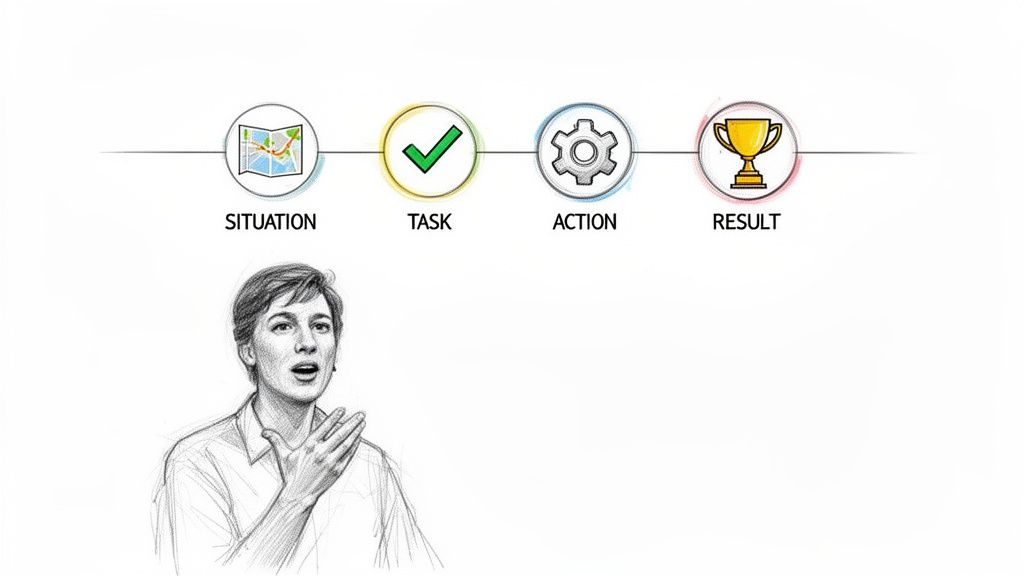
The STAR method is an acronym that breaks your response into four distinct parts, ensuring a complete and impactful answer.
- Situation: Briefly set the scene. Describe the context of the event or challenge you faced. (e.g., "During a clinical volunteer shift, I noticed a patient was becoming increasingly anxious and wasn't communicating with the staff.")
- Task: Explain your specific responsibility or goal in that situation. What were you trying to achieve? (e.g., "My task was to build rapport with the patient to understand their concerns and provide comfort.")
- Action: Detail the concrete steps you took to address the task. This is the core of your story, so be specific about your actions. (e.g., "I sat with the patient, used active listening techniques, and learned they were worried about a family member. I then relayed this specific concern to the charge nurse.")
- Result: Conclude by explaining the outcome of your actions. Quantify the result if possible and, most importantly, reflect on what you learned. (e.g., "The nurse was able to arrange a phone call, which immediately calmed the patient. I learned how crucial it is to look beyond physical symptoms to address a patient's holistic needs.")
To prepare effectively, you can explore common healthcare interview questions and answers and craft several STAR stories covering teamwork, leadership, conflict, and patient advocacy.
3. Demonstrate Authentic Passion for Patient Care and Nursing
Interviewers are looking for more than just academic achievement; they want to see your intrinsic motivation for nursing. Your ability to demonstrate a genuine passion for patient care shows that you understand the profession's realities, including its emotional and physical demands. This authenticity separates truly committed applicants from those who view nursing simply as a stable career path. It proves you have reflected on the role and are choosing it for the right reasons.

This passion should be communicated through specific, personal stories rather than broad statements. Instead of saying, "I want to help people," describe a time you advocated for a family member or volunteered in a setting where you witnessed a nurse’s holistic approach to care. Connecting your "why nursing" to tangible experiences makes your answer compelling and credible. It shows the admissions committee that you have thoughtfully considered what it truly means to be a nurse.
How to Articulate Your Passion
Focus on developing and practicing your narrative. Your goal is to tell a story that is both personal and professional, linking your past experiences to your future aspirations as a nurse.
- Reflect on Your "Why": Pinpoint the specific moments that solidified your commitment to nursing. Was it caring for a loved one, a volunteer experience, or witnessing a nurse’s impact firsthand? Prepare to share this story concisely.
- Go Beyond the Hospital: Show you understand the breadth of the nursing profession. Research and mention nursing roles in public health, policy, community clinics, or research to demonstrate a sophisticated understanding of the field.
- Connect Passion to Action: Explain how your passion has already driven you to act. Mention relevant coursework, certifications (like a CNA), or volunteer work that you pursued because of your interest in healthcare.
- Be Honest and Evolving: It’s okay to admit what first drew you to nursing, even if it was a simple idea. The key is to explain how your understanding has deepened over time through research and experience, proving your commitment is mature and well-informed.
4. Prepare for Ethical Dilemmas and Healthcare Policy Questions
Nursing schools increasingly use questions about ethical dilemmas and healthcare policy to evaluate your critical thinking and grasp of nursing's broader societal role. These scenarios test your ability to navigate complex situations, not to find a single "right" answer. Interviewers want to see how you process information, weigh competing values, and connect your reasoning back to the core principles of nursing. This demonstrates the maturity and ethical grounding required for professional practice.

This preparation is a key part of our nursing school interview tips because it shows you understand that nursing extends beyond clinical tasks. When you discuss how you would advocate for a patient's informed refusal of treatment or address healthcare disparities, you prove you're ready for the multifaceted challenges of modern healthcare. Articulating a well-reasoned, empathetic position on these issues can significantly distinguish you from other applicants.
How to Prepare for Ethical and Policy Questions
Your goal is to demonstrate a thoughtful, structured approach to difficult topics. This involves both foundational knowledge and a framework for your response.
- Review the ANA Code of Ethics: Use the American Nurses Association (ANA) Code of Ethics as your guide. Familiarize yourself with its provisions on advocacy, confidentiality, and patient dignity. Referencing these principles provides a solid, professional foundation for your answers.
- Stay Informed on Current Issues: Read recent articles about healthcare policy, social determinants of health, and public health challenges. Form an informed opinion on topics like healthcare access, resource allocation, and patient autonomy.
- Practice Articulating Your Thoughts: Avoid absolute statements. Use phrases like, “My initial approach would be to consider multiple perspectives,” or “The key ethical principle at play here is…” Acknowledge the complexity of the situation.
- Connect to Nursing Values: Always bring your response back to core nursing values such as compassion, integrity, social justice, and patient advocacy. Frame your final thoughts around what is in the best interest of the patient and community. You can find a variety of ethical dilemma and health systems questions to practice with on confetto.ai.
5. Practice Mock Interviews and Communicate Clearly to Reduce Nervous Habits
Clear communication is a fundamental nursing competency, and your interview is the first major test. Interviewers assess your ability to articulate ideas confidently and engage respectfully, looking for candidates who can handle the high-stakes communication required in healthcare. Deliberate mock interview practice is one of the most powerful nursing school interview tips because it builds the muscle memory needed to perform well under pressure, helping you eliminate filler words and nervous habits.
Structured practice transforms your delivery from hesitant to commanding. For instance, you can train yourself to replace filler-heavy phrases like, "Um, I think, like, teamwork is really important," with a direct and impactful statement: "Teamwork is essential in nursing because it directly impacts patient safety and outcomes." This shift demonstrates clarity and professionalism, proving you are ready for the demands of a nursing program.
How to Practice Effectively
Consistent, targeted practice is key to refining your communication skills and managing anxiety. This routine helps you focus on pacing, tone, and nonverbal cues.
- Record Yourself: Use your phone or computer to record your answers to common interview questions. Watching the playback is the fastest way to identify verbal tics (like "um" or "like"), awkward gestures, or a rushed speaking pace.
- Implement the 3-Second Pause: Before answering any question, take a slow, deliberate breath. This short pause gives you time to structure your thoughts and makes you appear more composed and thoughtful, rather than anxious or impulsive.
- Focus on One Habit at a Time: Don't try to fix everything at once. Dedicate each mock session to improving one or two specific areas, such as reducing filler words or improving your posture. For more insights, review these interview body language tips.
- Simulate the Real Environment: Conduct your practice sessions in a setting similar to your actual interview. Dress professionally, sit at a desk in a quiet room, and use the same technology if it's a virtual interview. To further aid in calming pre-interview jitters, consider exploring effective strategies for managing interview anxiety.
6. Show Self-Awareness and Ability to Discuss Limitations Honestly
Admissions committees aren't looking for perfect candidates; they are looking for mature, teachable individuals who are prepared for the rigors of nursing. One of the most insightful nursing school interview tips is to embrace questions about your weaknesses or past mistakes. These questions are designed to assess your self-awareness, honesty, and capacity for growth, which are critical traits for a safe and effective nurse. How you handle this discussion reveals your humility and commitment to lifelong learning.
Framing your limitations as opportunities for development demonstrates a proactive growth mindset. Instead of viewing a weakness as a permanent flaw, you can present it as a challenge you have actively worked to overcome. This approach turns a potential negative into a powerful story of resilience and personal accountability, making you a more compelling and realistic applicant.
How to Discuss Your Limitations Authentically
The goal is to show you can identify an area for improvement, take concrete steps to address it, and learn from the experience.
- Avoid Cliched Answers: Steer clear of the "weakness disguised as a strength" trap, such as saying, "I'm a perfectionist" or "I work too hard." These responses can sound disingenuous. Instead, choose a genuine, relevant area for growth.
- Use a Structured Response: Follow a simple, effective formula:
- Identify the limitation: Clearly state the weakness (e.g., initial difficulty with time management).
- Explain the impact: Briefly describe how it affected you (e.g., feeling overwhelmed by coursework).
- Describe your action: Detail the specific steps you took to improve (e.g., adopting the Pomodoro Technique and using a digital planner).
- Show the positive result: Share the outcome of your efforts (e.g., improved grades and reduced stress).
- Provide Concrete Examples: Back up your claims with evidence. For instance, if you struggled with public speaking, mention how you joined a club or took a course and can now present confidently to groups.
- Connect it to Nursing: Explain why this growth is important for your future as a nurse. For example, improving time management is crucial for prioritizing patient care on a busy clinical unit. This shows you understand the demands of the profession.
7. Ask Thoughtful Questions That Demonstrate Engagement
Nearly every interview concludes with the question, "Do you have any questions for us?" This is not a formality; it's a final opportunity to demonstrate your engagement and critical thinking. Preparing thoughtful questions is one of the most powerful nursing school interview tips because it shifts you from a passive participant to an active, inquisitive future colleague. It proves you view this as a mutual decision and are genuinely invested in finding the right program for your career.
Asking insightful questions reinforces your interest and shows you have done your research beyond a surface-level website scan. Instead of asking something easily found online, your questions should reflect a deeper curiosity about student life, program culture, and career outcomes. This moment allows you to highlight your priorities, such as mentorship, clinical specialization, or student support, confirming your alignment with the school’s values and resources.
How to Prepare Your Questions
Your goal is to prepare questions that are specific, insightful, and cannot be answered with a quick search. Aim for 4-5 well-researched questions, knowing you will likely only ask one or two.
- Focus on Student Experience & Support: Ask about things that matter to a student's success and well-being. For example, "I was impressed by the emphasis on student wellness on your website. Could you tell me more about the specific resources available to help students manage the academic and emotional demands of the nursing program?"
- Inquire About Professional Development: Frame questions around your future career. You could ask, "How does the program support students in securing clinical placements in competitive specialties like critical care or pediatrics?" or "What opportunities are available for students to get involved in faculty research projects?"
- Connect to Program Uniqueness: Refer back to your research. For instance, "I read about your global health initiative in [Country]. What is the process for students to become involved in these international clinical experiences?"
- Avoid Logistical or Basic Questions: Never ask about information that is clearly stated on the website, such as application deadlines or tuition costs. Also, avoid questions about salary or vacation time, as these are inappropriate for a school interview. Framing your curiosity genuinely, such as, "I'm interested in learning more about..." makes you sound engaged and professional.
8. Prepare for Technical and Clinical Scenario Questions with Nursing Knowledge Application
Beyond personal and behavioral questions, many nursing school interviews test your foundational knowledge and clinical reasoning skills. Interviewers use scenario-based questions to assess your ability to think critically under pressure, apply ethical principles, and understand the core responsibilities of a nurse. Answering these questions effectively demonstrates that you have moved beyond a surface-level interest in the profession and are prepared for the academic and clinical rigors ahead.
This preparation is a key nursing school interview tip because it shows your commitment to patient safety and evidence-based practice. Instead of just saying you are a critical thinker, you can prove it by logically working through a complex patient situation. For example, discussing how you would prioritize care for multiple patients with varying needs shows your understanding of acuity and resource management, core nursing competencies.
How to Prepare for Scenario Questions
Your goal isn't to have the perfect answer for every possible scenario but to demonstrate a sound, logical, and patient-centered thought process.
- Review Foundational Concepts: Refresh your knowledge of core principles like patient safety protocols (e.g., hand hygiene, fall prevention), the nursing process (ADPIE), infection control basics, and professional communication strategies.
- Study Current Nursing Issues: Read a few recent articles from reputable nursing journals or healthcare news sites. This will give you context for challenges like healthcare disparities, new technologies, or public health crises that might appear in scenarios.
- Use a Structured Framework: Practice responding to clinical prompts using a simple framework: Situation Assessment (What is the immediate problem? What information do I need?), Nursing Action (What are my priority actions based on my assessment?), and Rationale/Outcome (Why did I choose this action, and what is the desired patient outcome?).
- Acknowledge Your Limits: It is crucial to be honest about the boundaries of your current knowledge. Stating, "As a student, I would first ensure the patient is stable and then immediately consult with my preceptor or the charge nurse," shows maturity and a commitment to safety. Avoid guessing or speculating on advanced clinical interventions.
8-Point Nursing Interview Prep Comparison
| Strategy | Implementation Complexity 🔄 | Resource Requirements ⚡ | Expected Outcomes 📊 | Ideal Use Cases 💡 | Key Advantages ⭐ |
|---|---|---|---|---|---|
| Research the Nursing Program and Institution Thoroughly | Moderate 🔄 — time‑intensive but systematic | Moderate ⚡ — 20–30 min/program; web, contacts | Personalization & stronger fit ⭐⭐⭐ — more authentic answers | Program-specific interviews; tailoring application materials | Differentiates candidates; aligns goals with program offerings ⭐ |
| Master Behavioral and STAR Method Responses | Moderate 🔄 — collect stories and structure them | Moderate‑High ⚡ — prepare 5–7 STAR stories; practice sessions | Clear, structured competency evidence ⭐⭐⭐ — memorable responses | Behavioral-heavy interviews; competency assessments | Reduces rambling; shows reflection and measurable outcomes ⭐ |
| Demonstrate Authentic Passion for Patient Care and Nursing | Low‑Moderate 🔄 — reflective writing and rehearsal | Low ⚡ — personal reflection, 1–2 page narrative | Authentic connection & motivation evidence ⭐⭐⭐ — stronger rapport | "Why nursing?" questions; assessing intrinsic motivation | Builds genuine rapport; signals resilience and fit ⭐ |
| Prepare for Ethical Dilemmas and Healthcare Policy Questions | High 🔄 — nuanced reasoning across perspectives | Moderate‑High ⚡ — read ethics, policy, case analyses | Demonstrates critical thinking & advocacy ⭐⭐ — mature, reasoned positions | MMI ethics stations; policy/advocacy questions | Shows social responsibility; aligns with professional ethics ⭐ |
| Practice Mock Interviews and Communicate Clearly to Reduce Nervous Habits | Moderate 🔄 — iterative practice and review | High ⚡ — platform, recordings, time (weeks of mocks) | Measurable communication improvement ⭐⭐⭐ — fewer fillers, better pacing | Final prep, MMI/panel simulations, confidence building | Objective feedback; builds muscle memory; measurable gains ⭐ |
| Show Self‑Awareness and Ability to Discuss Limitations Honestly | Low‑Moderate 🔄 — prepare honest, growth‑focused examples | Low ⚡ — identify 3–4 limitations; practice delivery | Signals maturity & growth mindset ⭐⭐ — credible self‑reflection | "Weakness" questions; assessing emotional intelligence | Demonstrates humility, readiness to learn, and improvement ⭐ |
| Ask Thoughtful Questions That Demonstrate Engagement | Low 🔄 — prepare specific, researched questions | Low ⚡ — research program, craft 4–6 questions | Positive final impression & information gain ⭐⭐ — shows engagement | Interview close; mutual fit evaluation | Demonstrates interest; helps decide fit; leaves strong closing note ⭐ |
| Prepare for Technical and Clinical Scenario Questions with Nursing Knowledge Application | High 🔄 — study concepts and apply reasoning | High ⚡ — review clinical principles, case practice | Validates clinical readiness & critical thinking ⭐⭐⭐ — academic preparedness | Clinical scenario stations; assessing nursing knowledge | Demonstrates clinical reasoning and readiness for rigorous curriculum ⭐ |
Turning Your Preparation into a Confident Performance
The journey to your nursing school interview is a marathon, not a sprint. The culmination of your hard work, academic achievements, and clinical exposure comes down to this pivotal conversation. As we've detailed, success isn't about memorizing perfect answers; it's about building a framework of preparation that allows your authentic self to shine through. By implementing the nursing school interview tips outlined in this guide, you move beyond hoping for the best and start strategically engineering your success.
Your ability to articulate your journey, demonstrate critical thinking, and convey genuine empathy is what separates a good candidate from an unforgettable one. It's the difference between saying you're passionate and showing it through well-reasoned, patient-centered examples.
Key Takeaways for Interview Success
Let's distill the core strategies into a final, actionable summary. Mastering these areas will ensure you walk into your interview feeling prepared, poised, and confident:
- Foundation of Knowledge: Your preparation begins with deep research into the specific nursing program. Understanding their mission, values, and unique offerings allows you to tailor your responses and demonstrate genuine interest. This isn't just about flattering the school; it’s about proving you’ve made a deliberate and informed choice.
- Structured Storytelling: The STAR method is more than just a technique; it's your tool for transforming abstract claims into concrete evidence. By structuring your responses around a Situation, Task, Action, and Result, you provide clear, compelling proof of your skills, from teamwork to ethical decision-making.
- Authenticity and Self-Awareness: Admissions committees want to meet a future colleague, not a robot. Be prepared to discuss your motivations, reflect on your limitations with honesty, and articulate how your unique experiences have prepared you for the rigors of nursing. This vulnerability, paired with a commitment to growth, is a sign of true maturity.
Your Actionable Next Steps
Knowledge without application is just potential. To truly transform these tips into a confident performance, you must engage in deliberate practice. Start by scripting out answers to common questions, then move to verbalizing them out loud. Record yourself to identify and correct nervous habits, filler words, and unclear communication.
The most powerful step you can take is to simulate the interview experience. This is where you test your preparation under pressure. Engaging in mock interviews, whether with a career advisor, a trusted peer, or a specialized platform, is non-negotiable. This process builds the muscle memory needed to stay calm and focused when it truly counts, ensuring that your thoughtful preparation translates into a compelling, real-time conversation. Ultimately, these nursing school interview tips are your blueprint. Now, it's time to build the confidence to match your competence.
Ready to turn theory into practice and master your delivery? Confetto provides an AI-powered platform that simulates realistic nursing school interviews, offering instant, personalized feedback on your answers and communication style. Stop guessing and start improving with targeted practice at Confetto.