
Top Tips for physical therapy school interview questions
Master physical therapy school interview questions with sample answers, pitfalls to avoid, and concise practice tips to ace your DPT interview.

The physical therapy school interview is the final gatekeeper between you and your white coat. While your GPA and clinical hours get you to the door, your ability to articulate your passion, resilience, and clinical reasoning is what gets you through it. Many applicants with stellar stats stumble here, not from a lack of knowledge, but from a lack of preparation for the specific types of questions designed to test their suitability for the profession.
This guide moves beyond generic advice to deconstruct the most critical physical therapy school interview questions you are likely to face. We will dissect why admissions committees ask them, provide structured frameworks for crafting authentic answers, and highlight common pitfalls to avoid. By understanding the intent behind each prompt, you can shift from rehearsed responses to genuine, compelling conversations that showcase your readiness for a rigorous Doctor of Physical Therapy program.
Our goal is to equip you with the strategic insights needed to demonstrate your unique strengths and commitment. You will learn to articulate your experiences in a way that aligns with the core values of the physical therapy profession: empathy, critical thinking, and a dedication to patient-centered care. While DPT interviews have their unique focus, the core competencies tested often overlap with other healthcare professions. To broaden your preparation, exploring these 8 Common Medical School Interview Questions can provide valuable practice for similar DPT scenarios. Let's begin breaking down the questions that will define your interview performance.
1. Why Physical Therapy? (Motivation & Career Goals)
This foundational question is almost guaranteed to appear in your interview. It directly assesses your genuine interest in the profession, the depth of your research, and whether your personal motivations align with the realities of a physical therapy career. Admissions committees use this prompt to distinguish between applicants with a surface-level interest and those who possess a profound, well-researched commitment.
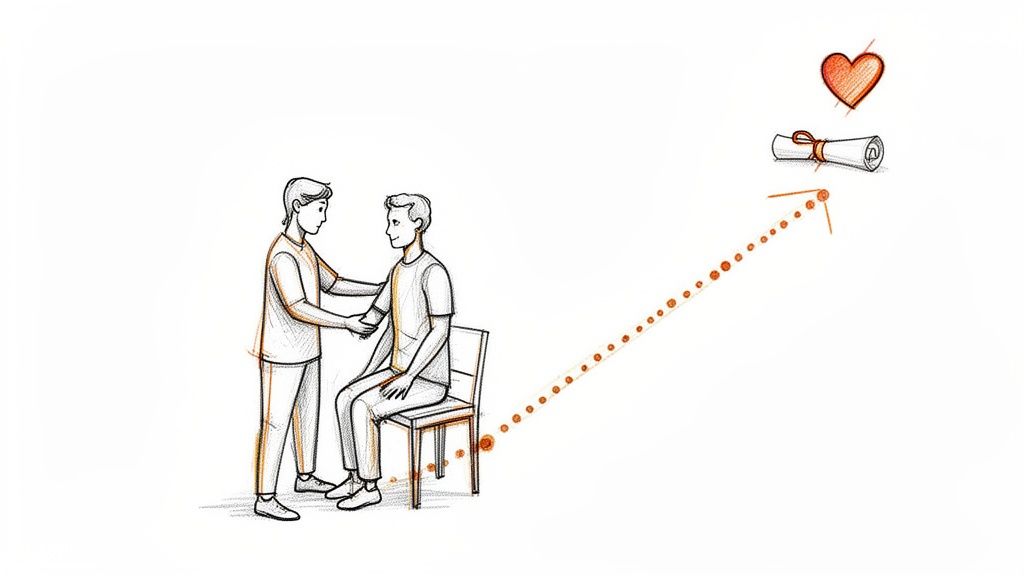
A compelling answer goes beyond generic statements like "I want to help people." Instead, it constructs a narrative that connects your personal experiences, academic journey, and clinical exposure. This is your opportunity to demonstrate that you understand the multifaceted role of a PT, which includes being an educator, a motivator, and an evidence-based practitioner. For more guidance on structuring personal narratives, explore these sample healthcare interview questions and answers.
How to Craft a Powerful Response
Your answer should be a story with three key parts: the spark, the exploration, and the future.
- The Spark: Begin with the specific moment or experience that first ignited your interest. Was it a personal injury, witnessing a family member’s recovery, or an impactful shadowing opportunity? For example, you could describe watching a physical therapist help a stroke survivor regain the ability to walk, focusing on the specific techniques and patient rapport you observed.
- The Exploration: Detail how you actively pursued this initial interest. Mention specific shadowing hours, volunteer roles, or research projects. Talk about what you learned about the scope of PT, such as its role in conservative care, interdisciplinary teamwork, and patient education.
- The Future: Connect your passion to your future career goals. Discuss specific PT specializations that interest you, such as pediatrics, geriatrics, or sports medicine. When articulating your career goals, consider how various therapeutic approaches, such as Pilates for rehabilitation, play a vital role in patient recovery and overall wellness. This shows you're thinking critically about the future of patient care.
2. Tell Us About Your Clinical Experience & Key Learnings
Admissions committees need to see that your understanding of physical therapy is grounded in real-world observation. This question probes beyond the number of hours you've logged; it evaluates your ability to reflect on those experiences, extract meaningful lessons, and demonstrate a mature understanding of the profession's challenges and rewards. It's your chance to prove you’ve moved from passive observer to active learner.
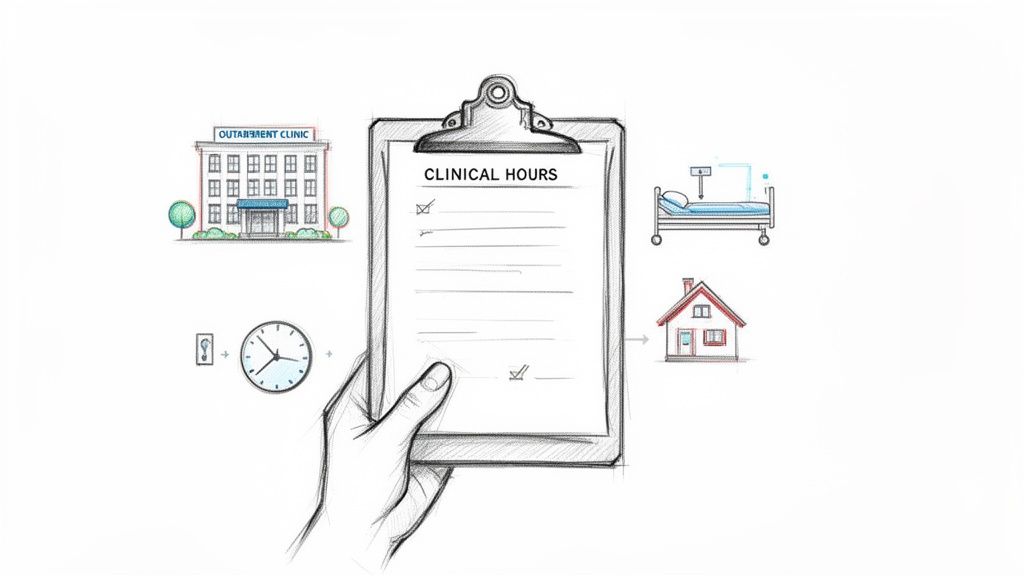
A strong answer demonstrates critical thinking and an awareness of the nuances of patient care. It's not enough to list the clinics you visited or the tasks you watched. The interviewers want to hear what you learned about communication, clinical reasoning, and the human side of rehabilitation. This is where you connect your observations to the core competencies of a successful physical therapist.
How to Craft a Powerful Response
Structure your answer around a few distinct, impactful stories. For each story, focus on the situation, the observation, and the reflection.
- The Situation: Briefly set the scene. Describe the clinical setting (e.g., outpatient orthopedic clinic, acute care hospital wing) and the general context of the patient case you observed. Keep this part concise. For example, "During my time at an outpatient neurological clinic, I observed a physical therapist working with a patient recovering from a traumatic brain injury."
- The Observation: Detail a specific action or interaction. Focus on a moment that taught you something significant about PT. This could be a PT modifying an exercise in real-time based on patient fatigue, using motivational interviewing to address a patient's frustration, or collaborating with an occupational therapist.
- The Reflection: This is the most crucial part. Explain what you learned from that observation and how it shaped your understanding of physical therapy. Connect it back to why you are a good fit for their program. For instance, you might explain how witnessing the psychological component of recovery solidified your interest in a holistic, patient-centered approach to care.
3. How Do You Handle Conflict or Disagreement with Authority?
Physical therapy is a collaborative profession, and your ability to navigate disagreements within a healthcare hierarchy is crucial. This question assesses your professional maturity, communication skills, and capacity for respectful advocacy. Admissions committees are looking for future practitioners who can question, learn, and contribute to a team without being insubordinate or passive.
This behavioral question is designed to see if you can balance advocating for patient safety and best practices with respecting the experience and authority of supervisors, clinical instructors, or other healthcare professionals. A strong answer demonstrates humility, critical thinking, and a commitment to collaborative problem-solving, which are all hallmarks of a competent clinician.
How to Craft a Powerful Response
Structure your answer using the STAR method (Situation, Task, Action, Result) to provide a clear, concise, and impactful narrative. Focus on a real experience where you demonstrated professionalism and a positive outcome.
- The Situation: Briefly describe a professional or academic scenario where you had a legitimate disagreement with a person in a position of authority, such as a clinical instructor, a supervising PT, or a professor. For instance, you might have observed a treatment approach during your shadowing hours that seemed to contradict what you learned was best practice.
- The Action: Detail the specific, respectful steps you took to address the conflict. This is the core of your answer. Explain how you chose the right time and place for the conversation, used “I” statements to express your perspective, and asked open-ended questions to understand their reasoning. For example, "I approached my CI after our patient session and said, 'I was curious about the choice of modality. Could you help me understand the clinical reasoning behind it compared to [alternative method]?'"
- The Result: Conclude by explaining the positive outcome of your actions. The goal isn't to prove you were "right," but to show you contributed to a better outcome or a valuable learning experience. Perhaps the discussion led to a modified treatment plan, or you gained a deeper understanding of an evidence-based technique you were unfamiliar with. Emphasize what you learned about professional communication and how it has shaped your approach to teamwork.
4. Describe Your Experience with Healthcare Disparities & Health Equity
This question has become a staple in modern physical therapy school interviews, reflecting the profession's growing emphasis on social responsibility and cultural competence. Admissions committees want to see that you understand how factors like socioeconomic status, race, location, and language impact a patient's ability to access and benefit from care. It's a test of your awareness, empathy, and readiness to treat the whole person, not just the diagnosis.

A strong answer demonstrates that you have moved beyond textbook knowledge and have engaged with these complex issues in a real-world setting. It shows you recognize that physical therapy doesn't exist in a vacuum and that achieving positive outcomes often requires addressing systemic barriers. This is your chance to showcase your commitment to providing equitable care for all future patients.
How to Craft a Powerful Response
Structure your answer around a specific experience, connecting it to a broader understanding of systemic issues and your future role as a physical therapist.
- The Observation: Start with a concrete example from your clinical, volunteer, or work experience. Describe a situation where you witnessed a healthcare disparity firsthand. For instance, you might discuss volunteering at a free clinic and observing how lack of transportation was a primary reason for missed appointments and inconsistent progress.
- The Analysis: Explain what you learned from this observation. Connect the specific instance to larger systemic factors like insurance gaps, food deserts, or language barriers. Show the interviewers you can think critically about the root causes. For example, connect the transportation issue to underfunded public transit in low-income neighborhoods.
- The Application: Articulate how this understanding will shape you as a future PT. Discuss how you would advocate for patients facing similar barriers. This could involve learning about community resources, using interpreter services effectively, or designing home exercise programs that don't require expensive equipment. This demonstrates your proactive commitment to health equity.
5. How Do You Balance Empathy with Professional Boundaries? (Emotional Intelligence & Professionalism)
This question evaluates your emotional intelligence, self-awareness, and understanding of the professional demands of physical therapy. PTs often form long-term relationships with patients who are navigating pain, disability, and significant life changes. Admissions committees want to see that you can provide compassionate care without succumbing to burnout or crossing professional lines, which is a critical skill for longevity and effectiveness in the field.
A strong response demonstrates that you understand this balance is not about being cold or distant; it's about sustainable, effective care. You must show that you can connect deeply with a patient's experience while maintaining the professional clarity needed to make objective clinical decisions. This is one of the more nuanced physical therapy school interview questions that separates mature applicants from those who are less prepared for the emotional rigors of the profession.
How to Craft a Powerful Response
Your answer should be grounded in experience and demonstrate a proactive approach to self-care and professional conduct. Focus on three areas: acknowledgment, strategy, and sustainability.
- The Acknowledgment: Start by acknowledging the inherent challenge. Use an example from your clinical or volunteer experience. For instance, describe observing a PT who provided immense emotional support to a patient with a chronic condition but knew when to redirect the conversation back to therapeutic goals to keep the session productive.
- The Strategy: Detail the concrete strategies you have learned or plan to use. This could include active listening to validate a patient's feelings without internalizing them, using peer support or mentorship for debriefing difficult cases, and clearly defining your role as a healthcare provider, not a personal friend. You can draw parallels to other high-stakes communication scenarios, similar to those discussed in these actionable medical school interview tips.
- The Sustainability: Explain why these boundaries are crucial for both the patient and the provider. Discuss how maintaining professional distance prevents compassion fatigue and burnout, ensuring you can provide high-quality care to all patients long-term. Mentioning the importance of your own well-being (e.g., exercise, hobbies) shows you have a plan for a sustainable career.
6. Tell Us About a Time You Failed or Made a Mistake & What You Learned
This classic behavioral question probes your self-awareness, resilience, and capacity for growth. Admissions committees are not looking for perfection; they are looking for future practitioners who can demonstrate accountability and a commitment to continuous improvement. How you respond reveals your maturity and ability to learn from setbacks, a critical skill in a field where mistakes can impact patient safety and trust.
An effective answer demonstrates that you can honestly self-assess, accept responsibility without making excuses, and translate a negative experience into a valuable lesson. This question is a prime opportunity to showcase your humility and the growth mindset essential for a lifelong career in healthcare. It’s a key part of many physical therapy school interview questions because it uncovers character.
How to Craft a Powerful Response
Structure your answer using the STAR method: Situation, Task, Action, and Result. This framework helps you create a concise yet impactful narrative.
- The Situation & Task: Briefly describe the context. Maybe you were in a group project aiming for a high grade, or shadowing in a busy clinic tasked with observing patient interactions. Choose a real, meaningful failure with a clear lesson, but avoid catastrophic errors or mistakes that suggest poor judgment. For instance, describe a time you misinterpreted a patient's non-verbal cues during a volunteer experience.
- The Action: Detail the mistake you made and, more importantly, the immediate and subsequent actions you took. First, explain what went wrong (e.g., “I assumed the patient's silence meant understanding, but it was actually confusion.”). Then, explain your corrective action (e.g., “I immediately asked my supervising PT for guidance, and they taught me to use teach-back methods to confirm comprehension.”). This shows initiative and accountability.
- The Result & Learning: Conclude by explaining the outcome and the lasting lesson. The result isn't just about fixing the initial problem; it's about the permanent change in your behavior. Explain how that experience shaped your approach to communication, teamwork, or clinical observation moving forward. For example, "As a result, I now proactively use clarifying questions and the teach-back method in all my patient interactions to ensure mutual understanding, a lesson I will carry with me as a physical therapist."
7. How Do You Stay Current with Evidence-Based Physical Therapy Practice?
Physical therapy is a dynamic, evidence-based profession that demands a commitment to lifelong learning. This question assesses your understanding of this core principle and your proactive approach to professional development. Admissions committees want to see that you recognize that your DPT education is just the beginning. They are looking for applicants who are already developing the habits of a modern, evidence-informed clinician who prioritizes patient outcomes above all else.
Answering effectively requires more than just stating that you read articles. It involves demonstrating your ability to find, evaluate, and consider the application of new research. This shows the interviewers that you respect the scientific foundation of the profession and are prepared to contribute to a culture of clinical excellence. It’s a key part of the modern identity of a physical therapist and one of the most important physical therapy school interview questions you can prepare for.
How to Craft a Powerful Response
Your answer should highlight your awareness, engagement, and application of evidence-based practice (EBP).
- Awareness: Start by acknowledging the importance of EBP in physical therapy. Mention specific resources you use or plan to use to stay informed. Name reputable journals like the Physical Therapy & Rehabilitation Journal (PTJ), resources like the Cochrane Library for systematic reviews, or the APTA's clinical practice guidelines. This shows you've done your homework.
- Engagement: Describe how you actively engage with new information. For instance, you could discuss a recent research article you read about telehealth effectiveness in post-operative care and what you found interesting. If you participated in a research project or even a detailed literature review for a class, this is the perfect place to mention it and connect it to your growing appreciation for EBP.
- Application: Connect your understanding back to patient care. Explain that the goal of staying current is to improve outcomes. You might say, “During my observation hours, my CI explained how she integrated new findings on pain neuroscience education into her treatment for a patient with chronic low back pain, which completely changed how I viewed the PT's role as an educator.” This demonstrates you understand the practical purpose of research.
8. Describe Your Involvement in Community Service or Volunteer Work
Physical therapy programs seek candidates who demonstrate compassion, empathy, and a commitment to serving others, qualities that extend beyond academic achievement. This question assesses your altruism, cultural competency, and understanding of the social determinants of health. Admissions committees want to see that you have a genuine desire to contribute to the well-being of your community, particularly vulnerable populations.
This prompt helps interviewers gauge your long-term dedication and the lessons you've learned from these experiences. They are evaluating whether you see service as a box to check or as an integral part of your personal and professional identity. It’s a key opportunity to showcase the values that will make you a patient-centered physical therapist.
How to Craft a Powerful Response
Structure your answer around the experience, the reflection, and the connection to physical therapy.
- The Experience: Begin by describing a specific, meaningful volunteer role. Focus on consistency over quantity. For instance, discuss your year-long commitment to volunteering at a pro bono clinic for uninsured patients, rather than listing several one-day events. Quantify your impact if possible: "I spent over 150 hours assisting therapists and interacting with dozens of patients who faced significant barriers to care."
- The Reflection: Share what you learned from the experience. This is the most critical part of your answer. Move beyond simple observations and discuss your personal growth. Did it change your perspective on healthcare access? Did you learn about the resilience of a specific population? For example, "This role taught me that a patient's healing is profoundly affected by factors outside the clinic, like their housing situation or ability to afford transportation."
- The Connection: Explicitly link your service back to your future as a physical therapist. Explain how these experiences have shaped your understanding of PT's role in the community and reinforced your motivation to join the profession. You could say, "My work at the clinic solidified my desire to practice in an underserved area and use my skills to advocate for health equity." This demonstrates that your service has directly informed your career path.
9. How Would You Handle a Patient Who Isn't Compliant with Their PT Program? (Clinical Judgment & Empathy)
This scenario-based question moves beyond your personal motivations and into the realm of clinical judgment and patient-centered communication. Patient adherence is a critical factor in successful rehabilitation outcomes, and interviewers use this prompt to see if you can problem-solve collaboratively, demonstrate empathy, and avoid a judgmental mindset. It's a key indicator of your understanding of behavioral change and the modern PT’s role as a partner in a patient’s health journey.

A strong answer showcases your ability to investigate the "why" behind the non-compliance rather than simply blaming the patient. It highlights your appreciation for the complex barriers that can affect adherence, such as pain, time constraints, financial issues, or a lack of understanding. This question is one of many challenging physical therapy school interview questions that requires you to think on your feet and apply principles of empathy and shared decision-making.
How to Craft a Powerful Response
Your response should demonstrate a multi-step, patient-first approach that prioritizes curiosity and collaboration over assumptions.
- Lead with Empathy and Inquiry: Start by stating your intention to understand, not to scold. Use non-judgmental, open-ended questions like, "Help me understand what challenges you're facing with the home exercise program," or "What parts of the program seem to be the most difficult to complete?"
- Explore Potential Barriers: Show your awareness of the diverse factors that impact compliance. Mention that you would explore issues like increased pain during exercises, scheduling conflicts, lack of equipment, confusion about the instructions, or even psychosocial factors like depression or low motivation.
- Problem-Solve Collaboratively: Frame the solution as a team effort. Suggest modifying the program based on the patient's feedback. For example, "If time is the biggest issue, what if we prioritized the two most impactful exercises?" or "If pain is a concern, let's try this modified version to see if it's more comfortable." This demonstrates flexibility and a commitment to patient-centered care. For more practice on these types of scenarios, you can review common MMI practice questions with answers.
10. What Are Your Strengths and Weaknesses as a Future PT?
This classic behavioral question is a powerful tool for admissions committees to assess your self-awareness, honesty, and capacity for growth. It goes beyond your academic achievements to probe your character and professional maturity. They want to see if you have a realistic perception of yourself and can identify genuine strengths that align with the core competencies of a physical therapist, while also acknowledging areas for development.
A strong answer demonstrates humility and a commitment to lifelong learning. It filters for candidates who can take constructive feedback and actively work on self-improvement, which are crucial traits for succeeding in a rigorous DPT program and as a future healthcare provider. This question is your chance to show you are reflective and coachable.
How to Craft a Powerful Response
Frame your answer to highlight both your current capabilities and your potential for growth. The key is to be authentic and provide specific, evidence-based examples for both your strengths and weaknesses.
- Select Relevant Strengths: Choose strengths directly linked to the demands of physical therapy, such as empathy, resilience, or critical thinking. Instead of just stating the trait, prove it with a concise example. For instance, describe a time your patience and communication skills helped de-escalate a frustrated patient during your observation hours. This provides concrete evidence of your aptitude.
- Present Weaknesses as Growth Opportunities: Avoid cliché "weaknesses" that are actually strengths in disguise, like "I'm a perfectionist" or "I work too hard." Instead, choose a genuine area for development that doesn't disqualify you as a candidate. A good example might be, "I sometimes get caught up in the details of a treatment plan and need to be more mindful of time management during a busy clinic schedule."
- Detail Your Action Plan: The most critical part of discussing a weakness is explaining what you are actively doing to address it. Conclude by outlining your improvement strategy. You could mention using specific planning tools, seeking feedback from mentors, or taking a workshop on a relevant skill. This transforms a potential negative into a compelling story of professional development and self-awareness.
PT School Interview Questions: 10-Point Comparison
| Item | 🔄 Implementation complexity | ⚡ Resource requirements | 📊 Expected outcomes | ⭐ Effectiveness/quality | 💡 Key advantages & tips |
|---|---|---|---|---|---|
| Why Physical Therapy? (Motivation & Career Goals) | Medium, reflective prep + program research | Low–Moderate, time for introspection and school-specific research | Establish rapport, demonstrate genuine motivation and program fit | ⭐⭐⭐⭐ | Be specific: link a personal story and shadowing to program values |
| Tell Us About Your Clinical Experience & Key Learnings | High, requires verifiable hours and varied examples | High, observation hours and settings vary by program; check each school’s requirements | Demonstrates clinical judgment, professionalism, readiness for training | ⭐⭐⭐⭐⭐ | Prepare 2–3 HIPAA-safe stories, quantify hours, connect to theory |
| How Do You Handle Conflict or Disagreement with Authority? | Medium, behavioral example using STAR | Moderate, need appropriate clinical/work example and reflection | Shows emotional intelligence, respect for hierarchy, advocacy skills | ⭐⭐⭐⭐ | Use STAR, emphasize listening, respectful advocacy, and learning |
| Describe Your Experience with Healthcare Disparities & Health Equity | Medium–High, needs systemic understanding and authenticity | Moderate, volunteer/research + ongoing learning | Demonstrates cultural humility, awareness of social determinants | ⭐⭐⭐⭐ | Combine personal examples with systemic insight; avoid savior narratives |
| How Do You Balance Empathy with Professional Boundaries? | Medium, nuanced, requires concrete strategies | Moderate, reflective examples and knowledge of burnout prevention | Shows emotional maturity, self-care, sustainable patient care approach | ⭐⭐⭐⭐ | Ground answers in specific strategies (supervision, self-care, role limits) |
| Tell Us About a Time You Failed or Made a Mistake & What You Learned | Medium, choose an appropriate, instructive example | Low–Moderate, one well-documented instance and reflection | Demonstrates accountability, growth mindset, improved practice | ⭐⭐⭐⭐ | Use STAR, show clear lesson and sustained change; avoid blame |
| How Do You Stay Current with Evidence-Based Physical Therapy Practice? | Medium–High, requires familiarity with literature and methods | Moderate, journals, memberships, journal clubs, CE activities | Shows commitment to lifelong learning and research-informed care | ⭐⭐⭐⭐ | Name journals/guidelines, explain how you apply evidence to clinical decisions |
| Describe Your Involvement in Community Service or Volunteer Work | Medium, expects sustained, meaningful engagement | Moderate–High, ongoing hours or leadership in community initiatives | Demonstrates service orientation, cultural competence, outreach | ⭐⭐⭐⭐ | Emphasize depth/consistency, quantify impact, tie to PT’s role in access |
| How Would You Handle a Patient Who Isn't Compliant with Their PT Program? | High, situational judgment with no single right answer | Moderate, knowledge of MI, behavior-change strategies, problem-solving | Shows patient-centered care, adaptability, improved adherence strategies | ⭐⭐⭐⭐⭐ | Lead with curiosity, identify barriers, co-create feasible plans and priorities |
| What Are Your Strengths and Weaknesses as a Future PT? | Low–Medium, common but requires honest self-assessment | Low, self-reflection and evidence/examples | Demonstrates self-awareness, fit with PT competencies, growth potential | ⭐⭐⭐⭐ | Align strengths to PT competencies; present a genuine weakness with corrective steps |
Turn Preparation into Confidence: Your Next Steps
Navigating the landscape of physical therapy school interview questions can feel like the final, most challenging leg of a marathon. You've dedicated years to building a strong academic record, gaining invaluable hands-on experience, and cultivating a genuine passion for the field. The interview is your opportunity to bring that dedication to life, showcasing the person behind the application. This guide has dissected the most common and challenging questions, moving beyond generic advice to provide you with strategic frameworks for crafting authentic, impactful responses.
We've explored everything from articulating your core motivation for becoming a physical therapist to navigating complex ethical scenarios and demonstrating your commitment to lifelong learning. The goal was never to give you a script to memorize. Instead, it was to empower you with a deeper understanding of what admissions committees are truly looking for: not just a future clinician, but a future leader, advocate, and compassionate caregiver.
Synthesizing Your Strategy: From Knowledge to Mastery
As you move forward, distill the extensive information from this article into a focused, actionable preparation plan. Your primary objective is to transition from simply knowing what to say to embodying confidence and competence in your delivery.
Remember these core principles we've discussed:
- The "Why" is Your Anchor: Every answer, whether about a past failure or your understanding of health equity, should implicitly connect back to your core motivations for pursuing physical therapy. This creates a cohesive and compelling narrative.
- Experience is Evidence: Don't just state your skills; prove them with specific examples. Use frameworks like STAR (Situation, Task, Action, Result) to structure stories about your clinical, volunteer, and teamwork experiences. This transforms abstract claims into concrete evidence of your capabilities.
- Reflection is Key: The most impressive candidates are those who demonstrate self-awareness. When discussing weaknesses, mistakes, or challenges, always focus more on the learning and growth that resulted. This shows maturity and a commitment to continuous improvement.
- Balance is Everything: Showcase your ability to balance empathy with professional boundaries, confidence with humility, and scientific knowledge with human connection. Physical therapy is a profession of nuanced interactions, and your answers should reflect this understanding.
Activating Your Preparation: The Power of Practice
Understanding these physical therapy school interview questions is the foundational first step, but true mastery comes from active, repetitive practice. You wouldn't teach a patient a new exercise by just describing it; you would demonstrate it, have them practice it, and provide corrective feedback. Apply this same clinical mindset to your interview preparation.
Key Insight: Your interview is a practical skills assessment, not just a verbal exam. The skills being tested are communication, critical thinking, and composure under pressure. These can only be honed through simulation and practice.
Create a structured practice schedule. Record yourself answering questions and analyze your pacing, body language, and the clarity of your message. Engage in mock interviews with pre-health advisors, mentors, or peers, and ask for honest, critical feedback. The more you simulate the real-world pressure of an interview, the more natural and composed you will be when the day arrives. This process turns your well-prepared talking points into authentic, confident conversation, allowing your true personality and passion to shine through. Your future patients deserve a practitioner who is not only knowledgeable but also an exceptional communicator. The work you do now is the first step toward becoming that professional.
Ready to transform your preparation from theory to practice? Move beyond static lists of physical therapy school interview questions and start training in a realistic, dynamic environment with Confetto. Our AI-powered platform provides unlimited mock interviews with instant, personalized feedback, helping you master your delivery and build unshakable confidence for interview day. Visit Confetto to begin your journey toward mastering the PT school interview.