
Elevate Your resume for nursing school: Tips to Impress Admissions
Need a strong resume for nursing school? Learn to showcase clinical experience, key skills, and your goals to boost admissions odds.
A strong resume for nursing school isn’t just a formality anymore—it’s the single most important marketing document you have to stand out in a sea of qualified applicants. Think of it as your primary tool to showcase the unique blend of academics, hands-on experience, and personal character that grades alone can never capture.
Why Your Resume Is a Secret Weapon for Admissions
Let’s be honest: getting into nursing school is tough. Really tough. The skyrocketing demand for skilled nurses has unleashed a flood of applications, making it incredibly competitive. Your GPA and prerequisites are the price of admission, sure, but they only tell half the story.
They prove you can handle the academic load, but they say nothing about your compassion, your resilience, or your ability to think on your feet. That’s where your resume becomes your secret weapon. It’s your chance to connect the dots for the admissions committee and paint a vivid picture of who you are beyond the transcript.
Moving Beyond Grades to Tell Your Story
Admissions committees aren't just looking for good students; they're searching for future nurses—people who are both competent and deeply compassionate. Your resume is where they hunt for evidence of the soft skills that are non-negotiable in healthcare.
Here’s how to think about it:
- Your GPA proves you can memorize the steps of the nursing process.
- Your resume shows you’ve actually handled pressure, communicated with distressed people, and managed your time—skills you picked up from jobs, volunteering, or even tough life experiences.
This personal narrative is what truly sets you apart. A well-crafted resume doesn’t just list jobs; it tells the story of your commitment to a career spent caring for others.
A resume gives the admissions committee a snapshot of your background. It should highlight your strengths and previous positions while emphasizing skills relevant to nursing. Pointing out your management experience in a different field can illustrate your ability to lead a team, while your community service efforts can demonstrate your compassion.
The numbers don't lie. In the most recent cycle, U.S. nursing schools were flooded with 728,819 applications. Despite the overwhelming interest, a staggering 80,162 qualified applications were turned away, mostly from entry-level BSN programs.
This isn’t because those candidates weren’t good enough. It’s often due to a shortage of clinical placements and faculty. You can dig deeper into these nursing school application trends to understand the landscape. With thousands of capable people competing for a handful of spots, your resume has to do the heavy lifting to make you memorable.
Showcasing Your Potential as a Future Nurse
Every single line on your resume is a chance to frame your potential. That job as a barista? It wasn't just about coffee. It was about multitasking in a chaotic environment and delivering top-notch service under pressure. Volunteering at the animal shelter? That wasn't just cleaning cages; it was about showing compassion and dedication to the vulnerable.
By strategically framing these experiences, you give the admissions committee tangible proof of the qualities that make a great nurse:
- Resilience: Juggling a part-time job with a full course load.
- Empathy: Volunteering with underserved populations in your community.
- Critical Thinking: Solving unexpected problems in a previous role.
Ultimately, your resume is your opening argument. It’s your first and best opportunity to convince the admissions committee that you have the unique mix of intellect, heart, and grit to excel—not just in their program, but in the demanding and rewarding world of nursing.
Building Each Resume Section for Maximum Impact
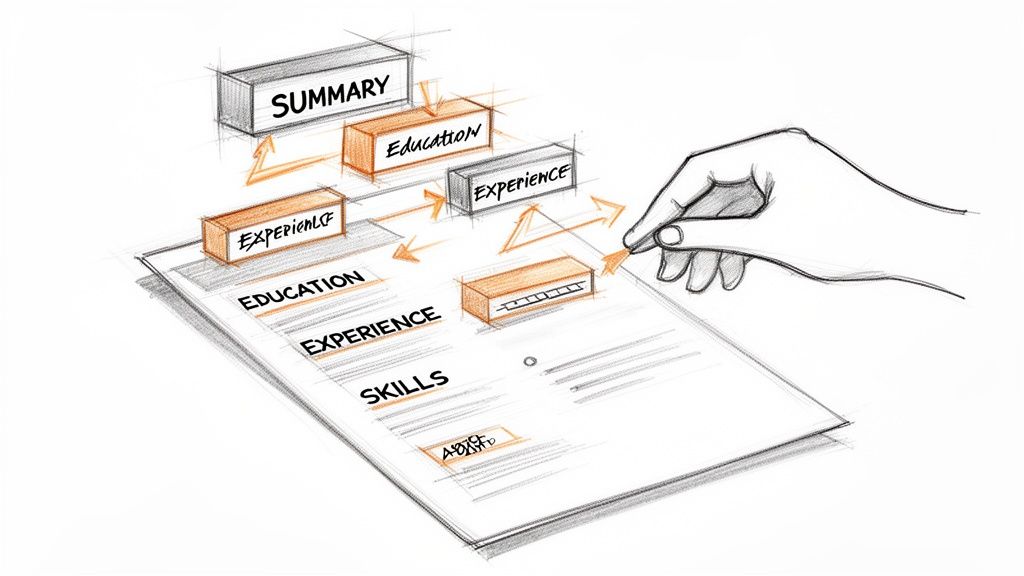
Putting together a powerful resume for nursing school isn't about just listing what you've done. It’s a strategic process. Each section needs to tell a part of your story, building on the others to create a clear, compelling picture of why you’re ready for this.
Let's walk through how to approach each piece of the puzzle, turning standard resume entries into memorable highlights that will catch an admissions officer’s eye.
Crafting a Compelling Professional Summary
First things first: ditch the old-school "Objective" statement. The modern, effective approach is a Professional Summary—a punchy, three-to-four-sentence paragraph that sits right at the top of your resume. Think of it as your elevator pitch. It’s your first, and maybe best, chance to set the tone for your entire application.
Your summary needs to quickly introduce who you are, spotlight your most impressive qualifications, and clearly state why you're pursuing nursing. This isn't the place for generic statements. It should be tailored to show off your unique strengths and where you're headed.
Good vs. Better Example
- Good: Hardworking and dedicated student with a passion for helping people seeking admission to a nursing program.
- Better: Compassionate and detail-oriented graduate with a 3.8 GPA in Biology, seeking to apply a strong scientific foundation and 200+ hours of patient-facing volunteer experience to the BSN program at [University Name]. Eager to develop clinical skills to serve pediatric populations.
See the difference? The "Better" example is packed with specifics. It uses hard data (3.8 GPA, 200+ hours) and even names the program and a specialty interest. That immediately tells the committee you're serious, you've done your homework, and you have a vision.
Detailing Your Education and Coursework
Your education section is way more than just a list of schools you attended. For a nursing school application, this section is critical real estate. Knowing how to list education on a resume properly can make a huge difference in demonstrating your academic readiness for a demanding program.
Don't just stop at your degree and GPA. Consider adding a "Relevant Coursework" subsection. This is a game-changer, especially if your major wasn't in a hard science. By highlighting strong grades in key prerequisite courses, you’re giving the admissions committee direct proof that you can handle the curriculum.
Make sure to include foundational courses for nursing, such as:
- Human Anatomy & Physiology
- Microbiology
- Chemistry
- Statistics
- Developmental Psychology
Listing these shows you already have the specific knowledge base to hit the ground running. It signals foresight and a clear alignment with the program’s academic demands.
Pro Tip: If you made the Dean's List or snagged any academic awards, this is the place to feature them. These honors are third-party proof of your work ethic and academic chops.
Framing Your Experience for a Nursing Context
This is where you connect the dots between your past jobs—even the non-healthcare ones—and the core skills a great nurse needs. Whether you were paid, volunteering, or shadowing, every role taught you something. Your job is to translate those duties into nursing-relevant competencies.
Admissions committees are scanning for evidence of empathy, sharp communication, and how to improve critical thinking skills. You have to show them you have these qualities, not just tell them. Use powerful action verbs and quantify your achievements whenever you can. Instead of saying you "were responsible for" something, describe what you actually did and the result it had.
Translating Non-Healthcare Roles
Let's say you worked as a server in a chaotic restaurant. You can frame that experience to highlight incredibly valuable skills.
- Weak Description: Took customer orders and served food.
- Strong Description: Managed up to 6 tables simultaneously in a fast-paced environment, ensuring accuracy and customer satisfaction. Effectively communicated with kitchen staff and patrons to resolve issues and accommodate special dietary needs, improving team efficiency.
The second version screams multitasking, problem-solving, attention to detail, and grace under pressure—all non-negotiable skills for any nurse.
Highlighting Your Volunteer and Clinical Hours
Nothing speaks louder than direct experience with patients. If you’ve volunteered at a hospital, shadowed a nurse, or worked as a Certified Nursing Assistant (CNA), this section provides undeniable proof of your commitment to the field.
Get specific about your duties and the environment. Admissions teams want to know you’ve seen the realities of patient care and aren’t just romanticizing the idea of nursing.
Good vs. Better Example
- Good: Volunteered at City General Hospital.
- Better: Volunteered 150+ hours on the geriatric floor at City General Hospital. Assisted nursing staff with patient mobility, provided companionship to residents, and restocked medical supplies. Praised by the charge nurse for proactive attitude and empathetic communication with patients experiencing cognitive decline.
The "Better" example is in a different league. It quantifies the time (150+ hours), names the patient population (geriatric), details the actual tasks, and even includes a positive outcome. It paints a vivid picture of who you are and what you can do.
Essential Action Verbs for Your Nursing School Resume
Using the right language can transform a simple description into a powerful statement of your abilities. This table provides a list of impactful action verbs, categorized by skill type, to help you describe your experiences with the professionalism and impact they deserve.
| Patient Care & Support | Communication & Teamwork | Administrative & Organizational |
|---|---|---|
| Advocated | Collaborated | Coordinated |
| Assisted | Communicated | Documented |
| Assessed | Educated | Organized |
| Cared | Facilitated | Implemented |
| Comforted | Guided | Managed |
| Counseled | Instructed | Monitored |
| Monitored | Mediated | Prepared |
| Provided | Motivated | Processed |
| Supported | Presented | Scheduled |
| Treated | Resolved | Systematized |
When you're writing your bullet points, start with one of these verbs. It immediately frames your experience in an active, competent light and helps the admissions committee see your potential as a future nurse.
Showcasing Relevant Skills
Finally, pull all your key qualifications together in a dedicated skills section. This gives reviewers a quick, scannable snapshot of what you bring to the table.
To make it even easier to read, break it down into logical categories.
- Certifications: List any relevant credentials you hold, like BLS (Basic Life Support) or CNA (Certified Nursing Assistant). Always include the certifying body and the expiration date.
- Technical Skills: Note your proficiency with any electronic health record (EHR) systems, medical software, or even the Microsoft Office Suite.
- Language Skills: If you speak another language, that’s a huge asset in healthcare. Be sure to specify your proficiency level (e.g., Fluent, Conversational).
By thoughtfully building out each of these sections, your resume becomes more than just a document. It becomes a compelling narrative that makes a strong case for why you are the perfect candidate for their nursing program.
Designing a Resume That Admissions Committees Will Actually Read
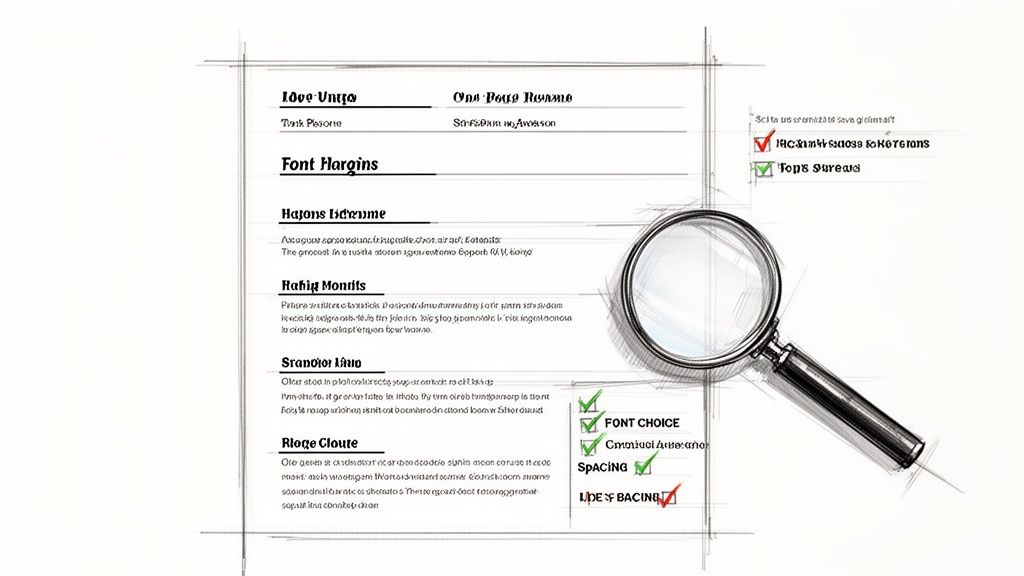
An admissions officer might only give your resume a few seconds of their time. It's a harsh reality. In that brief window, the layout and design create an immediate impression, long before they’ve read a single word. A cluttered, hard-to-read resume screams disorganization. But a clean, professional one? It signals attention to detail—a non-negotiable trait for any future nurse.
Your goal is simple: make it effortless for the reader to spot your best qualifications. This isn’t about flashy graphics; it's about clarity and scannability. A well-designed resume for nursing school acts like a guide, making your strengths impossible to miss.
Choosing Professional Fonts and Margins
The first rule of resume design is readability. This isn't the place to get creative with artistic fonts; it's about conveying professionalism quickly and clearly. Stick to the classics that are easy on the eyes.
- Recommended Fonts: You can't go wrong with Calibri, Arial, Garamond, or Georgia. They are universally recognized and display perfectly on any screen.
- Font Size: Keep your main text between 10 and 12 points. Your name can be bigger (around 16-20 points), and section headings should be a touch larger than the body text (12-14 points) to create a natural visual hierarchy.
Your margins are just as important. Use standard one-inch margins on all sides. I know it's tempting to shrink them to cram more in, but that just creates a crowded, overwhelming document. White space is your friend—it makes the page feel organized and much less intimidating to a busy reader.
The Power of Clean and Simple Formatting
Strategic formatting is how you direct the reader's attention. Think of bolding and bullet points as little signposts that say, "Look here! This is important!" Avoid the trap of using overly complex templates with multiple columns, colors, or images.
These fancy designs often confuse Applicant Tracking Systems (ATS), the software many schools use to screen applications before a human ever sees them. A simple, single-column layout is always the safest and most professional choice. It ensures that both software and human reviewers can parse your information without a hitch.
A resume offers a high-level overview of your experiences. For most applicants, one page is the ideal length and provides more than enough space to present your qualifications effectively and concisely.
This single-page rule is a critical guideline. It forces you to be selective and include only the most relevant, high-impact information. Remember, the admissions committee is looking for quality, not quantity. If you're struggling with what to cut, try thinking about potential interview questions. Framing your resume with those in mind can help clarify what's truly essential.
Submitting a Flawless Final Document
Proofreading is absolutely non-negotiable. Typos or grammar mistakes can signal carelessness, which is the last impression you want to make on a nursing school. Read your resume multiple times, then have a trusted friend, professor, or mentor review it with a fresh set of eyes. They'll catch things you've missed.
Once you’re confident it’s perfect, always save and submit your resume as a PDF. This locks in your formatting, ensuring it looks exactly as you designed it, no matter what device or operating system the admissions committee uses.
Finally, after you've polished your resume and other materials, you might need to combine your resume with other application documents into a single file. Taking this extra step makes your application packet look professional and is a small courtesy that makes the admissions team's job just a little bit easier.
How to Tailor Your Resume to Your Dream Nursing Program
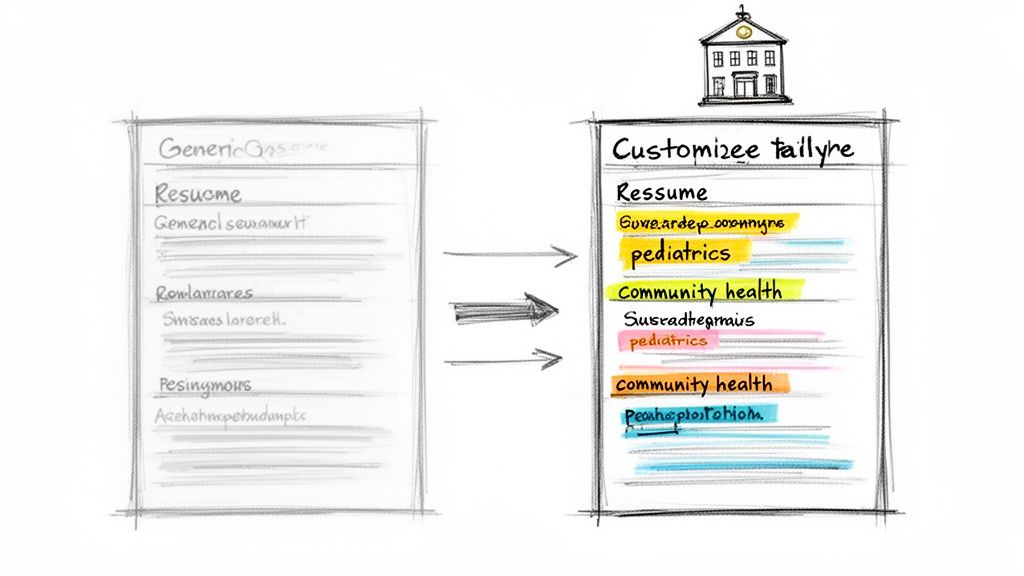
Submitting the same generic resume to every nursing school is one of the biggest mistakes I see applicants make. Admissions committees aren't just looking for qualified candidates; they're looking for people who are a genuine fit for their specific community and values.
Tailoring your resume is how you prove you've done your homework. It shows you're invested in their program, not just any program.
Think of it this way: you have a master resume that’s like a block of clay. For each application, you’ll sculpt that clay, shaping it to perfectly match the mold of the school you're targeting. This focused approach signals a deep level of interest that makes a lasting impression on a busy admissions team.
Become a Program Investigator
Before writing a single word, you need to become an expert on the nursing program you're targeting. Your mission is to decode its unique identity, figure out what it prides itself on, and understand its core values. This research is the bedrock of a perfectly tailored resume.
Start by digging into the school’s website. Don't just skim the homepage. Go deeper.
- Mission and Values Statement: This is a goldmine. Does the program emphasize community health, research, global nursing, or holistic care? These are your keywords.
- Faculty Profiles: See what the professors are researching. If their work in pediatric oncology or geriatric care aligns with your interests, that’s a powerful connection to highlight.
- Program Tracks and Specializations: Take note of the specific pathways they offer. If a school has a strong psychiatric-mental health nurse practitioner track and you have volunteer experience in mental health, that’s a perfect match.
- News and Press Releases: These articles often highlight recent achievements, new clinical partnerships, or community projects the school is proud of.
As you go, create a running list of keywords and themes for each school. This list will be your guide.
Weave Program Keywords into Your Resume
Once you have your keyword list, it's time to strategically sprinkle those terms throughout your resume. The goal is to make it seem like your experiences were practically designed for their program. You’re not changing your history; you’re just changing the lens through which you present it.
Let's say you're applying to a program that heavily emphasizes its commitment to "serving underserved urban populations."
A generic bullet point might look like this:
- Volunteered at a local health clinic, assisting with patient intake and vitals.
Now, here’s the tailored version:
- Provided direct patient support at a downtown health clinic, delivering compassionate care to underserved urban populations and assisting with intake for over 30 patients per day.
See the difference? The second version uses the program’s exact language and adds a powerful, quantifiable achievement. It instantly creates a stronger connection and shows the admissions committee that your values align with theirs.
By mirroring the language and priorities of the nursing program, you move from being just another applicant to becoming the ideal candidate they didn't even know they were looking for.
Align Your Experiences with the Program’s Focus
Beyond just keywords, think about the overall story your resume tells. If you're applying to a program known for its cutting-edge research, you should reorder your resume to highlight any lab experience or data analysis skills you have, even if it was just from a biology class.
Let's imagine you're deciding between two very different top-tier schools. Global rankings often highlight these institutional strengths; for instance, the QS World University Rankings evaluate over 200 institutions, with schools like King's College London excelling in academic reputation and research. You can dig into these global nursing school rankings on TopUniversities.com to see how programs set themselves apart.
If one of your target schools is a research powerhouse, you'd frame your experience to match.
Scenario A: School with a Community Health Focus
- Professional Summary: Aspiring nurse dedicated to improving health equity, with 150+ volunteer hours in community-based clinics.
- Experience: Prioritize volunteer work that shows direct interaction with diverse patient populations.
Scenario B: School with a Research Focus
- Professional Summary: Detail-oriented student with a strong foundation in biological sciences, eager to contribute to evidence-based nursing practice.
- Experience: Prioritize a role as a research assistant or a capstone project that involved data collection.
This strategic alignment shows a sophisticated understanding of what makes each program tick. You can also explore various nursing school programs and their unique offerings to guide your research. Each resume you tailor tells a slightly different story—one that proves you are the perfect fit for that specific academic environment.
Common Resume Mistakes That Can Sink Your Application
You’ve poured countless hours into building experience and polishing every word on your resume. But even the most qualified candidates can get tripped up by simple, avoidable errors. This final check is about protecting all that hard work by catching the little mistakes that make admissions committees cringe.
And make no mistake, the competition is fierce. Nursing programs like the one at the University of Louisville are seeing a record-breaking surge in applicants, expanding class sizes just to meet demand. In an environment that competitive, a small slip-up can be the deciding factor. Let's make sure your application stands out for the right reasons.
The Unforgivable Errors: Typos and Poor Grammar
This is the number one resume killer, and it’s also the easiest one to fix. Typos, spelling mistakes, and bad grammar send a loud, clear message: you lack attention to detail. In a profession where a misplaced decimal point can have life-or-death consequences, precision is non-negotiable.
Don't just trust your own eyes or a spell checker. After you've read a document a dozen times, your brain starts to see what it expects to see, not what’s actually on the page.
- Read it aloud. This simple trick forces you to slow down. You'll catch awkward phrasing and typos you would have otherwise skimmed right over.
- Get a second opinion. Ask a trusted professor, a mentor, or even just a friend with a sharp eye to give it a once-over. A fresh perspective is invaluable.
- Print it out. Staring at a screen all day makes it easy to miss things. Reviewing a physical copy can help errors jump off the page.
Using a Passive and Vague Voice
Your resume isn’t just a list of job duties; it’s a highlight reel of your achievements. A passive voice waters down your contributions and makes your accomplishments sound weak. You need to frame yourself as the active force behind your successes.
Let’s look at two ways to describe the same role:
Weak (Passive):
Responsibilities included assisting nurses and patient monitoring.
Strong (Active):
Assisted a team of 5 nurses with daily patient care on a busy 30-bed medical-surgical unit, proactively monitoring vital signs and reporting changes to the charge nurse.
See the difference? The second example uses strong action verbs and specific numbers to paint a vivid picture of competence and initiative. It turns a boring duty into a tangible achievement, which is exactly what admissions committees want to see.
Irrelevant and Unprofessional Additions
Every single thing on your resume should serve a purpose—to strengthen your case for getting into nursing school. Anything that doesn't add value is just noise that distracts from your qualifications.
Here are a few things to cut from your resume immediately:
- Photos: Unless a program specifically asks for one, never include a headshot. In the U.S., it's considered unprofessional and can introduce unconscious bias.
- Irrelevant Hobbies: Your passion for rock climbing or antique collecting probably doesn’t demonstrate your fitness for nursing. Stick to experiences that highlight relevant traits like compassion, teamwork, or resilience.
- An Unprofessional Email Address: An email like
partyanimal2025@email.cominstantly tanks your credibility. Create a simple, professional one, likefirstname.lastname@email.com.
Your resume should be a concise, powerful argument for why you belong in that program. Every word and every section must contribute to that argument. If it doesn't, it's got to go.
Finally, the most damaging mistake of all is dishonesty. Never exaggerate your roles, inflate your GPA, or invent experiences. Nursing is built on a foundation of trust and integrity. Getting caught in a lie is an automatic disqualification and can follow you for the rest of your career. Present the best, most polished, and most honest version of yourself.
Your Nursing School Resume Questions Answered
Navigating the application process can feel like a maze, but you're not alone. Most applicants run into the same handful of questions. Let’s get those sorted out right now with clear, practical advice you can put to use immediately.
How Long Should My Resume Be?
For almost everyone, one page is the gold standard. That’s it.
Admissions committees are buried under hundreds, sometimes thousands, of applications. They need to see your value quickly. A concise, powerful, single-page resume that gets straight to the point is not just appreciated—it's expected.
Now, if you have over a decade of high-level, directly relevant healthcare experience—maybe as a seasoned paramedic or a clinical researcher—then a two-page resume might be appropriate. But tread carefully. Every single bullet point has to earn its spot and prove its worth to that specific program.
What if I Have No Direct Healthcare Experience?
First, don't panic. This is incredibly common. The trick is to stop thinking about job titles and start focusing on transferable skills. Admissions committees are skilled at spotting potential, and your non-clinical jobs are packed with relevant experience if you know how to frame it.
Did you work in a chaotic restaurant or a busy retail store? That’s not just customer service; it’s high-stakes communication, rapid problem-solving, and managing competing priorities under pressure. Any volunteer work shows compassion and a commitment to your community. You need to highlight these skills and connect them to your strong academic performance in science prerequisites. This combination proves you can handle the demanding curriculum and the human side of nursing.
Your resume isn't just a record of what you've done; it's a compelling argument for what you're capable of doing. Frame every experience to highlight your potential as a caring, competent, and resilient nursing student.
Should I Include a Resume Objective?
In a word: no. Objectives are a thing of the past. What you need instead is a modern, effective "Professional Summary." This is a tight, three-to-four-line paragraph at the very top of your resume that you should tailor for each school you apply to.
Your summary should hit three key points: your career aspirations, your most compelling qualifications (like a high science GPA or unique volunteer work), and your specific interest in their nursing program. It's your first—and best—chance to make a strong impression and show you're a serious, well-researched candidate from the first glance.
Is It Okay to Use a Creative Resume Template?
Absolutely not. Nursing is a serious, trusted profession, and your application materials must reflect that. Stick to a clean, traditional, and professional format.
This means you must avoid:
- Colors and graphics
- Photos or headshots
- Unconventional fonts
- Multiple columns or complicated layouts
Your goal is for the content to shine, not the design. A simple, well-organized, black-and-white resume demonstrates professionalism. It also ensures your document can be easily read by any Applicant Tracking Systems (ATS) a school might use to screen applications. A simple layout is always the safest and most effective choice.
Ready to ace the next step after submitting your resume? An interview can make or break your application. Confetto provides AI-powered mock interviews that simulate the real thing, offering instant, detailed feedback on your communication, empathy, and critical thinking. Practice for MMI, panel, or traditional interviews 24/7, and walk into your nursing school interview with total confidence. Start your free trial at https://confetto.ai.