
How to Improve Critical Thinking Skills: Proven Strategies for Interviews
Learn how to improve critical thinking skills with practical exercises, frameworks, and interview-ready tips for MMI or panel questions.
Improving your critical thinking isn't just an academic exercise. It's about fundamentally changing how you approach problems by deliberately questioning assumptions, dissecting arguments, and forming conclusions that actually hold up under pressure. The only way to make this stick is to move past theory and start applying analytical frameworks to real-world situations, turning an abstract idea into a practical, repeatable skill.
Why Critical Thinking Is Your Most Important Interview Skill
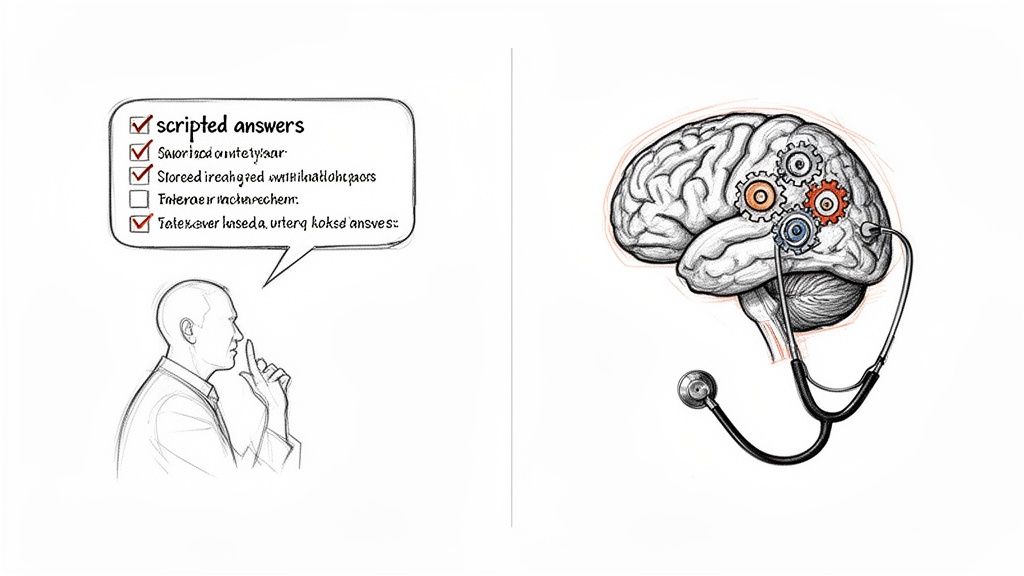
Let's be blunt: generic advice isn't going to cut it in a high-stakes medical school interview. Top-tier programs aren't looking for applicants who can rattle off memorized answers. They're searching for future physicians who can think on their feet, navigate messy, ambiguous situations, and solve complex problems when the pressure is on.
This is exactly where critical thinking becomes your biggest advantage. When an interviewer throws a complex ethical dilemma or a tough situational judgment question your way, they aren't testing your memory. They're evaluating your thought process. They want to see how you think, not just what you know.
Moving Beyond Memorization
So many applicants fall into the trap of preparing canned responses. They rehearse answers to the "most common questions," hoping it will make them sound polished. But this strategy usually backfires. Interviewers can spot a rehearsed answer from a mile away, and it sends a clear signal: this candidate can't engage with the unique demands of the prompt in front of them.
Critical thinking is the antidote to memorization. It gives you the tools to deconstruct any prompt, identify the core issues, and build a logical, empathetic, and coherent response from scratch—even if it’s a question you’ve never seen before.
Demonstrating this skill is what separates a good candidate from an exceptional one. It proves you have the intellectual maturity and analytical rigor to not only survive medical school but thrive as a physician. After all, patient care is rarely a textbook case; it demands constant analysis, adaptation, and sound judgment.
A Skill in High Demand and Short Supply
The need for this skill goes far beyond your interview day. The World Economic Forum's 2023-2027 Future of Jobs Report ranked analytical thinking as the single most sought-after skill by employers worldwide.
And yet, there's a huge gap between demand and supply. A Reboot Foundation survey found that a staggering 86% of people believe this skill is lacking in the general public. This is backed by a massive OECD study where one-fifth of 120,000 students performed at the lowest possible level of critical thinking.
This gap is your opportunity. By deliberately training your analytical abilities, you’re not just prepping for an interview—you’re building a foundational skill for your entire career.
The Four Pillars of Effective Critical Thinking
To make this practical, we can break down critical thinking into four core components. Think of these as the pillars holding up your entire thought process. Mastering them gives you a clear roadmap and the structure needed to excel in any interview format—whether it's an MMI, a panel, or a traditional one-on-one.
Here's a quick look at what we'll be building throughout this guide.
| Pillar | What It Means | Why It Matters in Interviews |
|---|---|---|
| Analysis | Breaking down complex information into its fundamental parts to understand its structure and relationships. | Allows you to identify the key stakeholders, ethical principles, and potential conflicts in any scenario. |
| Evaluation | Assessing the credibility, relevance, and strength of arguments, claims, and evidence. | Helps you weigh competing priorities and justify your proposed course of action with sound reasoning. |
| Inference | Drawing logical conclusions based on available information and identifying potential consequences. | Shows you can think ahead, anticipate outcomes, and make decisions in the face of uncertainty. |
| Communication | Articulating your thought process clearly, concisely, and persuasively. | Proves you can convey complex ideas in an understandable way, a vital skill for patient and team interactions. |
Throughout this guide, we'll dive into actionable strategies and exercises to develop each of these pillars. And if you're looking for more foundational strategies, learning how to improve critical thinking offers a great starting point for continuous development. Our goal is to transform this abstract concept into a tangible, trainable skill that gives you unshakable confidence on interview day.
Building Your Critical Thinking Framework
When you’re staring down a complex prompt in a Multiple Mini Interview (MMI), your best friend isn't a memorized answer. It's a reliable mental model—a structured way of thinking you can instantly deploy to take apart any problem that comes your way.
Abstract theories on logic are fine in a classroom, but they tend to fall apart under real pressure. You need an actionable framework. Something that gives your thoughts immediate structure, helping you deliver a response that’s coherent, logical, and genuinely empathetic.
Adopting the RED Model for Interview Success
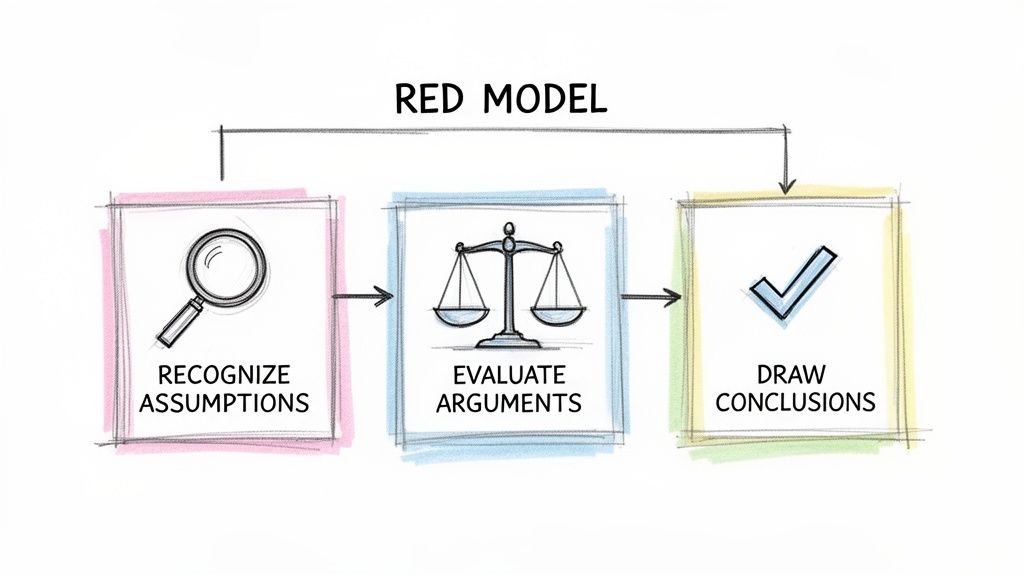
One of the most practical and adaptable frameworks out there is the RED Model. It’s a clean, three-part process that guides you from knee-jerk reaction to a well-reasoned conclusion.
Let's unpack it:
- Recognize Assumptions: This is where you start. What are the unstated beliefs, biases, or presuppositions in the scenario? This includes your own assumptions and those held by others involved in the problem.
- Evaluate Arguments: Next, you systematically pick apart the different viewpoints and potential paths forward. You'll weigh the pros and cons, consider the ethical principles at play, and look at the quality of the information you have.
- Draw Conclusions: Finally, based on your evaluation, you form a justifiable conclusion or propose a course of action. A strong conclusion is never a simple declaration; it’s a nuanced decision backed by the evidence and reasoning you just walked through.
This model is so powerful because it forces you to slow down. It helps you resist the urge to jump to the first answer that pops into your head—a massive pitfall for so many applicants.
By deliberately moving through these three stages, you ensure your response isn't just a gut reaction. Instead, it becomes a thoughtful demonstration of your analytical capabilities, showing interviewers how you think through complexity.
Applying the Framework to a Real MMI Prompt
Okay, let's make this real with a classic MMI ethical dilemma. Imagine you get this prompt:
"A 22-year-old patient has been in a severe car accident and requires a life-saving blood transfusion. The patient is a Jehovah's Witness and has explicitly refused the transfusion based on religious beliefs, even after being told of the fatal consequences. How do you proceed?"
Instead of letting the panic set in, you can immediately fire up the RED Model to structure your thoughts.
First, Recognize Assumptions
Your first job is to identify all the assumptions floating around.
- Your own assumptions: You might assume your primary duty is to preserve life above all else, which could cause you to overlook patient autonomy. You might also assume the patient's decision isn't fully informed or that they could be swayed.
- The patient's assumptions: The patient is operating on the belief that their faith is paramount and that accepting a transfusion would have devastating spiritual consequences for them.
- The healthcare system's assumptions: The system is built on principles like beneficence (doing good) and non-maleficence (do no harm), which can sometimes slam right into the principle of patient autonomy.
Just listing these out helps you see the full landscape. The problem shifts from a simple "yes or no" question to a nuanced conflict between core medical principles.
Second, Evaluate Arguments
Now, you start weighing the different sides of the dilemma.
- The Argument for Intervention (Giving the Transfusion): This path leans heavily on the principle of beneficence. The core idea here is that a physician’s duty to prevent a death outweighs the patient's refusal, especially for a young person where the outcome is certain death without action. You'd evaluate this by thinking about medical ethics and any relevant legal precedents.
- The Argument for Non-Intervention (Respecting the Refusal): This side champions patient autonomy. A competent adult has the right to make decisions about their own body, even if those decisions seem harmful to medical professionals. You'd test this argument by making sure the patient truly has the capacity to make an informed decision—are they lucid? Free from coercion?
During this stage, you’d also want to verbally walk through the stakeholders: the patient, their family, the healthcare team, and even the hospital's legal and ethics committees.
Third, Draw Conclusions
Finally, you pull it all together into a defensible plan. A weak answer just picks a side. A strong, critically-reasoned answer proposes a multi-step, empathetic approach.
You might conclude that the most ethical path is to respect the patient's autonomy, but only after their capacity is confirmed. Your proposed actions would then flow logically from that conclusion:
- First, I would ensure the patient is fully informed and has the decision-making capacity to refuse treatment.
- Next, I would gently explore their understanding and the reasons for their decision, being careful not to be coercive.
- I would involve the hospital's ethics committee to ensure all protocols are followed and the decision is sound.
- Finally, I would commit to providing the best possible palliative care to ensure the patient's comfort and dignity, even if we cannot save their life.
Having a framework like this is like having a toolkit you can always depend on. It turns a scary, open-ended question into a manageable set of steps, allowing you to build a structured, thoughtful, and compassionate response every single time.
Daily Drills to Sharpen Your Analytical Mind
Mastering critical thinking isn’t something you can cram for the night before a big interview. It’s a mental muscle. It only grows stronger with consistent, deliberate exercise. The goal is to build habits that make structured, analytical thinking feel like second nature, so it flows effortlessly when you're under pressure.
Integrating small, focused drills into your daily routine is far more effective than sporadic, multi-hour study sessions. These aren't meant to be a burden. Think of them as quick, powerful exercises designed to fit into a busy schedule and sharpen your mind incrementally.

The 5-Minute Healthcare Deconstruction
Start by changing how you consume news. Instead of just passively reading a healthcare or medical article, take five minutes to actively deconstruct it. This daily drill trains you to look past the headlines and really evaluate the substance of an argument.
During this quick analysis, ask yourself a few targeted questions:
- Who is the source? Is it a peer-reviewed journal, a news outlet with a known bias, or a press release from a pharma company?
- What is the primary claim? Pinpoint the main argument the article is trying to make.
- What evidence is provided? Are they citing data, expert opinions, or just anecdotal stories? Judge the quality and relevance of the proof.
- Are there unstated assumptions? What does the author assume you already believe to be true?
- What perspectives are missing? Think about the stakeholders not represented in the article—patients, insurers, or specific demographics, for example.
This simple exercise forces you to practice evaluation and analysis every single day, making it a powerful tool for honing your critical thinking.
The Ethical Dilemma Journal
Another high-impact daily habit is the ten-minute ethical dilemma journal. The goal here isn't to write a perfect, polished essay. It's about practicing how to structure your thoughts on complex issues, fast. This drill is direct prep for the kinds of scenarios you'll face in MMI stations.
Each day, find a classic medical ethics prompt or a current healthcare controversy. You can explore a comprehensive MMI question bank to find an endless supply of relevant scenarios. Set a timer for ten minutes and just outline a structured response using a framework like the RED Model.
Your journal entry should briefly touch on recognizing assumptions, evaluating the arguments for different courses of action, and drawing a preliminary, justified conclusion. The key is consistency, not perfection.
This regular practice builds the mental pathways you need to break down complex problems systematically, even when the clock is ticking.
Making Practice Measurable and Effective
The real value of these daily drills comes when they're part of a structured approach to learning. Research consistently shows that deliberate practice—combining exercises with discussion and feedback—is what yields significant results.
For instance, one study found that a structured module including writing assignments and group discussions led to measurable gains in students' ability to present evidence and articulate assumptions. Students improved by 0.78 points in presenting evidence and 0.998 in articulating context on a four-point scale. This shows that consistent, varied engagement is the key to real progress.
By committing to these small but powerful daily exercises, you are actively rewiring your brain. You’ll move from being a passive consumer of information to an active, analytical thinker—ready to tackle any challenge an interviewer throws your way.
Using Simulated Interviews to Accelerate Improvement
Knowing the theory behind critical thinking frameworks is a great start, but it’s only half the battle. Real mastery comes from applying those frameworks under pressure, which is exactly where just reading books or watching videos falls short.
Performance-based skills like critical thinking are forged in the fire of active, realistic practice. It’s one thing to outline a response to an ethical dilemma with all the time in the world; it’s another to articulate that same response coherently in the two minutes an MMI station gives you.
This is where simulated interviews become so valuable. They bridge that critical gap between understanding a concept and executing it flawlessly when the stakes are high.
Why Realistic Practice Is Non-Negotiable
To be effective, your practice needs to feel real. That means dealing with time constraints, getting hit with unexpected follow-up questions, and managing the stress of a high-stakes evaluation. Simply rehearsing answers with a friend, while better than nothing, often lacks the structure and objectivity needed for true skill development.
Modern AI-powered interview platforms are built to solve this exact problem. They can replicate the dynamics of MMI, panel, and traditional interviews by enforcing strict time limits and mimicking the feel of a real interview. Tools like a dedicated MMI interview timer are helpful for getting used to the pacing, but a full simulation integrates timing into a much more dynamic experience.
This kind of targeted, repetitive practice builds the mental muscle memory you need to perform confidently.
The data backs this up. A landmark study by the Council for Aid to Education (CAE) that analyzed 120,000 students found a startling gap, with half performing at the two lowest levels of critical thinking. The study’s main takeaway? Meaningful improvement requires explicit instruction, repeated practice, and reliable measurement. You can dig into the full CAE report on measuring critical thinking yourself.
AI platforms mirror these principles by giving you instant, data-driven feedback on your performance, turning your weaknesses into strengths.
From Vague Feedback to Actionable Data
Perhaps the biggest advantage of simulation technology is the shift from subjective, often generic feedback to objective, data-driven insights. After a practice session with a friend, you might get comments like, "That sounded pretty good" or "Maybe be a little more confident." While well-intentioned, that advice isn't actionable. How do you practice being more confident?
In contrast, an AI-driven platform gives you a detailed breakdown of your performance across key competencies.
This screenshot shows the kind of instant, granular feedback you can get, breaking down scores for critical thinking, empathy, and communication. By analyzing your transcript, tone, and pacing, the system can pinpoint exactly where you went wrong. Instead of vague advice, you get specific, measurable feedback you can act on immediately.
Key Takeaway: You can't fix what you can't measure. Data-driven feedback turns a frustrating cycle of guesswork into a clear, targeted path for improvement. It tells you whether your weakness is in recognizing assumptions, evaluating arguments, or articulating your final conclusion.
To highlight the difference, let’s compare traditional practice with a more modern approach.
Comparing Interview Practice Methods
| Feature | Traditional Practice (with a friend) | AI Simulation (like Confetto) |
|---|---|---|
| Feedback Quality | Subjective, often vague ("be more confident") | Objective, data-driven (scores for empathy, critical thinking) |
| Availability | Dependent on a friend's schedule | 24/7, on-demand |
| Scenario Variety | Limited to what your friend can think of | Vast library of scenarios for MMI, panel, and traditional interviews |
| Realism | Hard to replicate real interview pressure and timing | Accurately simulates time constraints and question flow |
| Progress Tracking | Difficult to measure improvement over time | Tracks performance data, showing clear progress |
| Cost & Scalability | Free, but limited in reps and quality | Subscription-based, offering unlimited, targeted practice |
The table makes it clear: while practicing with a friend is a good start, AI simulation offers a structured, scalable, and data-backed way to build real skill.
Turning Reps into Real Skill
This level of detailed analysis transforms your practice from simple repetition into what experts call deliberate practice. You’re no longer just going through the motions. Each simulated interview becomes a targeted training session designed to strengthen a specific area.
Here’s how you can use this feedback loop to accelerate your progress:
- Pinpoint Your Weakest Pillar: After a few mock interviews, a pattern will emerge. Are your critical thinking scores consistently lower than your empathy scores? That tells you to focus more on applying frameworks like the RED Model in your next session.
- Focus on One Skill at a Time: Don't try to fix everything at once. Dedicate one practice session to improving your pacing and reducing filler words. In the next, focus entirely on ensuring you acknowledge multiple perspectives before drawing a conclusion.
- Track Your Progress: Keep a log of your scores over time. Seeing your critical thinking score climb from a 3/5 to a 5/5 provides a massive confidence boost and confirms that your hard work is paying off.
Ultimately, this process is about replacing expensive, one-off coaching sessions with unlimited, targeted reps that build real, lasting skill. It gives you the power to practice anytime, anywhere, and receive the kind of objective feedback that was once only available to a select few.
Through consistent, data-informed practice, you can methodically build the competence that leads to unshakeable interview confidence.
Seeing What Works: Deconstructing Example Answers and Common Pitfalls
One of the fastest ways to sharpen your critical thinking under pressure is to see what works—and what doesn’t. When we deconstruct real-world interview responses, we can spot the subtle differences that separate a weak answer from an exceptional one. It gives you a clear model to aim for in your own practice.
Let’s break down a classic MMI prompt: “A patient on your ward confides in you that they are using a popular herbal supplement to help with their anxiety, but they haven't told the attending physician. What do you do?”
This scenario isn't just about a supplement. It’s a test of your ability to navigate patient confidentiality, professional hierarchy, and, most importantly, patient safety all at once.
The Weak Response: Jumping to Conclusions
A weak answer almost always jumps straight to a conclusion. It makes assumptions, fails to consider multiple perspectives, and comes across as rigid. You can practically hear the lack of empathy and structured thought.
Here’s what it sounds like:
“I would immediately tell the patient that herbal supplements are dangerous and unproven. I’d explain that they have to tell the attending physician right away because it could interfere with their prescribed medications. If they refused, I would tell the physician myself because patient safety comes first.”
Why does this fall flat?
- It’s Authoritarian: The tone is confrontational, completely dismissing the patient's autonomy and their reasons for trying the supplement.
- It Makes Assumptions: It instantly labels the supplement as "dangerous" without gathering a single piece of information.
- It Ignores Nuance: The response bulldozes a complex issue into a simplistic, black-and-white problem of safety versus secrecy.
This kind of answer raises a red flag. It signals an applicant who might struggle with collaborative decision-making and empathy—two non-negotiable skills for any healthcare professional.
The Good Response: A More Balanced Perspective
A good response shows a much more balanced approach. The candidate identifies the key stakeholders and acknowledges the complexity of the situation before offering a solution. It's a huge improvement because it reveals a more thoughtful process.
A better approach:
“First, I would thank the patient for trusting me with this information. I’d ask non-judgmental questions to understand why they chose the supplement and why they’re hesitant to tell the physician. I would then gently explain the importance of transparency for their safety, highlighting potential interactions. My goal would be to encourage them to have that conversation, perhaps even offering to be there with them for support.”
This answer is much stronger because it:
- Builds Rapport: It leads with empathy and seeks to understand the patient’s point of view.
- Prioritizes Education over Orders: It aims to inform and empower the patient rather than just command them.
- Considers Autonomy: It respects the patient’s role in their own care while gently steering them toward a safer course of action.
This is a solid, competent answer. But it could be even stronger by more clearly articulating the underlying ethical principles and outlining a more comprehensive, step-by-step action plan.
The Excellent Response: Demonstrating True Nuance
An excellent answer goes beyond just a good plan. It showcases a deep understanding of the ethical landscape and a sophisticated, multi-layered approach to problem-solving.
Key Insight: Top-tier answers don't just solve the immediate problem. They use the situation as an opportunity to strengthen the patient-provider relationship, educate, and uphold multiple ethical principles simultaneously.
Here’s what excellence sounds like:
“My primary responsibility is to maintain the patient's trust while ensuring their safety. I would start by validating their decision to seek solutions for their anxiety and thank them for their honesty. Next, I’d open a dialogue by asking open-ended questions like, ‘Can you tell me more about the supplement and what you’ve heard about it?’
This lets me gather information without being confrontational. I would then explain my concern, framing it collaboratively: ‘For us to give you the best and safest care, it’s really important that the whole team has a complete picture of your health, including any supplements.’ I’d explore their hesitation and, if they consent, offer to research the supplement with them to check for known interactions.
Ultimately, I would empower them to speak with the physician, offering to facilitate the conversation. If they still refused and I believed there was a significant, immediate risk, I would consult with a senior colleague or the ethics committee on how to proceed, balancing my duty to patient confidentiality with the principle of non-maleficence.”
This answer excels because it demonstrates a mastery of critical thinking through its structure, empathy, and foresight. To get better at spotting these nuances in verbal responses and avoid misinterpretations in your own analysis, learning how to analyze qualitative interview data is a crucial skill.
By studying examples like these, you can start refining your own approach. For more hands-on practice, you can find a wide range of MMI practice questions with answers to help you prepare.
Your Path to Interview Confidence
So, let's pull all these threads together into a concrete action plan.
Getting better at critical thinking for an interview isn’t an overnight fix. It’s a journey of consistent, deliberate practice. Real competence—the kind that breeds genuine confidence—comes from weaving these core strategies into your prep until they become second nature.
By using a mental framework for every question, committing to daily analytical drills, and leaning on simulations for targeted feedback, you systematically turn your weak spots into strengths. Taking the time to analyze examples of weak, good, and excellent answers sharpens your instincts and gives you a clear target to aim for.
This chart shows you exactly what that progression looks like—moving from a shaky, unsupported answer to one that’s well-reasoned and truly excellent.
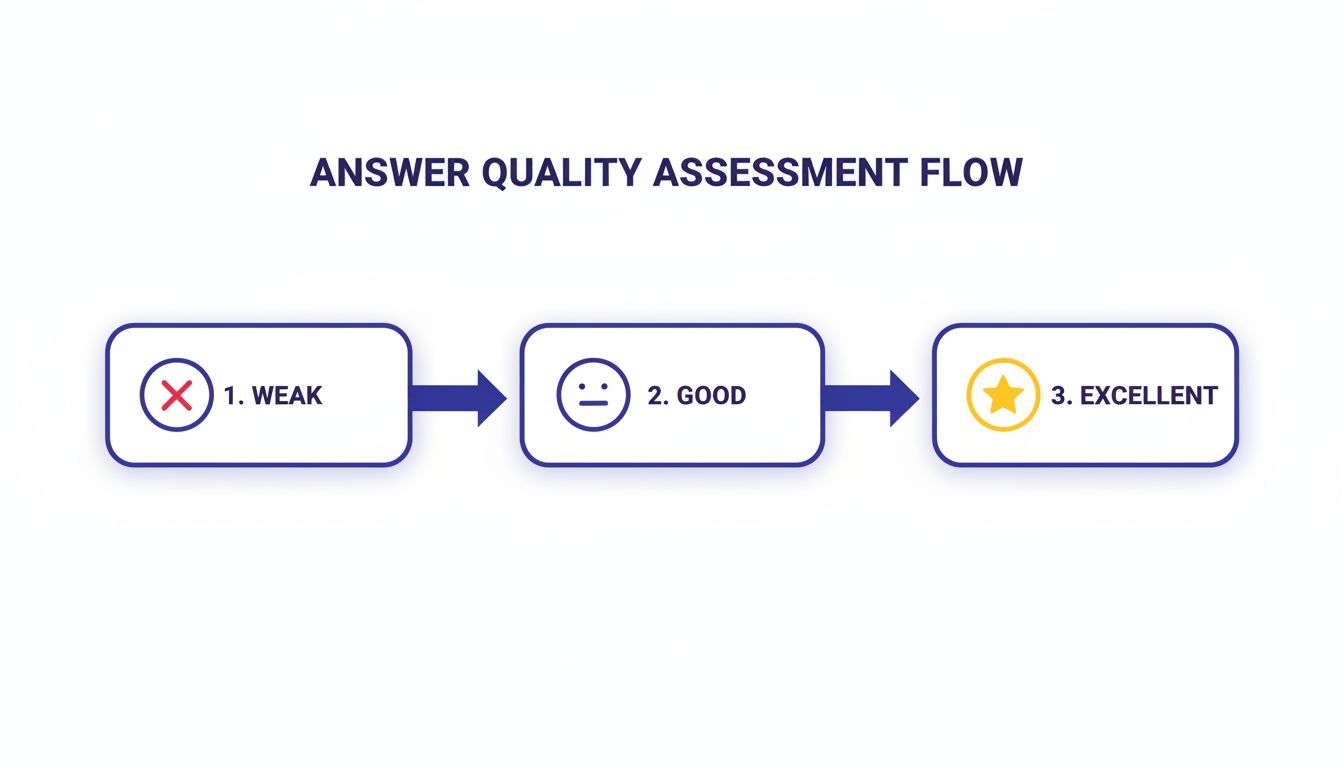
The key takeaway here? Excellence isn’t just about having a balanced view. It’s about demonstrating real nuance and structure in your thinking.
The ultimate goal is to walk into your interview not with fear, but with the assurance that you have the tools to deconstruct and handle any scenario thrown your way. Your preparation for that moment starts now.
Common Questions
How Long Does It Take to See Real Improvement in Critical Thinking?
While mastering critical thinking is a lifelong journey, most applicants start feeling a noticeable shift in their confidence and structure within 3-4 weeks. This usually comes from about 20-30 minutes of focused daily practice—running through frameworks, doing drills, and getting into simulated interviews.
Ultimately, measurable progress comes down to the quality and intensity of your practice, not just the hours you put in.
Can I Get Better at Critical Thinking Without an AI Simulator?
Absolutely. You can build a powerful foundation by journaling, debating ethical scenarios with friends, or breaking down healthcare news articles. These habits are incredibly effective for developing analytical muscle.
That said, AI simulators are built to fast-track your progress. They give you instant, objective feedback on how you perform under pressure, which is something that’s tough to replicate on your own or even with a willing peer.
The real edge of simulation is in spotting your blind spots. It’s hard to know if your communication is clear or if your empathy lands well without objective data on how you’re actually coming across.
What's the Single Biggest Mistake Applicants Make?
By far, the most common pitfall is rushing to a conclusion. Applicants often latch onto the first solution that comes to mind without taking a moment to explore the other angles—the different stakeholders, potential ripple effects, and ethical trade-offs.
Interviewers care less about your final answer and more about seeing you grapple with the complexity of the problem. A strong response always starts by mapping out the nuances before you even think about proposing a course of action.
How Can I Sound Structured Without Sounding Like a Robot?
This is a great question. The trick is to internalize the frameworks so they guide your thinking, not dictate your exact words. Think of them as a mental checklist, not a script.
Once the structure is second nature, you can focus on explaining your thought process in natural, conversational language.
Try using signposting phrases that feel more like you're thinking aloud:
- "My first instinct is to look at this from the patient's perspective..."
- "On the flip side, we also have to consider the hospital's policy..."
- "After weighing those factors, I think the most responsible next step would be..."
This approach lets the interviewer follow your logic in a way that feels authentic and human.
Ready to turn practice into confidence? Confetto provides instant, data-driven feedback on your critical thinking, empathy, and communication, helping you pinpoint weaknesses and accelerate improvement. Start your 7-day trial and get three free mock interviews at https://confetto.ai.