
Updated · Published
What Is a Good MCAT Score to Get into Medical School
Struggling to figure out what is a good MCAT score? This guide decodes percentiles, target scores for top med schools, and how to define your personal goal.

So, what is a good MCAT score?
The short answer is a score of 511 or higher. That number makes you a competitive applicant for most US MD programs because it puts you comfortably above the average for students who actually get in.
Think of your MCAT score less like a pass/fail grade and more like a key. It’s the thing that unlocks interview opportunities at the schools you’re aiming for.
Defining a Good MCAT Score in a Competitive Landscape

To really understand what makes a score "good," you have to stop looking at it as a single number and start seeing it through the eyes of an admissions committee. It’s a standardized tool meant to gauge your readiness for the marathon that is medical school, but its real value is always relative to your goals and the rest of your story.
Let's start with the basics. The total MCAT score runs on a scale from 472 to 528. This is a sum of your scores from four individual sections, each graded from 118 to 132:
- Chemical and Physical Foundations of Biological Systems (CPBS)
- Critical Analysis and Reasoning Skills (CARS)
- Biological and Biochemical Foundations of Living Systems (BBLS)
- Psychological, Social, and Biological Foundations of Behavior (PSBB)
The Power of Percentiles
Your total score is the headline, but your percentile rank is what gives it context. The percentile tells you exactly how you stacked up against every other person who took the test. Scoring in the 85th percentile, for example, means you performed better than 85% of your peers.
This is the metric that truly shows admissions officers where you stand in a massive applicant pool.
Your MCAT score is a crucial data point, but it's interpreted within the context of your entire application narrative. A great score opens doors, but your experiences, essays, and interview performance are what ultimately get you through them.
The numbers don't lie—it’s a competitive field. According to the latest data from the AAMC, the average score for everyone who takes the test hovers around 500.5. But for applicants who actually enrolled in MD programs, that average jumps to a striking 511.9.
That gap is everything. It highlights the high bar set by medical schools and makes it crystal clear why you need to aim for a score well above the general average.
Of course, hitting that kind of number takes serious, focused preparation. It's not just about putting in the hours; it's about making those hours count. A big part of that is figuring out how to improve focus while studying, because deep mastery of the material is what separates a good score from a great one.
To help you visualize where different scores fall, here’s a quick breakdown of the general tiers for US MD programs.
MCAT Score Tiers at a Glance
This table gives you a rough idea of how different score ranges are perceived by admissions committees. Remember, these are general guidelines, and the rest of your application always plays a major role.
| Score Range | Percentile Rank (Approx.) | General Competitiveness Level |
|---|---|---|
| 517+ | 94th - 100th | Highly Competitive (Top-tier MD programs) |
| 510 - 516 | 80th - 93rd | Very Competitive (Most US MD programs) |
| 506 - 509 | 65th - 79th | Competitive (Some MD programs, strong DO programs) |
| 500 - 505 | 45th - 64th | Less Competitive (Some DO programs, post-bacc) |
| Below 500 | < 45th | Not Competitive (Significant improvement needed) |
Ultimately, a "good" score is one that gets you where you want to go. Use these tiers to set a realistic target based on your school list and the strength of your overall profile.
How Your MCAT Score and Percentiles Are Calculated
To figure out what a "good" MCAT score really is, you first have to understand where the numbers come from. It's not as simple as counting up your right answers. The whole system is scaled to keep things fair for everyone, no matter which version of the test they took.
Let's pull back the curtain on how it works.
Your final score starts with your performance in the four sections of the exam. For each of those, you'll get a scaled score that falls somewhere between 118 (the lowest) and 132 (the highest). This scaling is the secret sauce—it adjusts for tiny differences in difficulty from one test date to another, making sure a 128 earned in May is worth the exact same as a 128 earned in September.
From Section Scores to Your Total Score
Once you have your four section scores, the next step is simple addition. They're all added together to give you a total MCAT score, which will land somewhere on a scale from 472 to 528. The middle of that road is right around 500, which represents the average score for everyone taking the test.
This three-digit number is the first thing admissions committees will see, but it doesn’t tell them the full story. To give it context, they lean heavily on another number: your percentile rank.
The Power of Percentiles
Think of your total score like your time in a marathon. Knowing you ran it in four hours is one thing. But knowing you finished faster than 90% of the other runners? That’s what really matters. A percentile does exactly that for your MCAT score.
A percentile rank tells you the percentage of test-takers who scored at or below your level. If you're in the 90th percentile, it means you scored higher than 90% of all other premeds who took the MCAT.
This is the number that gives your score its meaning. It instantly shows an admissions officer where you stack up in a huge and incredibly competitive applicant pool. Based on the most recent data from the AAMC, here’s a quick look at how some key scores translate:
- A 522+ Score: You’re in elite territory—the 99th percentile or higher.
- A 515 Score: This puts you squarely in the 90th percentile.
- A 508 Score: You’re performing solidly, right around the 72nd percentile.
- A 501 Score: This is the 50th percentile, the exact middle of the pack.
This simple calculation transforms an abstract number into a powerful signal of your readiness for medical school. A high percentile tells admissions committees that you have the academic horsepower to handle their curriculum, making it one of the most important factors in their decision.
Setting Your Target Score Based on School Competitiveness
Let’s be honest: a “good” MCAT score isn’t some universal number. It’s a moving target, and where you’re aiming determines everything. The score that makes you a star applicant at a state school might be just the starting line for a top-10 research powerhouse. This is where your application strategy gets personal.
Setting a realistic target score starts with your school list. Are you aiming for an elite MD program, a fantastic state school, or a competitive Doctor of Osteopathic Medicine (DO) program? Each has a different statistical profile, and knowing those numbers is the key to using your time and energy wisely.
This breakdown shows how your individual section scores add up to your total score and its all-important percentile rank.
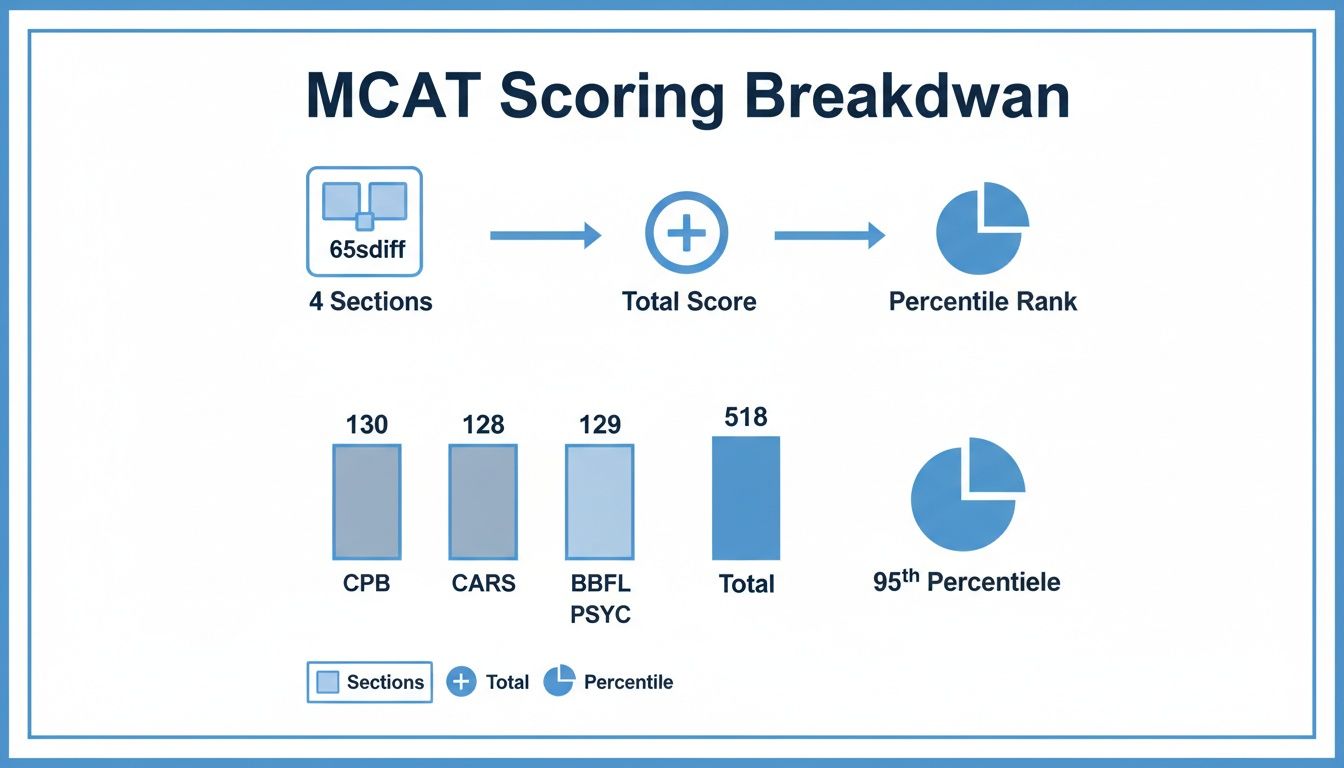
As you can see, that final percentile is the most direct signal of how you stack up against every other applicant in the pool.
To help you get a clearer picture of where you might stand, here’s a quick look at the average scores for matriculants at different types of medical schools. This isn't about setting rigid cutoffs but about understanding the competitive landscape.
Average MCAT Scores by Medical School Tier
| School Tier / Program Type | Average Matriculant MCAT Score | Competitive Score Range to Aim For |
|---|---|---|
| Top-20 MD Programs | 520+ | 518 - 524 |
| Top-100 MD Programs | 512 - 515 | 514 - 517 |
| State MD Schools | 510 - 512 | 510 - 514 |
| DO Programs | 504 - 505 | 506 - 509 |
Remember, these are averages and ranges. A stellar score doesn’t guarantee an acceptance, just as a slightly lower one doesn't sink your application if other parts of your story shine. Use this table to set a challenging but achievable goal for yourself.
Defining Targets for Top-Tier MD Programs
Highly competitive MD programs are screening for applicants who have demonstrated exceptional academic horsepower. For these schools, a “good” MCAT score is significantly above the national matriculant average of 511.9.
If your list includes any top-20 schools, your target should be 518 or higher. This range puts you in the top 5-10% of all test-takers, sending a clear signal to admissions committees that you can handle the most demanding medical curricula without breaking a sweat.
The numbers from these elite schools back this up. For instance, Harvard Medical School's entering class has an average total MCAT of 520.48, while NYU Grossman is at 523, and both Penn Perelman and Yale are at 522. Even looking across the top 100 U.S. schools, averages often hover in the 512-515 range. Hitting a 515 puts you in the 91st percentile and can dramatically open doors, making it a critical threshold for ambitious applicants.
Competitive Scores for Mid-Tier and State Schools
For the vast majority of excellent mid-tier and state-funded MD programs, a score between 510 and 514 is considered very competitive. A score in this zone shows you have a strong command of the sciences and solid critical reasoning skills, making you a desirable candidate at hundreds of great medical schools across the country.
A score of 510 isn't just a number—it’s a powerful signal. It tells admissions committees you are well-prepared and places you in the top 20% of test-takers, opening the door to a wide array of quality MD programs.
What Is a Good MCAT Score for DO Programs
Doctor of Osteopathic Medicine (DO) programs also look for highly qualified candidates, but their average MCAT scores are typically a bit different from their MD counterparts. The average MCAT for students matriculating into DO schools is around 504-505.
Based on that, a competitive score for most DO programs would fall in the 506 to 509 range. This would put you comfortably above average and make your application stand out. Just keep in mind that the most competitive DO programs will have averages that start to look more like those of MD schools.
You can explore a variety of medical school programs to see which might be the best fit for your score range and career goals.
Why Admissions Committees Look Beyond Your Total Score

That three-digit number at the top of your MCAT report? It’s important, but it’s not the whole story. Not even close. Admissions committees are trained to dig deeper, analyzing the story your individual section scores tell about your academic readiness—your strengths, your potential weaknesses, and your overall balance as a future physician.
A balanced score profile sends a powerful signal: you’re a well-rounded candidate prepared for the diverse demands of medical school. On the flip side, a lopsided score can raise a red flag. Imagine a stellar performance in the science sections dragged down by a much lower CARS score. An admissions officer might see that and wonder about your critical reasoning or reading comprehension skills, which are non-negotiable for a doctor.
Your total score is what gets your foot in the door. The section breakdown, however, helps an admissions committee build a complete picture of you as a thinker and a learner.
The Story Each Section Score Tells
Think of your MCAT report as a diagnostic tool for medical schools. Each section gives them a specific piece of information about your ability to handle their curriculum. It’s not just about what you know, but how you know it.
Here’s a look at what they’re trying to figure out from each part of your score:
- Chem/Phys & Bio/Biochem: High scores here are your proof of content mastery. You’ve put in the work and have a firm grasp on the foundational sciences that will dominate your first two years of med school. It shows you won’t buckle under dense, complex material.
- CARS (Critical Analysis and Reasoning Skills): This section is often seen as a proxy for your ability to think like a doctor. Can you analyze dense, unfamiliar information, navigate ambiguity, and reason your way to a sound conclusion? You’ll be doing that every single day in the clinic.
- Psych/Soc: A strong performance here shows you understand the social and behavioral factors that influence health. This is a huge and growing focus in modern medicine—treating the whole person, not just the disease.
The averages across these sections aren’t uniform. For example, the 50th percentile for the Psych/Soc section has climbed to 125.9, while the CARS average sits around 124.6. In CARS, hitting a 128 vaults you into the 90th percentile, showing just how much that section can differentiate applicants.
Balancing Strengths and Weaknesses
One of the biggest anxieties for pre-meds is wondering if a monster score in one section can make up for a weaker one somewhere else. While an amazing science score is definitely impressive, the hard truth is that it rarely compensates for a low CARS score, which many schools weigh heavily.
Admissions committees look for consistency. A balanced score—even if it's slightly lower overall than a lopsided one—often presents a lower-risk candidate who is prepared for all facets of medical training.
This comes back to the idea of a holistic review. They’re not just assessing your ability to pass biochemistry; they’re picturing you in clinical rotations, talking to patients, and collaborating with colleagues. And if your application moves on to the next stage, you'll have to prove those reasoning skills again in person, which is why practicing with a medical school mock interview can be a game-changer.
At the end of the day, aiming for a balanced profile is your smartest strategy. It tells a much more compelling story: you have the broad skill set needed to become a competent, compassionate, and well-rounded physician.
Deciding if You Should Retake the MCAT
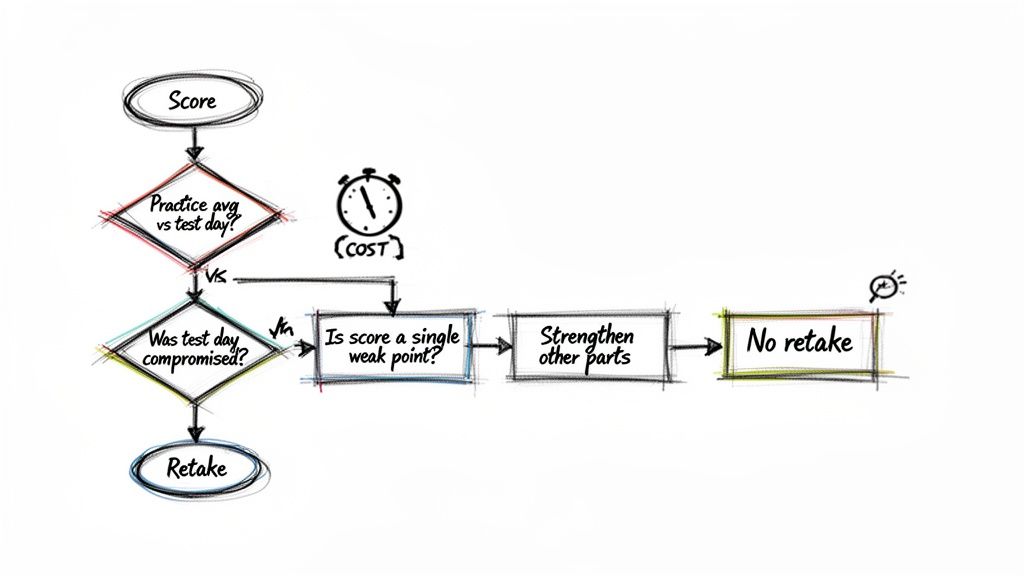
Getting an MCAT score that doesn't feel like your score is a gut punch. It’s a tough, but surprisingly common, experience. Before you jump online to book another test date, take a deep breath. The decision to retake the MCAT needs to be strategic and clear-headed, not an emotional reaction.
This is a major commitment. We're talking time, money, and a whole lot of mental energy. So, let's make sure it's the right move.
Start with a few honest questions. Was your official score way off from your full-length practice exam average? Did something go sideways on test day—sudden sickness, a computer glitch, or a personal crisis that completely threw you off?
And what about the rest of your application? Is your MCAT score the one glaring weak spot in an otherwise solid profile? If you're nodding "yes" to these, a retake might be a very smart play.
Weighing the Pros and Cons
A successful retake isn't just about bumping up a number. It sends a powerful message to admissions committees about your resilience and academic drive. It proves you can spot a weakness, build a plan, and execute it—all qualities of a great future doctor. It can take a borderline application and push it firmly into the "competitive" pile.
But the risks are just as real. A second attempt that lands you a similar or—worse—lower score can be a red flag, suggesting you've hit your academic ceiling. The financial hit from re-studying and re-testing is no joke, and the mental drain can be immense.
Key Questions for Your Retake Decision
Work through this checklist to get some clarity. Your answers will tell you if a retake truly aligns with your goals.
- Performance Gap: Was your real score 5+ points lower than what you were consistently hitting on practice tests?
- Test Day Issues: Can you point to a specific, significant event that messed up your performance? Think beyond just "I was nervous."
- Application Imbalance: Is your score the one thing holding back a strong GPA, great extracurriculars, and glowing letters of recommendation?
- Potential for Improvement: Have you figured out exactly what went wrong? Whether it was content gaps or flawed strategy, you need a concrete plan to fix it. Using a comprehensive MCAT question bank is a great way to diagnose those specific weaknesses and target them head-on.
"A low MCAT score is often the first filter. If your score doesn't meet a school's threshold, the rest of your amazing application might never get a full review."
The data backs this up. In surveys of admissions officers, 39% named low MCAT scores as the top reason for rejecting an application—even more than a low GPA.
Knowing how to deal with exam stress is also non-negotiable, whether it's your first attempt or a retake. Your ability to stay confident under pressure is a huge part of the battle.
Ultimately, a strategic retake can be a game-changer, but only if it's a decision based on data, not disappointment.
Alright, you’ve got the score report in your hand. Now what?
That number isn’t the finish line—it’s a signpost. It tells you where you are and helps you map out your next strategic moves. Turning that score into a clear, actionable plan is how you make the MCAT work for you.
Your path forward really depends on how your score stacks up against your goals. Let's walk through the three most common scenarios and figure out exactly what you should do next.
Scenario 1: You Crushed Your Goal Score
First off, congratulations! A score that blows past your target gives your application a serious competitive edge. It gets you a hard look from admissions committees, but don't mistake it for a golden ticket.
Your focus now pivots. You've proven your academic chops; it's time to show them who you are as a person.
Here’s how to build on this momentum:
- Tell a compelling story. Your personal statement and secondary essays need to be just as strong as your stats. Weave a narrative that shows your character and complements your academic achievements.
- Prep relentlessly for your interviews. A killer MCAT score opens the door, but a phenomenal interview is what gets you the acceptance letter.
An exceptional score gets you the interview, but it's your ability to connect with another human—to articulate your empathy, passion, and critical thinking in person—that truly earns you a spot. Don't let a great number be undermined by a weak interview.
This is where practice becomes non-negotiable. Using a tool like Confetto’s AI-powered interview prep can help you translate those impressive stats into a confident, polished performance that genuinely connects with your interviewers.
Scenario 2: You Hit Your Target Score
Hitting your goal is a solid win. You’ve just shown your target schools that you have the academic horsepower to succeed in their program. Great.
Now, your job is to stand out from the crowd of other applicants with similar scores. Since your MCAT is right in line with the school's average, the other pieces of your application need to do the heavy lifting.
Pour your energy into highlighting what makes you more than just a number. This is the time to really lean into your unique clinical experiences, research contributions, or leadership roles. Your goal is to build a complete, holistic profile that makes you a memorable and compelling candidate.
Scenario 3: Your Score Fell Short
Okay, this stings. But it is absolutely not a dead end.
First, take a deep breath and remember that a score even around 500 has real predictive power. Research straight from the AAMC shows that students scoring 125 per section (totaling 500) are strong contenders who not only get accepted but also graduate and pass their licensing exams. You can read more about how scores correlate with long-term success here.
Your next steps are all about honest assessment and smart adjustments:
- Broaden your school list. It's time to add some programs where your score isn't just at the bottom of their range, but is genuinely competitive.
- Beef up the rest of your application. If your score is a weak point, make sure your experiences, essays, and letters of recommendation are undeniable strengths.
- Consider a strategic retake. This is a serious decision. Only go down this path if you have a concrete, realistic plan to make a significant jump.
Common Questions About MCAT Scores
As you get deeper into the application process, a few practical questions about MC.AT scores always seem to pop up. Let's tackle the most common ones.
How Long Is My MCAT Score Valid?
Think of your MCAT score as having a shelf life of about two to three years. Most medical schools won't look at a score older than that.
Because this policy can vary slightly from one school to another, you absolutely have to check the specific requirements for every single program on your list. If your score is pushing past the three-year mark, you'll almost certainly need to retake the exam.
Can a High GPA Make Up for a Low MCAT Score?
Not really. A high GPA is fantastic—it proves you have the academic discipline for the long haul. But it rarely cancels out a low MCAT score.
Here's why: many schools use automated screening filters. If your MCAT score is below their programmed cutoff, a human may never even see your application, no matter how great your GPA is. A balanced application with strong numbers across the board is always your safest bet.
Can I Pick and Choose Which MCAT Scores Schools See?
Unfortunately, no. When you release your scores through AMCAS (for MD programs) or AACOMAS (for DO programs), your entire MCAT history is sent along with it.
Schools see every attempt and every score. This is precisely why the decision to retake the exam is such a big one and needs to be made strategically.
Prepare to impress admissions committees by turning your strong stats into a compelling interview performance. Confetto offers AI-powered mock interviews and instant, actionable feedback to build your confidence and polish your delivery. Start your free trial today at confetto.ai.