
BS MD Programs Your Guide to Combined Medical School Paths
Explore top BS MD programs with our complete guide. Learn about eligibility, application strategies, and interview prep to secure your spot in medical school.
For the exceptionally driven high school student who knows, without a doubt, that medicine is their future, a BS MD program offers a direct, continuous path to becoming a doctor. Think of it as an academic express lane that bypasses much of the uncertainty and stress of the traditional premed journey.
The Academic Express Lane
Imagine the long road to becoming a physician. The standard route involves four years of undergraduate study, the grueling Medical College Admission Test (MCAT), and then the high-stakes, incredibly competitive medical school application process. It’s a path with potential detours, roadblocks, and absolutely no guarantee you’ll reach your destination on time.
BS MD programs run parallel to this road—but they’re a dedicated, streamlined route. They are designed from the ground up for students who have already locked in their destination before even setting foot on a college campus.
By committing to one of these combined programs, a student steps onto a single track that merges their bachelor’s degree directly into their medical degree. It’s a profound shift from the conventional premed experience.
A Guaranteed Seat at the Table
The single greatest value of a BS MD program is the conditional promise of a medical school seat. As long as you maintain specific academic standards during your undergraduate years—like a minimum GPA—your spot in the affiliated medical school is secure. This provides an immense psychological advantage.
Instead of spending four years laser-focused on building a resume for admissions committees, students in these programs have the freedom to:
- Explore diverse academic interests without worrying if a course looks "good" for a med school application.
- Engage deeply in research or clinical experiences out of genuine intellectual curiosity, not just obligation.
- Dramatically reduce the stress associated with the conventional medical school application cycle.
In short, BS MD programs replace the burning question of “if I get into med school” with a clear plan for “when I go to med school,” allowing students to truly focus on learning and growth.
To give you a clearer picture, here’s a quick comparison of the two paths.
BS MD Programs At a Glance
This table breaks down the key differences between committing to a BS MD program and navigating the traditional premed route.
| Characteristic | BS MD Programs | Traditional Premed Path |
|---|---|---|
| Medical School Acceptance | Conditional acceptance out of high school | No guarantee; apply during or after college |
| MCAT Requirement | Often waived or requires a minimum score | Required; a high score is critical for admission |
| Application Process | Single, intense application in high school | Separate undergraduate and medical school applications |
| Undergraduate Flexibility | Curriculum may be structured or accelerated | Complete freedom to choose major and courses |
| Stress and Uncertainty | Lower during college; focus is on learning | High stress around grades, MCAT, and application |
| Competition Level | Extremely high for program admission | Very high for medical school admission |
While the BS MD path offers incredible security, securing a spot is a challenge in itself, which brings us to the tradeoff.
The Tradeoff: Extreme Competition
This streamlined path comes with a massive catch: getting in is extraordinarily competitive. In fact, the competition for BS MD programs dwarfs that of the traditional medical school pathway. The numbers tell a stark story.
Average acceptance rates for some programs can dip below 1%, a sharp contrast to the 44.58% overall MD acceptance rate for traditional applicants in 2024.
For instance, Baylor University's prestigious program selects just five or six students from a pool of over 1,200 applicants—a rate of about 0.4%. You can discover more insights about medical school acceptance rates on MedEdits.
This intense selectivity sets an incredibly high bar from the very beginning. Applicants are expected to have near-perfect grades, top-tier standardized test scores, and a demonstrated, mature commitment to medicine. Understanding this reality is the first step for any high school student considering this demanding but rewarding academic express lane.
Understanding Different Combined Medical Programs
While "BS/MD program" gets tossed around as a catch-all term, the reality is a lot more nuanced. These combined pathways aren't all built the same, and the first step to finding the right fit is understanding the different models. Think of it like choosing how to get across the country: you could take a high-speed train, a scenic cross-country route, or a specialized research vessel. Each gets you to your destination—a career in medicine—but the journey, the timing, and the purpose are completely different.
This flowchart lays out the two main routes to becoming a doctor, starting right from high school. It really highlights how direct the BS/MD path is designed to be.
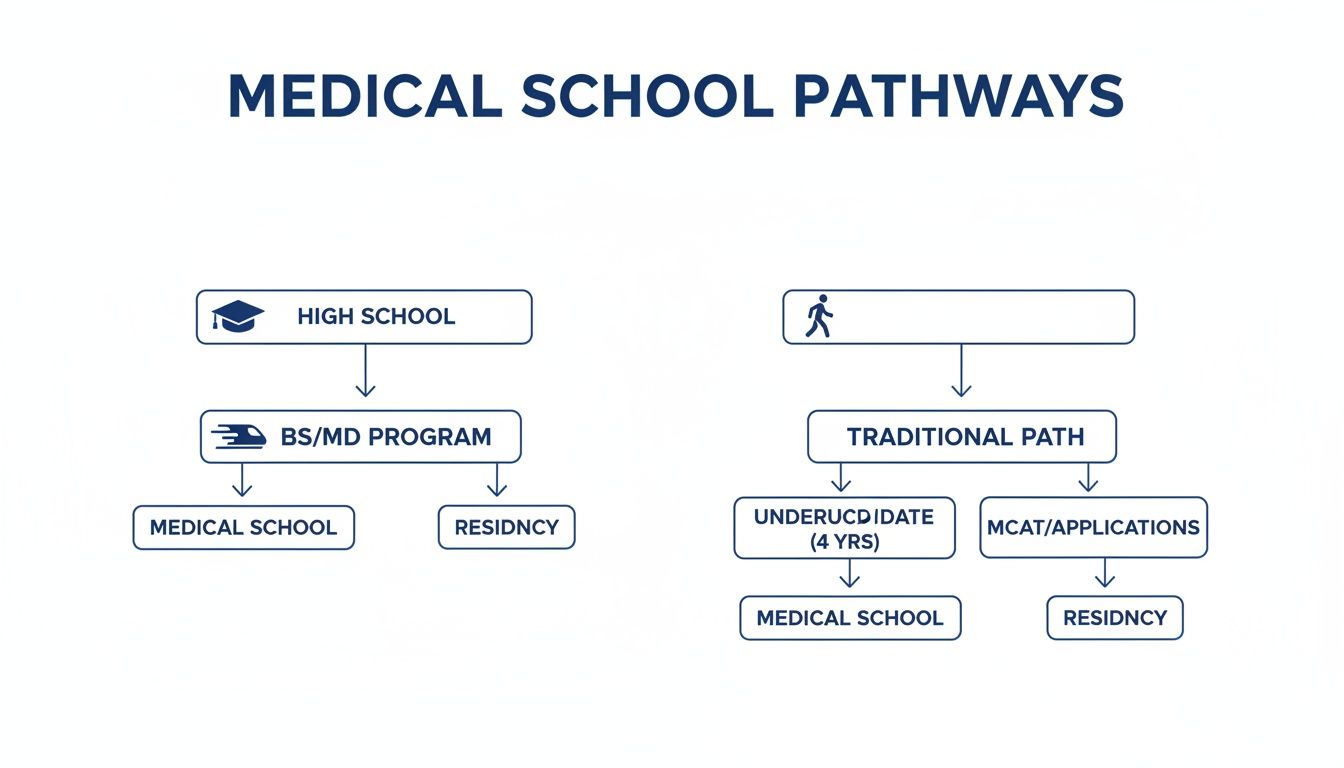
As you can see, BS/MD programs are essentially an express route that merges two distinct stages into one continuous journey, while the traditional path keeps them separate.
Guaranteed Admission Programs: The Classic Model
This is what most people picture when they hear "BS/MD program." You apply during your senior year of high school and, if you get in, you receive a single acceptance letter that covers you for both your undergraduate degree and medical school. It's the ultimate academic express lane.
But there’s a catch: this acceptance is almost always conditional. You’ll need to maintain a minimum GPA (often 3.5 or higher) and, for some programs, hit a certain score on the MCAT to officially keep your seat in the medical school class.
- Ideal Candidate: An exceptionally focused high school senior with a stellar academic record who is 100% certain they want to be a physician.
- Timeline: Apply as a high school senior; your commitment will span 6 to 8 years.
- Key Feature: This route offers the most security right out of the gate, slashing the stress that comes with the traditional medical school application cycle.
These programs are all about providing a clear, structured path from day one of college.
Early Assurance Programs: A Mid-College Entry Point
What if you don't figure out your passion for medicine until after you've already started college? That’s exactly what Early Assurance Programs (EAPs) are for. Instead of applying from high school, talented undergrads typically apply to an EAP during their sophomore year.
Get in, and you've just locked down your spot in medical school two years early. This lets you bypass the entire traditional application grind during your junior and senior years. It’s a great middle ground between the all-in commitment of a BS/MD program and the uncertainty of the standard premed track.
Early Assurance Programs reward students who show exceptional promise early in their college careers, giving them a guaranteed seat and the freedom to explore their academic interests without the pressure of a looming med school application.
This pathway offers a ton of flexibility for students who need a year or two of college to be absolutely sure about their career choice.
Specialized Combined Degrees: For the Scientist-Physician
Beyond the standard MD, some programs offer even more specialized tracks for students who have a crystal-clear vision for a research-heavy career. The most common of these is the BS/MD/PhD program, which is designed to train the next generation of physician-scientists. These are incredibly demanding programs that weave together medical training and rigorous doctoral research.
Other specialized tracks include:
- BS/MD/MPH: This combines medical training with a Master of Public Health, perfect for students who want to tackle healthcare policy, community health, or epidemiology.
- BS/MD/MBA: Built for future physician-executives, this path blends clinical know-how with business and management skills, preparing graduates to lead entire healthcare organizations.
These specialized degrees are for a very select group of students who know from the start that they want to merge clinical practice with another professional field. They represent the most focused and intensive pathways out there, demanding an extraordinary level of commitment.
Ultimately, choosing the right type of combined program isn't about which one is "best"—it's about which one best fits your personal timeline, your level of certainty, and your long-term career goals.
Building a Winning BS MD Application
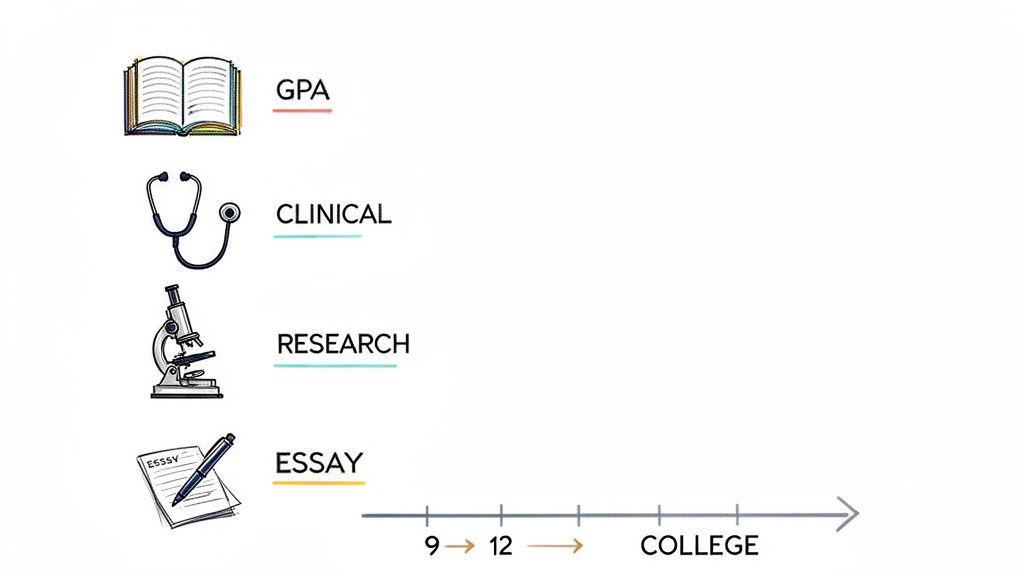
Putting together a standout application for bs md programs isn't a final sprint; it’s more like a marathon you start training for the moment you enter high school. Think of it as a multi-year project where every piece—from your grades to your essays—needs to tell a cohesive story about why you’re ready for this accelerated path.
Success hinges on four core pillars. Admissions committees aren't looking for a one-dimensional academic machine. They want a complete candidate, and a weakness in one area can’t be easily offset by strength in another.
Stellar Academics and Rigorous Coursework
Let's be clear: a top-tier academic record is the absolute price of admission. These programs are hunting for students who not only ace their classes but actively seek out the most challenging coursework their high school offers. A near-perfect GPA isn't just a goal; it's the baseline.
This means consistently earning As in Advanced Placement (AP) or International Baccalaureate (IB) science courses—biology, chemistry, and physics are the big three. But don’t stop there. Excelling in advanced math and even humanities classes shows you have the intellectual horsepower and curiosity to thrive as a physician. Committees need proof you can handle a brutal, science-heavy load without breaking a sweat. For more on the numbers, see our guide on the ideal GPA for medical school.
To ensure your test scores are just as strong, you might look into the best test prep centers. Structured preparation for the SAT or ACT can make a huge difference in hitting the scores that reflect your true potential.
Sustained Commitment to Healthcare
Beyond the transcript, committees need to see a genuine, long-term fascination with medicine. This isn’t something you can fake by cramming a few activities into your junior year. They want to see a story of authentic exploration.
Focus on depth, not just checking boxes.
- Clinical Volunteering: Sticking with a volunteer role at a hospital or local clinic shows you understand the day-to-day realities of patient care. It’s less about the raw number of hours and more about what you learned from the experience.
- Physician Shadowing: Observing doctors in various specialties gives you an unfiltered look into the profession. It confirms your interest is based on reality, not a TV drama.
- Meaningful Research: Getting involved in a research project—whether at a university or through a school program—demonstrates your scientific curiosity and analytical mind. It shows you want to understand the why behind the medicine.
A strong application shows a clear narrative arc. Maybe you started with general hospital volunteering in 9th grade, which led to shadowing a cardiologist in 10th, and culminated in a cardiovascular research project in 11th. That progression shows maturity and deepening commitment.
Crafting a Narrative Through Essays
Your essays are where the numbers on your transcript become a human story. This is your one chance to connect the dots for the admissions committee and explain what drives you to pursue medicine so early.
Ditch the clichés about "wanting to help people." Dig deeper. Use specific anecdotes from your clinical or research experiences to show why you’re drawn to this path. What patient interaction changed your perspective? What scientific question keeps you up at night? Your essays need to reveal maturity, empathy, and resilience—the core traits of a great physician.
BS MD programs, which first appeared in the 1980s to create a direct path for exceptional high schoolers, are designed to find this rare mix of intellect and maturity. With roughly 50 programs in the U.S. today, the competition is fierce. Elite programs like Brown University's PLME accept under 3% of applicants, a far cry from the 44.58% overall MD acceptance rate reported in 2024.
Securing Powerful Letters of Recommendation
Finally, strong letters of recommendation act as a third-party validator of everything you claim in your application. These letters must come from people who know you well and can speak to your specific strengths and character.
Start building real relationships with your teachers, especially in science, and with any mentors from your volunteering or research. When you ask for a letter, give them your resume and a short brief on your goals to help them write a detailed, personal endorsement. A generic letter is a red flag, but a glowing, specific one can be the final piece that gets you into one of these coveted bs md programs.
Preparing for the High-Stakes BS/MD Interview
Getting the application in gets your foot in the door. The interview is what lands you a seat at the table. For anyone aiming for competitive BS/MD programs, this is almost always the final, make-or-break hurdle. It’s where your perfectly polished essays and stellar grades come to life, giving the admissions committee a chance to see the maturity, empathy, and critical thinking skills that a paper trail can only suggest.
This isn’t your typical college interview. The questions are designed to test your resilience and ethical reasoning under pressure. They want to know if a high school student truly has the self-awareness needed to commit to medicine this early. Think of it as the ultimate test of your readiness for this accelerated path.
Cracking the Code on Different Interview Formats
Admissions committees use a few different formats to get to know their candidates, and each one has its own focus and feel. Understanding them is your first step. After all, you wouldn't train for a sprint and a marathon the same way, and that same logic applies here.
You’ll most likely run into one of these three:
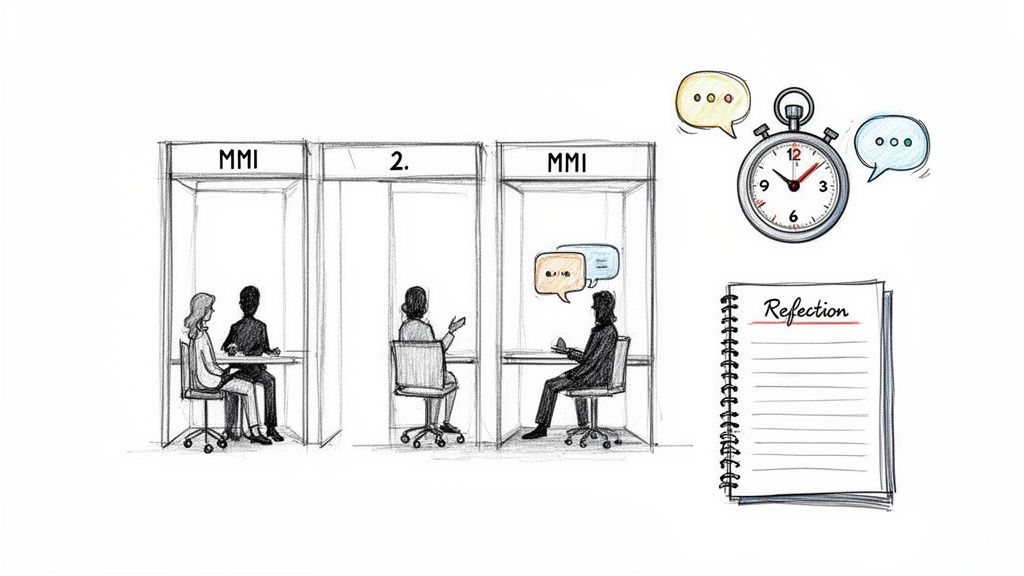
- Multiple Mini Interview (MMI): A series of short, timed "stations" where you react to different scenarios or ethical puzzles.
- Traditional Interview: A classic one-on-one or two-on-one conversation, much like a standard job interview.
- Panel Interview: You’ll face a group of interviewers at once, testing how you handle group dynamics and pointed questions.
Each format calls for a different game plan to really let your strengths shine.
Mastering the Multiple Mini Interview (MMI)
The MMI has quickly become a favorite for medical admissions because it tests core skills that go way beyond academics. Instead of just asking what you’ve done, it forces you to show your thinking process in the moment. Picture a circuit of small rooms, with each one presenting a new challenge you have just a few minutes to tackle.
In one station, you might be asked to discuss an ethical dilemma with an actor playing a patient. In the next, you could be tasked with explaining a complex scientific concept to someone with no background in the subject. The whole point is to see how you think on your feet, collaborate, and communicate. If you want a deep dive, our full guide on how to prepare for MMI interviews lays out specific strategies.
The MMI is less about finding the single "right" answer and more about demonstrating how you arrive at a thoughtful one. Interviewers are assessing your empathy, ethical reasoning, and communication skills—not just your ability to recall facts.
Navigating Traditional and Panel Interviews
While the MMI is all about scenarios, traditional and panel interviews are more conversational—but no less intense. The focus shifts squarely to you: your motivations, your experiences, and your real-world understanding of medicine. Get ready to answer classics like "Why medicine?" and "Why our program?" with responses that are both deep and genuinely authentic.
For a panel interview, the key is to connect with everyone in the room. Make eye contact with each person as you speak. It shows confidence and respect for the group. They're looking for a candidate who is poised, reflective, and truly all-in on their future in medicine.
The Power of Advanced Preparation
You can't just wing these interviews. Excelling requires practice, and this is where modern prep tools can give you a serious edge. Using AI-powered mock interviews lets you simulate the pressure of the real thing right from home.
Platforms like Confetto provide a safe space to rehearse your answers to hundreds of prompts, from tricky ethical scenarios to personal questions about your journey. You can work on your pacing, refine your communication, and build the muscle memory needed to walk into your interview feeling calm and ready. By turning practice into a habit, you transform nervous energy into unshakeable confidence, making sure you present the very best version of yourself when it counts the most.
Is a BS/MD Program Actually Right for You?
The idea of a guaranteed seat in medical school is a powerful draw, making BS/MD programs feel like the ultimate prize for a driven high school student. But let’s be clear: this path isn’t for everyone. It’s an intense, long-haul commitment that demands a level of certainty and maturity well beyond that of a typical 17-year-old.
Deciding if this is your route is about honest self-reflection. The question isn't just whether you can get in, but whether you should. The answer comes from weighing the incredible upsides against some very real, and often overlooked, downsides.
The Obvious Upside: A Direct, Less Stressful Path
The biggest, most talked-about benefit is simple: peace of mind. Locking down a spot in medical school before you even start college lifts a massive weight off your shoulders, allowing you to approach your undergraduate years very differently from your peers on the traditional premed track.
Instead of a grueling four-year audition for medical school, college can become a time for genuine exploration and learning. This security unlocks a few key advantages:
- Massively Reduced Stress: You get to sidestep the soul-crushing anxiety of studying for the MCAT and navigating the hyper-competitive medical school application cycle. That frees up a ton of mental and emotional bandwidth.
- True Academic Freedom: Want to minor in philosophy or study abroad in Spain? Go for it. You can take fascinating courses outside the rigid premed curriculum without worrying if it’ll tank your med school chances.
- A Head Start on Your Career: Many programs, especially the accelerated ones, save you both time and money. Starting your career as a physician a year or two earlier is a huge financial and personal advantage.
Ultimately, this environment lets you learn for the sake of learning, not just to check another box for an admissions committee.
The Hidden Costs and Serious Downsides
But that streamlined journey comes with significant trade-offs you need to consider carefully. Committing to medicine at 17 is a double-edged sword. It can lock you into a future before you’ve had a real chance to discover other passions.
And the pressure doesn’t just vanish once you’re accepted—it just changes shape. You’ll still face immense pressure to maintain a high GPA and meet other program requirements to keep that conditional acceptance. For some, that’s just as stressful as the traditional path.
The real question isn't just, "Do I want to be a doctor?" It's, "Am I so certain about this that I'm willing to shut the door on every other possible future, right now?" That's a heavy burden for a teenager to carry.
Before you even think about applying, you have to be brutally honest with yourself about these potential negatives.
Weighing Your Options: BS/MD vs. Traditional Premed
To make the right call, it helps to see the two paths laid out side-by-side. This table breaks down how the experience differs across the factors that matter most.
| Decision Factor | BS/MD Programs | Traditional Premed Path |
|---|---|---|
| Certainty & Stress | High certainty of a med school seat, but intense pressure to maintain grades and meet program standards. | High stress and uncertainty throughout college and the entire application cycle. |
| Flexibility | Limited. You're committed to one specific path and institution for the next 6-8 years. | High. You have the freedom to change your major, transfer schools, or explore other careers entirely. |
| Pace & Workload | Often accelerated with a heavier, more demanding course load, especially in 6 or 7-year tracks. | Standard college pace with the flexibility to take gap years for work, research, or personal growth. |
| Personal Growth | The highly structured environment can sometimes limit opportunities for exploration outside of medicine. | Allows for more personal and professional maturation before you make a lifelong commitment to medicine. |
| Risk of Burnout | A higher risk of early burnout due to the long, unbroken commitment that starts at such a young age. | Gap years can offer a much-needed break, which often reduces the risk of burning out before you even start. |
In the end, there’s no single "better" option. The right choice is deeply personal and depends on your maturity, personality, and how certain you are about your future.
A BS/MD program is an incredible opportunity for the student who has genuinely explored medicine and knows, without a shadow of a doubt, that it is their calling. But for anyone with even a flicker of uncertainty, the traditional path offers the invaluable gift of time—time to explore, to grow up, and to walk into a demanding profession with total confidence.
A Curated List of Notable BS/MD Programs
Finding the right BS/MD program can feel like searching for a needle in a haystack. To give your research a running start, we’ve put together a launchpad of notable BS/MD programs across the United States.
Think of this list not as a final destination but as a well-marked trailhead for your journey. It’s designed to help you quickly identify potential fits based on key factors like duration, MCAT policies, and institutional prestige. But true success comes from digging deep into each program’s unique culture, curriculum, and specific requirements.
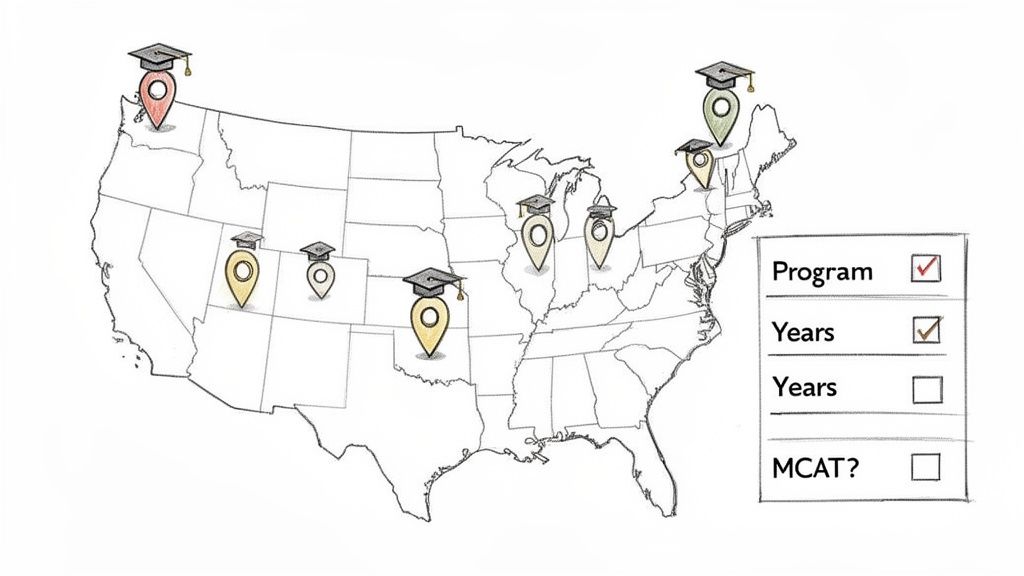
Prominent BS/MD Programs at a Glance
Every program has its own distinct identity, and finding the one that’s right for you involves more than just stats on a page. You can learn more about how to evaluate different medical school programs in our detailed guide.
Use the links in the table below to explore the official program pages and get a feel for what makes each one unique.
| University | Program Name | Duration | MCAT Required? |
|---|---|---|---|
| Brown University | Program in Liberal Medical Education (PLME) | 8 Years | No |
| Case Western | Pre-Professional Scholars Program (PPSP) | 8 Years | No |
| Rice/Baylor | Medical Scholars Program (MSP) | 8 Years | Yes |
| U Pitt | Guaranteed Admission Program (GAP) | 8 Years | Yes |
| U Rochester | Rochester Early Medical Scholars (REMS) | 8 Years | No |
| Penn State | Accelerated Premedical-Medical Program | 7 Years | Yes |
| GW University | B.A./M.D. Program | 7 Years | Yes |
| UConn | Special Program in Medicine | 8 Years | No |
| Stony Brook | Scholars for Medicine Program | 8 Years | No |
| VCU | Guaranteed Admission Program | 8 Years | Yes |
| UMKC | B.A./M.D. Program | 6 Years | Yes |
| Howard University | B.S./M.D. Program | 6 Years | No |
| Augusta University | B.S./M.D. Program | 7 Years | Yes |
| USF | 7-Year B.S./M.D. Program | 7 Years | Yes |
Common Questions About BS/MD Programs
As you dive into the world of combined medical degrees, a lot of specific questions are bound to pop up. Let's tackle some of the most common ones to clear up any lingering uncertainties.
Can I Apply to BS/MD Programs and a Regular Undergraduate Track Simultaneously?
Yes, and you absolutely should. In fact, think of it as the standard strategy. You can—and should—apply to the traditional four-year undergraduate program at the same universities where you’re shooting for a BS/MD spot.
Think of the BS/MD application as a high-stakes, specialized layer on top of your regular college application. This dual approach is a critical safety net. Given that the acceptance rates for these combined degrees are incredibly low, having a solid list of undergraduate options ensures you have a great path forward, no matter what happens.
What Happens If My GPA Drops Below the Program Requirement?
This is a huge point of anxiety for many students, and for good reason. If your GPA dips below the program's minimum threshold—often a 3.5 or higher—you don't get kicked out of the university. What usually happens is that you're removed from the guaranteed medical school track.
From there, you’d simply continue as a regular undergraduate student. You would then have to apply to medical school the old-fashioned way, through the traditional, highly competitive application cycle. This is precisely why maintaining near-perfect grades throughout your undergrad years is non-negotiable in these programs.
The "guarantee" in guaranteed admission is always conditional. It’s not a free pass; it’s a reserved seat that you must continuously earn by meeting the program's tough academic and professional standards.
Is It Possible to Change My Mind and Not Go to Medical School?
Of course. You can always leave a BS/MD program if you realize medicine isn’t the right path for you. You are never contractually locked into completing the MD portion. If you discover a passion for something else, you can typically withdraw from the medical track and finish your bachelor's degree in your new major.
However, this brings up one of the core trade-offs of these programs. The curriculum is often highly structured and medically focused from day one. This might mean you get less exposure to other fields, making it a bit harder to pivot later in your college career compared to a student on a traditional track. It's a path that really values certainty.
Ready to conquer your medical school interview? Confetto is your AI-powered preparation platform, offering realistic mock interviews for MMI, panel, and traditional formats. Get instant, detailed feedback on everything from your communication skills to your ethical reasoning, and walk into your interview with total confidence. Start your free trial today at https://confetto.ai.