
Early Decision vs Early Action: The Ultimate Admissions Guide
Deciding between early decision vs early action? This guide breaks down binding vs non-binding options to help you choose the best college application strategy.

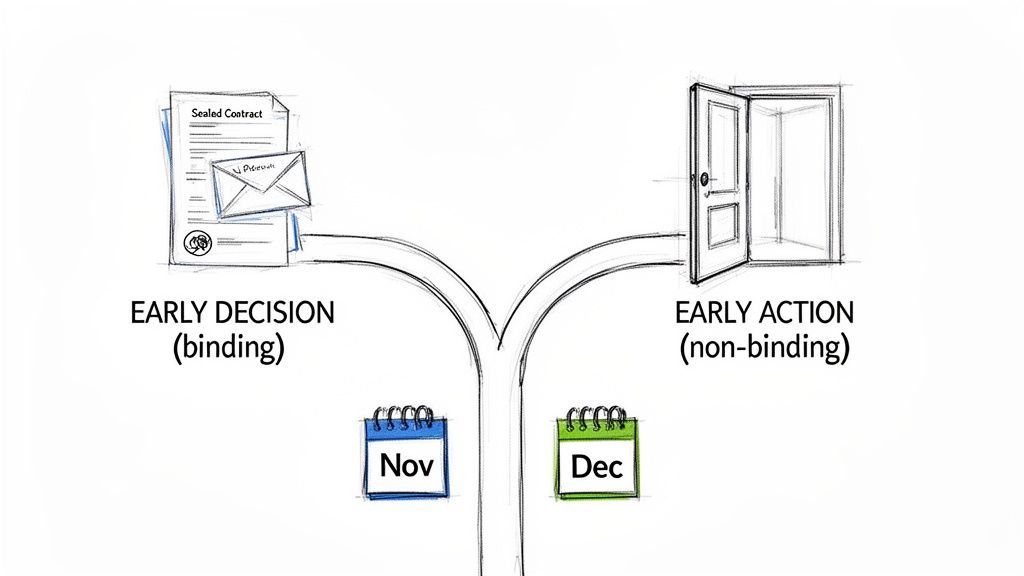
The big difference between Early Decision and Early Action really comes down to one thing: commitment.
Think of Early Decision (ED) as a binding agreement. You’re telling your dream school they are unequivocally your number one, and if they accept you, you’re coming, period. Early Action (EA), on the other hand, is a non-binding offer. It lets you apply early and hear back early without locking you in, so you can still compare offers from other colleges. This one distinction changes everything about your application strategy, from which schools you target to how you handle financial aid.
Decoding The Early Admissions Landscape
Deciding between Early Decision (ED) and Early Action (EA) is one of the biggest strategic calls you'll make in the college application game. It’s a choice between showing one school your absolute, unwavering loyalty versus keeping your options wide open. Getting the mechanics of each one straight is the first step to making a smart decision that actually fits your goals, financial reality, and how certain you feel.
Commitment Versus Flexibility
At its core, applying ED is a massive signal to your top-choice school. You're signing a contract that says if they admit you, you'll enroll and immediately pull all your other applications. Admissions committees love this. It gives them certainty and helps them lock in their incoming class.
In contrast, EA gives you the best of both worlds: you get an early verdict—usually by mid-December—but without the strings attached. If you get in, you have until the national reply date of May 1st to make up your mind. That gives you plenty of time to see what other acceptances and financial aid packages roll in.
To make it even clearer, here's a quick breakdown of how these two plans stack up.
Early Decision vs Early Action at a Glance
| Feature | Early Decision (ED) | Early Action (EA) |
|---|---|---|
| Commitment | Binding; you must attend if accepted. | Non-binding; you're free to decline. |
| Application Scope | Apply to only one school ED. | Apply to multiple schools EA. |
| Decision Deadline | Must enroll immediately upon acceptance. | Have until May 1st to decide. |
| Strategic Use | For students 100% certain of their #1 school. | For strong applicants wanting an early answer. |
This table lays out the fundamental trade-offs. It's a direct choice between demonstrating ultimate interest and maintaining your flexibility.
Does Applying Early Actually Help?
The numbers often say yes. Early applicants tend to see higher acceptance rates. For Harvard’s Class of 2028, the EA acceptance rate was 8.74%, which is more than double its overall rate of 3.6%. It's a similar story at Brown University, which admitted 17.9% of its ED applicants for the Class of 2029—a huge jump from its 4% Regular Decision rate.
On average, ED applicants to the most selective schools have a 60% higher chance of getting in. But—and this is a big but—that statistic comes with some major caveats we'll get into later. You can dig into more of these admissions statistics on bestcolleges.com.
A Detailed Comparison of Application Plans
Beyond the simple definitions, the real differences between Early Decision (ED) and Early Action (EA) come down to commitment, timing, and strategic freedom. Picking the right path means taking a clear-eyed look at how these plans shape your entire application journey. Understanding these nuances is the key to aligning your strategy with your goals.
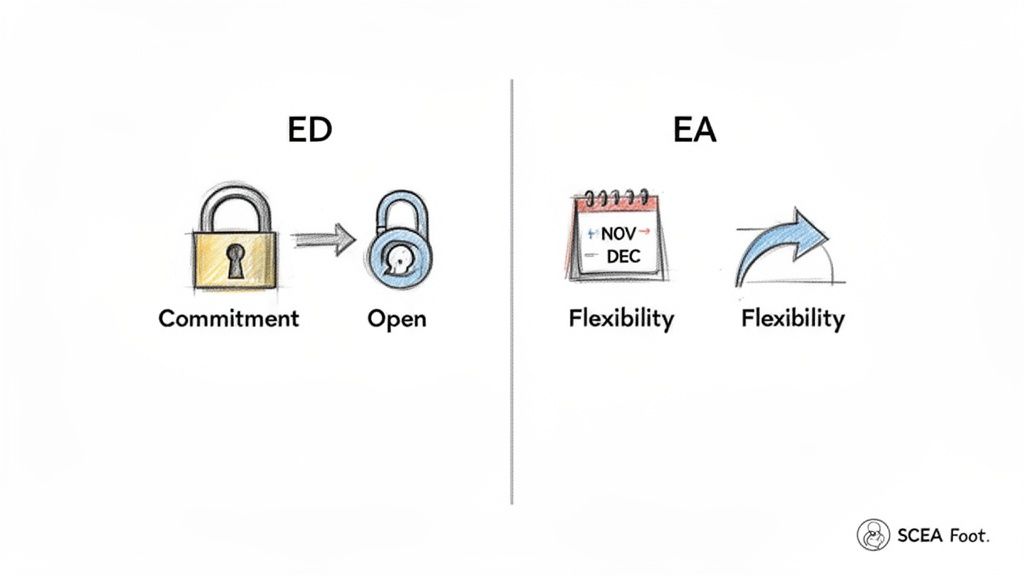
The single biggest factor in the early decision vs. early action debate is the binding commitment. An ED acceptance is a signed contract. If you get in, you’re obligated to enroll and immediately withdraw all other college applications. It’s a powerful way to show a college they’re your top choice, but it completely takes away your ability to consider other offers.
EA, on the other hand, is all about gathering information early. You get an admissions decision without having to pledge anything in return. This flexibility is huge—it lets you keep all your options on the table until the universal May 1st reply deadline.
Commitment and Strategic Freedom
The level of commitment you’re willing to make directly shapes your application strategy. With ED, your game plan is simple: you’re going all-in on one undisputed dream school. All your focus, energy, and effort are channeled into a single, high-stakes application.
With EA, you can apply to several schools early, collecting acceptances and, just as importantly, financial aid packages to compare later. This is the ideal approach for students who are strong contenders at multiple top-choice schools but aren't quite ready to commit to just one.
The Hybrid Model: Single-Choice Early Action (SCEA) A handful of highly selective schools like Harvard, Yale, and Princeton offer a restrictive version of EA called Single-Choice Early Action (SCEA) or Restrictive Early Action (REA). With this plan, you can only apply early to that one private university. You can still apply to public universities' non-binding early plans, but it locks you out of other private EAs. It signals very strong interest without the ironclad commitment of ED.
Comparing Application Timelines and Outcomes
Even though both plans run on an accelerated schedule, their structures create entirely different pressures and outcomes. Nailing down this flow is essential.
| Factor | Early Decision (ED) | Early Action (EA) |
|---|---|---|
| Application Deadline | Typically November 1 or November 15. | Usually mirrors ED deadlines (Nov. 1/15). |
| Notification Date | Mid-December. | Mid-December to late January. |
| Possible Outcomes | Accepted, Deferred, or Denied. | Accepted, Deferred, or Denied. |
| Post-Acceptance | Action required. Must withdraw other apps and enroll. | No action required. Can wait until May 1 to decide. |
Think about it this way: a student who gets into their ED school in December finds out their college search is officially over. That’s it. In contrast, an EA applicant might have three acceptances in hand by January, giving them months to revisit campuses, talk to current students, and meticulously compare financial aid offers before making a final, informed decision.
The difference in freedom after you get that acceptance letter is immense. That strategic waiting period is a luxury that ED applicants completely give up.
The Truth Behind Early Application Acceptance Rates
On the surface, the numbers look like a no-brainer. Compare the acceptance rates for early applicants to the regular decision pool, and the advantage seems huge. Top-tier schools often admit a much higher percentage of students who apply early, which naturally leads people to think it's a golden ticket.
But this perception can be really misleading. The stats are real, but they don't paint the full picture. Those higher acceptance rates in the early rounds aren't just about timing; they're a direct reflection of who is in that applicant pool.
Why Early Acceptance Rates Are So Much Higher
Think about the type of student who applies early. It’s not a random cross-section of applicants. That pool is heavily weighted with highly qualified, incredibly prepared candidates who have known their top-choice school for a long time.
This group almost always includes:
- Recruited Athletes: Many of these students have been talking with coaches for months, if not years. Applying early is often part of their commitment to a team.
- Legacy Applicants: Students whose families have ties to the university frequently apply early to signal that their interest is serious and multi-generational.
- Top-Performing Students: The most organized, highest-achieving students are usually the ones with a polished application ready to go by a November deadline. They naturally self-select into the early pool.
Admissions offices are well aware of this. A strong ED pool lets them build a solid foundation for their incoming class with students who are a guaranteed fit and are legally bound to enroll. It’s less about giving just anyone an "edge" and more about locking in the fantastic candidates they would have likely admitted anyway.
Debunking the "Strategic Advantage" Myth
It’s a tempting but dangerous myth: applying early can make up for a weaker academic profile. The reality is often the exact opposite. Competition in the early rounds can be even more ferocious because you’re up against the most prepared applicants in the entire cycle.
An ED or EA application isn't a shortcut. It's a declaration that you believe you are one of the strongest candidates applying, period. Submitting a borderline application early just gets you a faster rejection or a deferral to the regular pool.
Elite universities are pretty upfront about this. Don't let the shiny stats fool you—those high acceptance rates almost always have a catch. Once you filter out special cases like recruited athletes, the real advantage shrinks dramatically. For its Class of 2028, Harvard's EA rate was 8.74% versus its tiny 3.6% overall rate, but the university is quick to say this reflects a stronger applicant pool, not a timing advantage. Princeton and Yale have said the same, making it clear there is no real strategic boost for early applicants. For a deeper look at how colleges see these numbers, you can explore the context behind early acceptance statistics.
Thinking ahead to the high stakes of medical school admissions? The lessons from undergraduate trends are incredibly valuable. In fact, you might be interested in our deep dive into the factors influencing medical school acceptance rates. The takeaway is clear: apply early only when you are a confident, well-matched candidate, not because you think it’s an easier way in.
Picking Your Playbook: Common Applicant Scenarios
So, how does all this theory about Early Decision and Early Action translate into a real-world strategy for you? It all comes down to matching your academic profile, financial situation, and level of certainty with the right plan.
Your application is more than just stats on a page—it's a narrative about your ambitions and readiness. The early path you choose should feel like a natural extension of that story. Let's walk through a few common scenarios to see which strategy makes the most sense.
The "Top-Choice-or-Bust" Contender
You've had your heart set on one university for years. You’ve done the virtual tours, devoured the program catalogs, and can pinpoint exactly why it’s the only place for you. More importantly, your grades, test scores, and extracurriculars are squarely within—or even above—the school’s typical range for accepted students.
- Recommended Strategy: Early Decision (ED)
For this type of applicant, ED is a game-changer. Applying ED is the single strongest signal of commitment you can send, and admissions committees absolutely take notice. Since you’re already a strong candidate on paper, broadcasting that "super-interest" can give you a genuine leg up. Crucially, this only works if your family has run the numbers on the school's Net Price Calculator and feels confident about the likely financial aid outcome.
The Strong but Undecided Applicant
You have a killer academic record and a compelling application, making you a competitive candidate at several top-tier schools. You've got a favorites list, but there isn't one undisputed "dream school" that eclipses all the others. Getting an early acceptance would be a huge relief, but you're not about to sign on the dotted line without comparing all your options.
- Recommended Strategy: Early Action (EA)
EA was practically designed for this situation. It lets you put your strong profile to work and lock in early acceptances without sacrificing your freedom to choose. Imagine having several offers in hand by December or January. That gives you months to compare financial aid packages, revisit campuses, and make a thoughtful, fully informed decision by the May 1st deadline. This strategy maximizes both your options and your bargaining power.
Applying early fundamentally reshapes a college's incoming class. For premeds, it offers a preview of how commitment can influence outcomes, especially at elite feeder schools. This approach helps colleges secure strong candidates early, building a solid foundation for their class.
The Financial Aid-Dependent Student
You’re a highly qualified applicant, but your ability to attend a particular college hinges on getting a generous financial aid package. You might have a top-choice school, but committing to attend before you can compare financial aid offers from multiple institutions is a massive financial risk for your family.
- Recommended Strategy: Early Action (EA) or Regular Decision (RD)
The binding nature of ED is simply too risky here. A non-binding EA plan is a much safer bet, letting you secure an early win while keeping your options open. If your favorite schools don't offer EA, then applying through Regular Decision is the most sensible path.
This approach guarantees you can lay all your financial aid awards out on the table and choose the school that's not just the best academic fit, but also the most financially sustainable. That decision-making power is something you shouldn't give up lightly. The best pre-med schools often have competitive aid, which you can read more about in our guide on pre-med program selection.
Navigating Financial Aid in Early Applications
Let’s talk about money. When you’re weighing Early Decision versus Early Action, your family’s financial situation has to be front and center. By its very design, the binding nature of Early Decision introduces a serious financial risk. Committing to an ED agreement means you’re promising to attend if you get in, no matter what the financial aid package looks like.
This is a big deal. It means you give up the ability to compare aid offers from other colleges. For many families, that alone is a deal-breaker. You could get into your dream school only to find the aid package falls short, leaving you in an incredibly tough spot.
The Flexibility of Early Action
Early Action, on the other hand, gives you the best of both worlds. You can lock in an early acceptance—sometimes as soon as mid-December—but you keep your freedom to see what other schools offer. Because it’s non-binding, you can review your financial aid award and use it as a baseline while you wait on your Regular Decision results.
This flexibility is absolutely critical for students who need to make a financially smart choice. It puts you in the driver's seat, allowing you to compare scholarship amounts, grants, and loan options side-by-side. You get to choose the school that’s not just a great academic fit but also one you can actually afford.
This flowchart can help you visualize which application path might make the most sense for your priorities and financial picture.
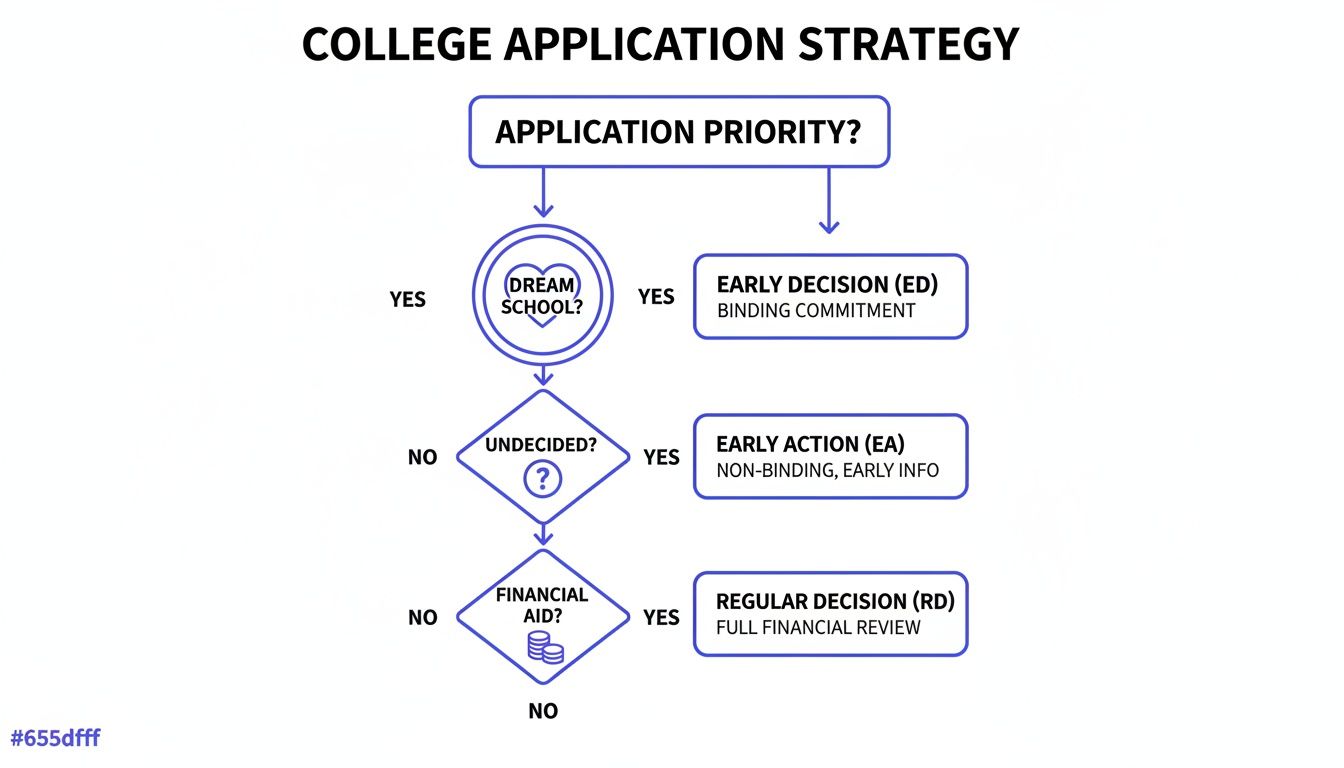
As the chart makes clear, if financial aid is a major factor, keeping your options open with EA or Regular Decision is usually the wisest move.
Making an Informed ED Choice
If you're still leaning toward ED, you absolutely must do your financial homework beforehand. Every family should use the school’s Net Price Calculator, which you can find on its website. This tool gives you a personalized estimate of what your family will likely be expected to pay, providing a realistic preview of your potential aid package before you commit.
Can You Break an ED Agreement? It's extremely rare, but the one widely accepted reason for backing out of an ED agreement is documented financial hardship. If the aid package offered is demonstrably insufficient and makes it impossible to attend, you can appeal to the admissions office to be released from the commitment.
When mapping out your financial strategy, look at all possible funding sources. You might find some good ideas in lists like the Top 10 Scholarships. For some applicants, like international students who face a unique set of funding hurdles, understanding these dynamics is even more critical. We cover this in more detail in our guide to medical school for international students.
Ultimately, ED should only be for students who are 100% certain they can afford their top-choice school, even if the financial aid award isn’t perfect.
Untangling the Fine Print: Your ED & EA Questions Answered
When you’re staring down application deadlines, the nuances between Early Decision and Early Action can feel a little blurry. Let's clear up some of the most common questions students run into while building their strategy.
Can I Apply to More Than One School Early Decision?
This one’s a hard no. You are only allowed to apply to one school under a binding Early Decision plan. Think of it as a serious commitment—when you sign that ED agreement, you’re making a promise to attend that college if they accept you.
Trying to game the system by applying to multiple schools via ED is a major ethical breach in the world of college admissions. If colleges discover it, they can—and often do—rescind all of your acceptances. It’s simply not worth the risk.
What Happens if I Get Deferred?
Getting deferred from your ED or EA school means you haven't been accepted yet, but you haven't been rejected either. Your application is being moved into the Regular Decision pool for a second look. The most important thing to know? You are now completely released from your binding ED agreement.
A deferral isn't a "no," but it's not a "yes," either. It's a signal to keep pushing forward with your other applications. Don't sit back and wait; assume that deferral might not convert to an acceptance later on and focus on making your other options as strong as possible.
A deferral essentially resets the board. It releases you from that high-stakes, binding commitment and gives you back the flexibility to weigh all your options right alongside the regular applicant pool.
Does Applying Early Action Hurt My Chances Elsewhere?
Generally, not at all. Standard Early Action is non-binding and doesn't come with strings attached, so you're free to apply to as many other EA or Regular Decision schools as you want.
The one major exception is Restrictive Early Action (REA), sometimes called Single-Choice Early Action (SCEA). A handful of highly selective universities use these hybrid plans, which may limit where else you can submit early applications. Always double-check each school's specific policy so you don't accidentally violate their rules.
Early applications move fast, which means your interview prep needs to start sooner. With Confetto, you get instant, AI-powered mock interviews 24/7, letting you practice on your own time. You’ll get actionable feedback to help you build confidence long before you step into the real interview. Give it a try with a free trial at Confetto.ai.