
Your Guide to International Student Medical School Admissions
Explore your guide to international student medical school pathways. Get expert tips on applications, interviews, visas, and securing a residency match.
So, you're thinking about applying to medical school abroad. That's a huge step, and it speaks volumes about your drive. But let's be honest: it’s a competitive and complex world. This guide is designed to be your roadmap, breaking down the entire process from start to finish, beginning with the most popular destinations and what it really takes to get in.
Charting Your Global Medical School Journey
Pursuing a medical degree in another country is like planning a major expedition. Every country has a different terrain—its own unique climate, rules, and gear requirements. Being a strong applicant isn’t enough; success comes from choosing the right path for your specific strengths and career goals. The landscape for an international student applying to med school in the United States is worlds apart from the United Kingdom, Canada, or the Caribbean.
Getting a handle on these core differences from the very beginning is the first, most crucial step. Each destination comes with its own set of expectations, timelines, and post-graduation realities that will shape your entire career.
A High-Level Comparison of Medical School Destinations
The first decision is figuring out which path even makes sense for you. While they all lead to a medical degree, the entry barriers, educational systems, and residency prospects couldn't be more different.
A few key factors to weigh right away:
- Entrance Exams: The standardized tests you’ll need to conquer, like the MCAT in the US and Canada or the UCAT in the UK, are the first major hurdles.
- Acceptance Rates: The competition for international seats is incredibly stiff. Some countries have only a handful of spots available for non-citizens.
- Post-Graduate Training: Your journey doesn't end with a degree. The pathway to becoming a licensed, practicing physician—especially the residency match process—varies dramatically from place to place.
This chart gives you a quick visual of how the primary global destinations stack up.
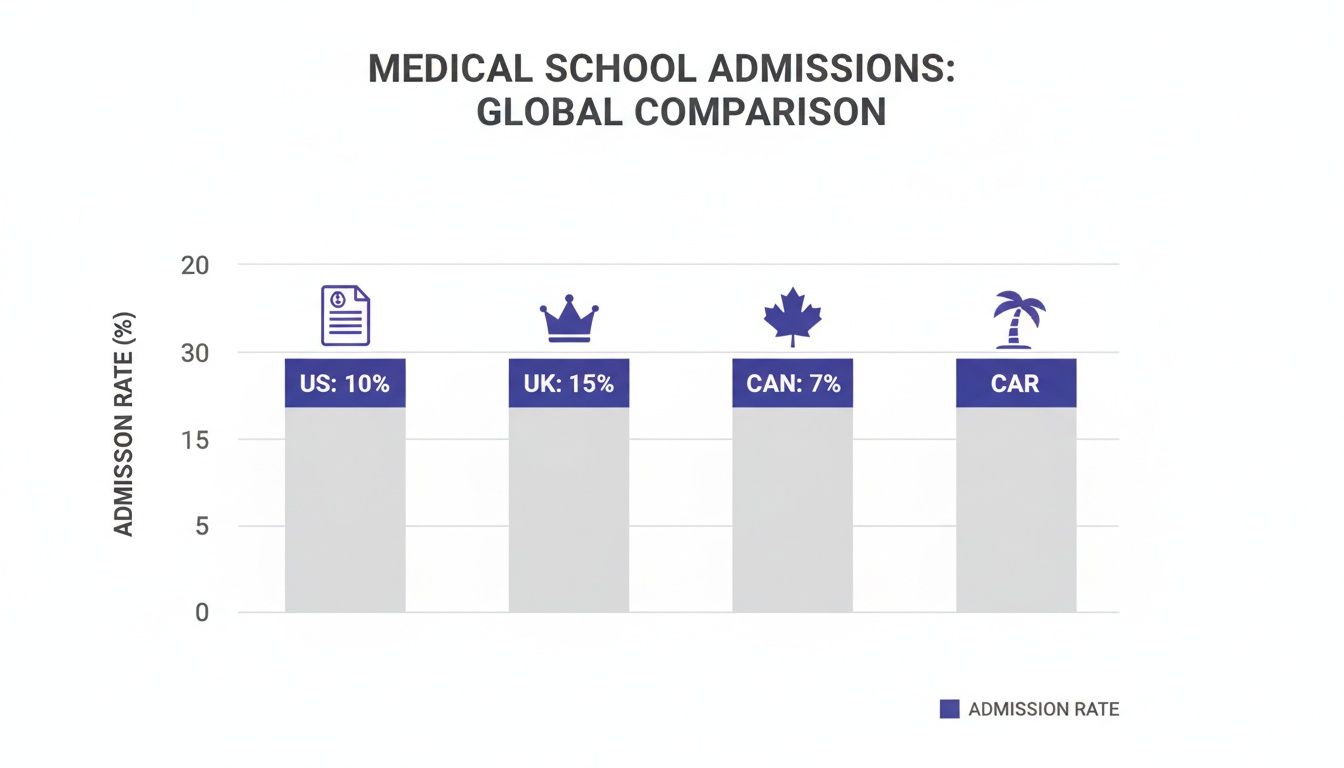
As you can see, the numbers tell a story. While Caribbean schools might seem more accessible on the surface, US and Canadian programs represent the highest bars to clear due to the intense competition for an extremely limited number of international seats.
To help you compare these pathways more directly, here’s a table summarizing the key details for each country.
Medical School Admissions at a Glance for International Students
| Country | Primary Entrance Exam | Acceptance Rate (Approx. for Internationals) | Post-Graduate Residency Pathway |
|---|---|---|---|
| United States | MCAT | <1% at most schools | Highly competitive; requires ECFMG certification, USMLE exams, and often a J-1 or H-1B visa. |
| Canada | MCAT | Extremely Low; many schools do not accept internationals | Very limited spots for International Medical Graduates (IMGs); preference is given to Canadian citizens. |
| United Kingdom | UCAT or BMAT | ~5-10%, but varies by school | Two-year Foundation Programme; requires a Health and Care Worker visa. IMG competition is high. |
| Caribbean | MCAT (often required) | Varies widely, generally higher | Pathway focuses on US residency match (USMLE) or other international systems. Success rates differ significantly by school. |
This table is just a starting point, but it highlights the major differences you'll need to consider as you begin to map out your application strategy.
Your global perspective is a powerful asset. Admissions committees value the diverse experiences and resilience that international students bring. The key is to frame this perspective effectively within the application's cultural context.
With this high-level overview in mind, you're ready to dive deeper into each country's specific requirements. By understanding the foundational challenges and opportunities from the start, you can build a clear strategy for where you want to go and what you need to do to get there.
Navigating Medical School Admissions in the United States
For many aspiring doctors around the world, the United States represents the pinnacle of medical training and research. But let's be honest: its admissions process is notoriously tough, especially if you're not a U.S. citizen. Getting in requires more than just stellar grades; it demands a sharp, strategic understanding of a system that often feels like a black box to outsiders.
Think of it like this: if applying to med school is a maze, international students are handed a map with fewer marked paths. While domestic applicants follow a relatively clear route, you have to find the specific entry points that are open—and welcoming—to someone with your background. This means homing in on the right schools, framing your experiences in a way that resonates with admissions committees, and steeling yourself for a marathon of exams and interviews.
Building Your Competitive Application Profile
Every U.S. medical school application is built on three pillars: academics, standardized test scores, and meaningful experiences. For international applicants, each one comes with a unique twist.
First up is your undergraduate Grade Point Average (GPA). This is the first number admissions committees will look at. If your university doesn't use a 4.0 scale, you'll need to have your transcript evaluated by a service like World Education Services (WES) to translate your grades. What committees want to see is consistency and, ideally, an upward trend.
Next is the Medical College Admission Test (MCAT). This isn't just a science test; it's a grueling exam designed to assess your critical thinking and analytical skills. A high score is non-negotiable. It’s the great equalizer, giving schools a standardized way to compare you against a massive pool of highly qualified candidates. To get a clear idea of what to aim for, check out our guide on what constitutes a good MCAT score.
Identifying International-Friendly Schools
This is, without a doubt, the most critical step in your journey. Many U.S. medical schools, especially public, state-funded universities, simply do not accept applications from international students due to funding rules. You have to be meticulous in your research. Your best bet is to focus on private universities, which tend to have more flexibility.
Here’s what to look for when building your school list:
- Explicit Policies: Go to each school's admissions website and look for a clear statement on their policy for international applicants. If they don't have one, it's a red flag.
- Matriculation Data: Some schools publish data showing how many international students they've actually enrolled in recent years. A school with a track record of accepting non-U.S. students is a far safer bet.
- Financial Aid Requirements: Be prepared for this one. Many schools require international applicants to prove they can cover the full cost of attendance, sometimes by placing the entire four-year total into an escrow account.
The reality is stark: while thousands of international students apply each year, only a few hundred actually secure a spot. Your strategy has to be laser-focused, concentrating your energy and money on schools where you have a genuine shot.
The Application and Beyond
Your primary application will be submitted through the American Medical College Application Service (AMCAS). This is where you'll list your coursework, detail your experiences, and write your personal statement. That essay is your chance to tell your story—to connect your unique global journey to your drive to practice medicine in the U.S.
If your primary application makes the cut, you'll start receiving secondary applications, followed hopefully by interviews. But getting accepted is just the beginning. The journey continues with a series of licensing exams: the United States Medical Licensing Examination (USMLE) Step 1 and Step 2.
Your ultimate goal is securing a residency spot through the National Resident Matching Program (NRMP), better known as "The Match." This is an incredibly competitive process where you'll be up against U.S. graduates for limited training positions.
The U.S. continues to be the top destination for international students, with 1,177,766 enrolled for the 2024-2025 academic year. This talent influx, particularly from countries like India and China, is a vital part of the American healthcare system, where 23% of all physicians are non-U.S. international medical graduates.
Finally, navigating the U.S. visa system is a whole other journey running in parallel. You’ll likely start on an F-1 student visa and later transition to a J-1 or H-1B visa for your residency training. Each step is packed with complex legal and financial hurdles, making a clear, forward-thinking plan an absolute must.
Beyond the US: Exploring Pathways in the UK, Canada, and the Caribbean
While the United States often dominates the med school conversation, it's far from the only place for an ambitious international student to earn an MD. Smart applicants know to look beyond a single country. Exploring alternatives—like the UK, Canada, and the Caribbean—can unlock incredible opportunities you might not have considered.
Think of it like choosing a mountain to climb. Each region presents a totally different expedition with its own rules, required gear, and unique challenges. Canada might be a steep, direct climb with a high barrier to entry. The UK is more of a multi-stage ascent with specific checkpoints along the way. And the Caribbean? A less-traveled route that still leads to the same summit.
The United Kingdom: A Structured Pathway
The UK offers a refreshingly straightforward route into medicine, built around a single, centralized application portal. This simplifies the logistics of applying, but it also means your preparation has to be laser-focused from the start.
Your journey begins with the Universities and Colleges Admissions Service (UCAS). This is the one-stop shop where you’ll submit your personal statement, academic records, and references for up to four medical programs.
The UCAS platform is the gateway to your entire UK medical school application. It’s the central hub where you’ll manage everything.
Success in the UK also hinges on crushing one of two key aptitude tests.
- University Clinical Aptitude Test (UCAT): This is the big one, used by most schools. It doesn't test scientific knowledge but instead assesses your situational judgment, verbal reasoning, and decision-making skills—the soft skills of a good doctor.
- BioMedical Admissions Test (BMAT): A smaller number of top universities use the BMAT, which does test scientific knowledge and aptitude. Heads up: the BMAT is being phased out after 2024, so double-check the requirements for any school on your list.
After graduating, you'll enter a two-year Foundation Programme—the UK’s version of residency—before you can apply for specialty training. Getting a spot and securing a work visa to practice within the National Health Service (NHS) is competitive, but the path itself is clearly mapped out.
The Canadian Challenge: High Reward, Higher Barrier
Canada is home to 17 medical schools, and every single one is world-class. The flip side? For an international student, getting in is exceptionally tough. The system gives overwhelming preference to Canadian citizens and permanent residents, leaving only a handful of seats for everyone else.
In fact, many provincial schools are legally barred from accepting international students at all. The few that do, like the University of Toronto or McMaster University, are some of the most competitive on the planet. To even have a shot, you'll need a flawless GPA, a top-percentile MCAT score, and a truly impressive research or clinical background. The odds are long, but the prize is an elite education in a highly respected healthcare system.
When it comes to Canada, your application needs to be perfect. There is virtually no room for error. You have to build a compelling case for why you must study and potentially practice in Canada specifically.
Caribbean Medical Schools: A Pragmatic Alternative
For decades, Caribbean medical schools have been a popular and practical route for students who couldn't secure a spot in the US or Canada. These schools offer a curriculum modeled directly on the US system, with one primary goal: to prepare you to ace the USMLE exams and match into a US residency program.
The most reputable schools, often called the "Big Four," have a proven track record of placing graduates into US hospitals.
- St. George's University (SGU)
- Ross University
- American University of the Caribbean (AUC)
- Saba University
These institutions hold the necessary accreditations that allow their graduates to get licensed and practice in all 50 US states. Their acceptance rates are significantly higher than their US counterparts, making them a much more accessible entry point.
But this accessibility comes with a trade-off. While these schools produce thousands of successful physicians, the competition for US residency spots is much fiercer for Caribbean grads compared to US medical graduates. Your USMLE scores and clinical rotation performance will be scrutinized even more heavily. Choosing a Caribbean medical school is a strategic move that demands serious research into a school's residency match rates and alumni success.
For admission details at individual schools, see our guide to Caribbean medical school requirements.
Securing Your Residency Through The US Match
Graduating from medical school is a massive milestone, but for an international student, it’s just the start of the next high-stakes phase: landing a residency spot in the United States. This all comes down to the National Resident Matching Program (NRMP), better known as "The Match," the system that pairs medical graduates with training programs nationwide. For any International Medical Graduate (IMG), this process is the ultimate test of your preparation, grit, and strategy.
Think of The Match as the final round of a long, grueling tournament. You’ve already proven you have the academic chops and clinical skills. Now, you’re up against thousands of other brilliant candidates, all competing for a finite number of positions. Winning here means knowing the rules inside and out and putting together an application that’s impossible to ignore.
Understanding the IMG Landscape
The road for an IMG is different—and frankly, tougher—than it is for U.S. medical grads. Before you can even throw your hat in the ring for The Match, you have to get certified by the Educational Commission for Foreign Medical Graduates (ECFMG). This isn't optional; it's the official stamp that says your medical education meets U.S. standards.
Getting that ECFMG certification involves a few key steps:
- Passing USMLE Step 1 and Step 2 CK: These exams are the bedrock, testing your foundational science and clinical knowledge.
- Meeting Clinical and Communication Skills Requirements: This is now typically handled by passing the Occupational English Test (OET) Medicine.
- Verifying Your Medical School Credentials: The ECFMG directly confirms your graduation and transcripts with your medical school.
Once you're certified, you can officially enter the NRMP Match. But a successful application needs more than just credentials. It needs to tell a compelling story about your readiness for the American healthcare system.
The Critical Role of US Clinical Experience
This is the make-or-break factor for so many IMGs. Outside of your board scores, U.S. Clinical Experience (USCE) is the single most important part of your application. It’s your proof to residency program directors that you get the nuances of the U.S. healthcare environment, from navigating electronic health records to building rapport with American patients.
Think of USCE as your audition. It gives U.S. physicians a chance to see you in action and, crucially, to write powerful, credible Letters of Recommendation (LoRs) that carry serious weight.
There are a few ways to get USCE, but hands-on experience is what really moves the needle:
- Electives: These are clinical rotations you complete during your final year of medical school.
- Sub-Internships (Sub-Is): These are a step up from electives, where you function much like an intern.
- Externships: This is hands-on clinical work you do after you've already graduated.
While just observing can be useful, it's the hands-on work that truly distinguishes your application. The goal is to walk away with at least three strong LoRs from U.S. physicians who can vouch for your clinical skills, work ethic, and professionalism.
Targeting IMG-Friendly Specialties
Following your passion is important, but you also have to be strategic. Some medical specialties have a long history of being more open to IMGs. A quick look at the data from The Match can help you align your dreams with reality. Primary care fields, for instance, are consistently where the most opportunities are found.
The numbers don't lie. Data from the 2025 NRMP residency Match showed that IMGs achieved a 60.8% match rate overall. Diving deeper, the top specialties tell a clear story. Internal Medicine matched an incredible 3,573 non-U.S. IMGs, while Family Medicine matched 801 non-U.S. IMGs.
Here's a look at the top specialties where IMGs have found success:
Top 5 IMG-Friendly Specialties by Matched Positions (NRMP Data)
This table highlights the medical specialties with the highest number of successful matches for both U.S. and non-U.S. citizen International Medical Graduates.
| Specialty | Non-U.S. IMG Matches | U.S. IMG Matches | Total IMG Matches |
|---|---|---|---|
| Internal Medicine | 3,573 | 1,847 | 5,420 |
| Family Medicine | 801 | 1,173 | 1,974 |
| Pediatrics | 544 | 887 | 1,431 |
| Pathology | 314 | 171 | 485 |
| Neurology | 291 | 248 | 539 |
These numbers prove that while the field is competitive, success is absolutely within reach. Thousands of IMGs successfully match every year because they built a bulletproof application, targeted the right programs, and nailed their interviews.
For a deeper dive into the residency process, our comprehensive guide to residency programs offers additional strategies to help you navigate your journey.
Mastering the High Stakes Medical School Interview
Think of the interview as the moment your application file gets to breathe and become a person. For an international student, this stage is a unique kind of test. It’s not just about what you know, but how you communicate it across cultural lines and translate experiences from a completely different healthcare system. This is your chance to turn your global perspective into your greatest asset.
Your grades and MCAT score proved you can handle the science. The interview, on the other hand, reveals the kind of physician you're going to be. Admissions committees are looking for universal markers of a great doctor: empathy, sharp critical thinking, clear communication, and a strong ethical compass.
Cracking the Multiple Mini-Interview (MMI)
The Multiple Mini-Interview (MMI) has become a fixture in medical school admissions, particularly in Canada and the UK, and it's gaining ground fast in the US. Forget the idea of one long conversation. Instead, you'll rotate through a series of short, timed stations, each with a different scenario. It’s less like an interview and more like a series of real-world simulations.
These stations are built to test specific skills:
- Ethical Scenarios: You might get a prompt about a complex situation, like a patient refusing a life-saving treatment for religious reasons, and be asked to discuss it.
- Teamwork Challenges: You could be paired with another applicant to build something or solve a puzzle, while assessors watch how you collaborate.
- Role-Playing: You might have to act out a scene, like breaking bad news to a patient's family member (played by an actor).
The key to the MMI is showing your thought process. For each station, you need to quickly identify the core issue, think through multiple perspectives, and lay out a balanced, thoughtful response. It’s not about finding the single "right" answer. For more hands-on practice, check out our detailed guide on how to prepare for MMI interviews.
Navigating Traditional Panel Interviews
While the MMI is on the rise, the traditional panel interview is still very common. This is a much more personal conversation, usually with two to four people—faculty, doctors, and sometimes even current students. Their goal is simple: to get to know you.
Expect them to ask about your journey, why you’re pursuing medicine, and what you know about their school’s specific mission. For an international student medical school applicant, this is your moment to connect the dots.
Don't just mention your international background—frame it as a strength. Talking about how you navigated a different healthcare system shows incredible adaptability. Sharing stories about diverse patient populations proves your cultural competency. Your story is unique, so own it.
Be ready for the classics like "Why do you want to be a doctor?" or "Tell me about a time you failed." But also prepare for questions that dig into your international experience, such as "How will you adjust to the healthcare system here?"
Showcasing Your Global Perspective
Your international experience isn't a hurdle; it’s a powerful advantage. Interviewers are actively looking for candidates who will enrich their student body and are ready to care for an increasingly diverse patient population.
Here’s how to make your unique background shine:
- Connect experiences to core competencies: When asked about teamwork, talk about collaborating with people from different cultural backgrounds.
- Demonstrate resilience: Discuss the specific challenges you overcame to pursue a medical education abroad. This highlights your determination and problem-solving skills.
- Show awareness: Articulate what you understand about the ethical and social issues in both your home country's healthcare system and the one you're applying to.
The global medical field is growing fast. Across OECD nations, the number of medical graduates shot up by 75% between 2000 and 2023. In the U.S., non-U.S. International Medical Graduates (IMGs) now make up 23% of the physician workforce, making your cross-cultural skills more valuable than ever. Your success hinges on acing interviews that probe your understanding of different health systems and ethical frameworks. Modern AI-powered platforms can simulate these high-stakes scenarios, giving you detailed feedback on everything from your posture to your pacing, helping you measurably improve. Find out more about the global increase in medical graduates at OECD.org.
Your Financial and Visa Application Toolkit
Let's talk about the two biggest hurdles for most international applicants: money and visas. Getting these right isn't just about filling out forms; it’s about having a solid strategy from day one. These two pieces are non-negotiable, and they often feel like the most intimidating part of the entire journey.
The financial reality can be a shock. A four-year medical degree in the United States can easily soar past $250,000. Most schools will require you to prove you have the full amount ready to go before they'll even issue your visa paperwork. This often means putting the entire cost of tuition and living expenses into an escrow account.
Building Your Financial Plan
Because you won't be eligible for U.S. federal loans, your funding options are narrower. For most international students, the money comes from a mix of personal savings, family support, and private loans. The catch with private loans in the U.S. is that they almost always require a credit-worthy American citizen or permanent resident to co-sign, which is a massive barrier for many.
Scholarships are out there, but they’re incredibly competitive. You have to start looking early and cast a very wide net.
- University-Specific Aid: Some private universities offer a limited number of merit-based scholarships specifically for international students. Dig deep into their financial aid websites.
- External Scholarships: Look for organizations in your home country or those that specialize in international education.
- Government Sponsorship: In some cases, your home country’s government might sponsor its top students to study medicine abroad, usually with the agreement that you'll return to practice for a set number of years.
One mandatory cost you absolutely cannot forget to budget for is health insurance. Make sure you understand the requirements and factor this in. You can learn more about Health Insurance for International Students to get a clearer picture of the costs.
Demystifying the Student Visa Process
Once you have your acceptance letter and your finances sorted out, it’s time to tackle the visa. This is a step-by-step process where every single detail matters.
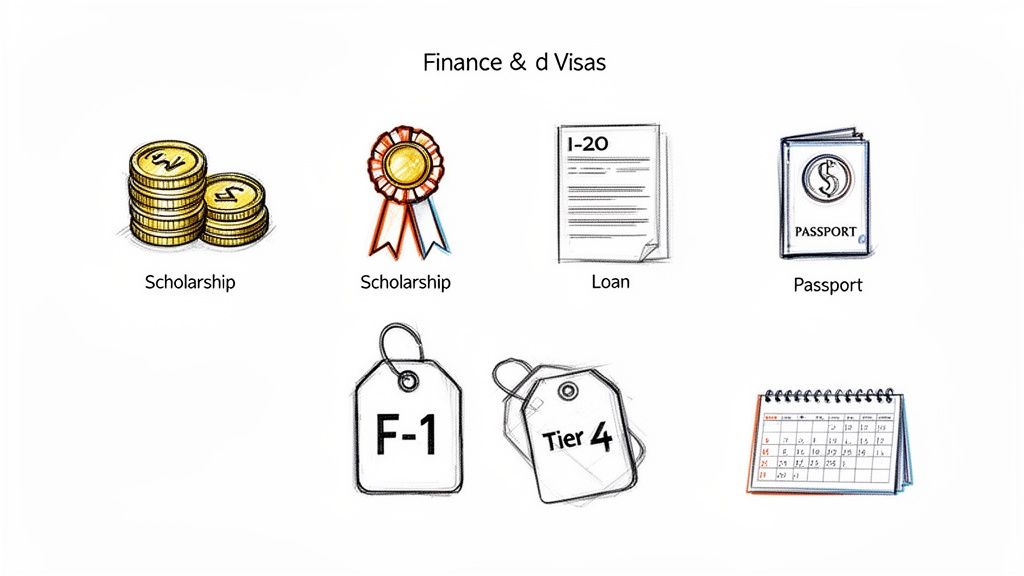
If you're heading to the United States, you'll need an F-1 student visa. Your journey starts when the medical school sends you a document called the Form I-20. Think of this as your official ticket to apply. With the I-20 in hand, you'll pay the SEVIS I-901 fee and then book your visa interview at the closest U.S. embassy or consulate.
The visa interview is the final boss. Your main objective is to prove "non-immigrant intent." In plain English, you must convince the consular officer that you plan to return to your home country after you finish your medical training. Be ready to talk about your ties to home—family, property, job opportunities—anything that shows you have strong reasons to go back.
Common Questions from International Med School Applicants
Trying to navigate the medical school application process as an international student can feel like a maze. Let’s clear up some of the most common questions and sticking points you'll run into along the way.
Which Caribbean Medical Schools Offer the Best Shot at a US Residency?
While there are dozens of medical schools in the Caribbean, a handful consistently stand out for placing graduates into U.S. residency programs. These are often called the "Big Four": St. George's University (SGU), Ross University, American University of the Caribbean (AUC), and Saba University.
What gives them an edge? A key factor is their approval status in critical states like New York and California, which opens up more opportunities for clinical rotations and, ultimately, residency. When you're comparing schools, cut through the marketing fluff and focus on two hard metrics: high first-time USMLE Step 1 pass rates and transparent, verifiable residency match lists from the last few years.
These numbers are the truest reflection of a school's quality. They tell you whether a program genuinely prepares its students to succeed in the U.S. medical system.
Do I Need a Master's Degree to Improve My Chances?
Not necessarily, but it can be a strategic move. A Master's or post-baccalaureate program is most helpful if your undergraduate GPA is sitting below the average for the schools you’re targeting.
If you go this route, a Special Master's Program (SMP) with a direct link to a medical school is often your best bet. It’s the most direct way to prove you can handle a demanding, graduate-level science curriculum—exactly what admissions committees want to see.
But if your GPA is already strong, don't just get a Master's for the sake of it. Your time and money would be far better spent racking up more U.S.-based clinical experience, research hours, and volunteering. Those hands-on experiences are gold on an application.
How Important Is Research for an International Applicant?
Research experience is a huge plus, especially if you're aiming for top-tier, research-heavy medical schools in the U.S. and Canada. It shows you’re curious, you can think critically, and you're invested in advancing medicine beyond just seeing patients.
It's not a deal-breaker for every single school, but having research under your belt—particularly if it led to publications or presentations—can absolutely make your application stand out from the pile. It signals that you're ready to contribute to the school's academic community.
If research opportunities are scarce in your home country, you’ll have to get creative. Look for summer research programs or post-bacc positions in the U.S. or Canada. A little proactive effort here can really pay off.
Your medical school interview is the final gatekeeper to your acceptance. At Confetto, our AI-powered platform lets you practice realistic MMI and panel interviews from anywhere, providing instant, detailed feedback to sharpen your skills. We help you learn how to frame your unique international background as your greatest strength. Start preparing for your interview with Confetto today.