
Updated · Published
Verbal Communication Skills for Your Med School Interview
Improve verbal communication for med school interviews: clarity, pacing and tone, nonverbal cues, answer frameworks by question type, and a practice routine.

Work on three things: clarity (plain words), pacing (about 150 words per minute, slower on your key point) and tone (warm and professional). Then record yourself, find your habits, like filler words or rushing, and practice under realistic pressure.
Improving your verbal communication skills isn't about having a natural gift for gab—it's about targeted, intentional practice. For anyone applying to healthcare programs, this means showing you have the empathy, clarity, and composure that signal you’re ready to be a future physician. How you speak is just as critical as what you say.
Why Your Verbal Skills Are the Deciding Factor
In the hyper-competitive world of healthcare admissions, your grades and experiences might get you an interview, but it’s your verbal communication that often decides if you get an offer. Admissions committees at top programs like UCSF or Mayo Clinic aren't just listening to your answers; they're analyzing how you deliver them. They’re searching for direct evidence of skills that are absolutely essential for clinical success.
This focus isn't random. Employer surveys consistently rank communication among the most sought-after skills, often alongside or above technical know-how. While that stat covers a lot of industries, its truth for aspiring physicians is undeniable, especially when you’re asked to talk through a complex ethical problem or a tough clinical scenario under a ticking clock. You can find more on why employers value these skills so highly in these 7 proven ways to improve communication at work.
More Than Just Answering Questions
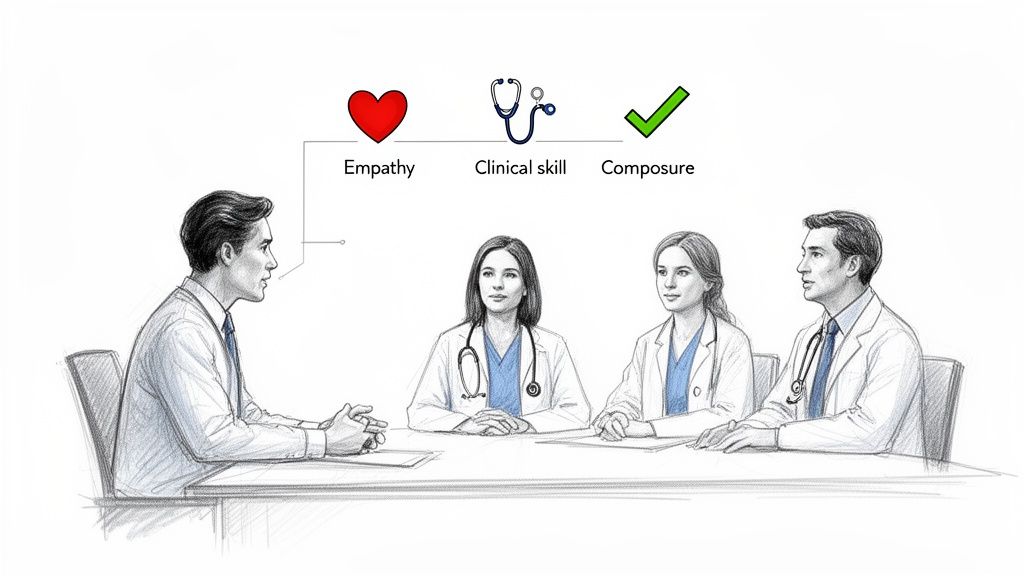
Admissions committees draw a straight line from how well you articulate your thoughts to how well you’ll perform as a healthcare professional. Put yourself in their shoes for a second. They’re asking:
- Can they build rapport? A warm, empathetic tone can signal your ability to connect with future patients on a human level.
- How do they handle pressure? Keeping a steady pace and calm demeanor, especially when a question throws you, is a powerful sign of composure.
- Do they think clearly? Structuring an answer logically shows you can process information and communicate it effectively in a high-stakes, fast-moving environment.
The goal isn't just to sound smart. It's to embody the trusted, articulate, and empathetic professional you want to become. Your delivery is the main tool you have to prove it.
This is exactly where targeted practice tools come in.
This screenshot from a platform like Confetto AI shows how you can get specific feedback on your communication metrics. It helps turn vague ideas like "clarity" and "tone" into real, measurable data points you can actually work on. This isn't about memorizing scripts—it’s about building the muscle memory for confident, clear, and compelling communication.
Breaking Down Powerful Verbal Delivery
"Be a good speaker" is probably the most useless advice an applicant can get. Let's move beyond that. Powerful delivery isn't some innate talent you either have or you don't—it's a set of distinct, trainable skills. When an interviewer is listening to you, they're subconsciously breaking down your delivery into three core pillars: clarity, pacing, and tone.
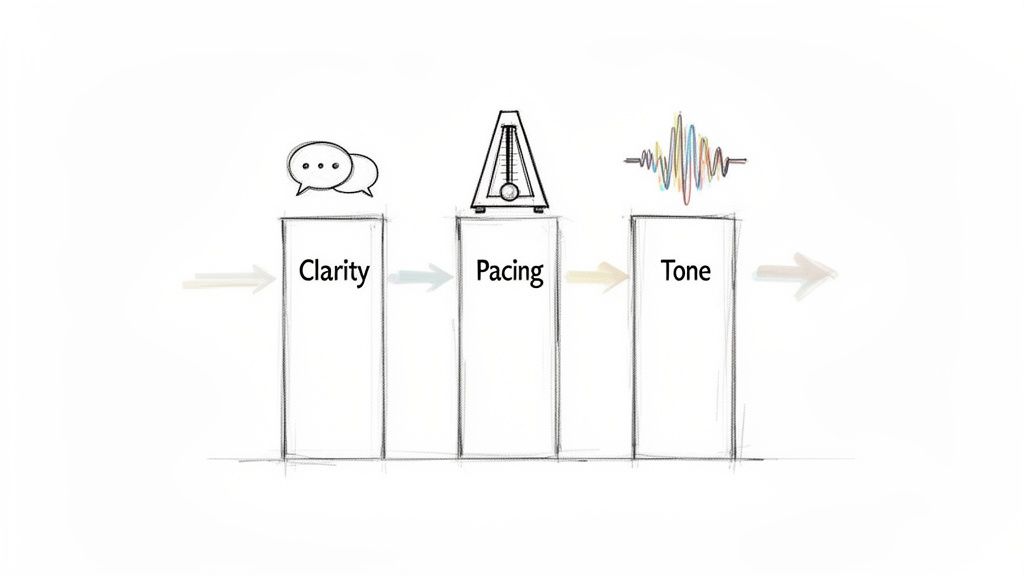
These elements work together to create an impression of confidence, thoughtfulness, and empathy. When you get them right, you control how your message lands, which is absolutely critical when you're discussing sensitive topics in a healthcare interview.
The Pillar of Clarity
Clarity is all about making your message easy to follow. It means consciously choosing simple, direct language over complex jargon. So many applicants make the mistake of trying to sound overly academic, thinking it makes them seem smarter. It usually backfires, making them sound disconnected or just plain hard to understand.
Think about explaining a complex research project you were involved in. Instead of launching into the technical methodology, start with the "why." You could say something like, "Our goal was to figure out why some patients just don't stick to their medication schedules," before you detail the process. Framing it this way makes the information instantly accessible.
The Pillar of Pacing
Pacing is the rhythm of your speech. We've all seen it: someone gets nervous and starts talking a mile a minute. It's a classic sign of anxiety, and it makes it nearly impossible for interviewers to absorb what you're saying. On the flip side, speaking too slowly can come across as low-energy or uncertain.
The real skill is learning to vary your pace intentionally.
- Slow down when you get to the most important part of your answer. This gives it weight.
- Use strategic pauses. A one-second pause right before or after a critical piece of information creates real emphasis. Imagine stating a personal failure, pausing for just a beat, and then explaining what you learned. That silence signals reflection and sincerity.
- Keep a steady, conversational speed for the rest of your response. It just sounds more natural and confident.
Your speaking pace has a direct line to how listeners perceive your confidence and control. A normal conversational speaking rate is around 150 words per minute. It's worth practicing with a timer—you might be surprised how much nerves can make you rush.
The Pillar of Tone
Tone is where you inject your personality and emotion. It’s what separates a robotic, rehearsed answer from a genuine, human one. In any healthcare interview, your tone needs to broadcast empathy, professionalism, and warmth, all at once.
Let's say you're asked about a time you handled a difficult team member. If your tone is flat and monotonous, it might sound like you were just annoyed by the whole thing. But a thoughtful, measured tone can show you approached the situation with maturity, looking for a solution instead of just complaining.
Modulating your tone lets you express genuine compassion when discussing a patient scenario or real enthusiasm when you're talking about why you want to go into medicine. This is something you can absolutely get better at. Tools like Confetto’s AI feedback actually analyze your tone, giving you objective data on how you're coming across so you can make small adjustments for a much bigger impact.
Speaking Without Saying a Word
In any interview, there’s a powerful, unspoken dialogue happening alongside your answers. Your body language—the subtle shifts in your posture, the way you meet someone’s eyes, your expressions—often says more about your confidence and empathy than your words ever could. It's the nonverbal layer that can either supercharge your message or silently sink it.
Walk into an interview knowing that how you say something (your tone, expressions, and posture) shapes how your words land. (You may have heard that 93% of communication is nonverbal; that figure is a widely repeated misreading of Albert Mehrabian’s research on feelings and attitudes, and it does not apply to communication in general.) Still, nonverbal cues matter, especially in visual formats like panel interviews or virtual MMIs, where eye contact and expression are central to building connection.
For a healthcare applicant, this is critical. Your posture can directly signal how much empathy an interviewer perceives.
Projecting Confidence Through Posture and Gestures
Your posture is the foundation of your nonverbal presence. Slouching in a chair during a long panel interview can broadcast fatigue or disinterest, even if you’re hanging on every word. The goal is to hold an active, open posture that communicates both alertness and respect.
- Sit Upright but Relaxed: Aim for a straight spine without looking stiff. Leaning forward just a bit shows you’re actively listening and invested in the conversation.
- Use Natural Hand Gestures: Your hands can add real weight and conviction to your points. Don’t lock them in your lap or let them fidget. Instead, let them punctuate your sentences naturally, just as you would in an engaging, everyday conversation.
This isn't about putting on a performance; it’s about making sure your physical presence aligns with your verbal message. For a deeper dive, check out our guide on essential interview body language tips.
Connecting Through the Screen in Virtual Interviews
Making a genuine connection in a virtual MMI feels different, but it’s just as crucial. Your screen is a window, and your nonverbal cues have to be more intentional to bridge that digital gap.
The trick is to look directly into your webcam when you speak, not at the interviewer’s face on your screen. It’s a small shift, but it creates the feeling of direct eye contact and real engagement.
A warm, genuine smile can instantly build rapport, even through a screen. It’s a universal signal of friendliness and approachability that helps an interviewer feel more connected to you as a person, not just as a candidate.
Ultimately, practicing these nonverbal elements—and getting real feedback on them—is what separates a good candidate from a great one. It helps you project the calm, professional confidence that admissions committees are always looking for.
How to Structure Answers That Stick
A brilliant insight is useless if it gets lost in a rambling, disorganized answer. In a high-stakes healthcare interview, clarity and structure aren't just nice-to-haves; they prove you can think logically under pressure. A well-structured response shows the interviewer that you can process a complex prompt, organize your thoughts, and deliver a coherent, persuasive argument on the spot.
This means moving beyond familiar frameworks like the STAR method. While it’s great for behavioral questions, it often falls short for the ethical dilemmas or policy questions common in MMIs. You need a more versatile toolkit.
Matching the Framework to the Question
The key is to quickly identify the type of question you're being asked and apply the right structure. A personal story requires a completely different approach than a question about healthcare policy.
Consider a common prompt you might find in a practice library: "What is your opinion on mandatory vaccinations?" A simple story-based answer won't cut it. This question demands a balanced, multi-faceted argument.
A powerful technique for policy or ethical questions is the "Stakeholder & Principles" framework.
- Acknowledge Complexity: First, state that the issue is complex with valid points on multiple sides. This immediately shows thoughtfulness.
- Identify Stakeholders: Briefly list the key groups involved—think individual patients, public health systems, healthcare providers, and the community at large.
- Discuss Core Principles: Touch upon the competing ethical principles, like individual autonomy versus the collective good or public safety.
- State and Justify Your Position: Clearly state your nuanced opinion, grounding it in the principles you've just discussed.
- Conclude with a Forward-Looking Statement: End with a summary or a thought about how to balance these competing interests going forward.
Using a framework isn’t about sounding robotic. It’s about creating a clear, logical container for your authentic thoughts, ensuring your core message is heard and understood without getting sidetracked.
This structured approach prevents you from simply stating a strong opinion without backing it up. It ensures your answer is thoughtful, comprehensive, and directly addresses the prompt. To see how this and other frameworks apply to a wide range of prompts, explore these examples of common healthcare interview questions and answers.
The infographic below shows how different nonverbal cues like posture, eye contact, and gestures can be interpreted, reinforcing the spoken structure of your answer.
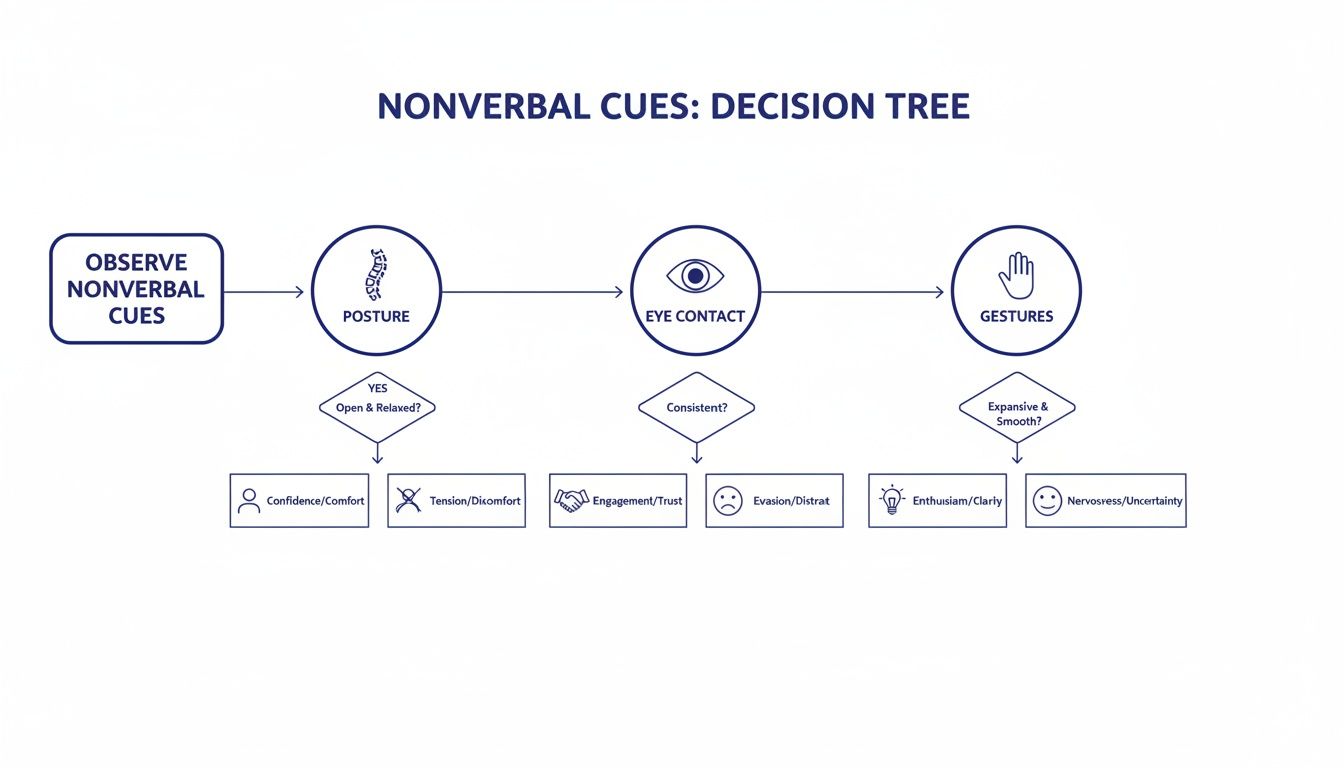
This visual guide is a great reminder that while frameworks provide the skeleton for your answer, it's your nonverbal delivery that gives it life and credibility.
A Quick Guide to Response Structures
Building a mental library of response frameworks is a game-changer. It gives you a reliable plan for nearly any question that comes your way, helping you stay calm and focused when the pressure is on.
Here’s a quick-reference guide to help you match common question types with the most effective response frameworks.
Matching Answer Frameworks to Interview Question Types
This table is designed to be a quick-reference guide. Use it to select the most effective structure for your answers based on the type of question you're asked in a healthcare interview.
| Question Type | Recommended Framework | Key Objective |
|---|---|---|
| Personal Experience | STAR Method (Situation, Task, Action, Result) | To tell a concise, compelling story that demonstrates a specific skill or quality. |
| Ethical Dilemma | Stakeholder & Principles Model | To show balanced, principled reasoning and an ability to analyze complex moral issues. |
| Policy/Current Events | Pro/Con/Synthesis Framework | To present a well-rounded view, acknowledge counterarguments, and form a thoughtful conclusion. |
| "Why Medicine?" | Past-Present-Future Narrative | To connect your past motivations and present experiences to your future goals as a physician. |
Think of these frameworks as mental blueprints. The more you practice with them, the more naturally you'll be able to build a strong, memorable answer on the fly.
Building Your Personal Practice Routine
Knowing how to structure an answer is one thing. Doing it consistently when the pressure is on is another beast entirely. Great verbal communication is a muscle—it gets stronger with deliberate, structured practice, not just random reps.
This is where you build the muscle memory that kicks in when your nerves are firing. The goal is to move from consciously thinking about the steps to instinctively executing them. A good routine is what turns theory into a reliable skill.
Starting With a Baseline
Before you can get better, you have to get honest about where you are right now. The first move? Record yourself answering a few common interview questions. No timer, no pressure. Just talk through your response naturally.
This recording is your diagnostic tool. Watch it back and look for your unfiltered habits.
- Are you leaning on filler words like "um," "so," or "like"?
- Is your pace rushed, or are you dragging?
- Does your tone sound engaged and confident, or does it fall flat?
- Is your answer structured with a clear beginning, middle, and end, or does it wander?
This isn’t about judging yourself—it's about gathering data. Pinpointing these baseline habits gives you specific, concrete targets to work on. Without this step, you’re just practicing in the dark.
Simulating Real-World Pressure
Once you have your baseline, it’s time to add a little heat. An interview isn’t a relaxed chat, so your practice shouldn't be either. Using a tool like Confetto’s timed MMI and panel simulators is crucial because it forces you to think on your feet, mimicking the exact conditions you’ll face on interview day.
Fire up a practice session and let the AI interviewer run you through timed prompts. The clock changes everything. It exposes the weak spots that don’t show up when you have all the time in the world. This is how you train yourself to stay clear and composed when it actually counts.
Deliberate practice isn't about repeating what you already do well. It's about intentionally targeting your weakest areas under realistic conditions until they become strengths. This is the fastest path to measurable progress.
After each simulation, dig into the feedback. Look at the AI-generated scores for communication, analyze the pacing metrics, and scan the transcript for filler words. This data-driven review helps you see exactly what needs work.
Maybe you notice your pace jumps by 30 words per minute when you get a tough ethics question. That’s a specific, actionable insight. Now you know what to focus on in your next session.
For more daily techniques to build into your routine, there are some great practical exercises to improve speaking skills. And for a deeper dive into specific interview formats, our guide on preparing for a medical school mock interview offers more focused strategies.
Got Questions About Interview Communication? We Have Answers.
Even with the best prep plan, nagging questions always seem to surface as interview day gets closer. It’s totally normal. Most of the time, these anxieties circle back to the same core concerns: Am I practicing enough? How do I keep my nerves from derailing me? How can I sound confident without coming off as arrogant?
Let’s tackle these head-on. The goal here isn't to give you canned answers, but to provide a framework for thinking through these challenges so you can walk in feeling prepared and authentic.
How Much Practice Is Really Enough?
There's no magic number. I’ve seen applicants burn themselves out on 50 generic practice questions and still feel unprepared, while others master 10 to 15 diverse prompts and walk in with total confidence. The difference? Quality over quantity.
Your goal isn’t to memorize answers; it’s to internalize the frameworks so they become second nature. You’ve practiced enough when you can get a question you've never seen before and, without panicking, immediately think, "Okay, I know how to structure this."
The real benchmark for readiness isn't hours logged. It's your ability to consistently apply the core principles—a clear structure, steady pacing, and an empathetic tone—even when you’re thrown a curveball. When the process feels instinctive, you’re ready.
What’s the Best Way to Handle Nerves?
First, know that nerves are a good thing. They mean you care. The trick isn't to eliminate them but to channel that energy.
One of the most powerful things you can do is a simple mental reframe. The physical feelings of anxiety—the racing heart, the butterflies in your stomach—are nearly identical to the feelings of excitement. Instead of telling yourself, "I'm so nervous," try this: "I'm excited to share my story and show them who I am." It’s a small shift, but it can turn that jittery energy into focused enthusiasm.
Right before you start, try this simple grounding technique. It takes less than 10 seconds.
- Plant both feet firmly on the floor. Feel the ground beneath you.
- Take one slow, deep breath—in for four counts, out for six.
- Briefly clench your hands into fists, then let them go completely limp.
This little sequence can reset your nervous system just enough to help you start your first answer with calm and composure. Honestly, mastering your internal state is just as important as mastering your words.
How Can I Stand Out Without Sounding Arrogant?
This is a big one. The key is to shift your focus from the result to the process and the people. True confidence comes from showcasing your impact through the lens of collaboration and learning, not just rattling off accomplishments.
Instead of saying, "I led a project that increased efficiency by 50%," try framing it this way:
"I was fortunate to lead a team where we were trying to solve a workflow problem. After listening to everyone's input and testing a few different approaches together, we landed on a process that ultimately boosted our efficiency by 50%."
See the difference? The first sounds like you're building a statue of yourself. The second demonstrates humility, teamwork, and leadership—all at once. It changes the narrative from "I am great" to "I help teams achieve great things." That’s the kind of person they want as a future colleague.
Ready to turn practice into confidence? Confetto provides the AI-powered mock interviews and instant, detailed feedback you need to master your verbal delivery. Start your free trial and get actionable insights on your pacing, tone, and answer structure today at https://confetto.ai.