
Crafting Your Medical School Personal Statement A Narrative Guide
Transform your experiences into a powerful medical school personal statement. This guide offers actionable advice on storytelling, structure, and standing out.
Your medical school personal statement is your single best chance to show admissions committees who you are beyond the numbers. It’s a 5,300-character story that has to answer one core question: "Why do you want to be a doctor?" When done right, this essay transforms your application from a flat list of achievements into a story someone can actually remember.
Why Your Story Is Your Strongest Asset in Admissions
In the hyper-competitive world of medical school admissions, great scores are just the price of admission. They get you in the door, but they don’t get you a seat.
Since the broad shift toward holistic review in medical admissions, your personal narrative has become the make-or-break factor. Admissions committees aren't just looking for academic machines; they’re searching for future physicians who bring empathy, resilience, and a real feel for the human side of medicine. Your personal statement is the main way they find those people.
This is where your story becomes your most powerful tool. It’s the connective tissue—the “why” behind all the “whats” on your resume. It proves you’ve done the hard work of reflecting on your journey and truly grasp the massive commitment you're about to make.
The Power of Narrative in a Data-Driven Field
Your GPA and MCAT scores are vital, of course, but they don’t say a thing about your character. A good story bridges that gap, making your application connect on a human level. Think of it this way: your transcript shows what you did, but your personal statement explains why anyone should care.
- It makes you a person. A story moves you from being Applicant #1138 to a real, memorable individual with a unique drive.
- It demonstrates core competencies. Stories are the only way to show qualities like compassion and perseverance, instead of just saying you have them.
- It reveals your "why." A strong narrative ties together the specific experiences that cemented your decision to pursue medicine.
The numbers don't lie. While roughly four in ten applicants matriculate to medical school in a typical recent cycle, getting into highly selective schools, where only a small fraction of applicants are accepted, requires a story that stands out. For aspiring doctors, mastering this essay is a non-negotiable step. Our medical school admissions programs can help you tackle this and every other hurdle in the process.
For a deeper dive into crafting a life story that resonates, these Autobiography Writing Tips are a great resource, especially the advice on starting with heart.
Your personal statement does something no other part of your application can. It contextualizes every other component, weaving your experiences, scores, and activities into a coherent and compelling whole. It’s the narrative thread that ties everything together.
How the Personal Statement Enhances Your Application
| Application Component | What It Demonstrates | The Personal Statement's Contribution |
|---|---|---|
| GPA & Transcript | Academic ability, consistency, and foundational knowledge. | Explains the why behind your academic path—a challenging semester, a passion for a specific science, or intellectual growth. |
| MCAT Score | Standardized scientific reasoning and critical thinking skills. | Provides the human context; it shows the motivation that drives you to master complex material for a purpose. |
| Activities Section | Breadth and depth of experiences (clinical, research, volunteering). | Connects the dots between activities, showing reflection and revealing how these experiences shaped your desire for medicine. |
| Letters of Recommendation | External validation of your skills, character, and potential. | Offers your internal perspective, giving voice to the personal growth and insights your recommenders observed. |
Ultimately, the personal statement is what makes your application three-dimensional. It’s the element that allows an admissions officer to advocate for you, arguing not just that you’re qualified, but that you belong.
Finding Your Narrative Before You Start Writing
The most powerful personal statements aren’t built on a chronological list of accomplishments; they’re built on a foundation of deep self-reflection. Before you even think about writing an opening sentence, the most important work happens away from the keyboard. It’s all about unearthing the core themes of your journey and finding the authentic "why" behind your ambition.
A lot of applicants make the mistake of pulling up their resume and trying to force-fit their experiences into a story. That approach almost always leads to a disjointed essay that reads more like a summary than a compelling narrative. The goal isn't to recount everything you've done. It's to select a few pivotal moments and explain why they matter.
Create Your Story Inventory
Think of yourself as a journalist investigating your own life. Your first task is to create a "story inventory" by mining every significant experience—clinical, research, volunteer, work, and personal—for moments of genuine growth and insight. You have to go beyond the surface level.
Instead of just jotting down "Scribed in the ER for 100 hours," ask yourself deeper questions:
- What specific patient interaction challenged my assumptions about medicine?
- Was there a moment of chaos, or maybe unexpected quiet, that taught me something about teamwork or empathy?
- How did I handle a tough conversation with a patient's family, and what did I learn from it?
This process applies to everything. That part-time job as a barista wasn't just about making coffee; it was a daily lesson in multitasking under pressure and connecting with strangers. That research project that failed wasn't a waste of time; it was a masterclass in resilience and methodical problem-solving.
Your personal statement needs to answer the question, "Why do you want to be a doctor?" It’s not about listing the skills you think will make you a good physician. It’s about your motivations, passions, and journey.
This visualization shows how your story acts as the essential bridge, transforming your academic stats into a compelling case for your future as a physician.
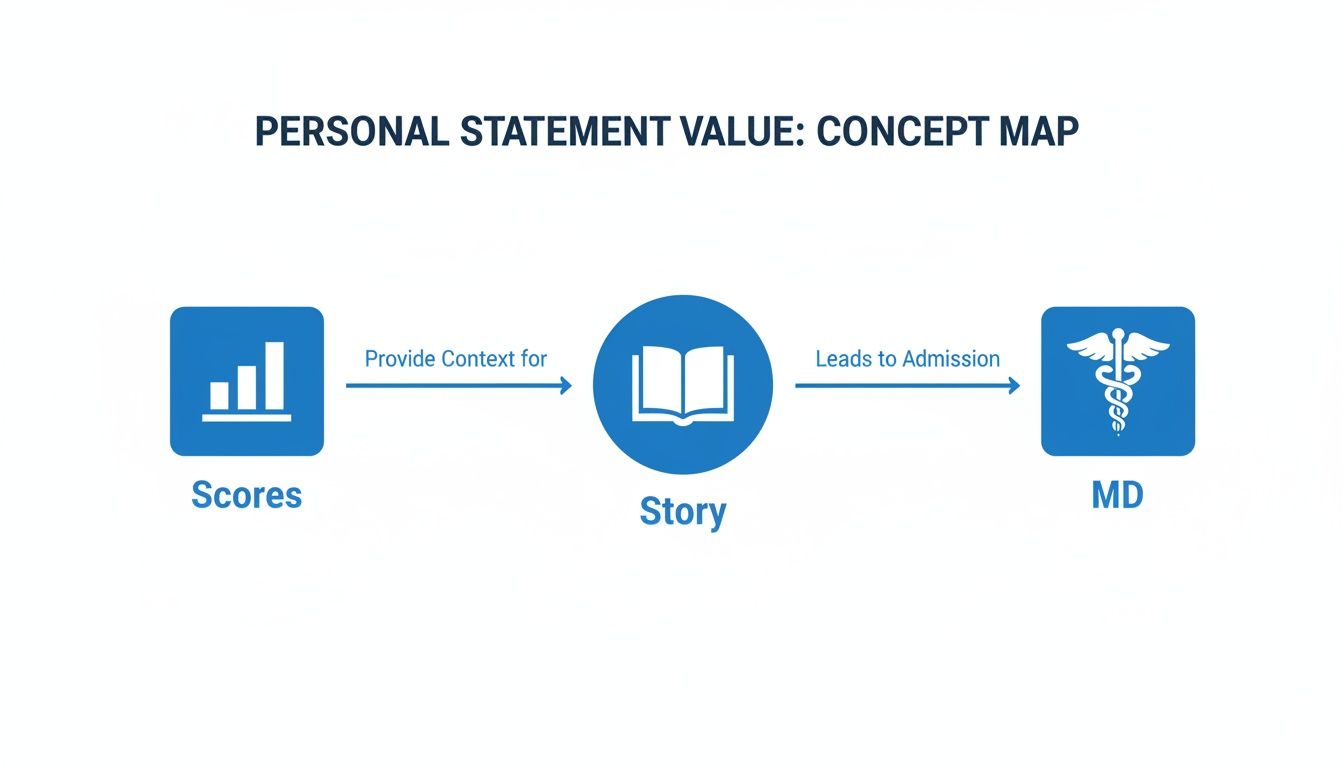
This simple flow drives home the point: while scores are the foundation, it's your unique narrative that truly paves the way to earning your M.D.
Connect Your Experiences to Core Competencies
Once you have your inventory, the next step is finding the "golden thread" that ties these seemingly separate events together. A mind map is a great way to do this. Start with a central idea—"My Journey to Medicine"—and then branch out with your key experiences.
For each experience, create smaller branches that connect to the AAMC's Core Competencies. Did your time in a lab demonstrate your capacity for inquiry and teamwork? Did leading a volunteer project show your leadership and social skills?
This technique helps you move from "what I did" to "what this says about me." For instance, a challenging experience from a previous career, even one outside of healthcare, can powerfully demonstrate resilience and maturity. The key isn't to hide from non-linear paths but to frame them as crucial parts of your development.
It's also essential to research your course and university selection before you start writing. Understanding a school's mission can help you figure out which of your core themes will resonate most with their values.
Identify Your Central Theme
As you map your experiences and competencies, a central theme should start to emerge. This theme is the heart of your medical school personal statement. It's the single, unifying idea that answers the "why medicine" question in a way that only you can.
Possible themes could be:
- A commitment to addressing health disparities, sparked by volunteering in an underserved clinic.
- A fascination with the intersection of technology and patient care, born from a research project.
- A deep-seated belief in patient advocacy, stemming from a personal family experience.
This theme becomes your narrative's anchor. Every story you choose to tell, from your introduction to your conclusion, should reinforce this central idea. It provides focus and ensures your essay is more than just a collection of anecdotes—it becomes a powerful, cohesive argument for your place in medical school. Doing this foundational work makes the actual writing process dramatically more focused and effective.
Structuring Your Personal Statement for Impact
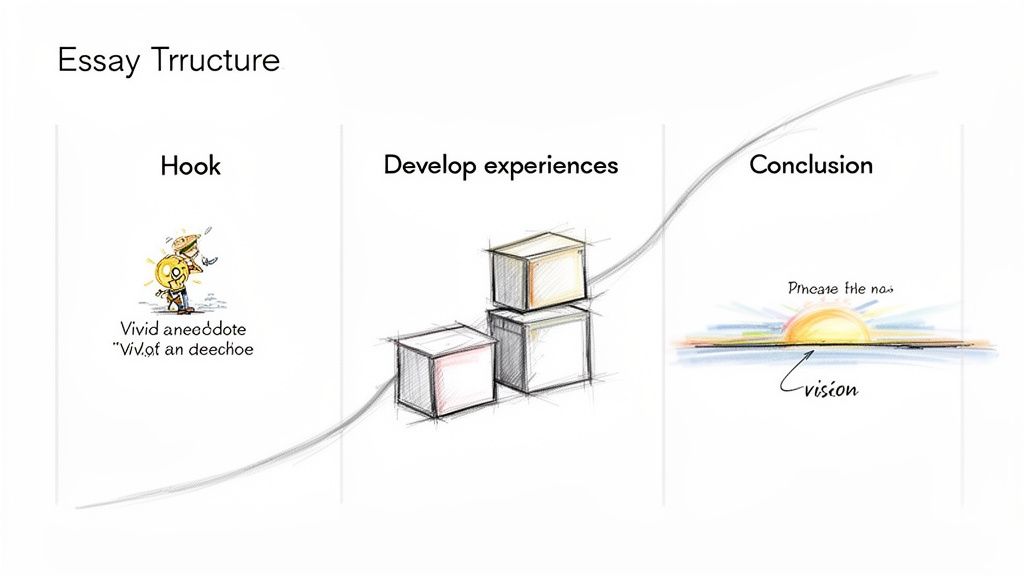
A powerful story needs a solid framework. If you just list your experiences chronologically, you’re missing a huge opportunity to build a memorable narrative. Think like a storyteller. You need to design an architecture that guides the admissions committee through your journey, making them feel the weight and significance of each step you took toward medicine.
A well-structured medical school personal statement doesn’t just recount events; it interprets them. It weaves everything into a cohesive argument for why you belong in this field. This structure is your roadmap, ensuring every paragraph serves a purpose, builds momentum, and leaves a lasting impression.
Crafting an Immersive Opening Hook
Your first paragraph is your handshake. It needs to be firm, confident, and interesting enough to make the reader want to know you better. The goal is to immediately pull them into your world by painting a scene or posing a question that sets the stage for everything that follows.
So many applicants make the mistake of starting with a generic, philosophical statement like, “I have always been fascinated by the human body.” This tells the reader nothing unique about you. Instead, drop them right into the middle of the action—in media res.
Try one of these two approaches:
- The Vivid Anecdote: Plunge the reader directly into a specific, sensory-rich moment. Describe the sterile smell of a clinic, the focused intensity of a surgeon's hands, or the weight of a difficult conversation with a patient’s family. This approach immediately shows your direct engagement with medicine.
- The Thought-Provoking Reflection: Start with a personal insight or a challenging question that came from one of your experiences. This can be a great way to introduce your central theme and prove you’re capable of deep, critical thought about the field.
A hook isn't about drama for its own sake; it's about relevance. A sensational ER story that doesn't connect to your larger theme will feel forced. The best hooks serve as the foundational scene upon which the entire essay is built, introducing the core tension or idea you plan to explore.
Whichever you choose, keep your opening concise and focused on a single moment or idea. Think of it as the trailer for your story, designed to make the reader eager to see the full film.
Developing Your Narrative in the Body Paragraphs
The body of your essay is where you make good on the promise of your intro. This is not the place for a laundry list of activities. Pick two, or at most three, pivotal experiences that best illustrate your central theme and show your growth. Each experience should get its own paragraph or two, giving you space to go for depth over breadth.
Think of each body paragraph as a mini-story with its own arc. For each experience you highlight, use this simple but effective structure:
- The Situation: Briefly set the scene. Where were you? What was the context?
- The Action: Describe what you did, thought, or observed. This is where you show your qualities in action.
- The Reflection: This is the most critical part. Explain what you learned. How did it change your perspective, solidify your commitment, or challenge your assumptions about medicine?
For example, if you're writing about a research project, don't just detail the methodology. Talk about the frustration of a failed experiment and what that taught you about persistence. If you’re discussing a clinical role, focus on a single patient interaction that reveals your empathy, rather than just summarizing your daily duties. This turns a simple activity into a meaningful learning experience.
Forging a Cohesive Narrative Arc
Your body paragraphs shouldn't feel like standalone islands. They need to connect logically, building on your central theme to create a compelling narrative arc. This arc is what demonstrates your progression and maturity over time.
For instance, your first body paragraph might describe an early shadowing experience that sparked your initial interest in patient care. The next could detail a more hands-on clinical volunteering role where you applied that interest and learned about the systemic barriers patients face. A final body paragraph might then discuss a research project you joined that was aimed at addressing one of those very barriers.
See the progression? It moves from observation to action to problem-solving. Each step builds on the last, creating a powerful story of your evolving commitment to medicine.
Writing a Powerful and Forward-Looking Conclusion
Your conclusion is your final chance to leave a lasting impression. It needs to provide a sense of closure while powerfully articulating your vision for the future. A great conclusion ties everything together without just repeating what you’ve already said.
Your final paragraph should hit three key goals:
- Synthesize Your Theme: Briefly bring your central message home, connecting the dots between the experiences you've shared.
- State Your Mission: Articulate what kind of physician you want to be. What specific impact do you hope to make? This shows you have a clear vision.
- Look to the Future: End with a forward-looking statement that expresses your readiness and genuine excitement for the challenges of medical school and beyond.
One powerful technique is to "close the loop" by subtly referencing the anecdote or idea you introduced in your hook. This creates a satisfying sense of symmetry and makes your essay feel complete and polished. Your conclusion isn't just an ending; it’s a launchpad, projecting your story from your past experiences into your future as a physician. It's the final, definitive statement that answers the "why you" question with confidence.
Bringing Your Experiences to Life with Vivid Storytelling
Every applicant gets the same advice: "show, don't tell." But what does that actually mean when you're staring at a blank page?
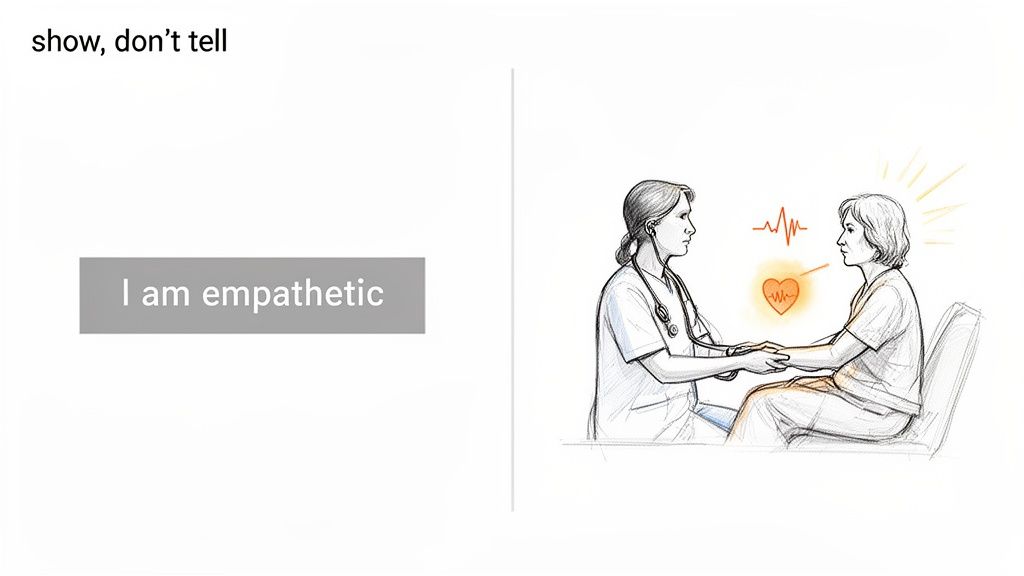
It’s the difference between a flat, forgettable claim and a scene that pulls an admissions officer into your world, letting them feel your qualities firsthand. Stating "I am empathetic" is an empty claim. Illustrating that empathy with a rich, detailed story proves it beyond a shadow of a doubt.
This is how you turn a list of activities into a compelling narrative. It’s what makes your insights feel earned and authentic. In a sea of qualified applicants—especially after the ‘Fauci Effect’ drove a roughly 18% application spike during the pandemic—a genuine, well-told story is your most critical tool. If you're curious, you can discover more insights about this trend and its impact.
From Telling to Showing: A Practical Transformation
The trick is to focus on actions, sensory details, and your internal thoughts instead of just slapping labels on your experiences. Let's look at a "before-and-after" to see this in action.
Before (Telling): "During my time volunteering in the pediatric wing, I developed strong empathetic skills by working with scared children. I learned how to comfort them and their families during difficult times, which confirmed my desire to pursue medicine."
This tells the reader what happened, but it has no pulse. It summarizes the experience without making anyone feel anything.
Now, let's inject some life into it.
After (Showing): "The air in the pediatric wing hummed with the steady beep of monitors. I met seven-year-old Maya, whose small hand trembled in mine as she faced her first IV insertion. Instead of offering empty reassurances, I asked about her favorite superhero. ‘Wonder Woman,’ she whispered. We spent the next ten minutes discussing Wonder Woman’s invisible jet, and as the nurse prepped her arm, Maya was so engrossed she barely flinched. Her mom later squeezed my shoulder, her eyes filled with a relief that said more than words ever could. It was then I understood that medicine isn’t just about procedures; it’s about creating moments of safety in the midst of fear."
See the difference? This version works because it:
- Uses Sensory Details: "hummed with the steady beep of monitors," "small hand trembled."
- Includes Action and Dialogue: The conversation about Wonder Woman is a specific action that shows empathy in practice.
- Reveals Internal Reflection: The takeaway—"...medicine isn’t just about procedures; it’s about creating moments of safety"—shows genuine insight.
Narrating Challenges as Catalysts for Growth
Your personal statement shouldn't be a highlight reel of flawless victories. Admissions committees are looking for maturity and resilience, qualities best demonstrated by how you handle tough situations. A story about a difficult patient, a failed experiment, or a moment of self-doubt can be incredibly powerful if you frame it right.
The key is to show how the experience sparked growth. Don't dwell on the negative; focus on what the setback taught you and how it deepened your commitment to medicine.
Don't shy away from vulnerability. A story about a moment of uncertainty or failure, followed by a thoughtful reflection on what you learned, is far more compelling than a story of effortless success. It shows self-awareness and a genuine capacity for growth—two essential traits for a future physician.
Weaving Storytelling Elements Together
To make your scenes truly immersive, you need to consciously blend different narrative elements. The best stories mix descriptive details, action, dialogue, and your own internal monologue.
Think of it like building a scene with a toolkit:
- Description: What did the room smell like? What sounds were in the background? Paint a picture.
- Dialogue: A single line of dialogue can reveal character or advance the story. A patient's question or a colleague's comment adds instant realism.
- Internal Monologue: Share your thoughts or questions as they happened. This gives the reader a window into your decision-making process and emotional journey.
By mastering these techniques, you transform your experiences from line items on a resume into powerful, evidence-backed narratives. Each story becomes proof that not only supports your claims but makes your journey unforgettable.
Handling Bumps in the Road and Unique Paths
Almost nobody’s path to medicine is a perfect, straight line. Life happens. Maybe you have a C+ in organic chemistry from a brutal sophomore semester, a gap year you didn't plan, or a whole other career you’re leaving behind. Admissions committees have seen it all, and they understand.
The trick isn’t to hide these things or hope they won’t notice. It’s to own your story with confidence and maturity. Frame these moments not as failures, but as inflection points that taught you something valuable.
Blaming a tough professor or a vague "personal issue" for a bad grade just sounds like an excuse. Instead, turn it into a story of growth. That difficult semester might have forced you to finally learn how to manage your time effectively. Maybe withdrawing from a class was the wake-up-call you needed to start using office hours and academic support services.
When you show that kind of self-awareness and resilience, a potential red flag becomes proof of your character—something every adcom is looking for.
If you're a non-traditional applicant, you don't need to spend paragraphs justifying why you left your old job in finance or teaching. The focus should always be on what is pulling you toward medicine. Acknowledge your past briefly, then pivot quickly to the experiences that solidified your decision to become a physician.
Addressing Setbacks with Confidence
When you do need to explain a challenge, a simple and direct approach works best. Think of it like this:
- Acknowledge It: Start by briefly and plainly stating the issue. Something like, "My grades during sophomore year don't reflect what I'm truly capable of academically."
- Analyze It: Explain what happened, but more importantly, what you learned. Did you overcommit to extracurriculars? Were your study habits ineffective? What did that experience teach you about yourself?
- Act on It: Show them what you did about it. This is the most important part. Did you change your study routine, seek out a tutor, or scale back on other commitments? This shows you’re a proactive problem-solver.
This structure proves you’re reflective and can bounce back from adversity—two of the most critical qualities for any future doctor. For more advice on contextualizing your academic record, check out our deep dive on the ideal GPA for medical school.
Weaving Your Story into a School’s Mission
Your main AMCAS essay goes to every single school, but that doesn’t mean it has to be completely generic. A little bit of strategic thinking can make a huge difference.
Take some time to research the missions and values of the schools at the top of your list. Is a program known for its commitment to rural health? Do they pride themselves on groundbreaking research or service to urban underserved communities?
Knowing this lets you subtly highlight experiences in your essay that resonate with what they care about. If a school’s mission is all about community health, making sure your time at the free clinic gets a little more emphasis can make your application click for their reviewers.
This kind of thematic alignment does two things: it strengthens your primary application and sets you up perfectly for writing powerful, tailored secondary essays down the road.
As applicant numbers stabilize after the post-pandemic surge, holistic review means your life experiences are more important than ever. While a low MCAT can still be a hurdle, even with a large share of applicants ultimately matriculating, a powerful and well-told story can make all the difference. You can learn more about recent medical school acceptance rates to get a better feel for the landscape. This kind of foresight turns your personal statement from just another story into a compelling argument for your spot in their class.
Time to Polish: A Strategic Editing Process
Even the most powerful story falls flat if it’s sloppy. Once you have a complete first draft of your medical school personal statement, the real work begins. This isn’t just about hunting for typos—it's a multi-stage refinement process that elevates a decent draft into an unforgettable essay.
First thing's first: walk away. After pouring so much of yourself onto the page, you're too close to see its flaws. Give yourself at least 24-48 hours before you even think about looking at it again.
When you come back, read your essay out loud. I can't stress this enough. It’s a simple trick, but it’s incredibly effective for catching those awkward phrases and clunky sentences that your eyes will just skim over.
High-Level Structural Editing
Before you start obsessing over comma splices, you need to zoom out and look at the big picture. Your first editing pass should be purely structural.
Ask yourself these questions:
- Is my theme crystal clear? Does every single story and reflection point back to my core "why medicine" message?
- Does my intro actually hook the reader? Is it relevant to the rest of the essay, or does it feel tacked on?
- Is the narrative logical? Do the paragraphs build on each other, showing a clear progression in my journey and insights?
- Does the conclusion tie it all together? Does it offer a forward-looking vision or just rehash what I’ve already said?
This is where you make sure the bones of your essay are strong. Be ruthless. If a paragraph doesn’t serve your central theme, cut it. Even if you love the way you wrote it.
Getting Feedback That Actually Helps
Fresh eyes are non-negotiable, but you have to pick your readers carefully. It's tempting to ask a parent or a best friend, but they often care more about your feelings than the quality of your essay. Their feedback can be too gentle to be useful.
One of the biggest mistakes I see is applicants asking everyone for feedback. Don't send your draft to ten different people. You’ll just get conflicting advice that paralyzes you. Instead, choose a small, trusted group of 2-3 readers who offer different perspectives—like a pre-health advisor, a writing tutor, or a mentor who’s a physician.
When you do ask for feedback, be specific. A generic "What do you think?" is a recipe for vague compliments. Guide them with targeted questions to get actionable advice.
Try asking things like:
- What’s the main thing you took away about my motivation for medicine?
- Which parts were the most engaging or memorable?
- Were there any sections that felt confusing, clichéd, or just didn't ring true?
This approach helps ensure your medical school personal statement isn’t just error-free, but authentically powerful.
Common Questions on the Medical School Personal Statement
Even with a solid plan, a few tricky questions always seem to pop up when you're in the thick of writing your medical school personal statement. Let's tackle some of the most common hurdles so you can finalize your essay with confidence.
How Do I Choose the Right Experiences to Write About?
This is where so many applicants get stuck. The instinct is to cram everything in, but the real goal is depth, not breadth.
Don't just summarize your resume. Instead, handpick two or three pivotal experiences that get to the heart of why you're pursuing medicine. Focus on the stories that reveal genuine growth, resilience, or a moment you truly grasped what patient-centered care means. Every anecdote you include must serve your central theme.
Is It Okay to Write About a Family Member's Illness?
This can be incredibly powerful, but it’s also a classic pitfall. If you go this route, the narrative has to pivot—and fast—from their experience to your journey.
The story should quickly shift to focus on how their illness shaped your actions, deepened your perspective on medicine, and ultimately solidified your commitment. Remember, the essay is about your qualifications and readiness, not theirs.
A quick heads-up on the technicals: The AMCAS application has a hard limit of 5,300 characters, and that includes spaces. That’s roughly 1.5 single-spaced pages. Use that space wisely to tell a complete, compelling story. Avoid fluff; every character should count.
What Are the Biggest Clichés I Should Avoid?
Admissions committees have seen it all, and certain themes are just plain tired. To make sure your essay stands out for the right reasons, steer clear of these common tropes:
- The "I've always known" opener: Starting with "From a young age, I always knew I wanted to be a doctor" feels generic and uninspired.
- The borrowed wisdom: Kicking things off with a famous quote rarely adds personal value or insight. Let your own voice do the talking.
- The superficial mission trip: A story about a "medical mission trip" that lacks deep, nuanced reflection can come across as naive or even privileged.
Instead of relying on these, dig deep for authentic, grounded reflections. An essay that shows humility and a realistic view of a medical career is far more compelling than any cliché. Your unique voice is your greatest asset.
At Confetto, we help you turn preparation into practice. Once your personal statement is polished, the next hurdle is the interview. Our AI-powered platform delivers realistic mock interviews with instant, actionable feedback to build your confidence and sharpen your delivery. Get ready for your big day by mastering the medical school mock interview.