
Prepare for panel interview: A Practical Guide to Succeed in Panels
Learn to prepare for panel interview with proven strategies for answers, body language, and a compelling follow-up.
To ace a panel interview, you need a different game plan than you'd use for a standard one-on-one. The key is to shift your focus from simply answering questions to understanding each interviewer's role, mastering group communication, and shaping your answers to resonate with a diverse audience.
Think of it this way: a panel interview isn't an interrogation. It's an opportunity to show you can handle a high-stakes meeting with poise and versatility.
Understanding the Panel Interview Dynamic
Walking into a room and seeing a row of faces staring back at you can feel like you’re about to be cross-examined. I get it. But companies don't use this format to scare you off; they use it because it’s incredibly efficient.
A panel interview gives the organization a 360-degree view of who you are. They get to see how you perform under a bit of pressure, how you navigate different personalities, and how you explain complex ideas to people with different priorities—all at once.
Instead of relying on one person's gut feeling, the company gathers a collection of perspectives. This reduces individual bias and gives them a much richer picture of your skills. For you, it’s a golden opportunity to win over several key decision-makers in a single hour.
Decoding the Roles in the Room
Every person on that panel has a reason for being there. They’re each wearing a different "hat" and listening for different things. Your first job is to figure out who’s who, because you’re not just talking to one person—you’re conducting a conversation with a team.
Before you even walk in, it's smart to anticipate who you'll meet. Below is a quick breakdown of the common players you’ll find on a panel and what they're typically looking for.
Common Panel Interviewer Roles and Their Focus
| Interviewer Role | Primary Focus | How to Impress Them |
|---|---|---|
| The HR Specialist | Culture fit, personality, and alignment with company values. | Tell stories that highlight your collaboration, problem-solving, and adaptability. Show you're a team player who will add to the workplace, not just fit in. |
| The Technical Expert | Hard skills, functional knowledge, and technical depth. | Be specific and data-driven in your answers. Show your work, explain your methodology, and demonstrate a clear command of the tools and processes relevant to the role. |
| The Senior Leader / Hiring Manager | Strategic thinking, leadership potential, and long-term impact. | Connect your skills to the department's goals. Talk about how you can drive results, contribute to the bigger picture, and take initiative beyond your job description. |
| The Cross-Functional Collaborator | Teamwork, communication, and ability to work across departments. | Frame your answers around collaboration. Talk about how you build relationships, manage stakeholder expectations, and facilitate projects with people outside your immediate team. |
Knowing these archetypes helps you tailor your answers on the fly. You can direct the technical part of an answer to the expert while making sure the strategic implications are clear to the hiring manager.
Why This Format Is So Common
Panel interviews are everywhere in fields where collaboration is king. Think about it—if your job involves presenting to clients, leading team meetings, or justifying a budget to different departments, this interview format is a direct simulation of your daily work.
It's particularly common in high-stakes environments. For instance, panel formats are used in 70% of North American medical school admissions because they're not just testing book smarts; they're assessing empathy, communication, and grace under pressure. You can explore more about healthcare hiring trends to see just how critical these "soft skills" have become.
A panel interview isn't just a test of your knowledge—it's an observation of your professional presence. They're watching how you think on your feet, connect with different personalities, and maintain composure when multiple eyes are on you.
Once you grasp this, your entire perspective shifts. You’re no longer just trying to survive the questioning; you're actively managing the room. By identifying who wants what, you can direct specific parts of your answers to the right person while keeping everyone else engaged. It's a subtle but powerful way to show you have the awareness and polish to handle whatever the job throws at you.
Creating Your Strategic Preparation Plan
Winning in a high-stakes panel interview isn’t about last-minute cramming. It’s the result of a deliberate, structured approach. When you treat your prep like a project—complete with a clear timeline—you build your knowledge and confidence step-by-step. This is how you walk into that room feeling composed and ready to engage, not just hoping to survive.
A four-week timeline is the ideal runway. It gives you enough breathing room to research deeply, practice extensively, and polish your delivery without feeling completely overwhelmed. Let’s break down that mountain of work into manageable weekly goals.
Week 1: Laying the Foundation with Research
The first seven days are all about intelligence gathering. Your mission is to understand the landscape—the company, the role, and the people you’ll be meeting. Go way beyond a quick glance at the "About Us" page.
Here’s where to focus this week:
- Company Deep Dive: Read their latest press releases, quarterly reports, and blog posts. What are their current challenges, recent wins, and strategic priorities?
- Role Deconstruction: Take the job description and analyze it line by line. Pinpoint the core competencies they’re looking for and start mapping your own experiences directly to them.
- Panelist Reconnaissance: Look up your interviewers on LinkedIn. Pay attention to their career paths, recent projects, and any articles or posts they’ve shared. This gives you clues about their individual priorities and the kinds of questions they might ask.
This initial research is your strategic advantage. Knowing one panelist comes from finance while another is a product development lead lets you frame your answers to connect with each of their worlds.
Week 2: Building Your Core Narrative
With a solid base of research, week two is all about crafting your story. This is when you build a library of versatile examples that don’t just list your skills but prove your value. Don't just think about what you did; focus on the impact you made.
Your goal this week is to identify and polish five to seven key career stories. These should be powerful, adaptable examples that can answer a wide range of behavioral questions—think leadership, teamwork, problem-solving, and even failure.
Think of these stories as your personal toolkit. For each one, you should be able to clearly articulate the situation, the task you faced, the specific actions you took, and the measurable results you achieved. This prevents you from fumbling for examples under pressure.
Week 3: Intensive Practice and Simulation
Week three is where the real training begins. It's time to pressure-test your stories and get comfortable with the unique dynamic of a panel interview. This means intensive mock interview sessions.
Ask mentors, trusted colleagues, or even use an AI-powered tool like Confetto to simulate the experience of facing multiple interviewers at once. The goal is to get used to the rapid-fire questioning and the need to engage different personalities simultaneously.
This diagram breaks down the typical roles you'll encounter, helping you visualize who you need to prepare for.
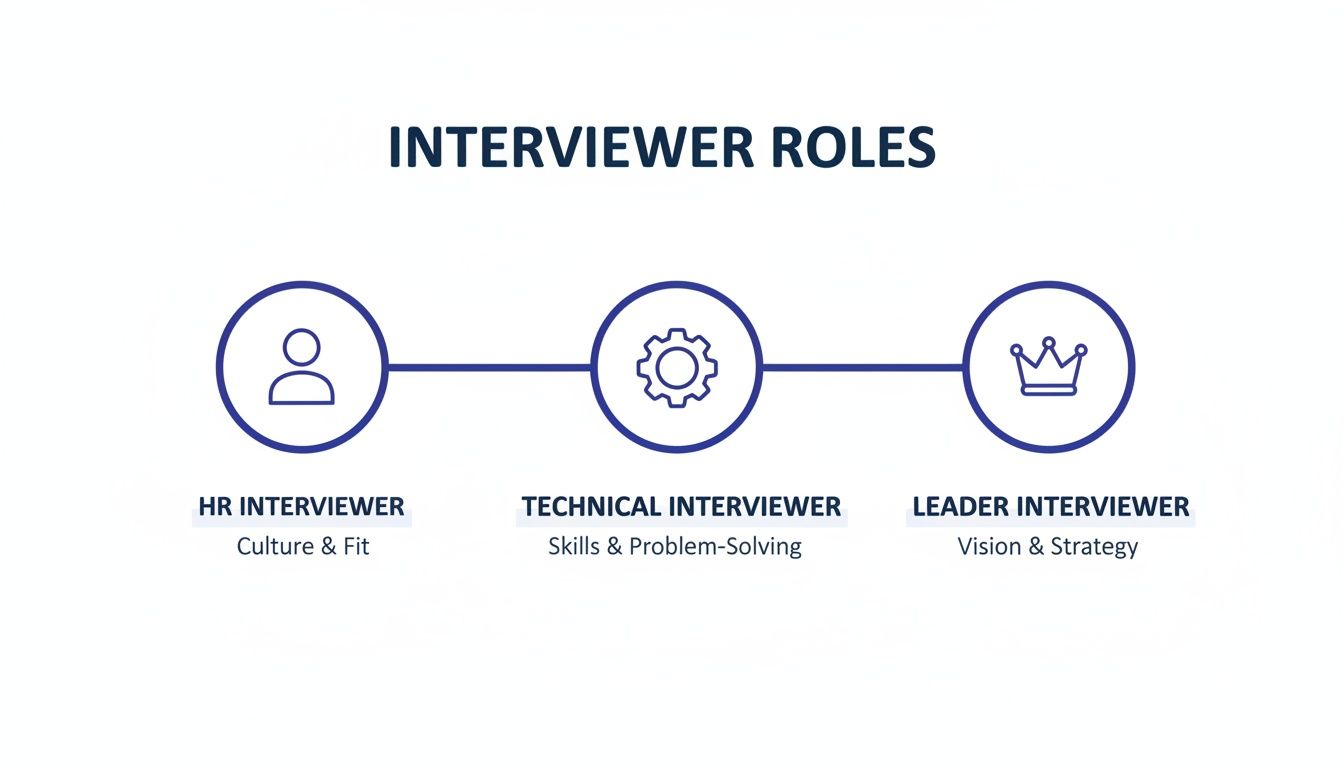
Understanding these distinct roles is crucial. The HR rep is focused on culture, the technical expert on your skills, and the leader on the bigger picture. Knowing this helps you direct your answers effectively.
Week 4: Refinement and Final Polish
The final week is for fine-tuning. Go over the feedback from your mock interviews, identify any weak spots in your answers, and smooth out your delivery. Concentrate on non-verbal cues—your posture, eye contact, and vocal tone can say as much as your words.
This is also the time to handle logistics. Plan your outfit, test your tech if it’s a virtual interview, or map your route if it’s in person. Eliminating these small stressors frees up your mental energy for the main event. Building out a comprehensive plan is a must for any interview, but it’s especially vital for panels. Be sure to incorporate these actionable job interview preparation tips to make sure you’ve covered all your bases.
By following this four-week plan, you turn preparation from a source of anxiety into a source of strength. You’ll be ready to not just answer questions, but to lead a compelling conversation.
For preparation advice that applies to every format, see our medical school interview tips.
Building Your Personal Answer Toolkit
Your success in a panel interview isn't just about having the right experience on paper. It’s about how you bring that experience to life. You need to tell clear, compelling stories that stick with the interviewers long after you've left the room.
This means ditching generic, rehearsed answers. Instead, you'll build a versatile toolkit of personal stories, hard data, and proven frameworks that you can adapt to whatever the panel throws your way.
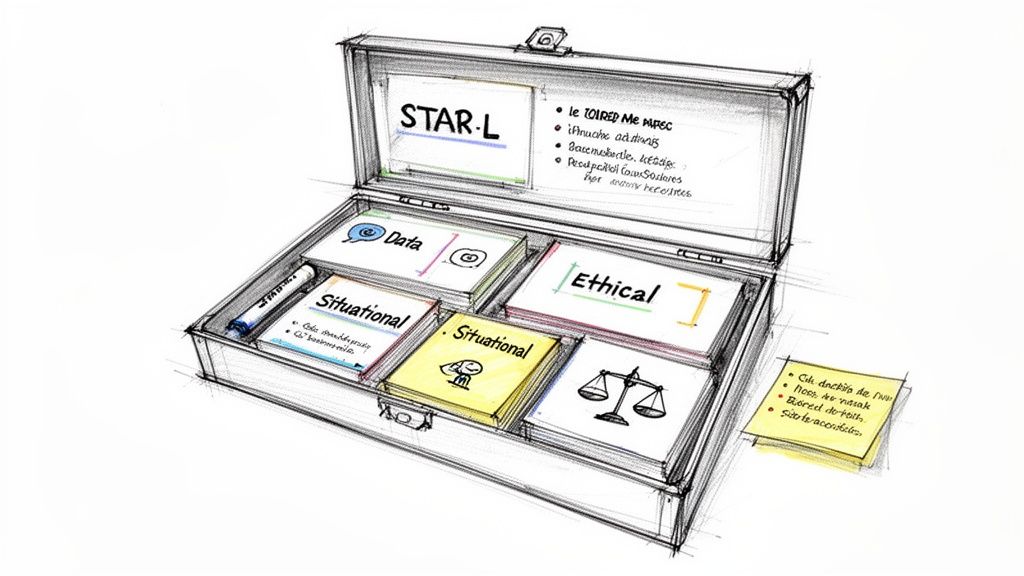
The goal here isn't to memorize scripts. Think of it as developing a core library of your greatest hits—experiences you can shape to answer a huge range of behavioral, situational, and even technical questions.
Frame Your Stories with the STAR-L Method
Behavioral questions—those classic "Tell me about a time when..." prompts—are the bread and butter of any panel interview. They're how interviewers find hard evidence of your skills in action. The absolute best way to structure these stories is with the STAR-L Method.
This framework keeps your answers tight, impactful, and dead simple to follow:
- Situation: Set the scene, but keep it brief. What was the context? (1-2 sentences)
- Task: What was your specific goal or responsibility? (1 sentence)
- Action: Detail the steps you took. This is all about "I" statements and your direct contribution.
- Result: Quantify the outcome. Use numbers, percentages, or concrete results to show the positive impact.
- Learning: This is what seals the deal. What did you learn, and how do you use that lesson now?
That "Learning" component is what separates a good answer from a truly great one. It shows you're self-aware and committed to growing, which is exactly what top employers are looking for.
STAR-L in Action: Answering "Describe a time you handled a conflict with a colleague."
- (S)ituation: In my last role, our lead designer and I were at odds over a new product feature. He was pushing for aesthetic perfection, while I was focused on a non-negotiable engineering deadline.
- (T)ask: I needed to find a middle ground that upheld our design standards without derailing the launch schedule.
- (A)ction: I set up a one-on-one and started by acknowledging how valuable his design principles were to our brand. I then laid out the project timeline and the potential revenue we'd lose if we were late. We mapped out a phased release together, getting the core functionality out first and scheduling the more polished design elements for the next sprint.
- (R)esult: We hit our launch date, which helped drive a 15% lift in user engagement that quarter. The designer felt heard, and our working relationship got a lot stronger.
- (L)earning: I realized that leading with data and shared goals is far more effective than clashing over opinions. It’s an approach I now use to get teams aligned before disagreements can even start.
Anticipate Questions by Researching the Panel
Good research goes beyond the company's "About Us" page. Digging into the backgrounds of the individual panelists gives you a massive advantage. It lets you anticipate their likely questions and pick stories that will resonate with their specific expertise.
If you see the Head of Engineering is on the panel, you know to have a story ready that showcases your technical problem-solving. If someone from Marketing is there, you can pull out a story that highlights the customer impact of your work. It's a subtle way to show you've done your homework and you get how your role fits into the bigger picture.
This research also helps you prep for more niche questions. For instance, if you're interviewing in healthcare, you should be ready for industry-specific scenarios. You can get a feel for what to expect by reviewing guides on frequently asked healthcare interview questions and answers.
Handling Tough and Unexpected Questions
Sooner or later, you'll get a curveball. It might be a situational judgment test, an ethical dilemma, or a tricky brain teaser. When this happens, remember: the panel is less interested in the "right" answer and more interested in how you think.
Here’s a simple game plan for tackling the unexpected:
- Pause and Clarify. Take a breath. It’s completely fine to say, "That's a great question. Let me think about that for a second." If the question feels vague, ask for more detail to make sure you're on the right track.
- State Your Framework. Before diving in, tell them how you're going to approach it. Something like, "In a situation like that, my first step would be to gather all the relevant data. I'd start by looking at..."
- Talk Through Your Reasoning. Walk them through your thought process out loud. Show them how you analyze information, weigh your options, and make logical decisions, especially under pressure.
By building a toolkit of well-structured stories and having a clear strategy for tough questions, you shift the dynamic. The interview is no longer a test you're reacting to; it's a platform for you to proactively showcase your talent and professional maturity.
Putting Theory into Practice with Mock Interviews
Knowing your stories and having your frameworks down is a great start, but theory has a way of crumbling under pressure. Performing in a real panel interview is its own unique skill, and the only way to get good at it is to simulate the real thing. This is where mock interviews stop being a simple exercise and become your single most powerful prep tool.
Effective practice isn't just reciting answers to a friend. It’s about recreating the specific tensions of the panel format—juggling multiple personalities, making eye contact with everyone, and thinking on your feet when you get an unexpected follow-up question.
The goal isn't just repetition. It’s about building a solid feedback loop so you can see measurable improvement. Every practice session should leave you with clear, actionable things to work on for the next round.
Designing a Mock Interview Strategy That Works
Your mock interview plan needs to be just as structured as the rest of your prep. First thing's first: assemble your own "mock panel." This is a great time to call in favors from mentors, trusted colleagues, or career advisors who can play the different roles you're likely to face.
Give them specific archetypes to work with:
- The Technical Expert: This person’s job is to dig deep into the nuts and bolts of your skills and past projects. No surface-level questions allowed.
- The HR Representative: They should focus on behavioral questions, culture fit, and what really motivates you.
- The Senior Leader: This person asks the big-picture, strategic questions about the impact you could have on the organization.
Tell them to ask tough follow-up questions and even interrupt you here and there. You want to mimic the unpredictable, sometimes awkward flow of a real panel. Afterward, ask for direct, candid feedback on both the substance of your answers and the confidence of your delivery.
Using AI for Scalable, Unbiased Feedback
Getting a panel of three busy people together is tough, and you can't always do it on demand. This is where AI-powered platforms like Confetto become an indispensable part of your toolkit. They offer instant, data-driven analysis you can tap into 24/7. These tools can simulate the panel dynamic, fire off relevant questions, and give you immediate, unbiased feedback on key metrics.
Here’s a look at the kind of dashboard you might see after a simulated interview.
This kind of instant analysis is gold. It turns subjective performance into objective data, showing you exactly where you stand on pacing, filler word usage, or how well your answers map to a specific scoring rubric.
The real game-changer here is the unlimited, judgment-free practice. You can hammer out a single answer ten times in a row without worrying about burning out your mentors. It’s the perfect way to build muscle memory for your core stories.
AI-driven practice isn’t just about convenience; it’s about getting better, faster. And the data shows this type of structured preparation works. Organizations that invested in simulated interview prep saw a 30% improvement in hiring goal attainment. For candidates, the results are just as compelling, with users of platforms like Confetto reporting 25% higher rubric scores after just 10 mock interviews. You can read the full research on modern hiring trends to see the impact for yourself.
From Practice to Performance
Ultimately, the whole point of mock interviews is to make the real thing feel familiar. By repeatedly exposing yourself to the pressure, pacing, and dynamics of a panel, you start to desensitize yourself to the anxiety. You’re training your brain to stay calm and focused, which allows all your well-prepared answers to come through clearly.
This process is especially vital for high-stakes fields. Aspiring medical students, for example, can get a huge leg up from targeted practice. Our guide on acing the medical school mock interview dives into specific strategies for that intense environment.
By the time you walk into the actual interview room, it won't feel like you're facing an unknown threat. You’ll be walking into a scenario you’ve already run through dozens of times, armed with the kind of confidence that only comes from dedicated, realistic practice.
Projecting Confidence with Your Communication and Body Language
In a high-pressure panel interview, your words are only half the story. The panel isn’t just listening to what you say; they’re watching how you say it. Your posture, eye contact, and vocal tone are constantly sending signals about your confidence, composure, and professional presence.
Mastering your non-verbal communication is a critical part of preparing. It’s the silent language that can either amplify the strength of your answers or completely undermine them. The good news is that with some conscious practice, you can ensure your body language and communication style project the calm, competent leader they’re looking for.
Engaging the Entire Room with Intentional Eye Contact
When you’re facing multiple interviewers, it's easy to lock onto the person who asked the question. This is a common mistake, and it can make other panelists feel completely left out. The key is to treat the interview less like a series of one-on-one Q&As and more like a group conversation that you are leading.
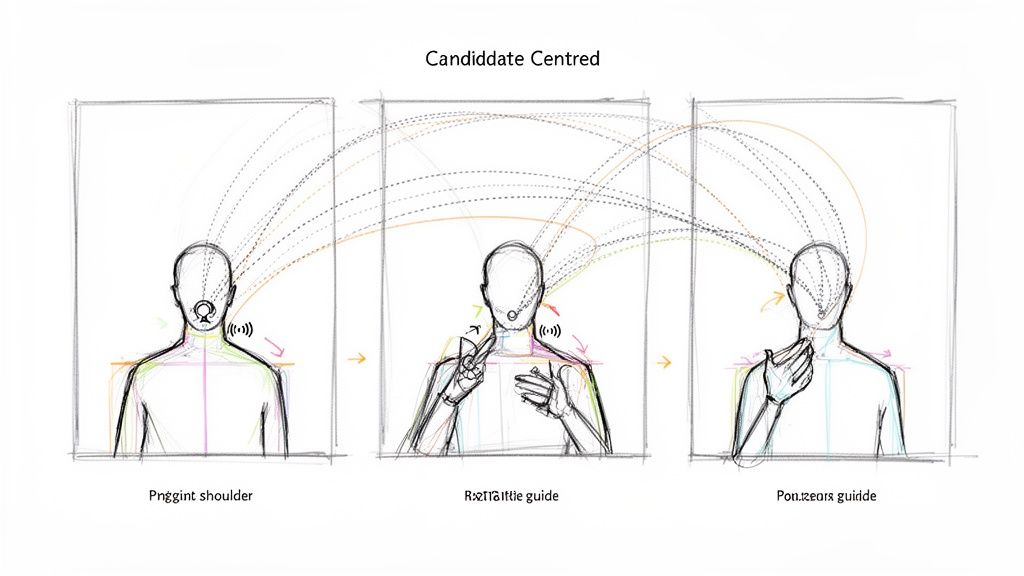
To pull this off, try the 'lighthouse technique'. When a panelist asks a question, start your response by making eye contact with them. Then, as you continue speaking, slowly and deliberately pan your gaze across the other members of the panel, making brief, natural eye contact with each person.
This simple technique accomplishes several things at once:
- It includes everyone: You make each interviewer feel seen and part of the discussion.
- It projects confidence: Shifting your gaze calmly shows you are comfortable addressing a group.
- It keeps the panel engaged: It prevents others from mentally checking out while you’re talking.
Finish your answer by returning your gaze to the original questioner. It creates a complete, inclusive loop of communication that signals strong interpersonal awareness.
Mastering Your Physical Presence
Your posture speaks volumes before you even say a word. Slouching can signal disinterest or low confidence, while sitting bolt upright can come across as defensive. You're aiming for a posture that is both relaxed and alert.
Sit upright with your back against the chair and your feet planted firmly on the floor. When a panelist is speaking, lean in just slightly to show you’re actively listening. Use hand gestures purposefully to emphasize key points, but watch out for fidgeting—it can be a major distraction. For more in-depth advice, our complete guide to powerful interview body language tips is packed with useful info.
A critical element in projecting confidence is learning to build lasting self-assurance and to proactively overcome imposter syndrome at work. The more you believe in your own competence, the more naturally your body language will reflect it.
Using Your Voice as a Tool of Influence
How you control your voice can dramatically alter how your message is received. During your mock interviews, pay close attention to your vocal delivery.
- Pacing: Speaking too quickly is a dead giveaway for nerves and makes you hard to follow. Make a conscious effort to speak at a measured, deliberate pace.
- Tone: A monotone delivery can make even the most impressive accomplishments sound dull. Vary your vocal tone to convey enthusiasm and energy.
- Strategic Pauses: Don't be afraid of silence. A brief pause before answering a tough question shows you are thoughtful. Pausing after making a key point gives it time to sink in and adds weight to your statement.
By weaving these non-verbal strategies into your preparation, you ensure your communication is as compelling as your content. You’ll walk into that room ready to command attention and leave a lasting, positive impression on every single member of the panel.
Don’t Skip the Final Step: Mastering the Post-Interview Follow-Up
Your interview isn't truly over when you leave the room. The final, and often fumbled, step is the follow-up. This is your last chance to reinforce the great impression you made and show a level of professional polish that separates you from the rest of the pack.
A generic, copy-pasted thank-you email is a massive missed opportunity. It screams low effort and treats the interviewers like a faceless committee instead of individuals who just spent an hour with you. To really make this count, you have to personalize your message for each person on that panel.
The Art of the Personalized Thank-You Note
Your mission is to send a separate, unique email to every single panelist. This takes a little strategic listening during the interview. As you talk with each person, make a mental (or physical) note of a specific point they raised, a sharp question they asked, or a topic they seemed genuinely excited about.
That specific detail is the key to making your follow-up stick. Instead of a bland "Thank you for your time," you can write something that actually adds value.
Example of a Personalized Reference: "I especially enjoyed our conversation about the new data analytics platform. Your question about scaling user onboarding was really insightful, and it got me thinking even more about how my experience with phased rollouts could help the team navigate that challenge."
This move does two things brilliantly: it proves you were actively listening, and it shows you're already thinking like a problem-solver on their team. Your follow-up transforms from a simple courtesy into one last piece of compelling evidence for why you're the right hire.
Nailing the Timing and Tone
Timing is everything here. You need to get those thank-you notes out within 24 hours of the interview. This keeps the conversation fresh in everyone’s mind and reinforces that you're prompt and organized. Waiting any longer makes it feel like an afterthought.
As for tone, aim for professional yet genuinely enthusiastic. You're not begging for the job, nor are you writing a legal document. You want to sound like a confident, grateful, and capable colleague they’d actually enjoy working with.
Here’s a quick rundown of what to include in each email:
- A Clear Subject Line: Keep it simple. "Thank you - Interview for [Role Name]" is perfect.
- A Personalized Opening: Address each interviewer by name.
- A Specific Reference: This is where you drop in that unique point from your conversation.
- A Reiteration of Interest: Briefly restate your excitement for the role and the company.
- A Professional Closing: End with a simple "Best regards" or "Sincerely."
What to Avoid in Your Follow-Up
Just as a great follow-up can give you an edge, a bad one can sink your chances. Steer clear of these common mistakes:
- Sending a Group Email: This is the cardinal sin. It completely negates the purpose of personalization and comes across as lazy.
- Asking About a Decision: The thank-you note is not the time to ask, "So, when will I hear back?" It can make you sound impatient.
- Writing a Novel: Keep it concise and impactful. A few short, well-written paragraphs are all you need.
- Typos and Grammatical Errors: Proofread. Then proofread again. A sloppy mistake can completely undermine the professional image you’ve worked so hard to build.
By mastering this final step, you complete your panel interview strategy with polish and thoughtfulness. It’s the finishing touch that confirms you are not just qualified, but also a considerate and detail-oriented professional.
Confetto offers an AI-powered platform to help you practice and perfect every stage of your interview preparation, from structuring answers to building confidence. Start your free trial today and walk into your next interview ready to succeed.