
Updated · Published
Required Classes for Medical School: 9 Core Courses
The 9 core required classes for medical school: biology, general and organic chemistry, biochemistry, physics, math, anatomy, physiology and labs, with tips.
Why practice with Confetto
- Follow-up questions and feedback on every answer
- Over 800 medical school questions
- 3 free mocks with a free trial

Most medical schools require a year each of biology, general chemistry, organic chemistry and physics, all with labs, plus a semester of math. Biochemistry is required or strongly recommended almost everywhere, and anatomy and physiology are common extras. Check each school's own list.
Your grades and MCAT get you an interview invitation, and then the interview counts too. When invitations arrive, Confetto, an AI mock interviewer for medical school and other healthcare program interviews (MMI, traditional, panel), lets you practice medical school interviews out loud with follow-up questions on your own experiences. You can also start with our medical school interview prep plan.
The journey to medical school is a marathon, not a sprint, and your undergraduate coursework is the foundation of that journey. Choosing the right classes isn't just about checking boxes on an application; it’s about building the scientific fluency, critical thinking, and intellectual resilience needed to excel as a physician. While the specific list of required classes for medical school can vary slightly, a core set of science and humanities courses forms the universal bedrock of pre-medical education.
This guide moves beyond a simple checklist, offering a strategic overview of the essential prerequisite areas. We will explain not just what you need to take, but why each subject matters and how it directly prepares you for the challenges ahead. Success in these foundational courses often comes from deep engagement with the material. When approaching these prerequisite courses, understanding the benefits of engaging with various learning methods, such as those found in active learning communities, can significantly enhance your educational experience and knowledge retention.
We will explore the crucial distinction between required and recommended courses, the specific nuances of laboratory versus lecture components, and how each class strategically prepares you for the MCAT. More importantly, we'll connect this academic blueprint to the intellectual rigors of medical school itself, demonstrating how a strong pre-med curriculum creates a powerful academic profile. Consider this your roadmap to building a course history that admissions committees will notice, showcasing your readiness for a career in medicine.
1. Biology (General Biology I & II)
As the cornerstone of all life sciences, a full year of general biology with a laboratory component is the most fundamental and universally required class for medical school. This two-semester sequence provides the essential framework for understanding the human body, from the molecular machinery inside our cells to the complex interplay of organ systems. It's the scientific bedrock upon which all subsequent medical knowledge, including physiology, pharmacology, and pathology, is built.
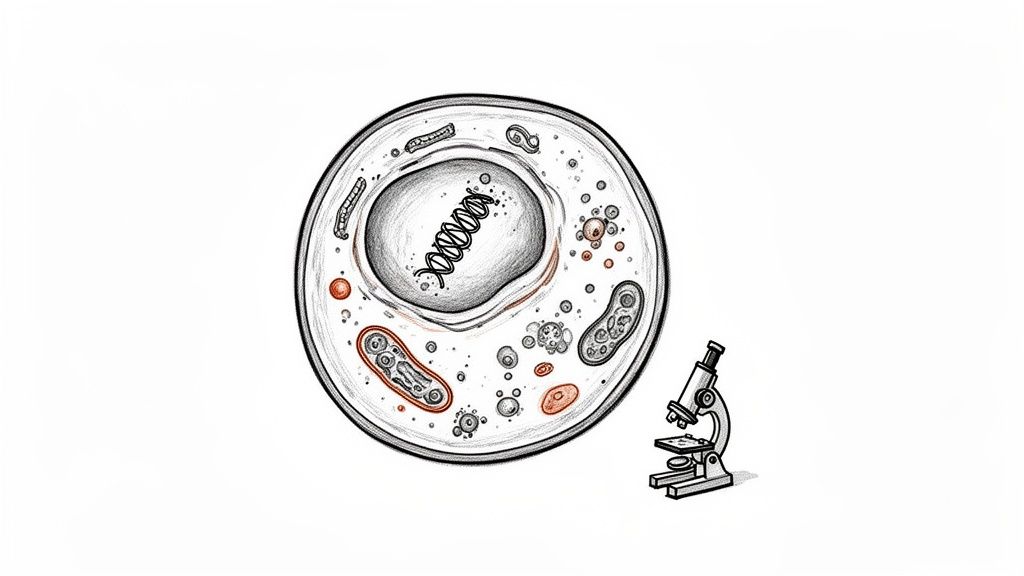
This foundational course sequence covers a vast range of topics critical for the MCAT and medical studies. You'll typically explore cellular and molecular biology, genetics and inheritance, metabolism (like glycolysis and the Krebs cycle), evolution, and organismal biology. The accompanying labs are not optional; they are a critical part of the prerequisite, designed to build hands-on skills in scientific inquiry, data analysis, and experimental design.
Why It's a Core Requirement
Medical schools require biology because medicine is, at its core, applied biology. A physician must understand how a healthy body functions at every level to diagnose and treat when it malfunctions. Concepts learned here directly translate to understanding disease processes, the mechanisms of medications, and the principles of human genetics. Strong performance in this area demonstrates to admissions committees that you have the foundational knowledge and aptitude necessary for the rigors of a medical curriculum.
Actionable Tips for Success
To excel in this critical prerequisite, go beyond simply memorizing facts. Focus on understanding the interconnectedness of biological systems and developing your analytical skills.
- Master the Lab: Don't treat lab sections as a secondary requirement. Actively participate, meticulously document your experiments, and be prepared to discuss the scientific principles and potential sources of error. Adcoms and interviewers value this hands-on experience.
- Form Study Groups: From the start, collaborate with peers to tackle complex topics like cellular respiration or gene expression. Explaining these concepts to others is one of the most effective ways to solidify your own understanding.
- Leverage Office Hours: Build a relationship with your biology professor. Attending office hours not only clarifies difficult material but is also essential for securing a strong letter of recommendation from a science faculty member.
- Practice Articulation: Get comfortable explaining complex biological ideas in simple, clear terms. This skill is invaluable for Multiple Mini Interviews (MMI) and panel interviews, where your communication abilities are under scrutiny. Building a solid foundation in these core classes is a key element of being one of the best pre-med candidates.
2. General Chemistry (General Chemistry I & II)
If biology is the "what" of life, chemistry is the "how." A full year of general chemistry with a corresponding lab is another non-negotiable prerequisite for nearly every medical school. This two-semester sequence lays the molecular groundwork for understanding the biochemical reactions that govern human physiology. From the way oxygen binds to hemoglobin to the complex mechanisms of drug action, the principles learned here are indispensable for a career in medicine.
This foundational course introduces you to atomic structure, chemical bonding, thermodynamics, stoichiometry, kinetics, equilibrium, and acid-base chemistry. More than just a collection of facts, general chemistry rigorously develops your quantitative reasoning and problem-solving abilities. The lab component is crucial for translating theoretical concepts into tangible experiments, honing your skills in measurement, data interpretation, and safe laboratory practices.
Why It's a Core Requirement
Medical schools mandate general chemistry because the human body is a dynamic system of chemical reactions. A deep understanding of chemical principles is essential for mastering pharmacology, biochemistry, and physiology in the medical curriculum. Admissions committees view strong performance in chemistry as proof that a candidate can handle the quantitative demands of medical science and think critically about molecular interactions, which is central to diagnosing and treating diseases.
Actionable Tips for Success
Excelling in general chemistry requires a shift from memorization to application. You must be able to apply principles to solve new problems, a skill that is directly tested on the MCAT and used daily in clinical practice.
- Master Stoichiometry Early: This concept of quantitative relationships in chemical reactions is the foundation for almost everything that follows. Dedicate extra time to mastering it, as weakness here will create problems throughout both semesters.
- Do Daily Practice Problems: Chemistry is a skill built through repetition, not last-minute cramming. Work through problem sets consistently to develop your analytical muscle memory and identify conceptual weak spots before they become major issues.
- Utilize Office Hours Strategically: Don't wait until you're completely lost. Visit your professor or TA with specific questions from homework or practice exams. This shows initiative and helps you build a strong rapport for a potential letter of recommendation.
- Connect Concepts to Medicine: In interviews, frame your experience in this challenging class as a training ground. Explain how mastering acid-base equilibrium or thermodynamics taught you the persistence and analytical problem-solving skills vital for a physician.
3. Organic Chemistry (Organic Chemistry I & II)
Often regarded as the ultimate "weed-out" course for pre-meds, the one-year organic chemistry sequence with its lab component is a non-negotiable prerequisite for nearly all medical schools. This challenging subject moves beyond the general principles of chemistry to explore the structure, properties, and reactions of carbon-based compounds. It provides the molecular logic necessary to understand pharmacology, biochemistry, and metabolic pathways, making it an essential intellectual hurdle.
This two-semester course delves deep into topics like stereochemistry, spectroscopy (NMR, IR, Mass Spec), and a vast array of reaction mechanisms such as substitution, elimination, and addition reactions. The lab component is critical for developing hands-on synthesis, purification, and analytical techniques. Success in this course requires a shift from memorization to a deep, puzzle-solving-based understanding of how and why molecules react.
Why It's a Core Requirement
Medical schools require organic chemistry because the human body is a marvel of organic reactions. Understanding how a drug molecule interacts with a receptor, how metabolic diseases disrupt biochemical pathways, or how enzymes function requires a firm grasp of organic principles. Excelling in this notoriously difficult subject signals to admissions committees that you possess resilience, strong problem-solving skills, and the intellectual horsepower to handle the complexities of medical science. It demonstrates that you can thrive when faced with a significant academic challenge.
Actionable Tips for Success
To succeed in organic chemistry, you must approach it as a new language built on rules and patterns, not as a list of facts to be memorized.
- Embrace Molecular Models: Don't just look at 2D drawings. Use a physical or digital molecular modeling kit from day one to understand 3D spatial arrangements and stereochemistry. This hands-on visualization is crucial.
- Practice, Practice, Practice: Treat reaction mechanisms like a skill to be honed. Redraw them repeatedly without looking at your notes until the flow of electrons becomes second nature. Work through countless practice problems.
- Form a Dedicated Study Group: This course is best tackled as a team. Work together on problem sets and quiz each other on mechanisms. Explaining a complex synthesis to a peer is a powerful way to solidify your knowledge.
- Frame Your Struggle as Growth: If asked about a challenging course in an interview, use organic chemistry as an example. Discuss how you overcame its difficulties, what study strategies you developed, and how it strengthened your resolve. Adcoms value this demonstration of resilience.
4. Biochemistry
While once considered an upper-level elective, a dedicated biochemistry course is now a firm prerequisite or a strong recommendation at the vast majority of U.S. and Canadian medical schools. This course serves as the critical bridge between the foundational principles of organic chemistry and the complex physiological processes of the human body. It delves into the molecular basis of life itself, exploring protein structure, enzyme kinetics, metabolic pathways, and the flow of genetic information.
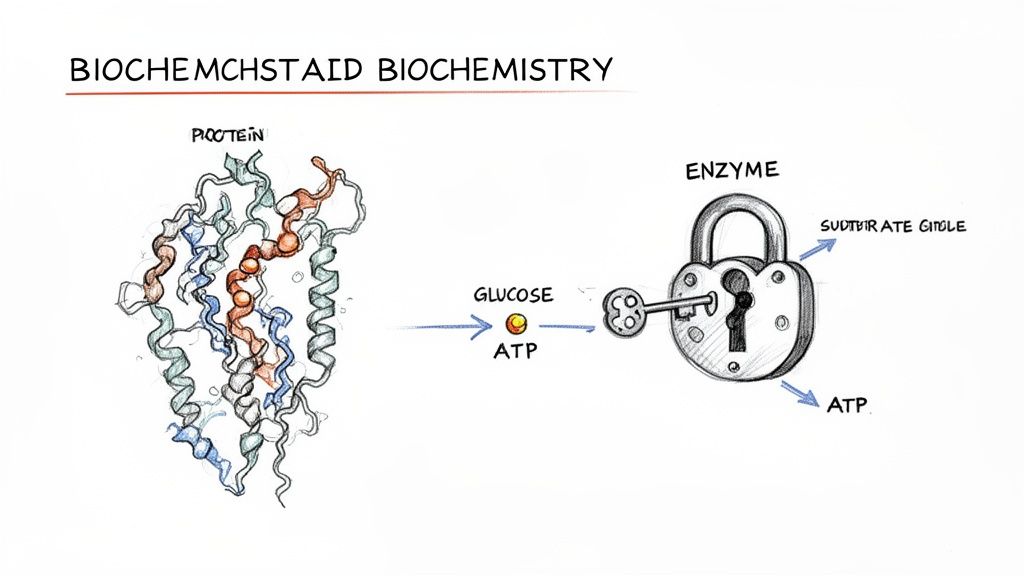
Often taught as a one-semester course, it is one of the most high-yield required classes for medical school in terms of its direct relevance to the MCAT and medical curriculum. You'll move beyond the theoretical reactions of organic chemistry to see how those principles apply within a biological system, studying everything from how our bodies derive energy from food to how DNA is replicated and repaired. Understanding these molecular mechanisms is non-negotiable for modern medicine.
Why It's a Core Requirement
Medicine is increasingly molecular. To understand diseases like diabetes, cancer, or genetic disorders, one must first understand the underlying biochemical pathways that have gone awry. Biochemistry provides the language to discuss pharmacology (how drugs interact with enzymes and receptors) and pathology (the molecular basis of disease). Admissions committees see strong performance in biochemistry as a clear indicator that a candidate can handle the integrated, systems-based curriculum of medical school.
Actionable Tips for Success
Success in biochemistry requires moving from memorization to genuine conceptual integration. Your goal is to see how individual molecules and pathways connect to create a functioning organism.
- Create Pathway Maps: Don't just memorize glycolysis or the Krebs cycle. Draw them out and create concept maps linking them to clinical conditions. For instance, connect defects in specific enzymes to known metabolic diseases.
- Focus on the "Why": Constantly ask yourself "why?" Why does this enzyme need a specific cofactor? Why is this pathway regulated at this particular step? This deepens understanding far more than rote memorization of structures.
- Connect to Human Disease: Actively relate biochemical concepts to real-world medicine. How does a protein misfolding problem lead to cystic fibrosis? How do insulin and glucagon regulate glucose metabolism in diabetes?
- Practice Systems Thinking: Prepare for interviews by articulating how a biochemical defect leads to a patient's symptoms. This demonstrates the high-level, integrated thinking that medical schools value and that is essential for a successful career in medicine.
5. Physics (General Physics I & II)
While it may not seem as directly connected to medicine as biology or chemistry, a full year of general physics with a laboratory is a standard prerequisite for most medical schools. This two-semester sequence builds critical quantitative reasoning and problem-solving skills, teaching you to apply fundamental principles of mechanics, thermodynamics, electricity, and magnetism to complex systems. This analytical framework is surprisingly relevant to understanding the biophysical forces at play within the human body.
This course sequence typically covers Newtonian mechanics, energy, waves, fluid dynamics, electromagnetism, and optics. The labs are essential for developing an appreciation for measurement, error analysis, and experimental verification. From understanding the fluid mechanics of blood flow to the optics of the human eye and the physics behind MRI and X-ray imaging, these concepts provide the scientific foundation for much of modern medical technology and diagnostics.
Why It's a Core Requirement
Medical schools require physics because it demonstrates a student's ability to master complex, abstract concepts and apply mathematical reasoning to real-world problems. Medicine is not just about memorization; it's about problem-solving. Physics trains your brain to think systematically and quantitatively, a skill that is indispensable when interpreting diagnostic data, calculating drug dosages, or understanding the pressure-volume loops of the cardiac cycle. It also forms a crucial part of your MCAT preparation.
Actionable Tips for Success
To excel in physics, focus on the underlying principles rather than memorizing formulas. Connect the abstract concepts to tangible medical applications to make the material more engaging and memorable.
- Connect Physics to Medicine: Actively look for medical relevance in every topic. Relate fluid dynamics to blood pressure and circulation, wave properties to ultrasound imaging, and electromagnetic radiation to X-rays and PET scans. This approach makes studying more engaging.
- Master Foundational Principles: Don't just learn equations; understand the core concepts behind them, like the conservation of energy and momentum. These principles are universal and appear repeatedly in biophysical systems, from cardiac work to molecular motion.
- Embrace the Lab: Use the laboratory component to translate theoretical knowledge into practical skills. The process of designing an experiment, collecting data, and analyzing results mirrors the evidence-based approach central to clinical practice.
- Frame It as Intellectual Breadth: In applications and interviews, discuss how studying physics has provided you with a unique analytical lens. Highlighting your ability to bridge disciplines shows intellectual curiosity and a well-rounded scientific mind, qualities highly valued by admissions committees. Achieving a high score on the MCAT's physics section can be a significant advantage; you can learn more about what constitutes a perfect MCAT score to set your goals.
6. Mathematics (Calculus and/or Statistics)
While not as universally standardized as the core sciences, at least one semester of college-level mathematics is a firm requirement for most medical schools. This prerequisite develops the quantitative reasoning and analytical problem-solving skills essential for a medical career. The specific course can often be either calculus or statistics, with both offering unique benefits for an aspiring physician's toolkit.
Calculus provides a deep understanding of rates of change, which is foundational for grasping concepts in physics and advanced physiology, such as cardiac output or drug clearance rates. Statistics, particularly biostatistics, is arguably more directly applicable to modern medicine. It provides the skills needed to critically evaluate clinical trial data, understand epidemiological studies, and practice evidence-based medicine, a cornerstone of contemporary healthcare.
Why It's a Core Requirement
Medicine is increasingly a data-driven field. Physicians must be able to interpret complex data from diagnostic tests, understand the statistical significance of research findings, and assess risks and probabilities when creating treatment plans. These math courses demonstrate to admissions committees that you possess the necessary quantitative literacy to handle the complex, data-rich environment of medical school and clinical practice. It proves you can think logically and analytically, a skill that transcends any single subject.
Actionable Tips for Success
To get the most out of this requirement, focus on its practical application in a medical context rather than just solving abstract problems.
- Choose Strategically: If a medical school doesn't specify, choose the course where you can perform best. However, a biostatistics course is often viewed favorably as it directly relates to clinical research and evidence-based medicine.
- Focus on Interpretation: For statistics, concentrate less on manual calculations and more on what the results mean. Learn to identify bias, understand p-values, and interpret confidence intervals in the context of a scientific paper.
- Apply Your Knowledge: Actively seek out and read medical research papers. Try to critique the "Methods" section, specifically how the authors used statistics. This is an excellent way to prepare for journal club discussions in medical school.
- Connect to Medicine in Interviews: When discussing your interest in evidence-based medicine or health disparities, mention how your understanding of statistics helps you appreciate the importance of robust data. This demonstrates a mature and insightful application of your pre-med coursework.
7. Human Anatomy
While not universally required by every single medical school, a dedicated course in human anatomy is one of the most highly recommended classes you can take. This course provides the foundational map of the human body, covering gross anatomy (the structures you can see with the naked eye) and often microanatomy or histology (the study of tissues at a microscopic level). It serves as a direct bridge between your prerequisite science courses and the clinical knowledge you will build in medical school, offering the essential structural context for understanding both normal physiology and complex pathology.
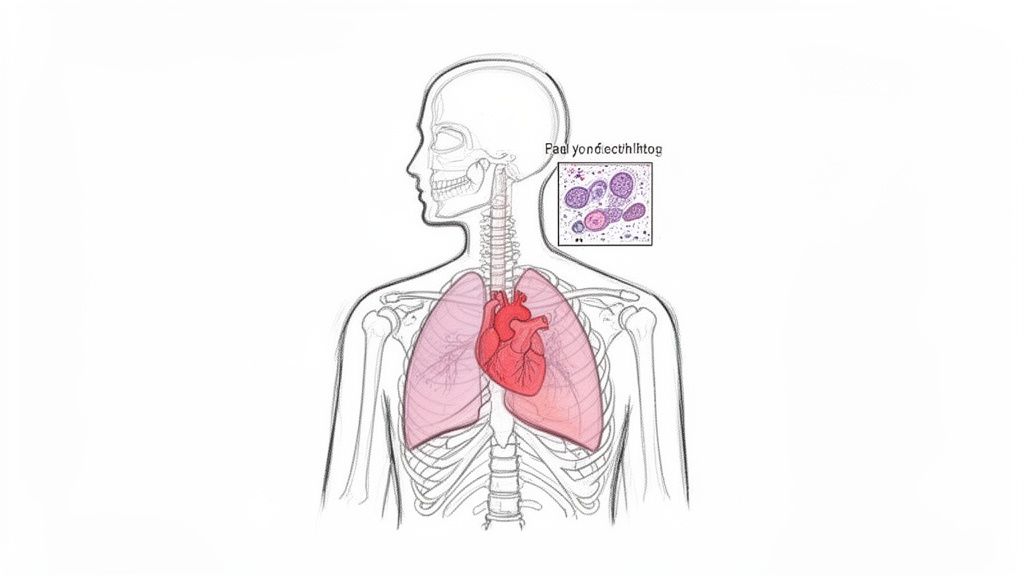
This one-semester course, sometimes offered as a two-part sequence with physiology, is where the abstract concepts from biology and chemistry become tangible. Courses with a hands-on cadaver lab, like those at the University of Michigan or Mayo Clinic, are considered the gold standard. They provide an unparalleled learning experience that cannot be replicated by textbooks or digital models alone, giving you a three-dimensional understanding of human systems.
Why It's a Core Requirement
Medical schools that require or strongly recommend anatomy do so because it is the language of medicine. To diagnose an ailment, perform a physical exam, or interpret an X-ray, you must have an intimate knowledge of the body's layout. Excelling in this course demonstrates to admissions committees that you can handle the high-volume memorization and spatial reasoning required in medical school. Furthermore, it shows a commitment to understanding the human form, which is central to the practice of medicine.
Actionable Tips for Success
Success in anatomy requires a multi-modal approach to learning and a deep respect for the subject matter.
- Prioritize the Lab: If you have the option, choose a course with a physical cadaver lab. The tactile experience of dissection or prosection builds a mental model of the body that is far more durable and detailed than any illustration.
- Use Multiple Resources: Don’t rely solely on your textbook. Supplement your learning with anatomical atlases (like Netter's), 3D modeling software, and flashcard apps to reinforce spatial relationships from different perspectives.
- Reflect on the Experience: A cadaver lab is a profound experience. Journaling or discussing your reflections on the ethical and humanistic aspects of working with donors can provide powerful material for your personal statement and interviews. This is a critical aspect of your premed journey, just as important as maintaining a strong GPA for medical school.
- Form a Dissection Group: Work collaboratively in the lab to identify structures and quiz each other. Teaching your lab partners is an excellent way to test and solidify your own knowledge of complex anatomical regions.
8. Human Physiology
While not universally mandated like general biology, a dedicated course in human physiology is one of the most strongly recommended and frequently required classes for medical school. This course serves as the critical bridge between foundational sciences and clinical medicine, explaining the how and why behind the body's functions. It moves beyond identifying anatomical structures to explore the dynamic mechanisms that maintain life, from neural signaling to renal filtration.
A semester of physiology delves deep into the integrated functions of the major organ systems (cardiovascular, respiratory, renal, endocrine, etc.). You'll learn the principles of homeostasis and the intricate feedback loops that govern everything from blood pressure to blood glucose. This knowledge is not just tested heavily on the MCAT; it is the very language of medicine, forming the basis for understanding pathology and pharmacology.
Why It's a Core Requirement
Medical schools value physiology because it is the science of function and regulation in the human body. A firm grasp of normal physiology is the prerequisite for understanding pathophysiology, the study of how disease disrupts these functions. Adcoms see strong performance in this course as proof that a candidate can handle the systems-based, integrated curriculum of medical school and think critically about cause and effect in a clinical context.
Actionable Tips for Success
To excel in physiology, you must transition from memorization to mastering mechanisms and integrated systems. Focus on understanding the logical flow of physiological processes.
- Create Flow Charts: Don't just list facts. Map out processes. For example, create a flow chart showing how low blood oxygen (hypoxia) triggers a cascade of events involving the kidneys, bone marrow, and respiratory system to restore homeostasis.
- Constantly Ask 'Why?': For every concept, challenge yourself to explain the underlying reason. Why does heart rate increase during exercise? Why does aldosterone secretion lead to sodium retention? This deepens your understanding far more than rote memorization.
- Use Clinical Case Studies: Anchor abstract concepts by connecting them to real-world diseases. Understanding the renin-angiotensin-aldosterone system is easier when you see how its dysfunction leads to hypertension.
- Practice Systems Thinking: In preparation for interviews, practice explaining how a problem in one organ system affects another. For instance, be ready to articulate how chronic kidney disease impacts cardiovascular function. This demonstrates the high-level, integrated thinking of a future physician.
9. Chemistry Lab and/or Organic Chemistry Lab
Separate from lectures, the laboratory components for general and organic chemistry are non-negotiable prerequisites. These hands-on courses are where the theoretical principles from your chemistry lectures are put into practice. You will move beyond memorizing reactions and mechanisms to performing titrations, synthesizing compounds, and using analytical techniques like spectroscopy to identify the molecules you create. These labs are crucial for developing the meticulousness and problem-solving skills of a scientific investigator.
These courses are designed to teach experimental design, wet chemistry techniques, precise data collection, and rigorous laboratory safety. Whether it's a General Chemistry Lab focused on stoichiometry and thermodynamics or an Organic Chemistry Lab dedicated to multi-step synthesis and purification, these experiences are a core part of the required classes for medical school. They demonstrate your ability to apply knowledge and learn from direct observation, not just from a textbook.
Why It's a Core Requirement
Medicine is a hands-on, evidence-based profession. Chemistry labs are the first real test of your ability to follow complex protocols, handle sensitive materials, and troubleshoot when things don't go as planned. Admissions committees see your performance in these labs as a direct reflection of your potential to handle the practical demands of clinical rotations and medical research. Strong lab skills indicate patience, attention to detail, and a capacity for analytical thinking under pressure, all of which are essential traits for a future physician.
Actionable Tips for Success
To truly stand out, view your lab courses as training grounds for your future career in medicine. Your mindset and approach matter just as much as your final product.
- Prepare Meticulously: Always read the lab protocol before you arrive. Understand the underlying chemistry, predict the expected outcomes, and identify potential safety hazards. This preparation prevents simple mistakes and shows initiative.
- Embrace 'Failed' Experiments: An unexpected result is not a failure; it's a data point. Treat these moments as learning opportunities to troubleshoot your technique and critically analyze the procedure. This resilience is a highly valued trait in medicine.
- Keep Impeccable Records: Your lab notebook is a record of your scientific process. Meticulous notes, clear data tables, and thoughtful observations are invaluable. This habit prevents having to redo work and builds skills directly applicable to patient charting.
- Develop Your Troubleshooting Story: Be prepared to discuss a time an experiment went wrong during your medical school interviews. Frame it as a story of problem-solving and intellectual growth. Detailing how you analyzed the issue and adjusted your approach demonstrates maturity and a scientific mindset.
9 Required Medical School Courses Compared
| Course | 🔄 Implementation complexity | ⚡ Resource requirements | 📊 Expected outcomes | 💡 Ideal use cases | ⭐ Key advantages |
|---|---|---|---|---|---|
| Biology (General Biology I & II) | High 🔄 — broad conceptual scope + mandatory labs | ⚡ Moderate–High: microscopes, dissection supplies, textbooks, lab time | 📊 Strong foundation for physiology, genetics, pathology; positive admissions signal | 💡 Core pre-med foundation; MCAT bio prep; interview examples from lab work | ⭐ Essential for disease mechanisms; lab skills mirror clinical observation |
| General Chemistry (I & II) | High 🔄 — quantitative concepts and lab techniques | ⚡ Moderate–High: lab equipment, problem sets, strong math background | 📊 Builds quantitative reasoning needed for pharmacology and biochemistry | 💡 Prepares for drug/electrolyte concepts; MCAT C/P section | ⭐ Develops analytical problem-solving and practical lab skills |
| Organic Chemistry (I & II) | Very High 🔄 — mechanism visualization, synthesis, rigorous exams | ⚡ High: molecular models, extensive study time, synthesis labs | 📊 Deep understanding of drug action/metabolism; major admissions filter | 💡 Demonstrates resilience and advanced problem-solving for med schools | ⭐ Strengthens spatial reasoning and complex mechanistic thinking |
| Biochemistry | High 🔄 — detail-heavy, requires cross-discipline integration | ⚡ Moderate: pathway maps, focused labs (varies), heavy reading | 📊 Molecular-level understanding of disease; highly MCAT-relevant | 💡 Bridge between organic chem and physiology; clinical/ research contexts | ⭐ Directly applicable to pathophysiology and pharmacology |
| Physics (General Physics I & II) | Moderate–High 🔄 — mathematical abstraction with labs | ⚡ Moderate: math skills, lab apparatus, problem practice | 📊 Quantitative reasoning; basis for imaging and biophysical concepts | 💡 Useful for imaging-related interests and MCAT physics prep | ⭐ Builds analytical skills and experimental design thinking |
| Mathematics (Calculus and/or Statistics) | Moderate 🔄 — abstract reasoning; course-dependent | ⚡ Low–Moderate: problem sets, statistical software (if applicable) | 📊 Quantitative literacy for research interpretation and epidemiology | 💡 Interpreting clinical studies, evidence-based medicine, biostatistics | ⭐ Improves data interpretation and clear analytical thinking |
| Human Anatomy | High 🔄 — 3D spatial learning plus dissection/prosection labs | ⚡ High: cadaver/prosection facilities, atlases, lab time | 📊 Faster transition to medical school anatomy and clinical exams | 💡 Hands-on prep for clinical skills; powerful interview narratives | ⭐ Direct clinical relevance to physical exam and imaging |
| Human Physiology | High 🔄 — integrative systems-level synthesis | ⚡ Moderate–High: case studies, labs, comprehensive textbooks | 📊 Systems-level understanding of homeostasis and pathophysiology | 💡 Linking anatomy to disease; clinical reasoning practice | ⭐ Essential for understanding organ function and clinical mechanisms |
| Chemistry Lab / Organic Chem Lab | Moderate–High 🔄 — experimental design, safety, data analysis | ⚡ High: reagents, instruments, safety gear, lengthy lab sessions | 📊 Practical lab competence; troubleshooting and data-report skills | 💡 Prepares for research, clinical lab tasks, and interview examples of learning from failure | ⭐ Demonstrates hands-on skills, attention to detail, and resilience |
Beyond the Transcript: Transforming Prerequisites into a Powerful Narrative
The journey through the required classes for medical school is more than a checklist; it's a foundational experience that shapes your scientific mind and prepares you for the rigors of a medical career. We've navigated the core prerequisites from Biology and General Chemistry to the intricate pathways of Biochemistry and the physical laws of Physics. We've also explored the nuances of lab requirements, the strategic importance of MCAT-aligned coursework, and the variations you'll encounter across different medical schools and countries.
Completing this academic gauntlet is a monumental achievement. Yet, the final grade in each course is just the beginning of its value. The true differentiator for a successful medical school applicant lies not just in what they learned, but in how they articulate the significance of that learning.
From Course Codes to Compelling Stories
Admissions committees see thousands of transcripts listing the same prerequisite courses. Your application, personal statement, and interviews are your opportunities to breathe life into those course codes. The goal is to transform your academic record from a flat, two-dimensional list into a dynamic, three-dimensional narrative of your growth and readiness.
Think beyond the simple fact that you passed Organic Chemistry. Instead, reflect on how it taught you resilience, problem-solving under pressure, and the ability to visualize complex, non-linear systems. Did your statistics class open your eyes to the power of evidence-based medicine or illuminate the stark realities of public health disparities? Did your human anatomy lab cultivate a profound sense of awe and respect for the human form, cementing your desire to heal?
Key Takeaway: Every prerequisite class is an opportunity to build a story. Don't just list the course; explain its impact on your perspective, your skills, and your motivation to pursue medicine.
Actionable Next Steps: Weaving Your Academic Narrative
As you transition from completing coursework to building your application, focus on these critical steps to translate your academic experiences into a powerful story:
Conduct a "Course-to-Competency" Audit: Review your transcript. For each key prerequisite, jot down at least one non-academic skill or personal insight you gained. For example:
- Physics Lab: Fostered meticulous attention to detail and a systematic approach to troubleshooting unexpected results.
- Biochemistry: Developed an appreciation for the molecular basis of disease, connecting textbook knowledge to future clinical practice.
- English/Writing: Honed the ability to communicate complex ideas clearly and compassionately, a vital skill for patient interaction.
Connect Coursework to Clinical Experiences: Bridge the gap between the classroom and the real world. How did understanding the principles of physiology make your hospital volunteering experience more meaningful? How did your knowledge of general chemistry help you grasp the mechanism of a medication you saw administered while shadowing? These connections demonstrate intellectual curiosity and an integrative mindset.
Draft Your Narrative for Essays and Interviews: The insights from your audit are the raw materials for your application. When writing your personal statement or preparing for interviews, you can now use specific examples. Instead of saying "I am resilient," you can say, "Mastering the multi-step syntheses in Organic Chemistry taught me to persevere through complex challenges, a skill I know is essential in diagnosing and treating patients." To truly stand out, aspiring medical students must articulate their journey and motivations in a compelling narrative. Exploring these powerful personal statements examples can provide invaluable guidance for crafting your own impactful application essay.
Mastering the required classes for medical school is the entry ticket. But crafting a compelling narrative around that journey is what gets you invited to the main event. It proves you are more than a student who met the requirements; you are a future physician who understands their purpose and is ready for the profound responsibility that lies ahead.
Once your prerequisites are planned, see what percent of applicants get into medical school and how long the MCAT takes.
Ready to practice articulating your academic journey for medical school interviews? Confetto provides AI-driven mock interviews to help you confidently connect your prerequisite coursework to your passion for medicine. Visit Confetto to transform your knowledge into a compelling narrative and master the art of the medical school interview.