
Updated · Published
What Is a Perfect MCAT Score and What Do You Actually Need?
Uncover what is a perfect MCAT score (528) and the score you actually need. Learn how med schools view scores to create a realistic target for your application.

Let’s get right to it: a perfect MCAT score is a 528. Think of it as reaching the absolute summit of a very tough mountain—an incredible achievement that comes from acing all four sections of the exam. But while a 528 is the peak, it’s far from the only path up. Another step on that path is the interview, and Confetto, an AI mock interviewer for medical school and other healthcare program interviews (MMI, traditional, panel), lets you practice medical school interviews out loud once invitations arrive.
Decoding the Perfect MCAT Score
So, what does a 528 really mean? It’s not just one big test; the MCAT is a composite of four distinct sections. To hit that perfect number, you have to earn the highest possible score—a 132—on every single one of them.
This scoring system isn't ancient history. The AAMC rolled it out in April 2015, making 528 the new gold standard. A perfect score signals flawless performance across the board: Chemical and Physical Foundations of Biological Systems (CPBS), Critical Analysis and Reasoning Skills (CARS), Biological and Biochemical Foundations of Living Systems (BBLS), and Psychological, Social, and Biological Foundations of Behavior (PSBB). For a deeper dive into how the scores shifted, Shemmassian Consulting offers a great breakdown.
Getting a handle on this structure is the first step for any premed student. Before we get into what scores you actually need, let's lay out the basic anatomy of the MCAT score.
MCAT Scoring At a Glance
The table below breaks down how each section contributes to that total score. As you can see, each part carries equal weight, and mastery of all four is required to reach that 528 pinnacle.
| MCAT Section | Abbreviation | Score Range | Perfect Section Score |
|---|---|---|---|
| Chemical and Physical Foundations | CPBS | 118-132 | 132 |
| Critical Analysis and Reasoning Skills | CARS | 118-132 | 132 |
| Biological and Biochemical Foundations | BBLS | 118-132 | 132 |
| Psychological and Social Foundations | PSBB | 118-132 | 132 |
While aiming high is always a good idea, it's just as important to recognize how rare a perfect score is. Understanding the foundation of the scoring system helps us pivot to a much more practical question: what score should you be aiming for?
Looking Beyond the Number to Percentiles
A 528 is the peak of the MCAT mountain, but its real power isn’t in the number itself—it’s in what that number says about you compared to every other hopeful pre-med who took the test. To get the full picture, you have to look past the score and into the world of percentiles.
Think of it this way: your score is what you got right on the test. Your percentile, on the other hand, tells admissions committees how you stacked up against everyone else. A score in the 90th percentile is a powerful statement, telling schools you outperformed nine out of every ten test-takers. That context is what separates a good applicant from a great one.
Comparing Yourself to the Right Group
It’s also crucial to know who you're being compared against. There’s a huge gap between the average score for everyone who takes the MCAT and the average score for students who actually get accepted into medical school. The average for all test-takers sits around 500.5, but for matriculants—the ones who make it in—that average jumps to nearly 512.
That’s a big difference, and it’s why your target score needs to be set against the right benchmark.
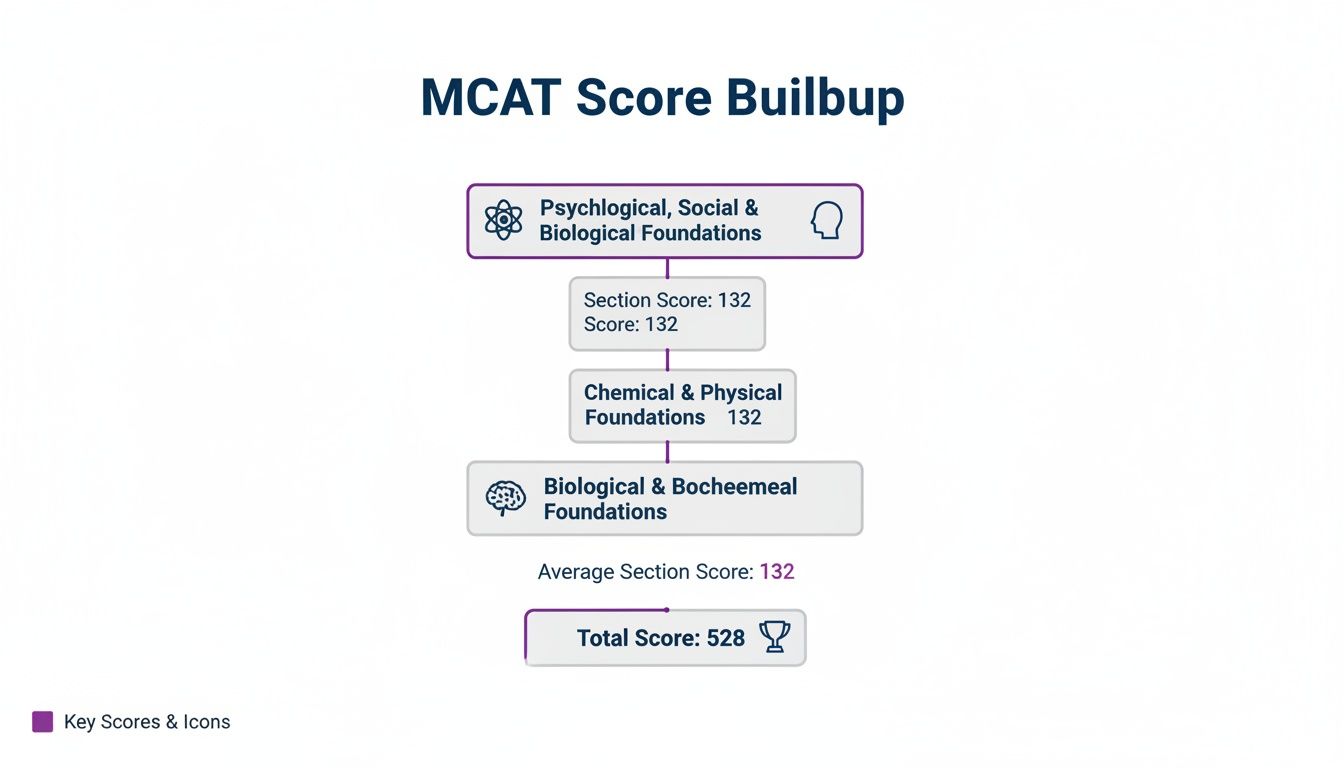
As this image shows, each section score is a building block toward that final number. To really grasp what a perfect MCAT score means, it helps to understand concepts like raw study scores and scaled scores and how they translate into percentiles.
To put some hard numbers to this, here's a quick look at how certain scores translate into percentile ranks.
MCAT Score Percentile Breakdown
This table breaks down key MCAT scores and their corresponding percentiles, giving you a clearer picture of where different scores land in the competitive landscape.
| MCAT Score | Percentile Rank | Interpretation |
|---|---|---|
| 525–528 | 100th | The absolute top tier; exceptionally rare. |
| 520 | 97th | Extremely competitive for top-tier programs. |
| 518 | 95th | A very strong score, highly competitive. |
| 512 | 84th | The average for medical school matriculants. |
| 501 | 52nd | Close to the middle of all test-takers. |
As you can see, hitting a 528 puts you in the exclusive 100th percentile. But because so few students reach these heights, recent data shows that any score from 525 and up will land you in that same top spot. The numbers underscore just how intense the competition gets at the highest levels.
Ultimately, your percentile rank tells admissions committees a powerful story about your competitiveness. For a deeper dive, check out our guide on what constitutes a good MCAT score.
Why a Perfect Score Is Not a Golden Ticket
It’s easy to think that a perfect 528 on the MCAT is an automatic key to any medical school you want. While it’s a massive accomplishment that will absolutely get an admissions officer’s attention, the reality is a bit more complicated. Medical schools aren't just hunting for high test scores; they're looking for future physicians.
This is where the holistic review process comes in. Imagine your application is a book about you. Your MCAT score is just one chapter—a really important one, for sure, but still only one piece of a much larger story.
Admissions committees pore over every single part of your file to get a complete sense of who you are and what you bring to the table.

More Than Just a Number
Beyond that shiny score, admissions committees are digging into other key areas to gauge your readiness for a career in medicine. These elements give your application the context and depth that a standardized test alone can never provide.
- Academic Record (GPA): Your GPA is the long-term track record of your work ethic and academic consistency.
- Clinical and Research Experience: This is where you show you’ve rolled up your sleeves and understand what a life in medicine and science actually looks like.
- Personal Statement and Essays: Here’s your chance to connect the dots. Tell your story, share what drives you, and show them who you are behind the numbers.
- Letters of Recommendation: Strong letters from professors and mentors give a crucial outside perspective on your character, skills, and potential.
- Interview Performance: The interview is your final audition. It's where you prove you have the empathy, communication skills, and professionalism to be an outstanding doctor.
Think of it this way: a high MCAT score is the key that gets your foot in the door for an interview. But it's the strength of your entire application—and how you connect with them in that interview—that convinces the committee to invite you all the way in.
The data backs this up. Even applicants with elite scores aren't a shoo-in. Schools regularly turn away candidates with near-perfect numbers, opting instead for others who present a more compelling, well-rounded case for why they belong in medicine. For a deeper dive into matriculant data, you can discover more insights about MCAT score ranges on Shemmassian Consulting.
How Admissions Committees View Your Score
While chasing a perfect MCAT score is a powerful motivator, the real question is much simpler: what score do you actually need? Admissions committees don’t just see a single number. They see your score as part of a competitive landscape, slotting it into different tiers of viability for their specific programs.
Think of it as a filtering system. A high score is no guarantee of admission, but a score below a certain threshold might get your application screened out before it ever gets a holistic review. For top-tier, research-heavy medical schools, that initial filter is set incredibly high.
Understanding Score Tiers
To make sense of this, let’s group scores into practical tiers. Each tier opens different doors and sets different expectations for the rest of your application.
Elite Scores (518+): Landing in this range puts you in the top 5% of all test-takers. It makes you a serious contender at the most prestigious MD programs and signals that you can handle the most demanding academic environments.
Highly Competitive Scores (510-517): This is the sweet spot for a huge number of applicants. A score here is strong enough to be competitive at most MD programs across the country, as long as the rest of your application is solid.
Competitive Scores (500-509): This range is a great fit for many paths, including Doctor of Osteopathic Medicine (DO) programs or in-state public universities. This is especially true if you have an outstanding GPA or compelling life experiences to round out your profile.
The key takeaway is that your target score has to align with your specific medical school goals. A 512 is a fantastic score for many schools but might be on the lower end for a top-10 research institution.
It's also crucial to ground your goals in reality. In the 2022-23 cycle, the average score for all MD applicants was 506.5, but the average for students who actually matriculated was a much higher 511.9—that’s in the mid-80s percentile range. You can explore more official MCAT statistics to see how these benchmarks evolve.
That data reveals the gap between just applying and actually getting accepted, which is exactly why setting a realistic, strategic target is so important.
Building Your Application Beyond the Score

If your MCAT score isn't a perfect 528, take a deep breath. That number is just one piece of a much larger, more interesting puzzle. A truly compelling medical school application is built on experiences, personal growth, and human qualities that a standardized test can never fully capture.
This is where you show admissions committees the heart of a future physician. Your personal statement, volunteer hours, and research experiences weave together a powerful narrative. They’re your proof of commitment, resilience, and genuine exposure to the realities of medicine. Committees look for the essential personality traits for the medical field, and your story is where they find them.
Turning a Good Application Into a Great One
The interview is often the final—and most decisive—moment. A standout performance can elevate a borderline application into the "accepted" pile, while a weak interview can sink even the most stellar scores. It’s your one chance to demonstrate what the MCAT can’t.
Can you show genuine empathy? Can you communicate complex ideas with clarity and compassion? Do you carry yourself with the maturity and integrity of a future physician?
A stellar interview proves you are more than your score. It’s where your unique strengths—your compassion, your dedication, your unique journey—become your greatest advantages in the admissions process.
Think about it historically. Before the current MCAT, a perfect 45 was achieved by only a tiny fraction of test-takers, yet top schools still looked at much more than the score. Today, while a score of 517+ is incredible, it’s not an automatic ticket in. The interview is what bridges that gap, allowing you to showcase the human qualities that truly matter.
And of course, your GPA for medical school is the other major number that rounds out your academic profile. Make sure you understand how it works alongside your MCAT to present the strongest case possible.
So, Should You Retake the MCAT?
Getting an MCAT score that’s lower than you hoped for is tough. It immediately brings up the big, stressful question: should I retake it? But this isn't a decision to make emotionally. It has to be a strategic calculation—weighing the potential score jump against the very real costs of more time, money, and mental energy.
Before you even think about booking another test date, you have to get brutally honest about why you didn't hit your target. The decision is much easier if there was a clear, external reason. Were you sick on test day? Dealing with a family emergency? Did a full-blown panic attack completely derail your focus? If something like that happened, a retake is a totally logical next step. Your score on paper probably doesn't reflect what you were hitting on your practice exams.
When to Consider Other Options
But what if your score was right in line with your practice test averages? In that case, simply wanting a higher score isn’t a good enough reason to dive back in. If your current score is already competitive for the schools on your list, your time and effort might be better spent on other parts of your application.
A big score increase on a retake can absolutely give your application a boost. But a small bump might not move the needle enough to be worth it. Sometimes, the smarter play is to shift your focus to polishing your personal statement or crushing your interview prep.
At the end of the day, you have to weigh the odds. A focused retake can become a powerful comeback story, but only if you have a clear, actionable plan to fix what went wrong. Without a solid strategy to address specific weaknesses, you risk getting a similar score, and that’s time you could have spent perfecting the rest of your story for the admissions committee.
Common Questions About MCAT Scores
Once you start digging into the MCAT, a ton of questions pop up. Let's tackle some of the most common ones that premeds run into when they're getting their applications ready.
How Many Times Can You Take the MCAT?
You can sit for the MCAT up to three times in a single year, four times over a two-year stretch, and a total of seven times in your life.
Since admissions committees see every single one of your scores, you really want to make each attempt count. It’s all about strategy.
Do Medical Schools Average Retake Scores?
Good news here: most medical schools don't average your scores. While they will see every attempt, admissions committees usually zero in on your highest or most recent score.
A big jump on a retake can be a powerful story in your application—it shows grit, resilience, and a serious commitment to your goals. For a deeper dive into the logistics of test day, check out our guide on how long the MCAT is.
While it varies, the average MCAT score for students accepted into Doctor of Osteopathic Medicine (DO) programs is typically a bit lower than the average for MD programs. Check AACOM's published data for the schools on your list, and don't get complacent—the top DO schools are still incredibly competitive. Always check the stats for your specific target schools.
An exceptional score gets your foot in the door for an interview, but a stellar performance is what seals the deal. Turn all that hard work into an acceptance letter by practicing your interview skills with Confetto. Start your free trial at https://confetto.ai.