
Your Guide to Caribbean Medical School Requirements
Unlock your path to medicine. This guide demystifies Caribbean medical school requirements, including GPA, MCAT, and non-academic factors for success.
So, you’re thinking about medical school. If you’ve started looking into the requirements for U.S. and Canadian programs, you already know how incredibly competitive it is. Each year, thousands of brilliant, dedicated applicants with solid stats don’t get an acceptance letter. It’s a numbers game, and the odds can feel stacked against you.
This is exactly why many aspiring doctors start looking at Caribbean medical schools. They offer a legitimate, well-respected path to earning your MD degree, but with a different approach to admissions.
Think of it this way: getting into a U.S. medical school is like trying to get through a single, very narrow gate. Caribbean schools offer another gate—just as rigorous to pass through once you're inside, but wider at the entrance. They look for more than just a sky-high GPA or MCAT score. They use a holistic review process that considers your life experiences, your resilience, and your genuine passion for medicine.
A More Accessible Starting Point
Let’s be honest: a huge reason this path is so popular comes down to acceptance rates. While you absolutely still need a strong academic record, your statistical chances are just plain better.
Top-tier schools like St. George's University and Ross University have acceptance rates of 41% and 42.7%, respectively. Now, compare that to the average acceptance rate for U.S. medical schools, which is a daunting 7%. For more context, you can explore more data on medical school acceptance rates to see just how competitive the landscape is.
This infographic really puts it in perspective.
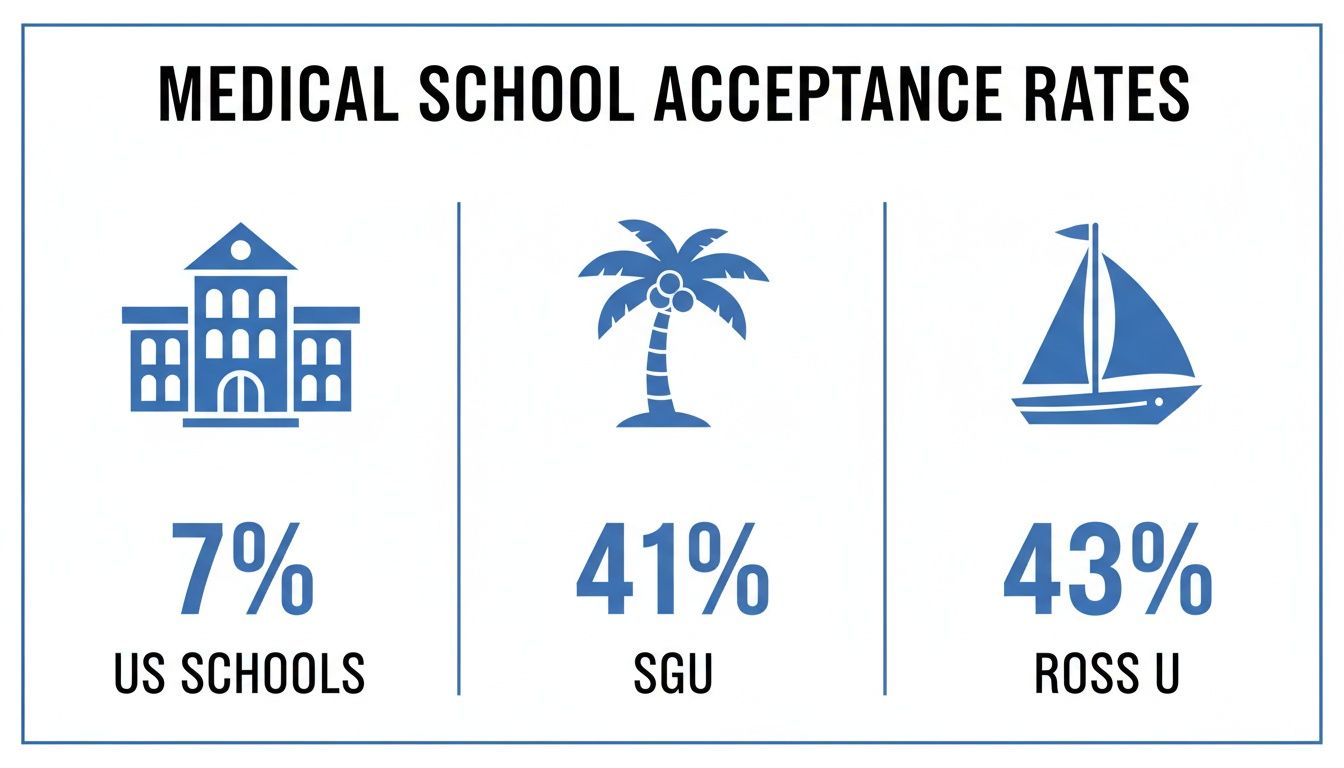
The numbers make it clear. The journey through medical school is tough no matter where you go, but the door to begin that journey is open to a much wider group of qualified applicants in the Caribbean.
To see how the numbers typically stack up side-by-side, here’s a quick comparison of the benchmarks for top Caribbean programs versus the averages for U.S. medical schools.
Caribbean vs US Medical School At-a-Glance Requirements
| Requirement | Top Caribbean Schools (e.g., SGU, Ross) | Average U.S. MD Programs |
|---|---|---|
| Average GPA | 3.2+ | 3.7+ |
| Average MCAT Score | 495-500 | 511+ |
| Application Review | Holistic (Emphasizes experience & resilience) | Heavily metrics-driven |
| Clinical Experience | Strongly recommended | Essentially mandatory |
Keep in mind, these are just averages. A lower GPA or MCAT score doesn't automatically disqualify you, especially if the rest of your application shines. It’s all about building a compelling case for yourself as a future physician.
What Does Holistic Review Really Mean?
You’ll hear the term “holistic review” a lot, but what does it actually mean in practice? It means the admissions committee is trying to see the whole person, not just a set of numbers on a transcript.
A holistic review is designed to identify candidates with the resilience, empathy, and hands-on experience necessary to succeed not only in medical school but also as practicing physicians. It's about assessing your potential, not just your past performance.
They are trying to answer a few key questions by looking at your entire application:
Academic Readiness: Do your science grades and overall academic record show you can handle the firehose of information that is medical school? They’re looking for a solid foundation, typically a GPA of 3.2+ and an MCAT score around 495-500.
Clinical Exposure: Have you actually spent time in a hospital or clinic? They want to see that you’ve gotten your feet wet and understand what you’re signing up for. This shows commitment.
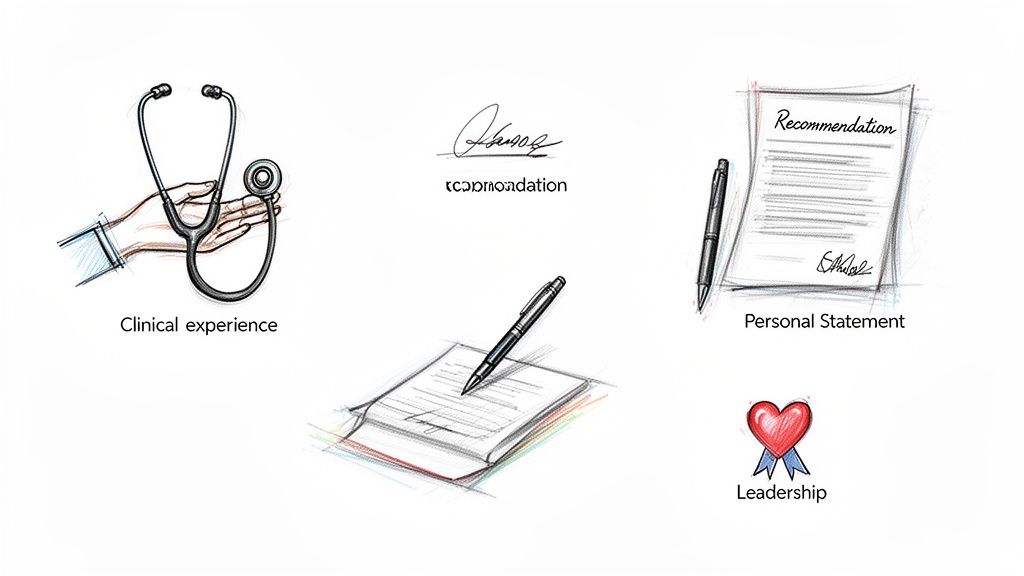
Personal Qualities: Who are you as a person? Your personal statement and letters of recommendation are your chance to show your maturity, compassion, and the real-world experiences that have shaped your desire to become a doctor.
This balanced approach is the cornerstone of the Caribbean medical school application process. It’s about finding the students who have the grit and the heart to become great doctors, even if their path wasn’t a straight line.
Building Your Academic Foundation for Success
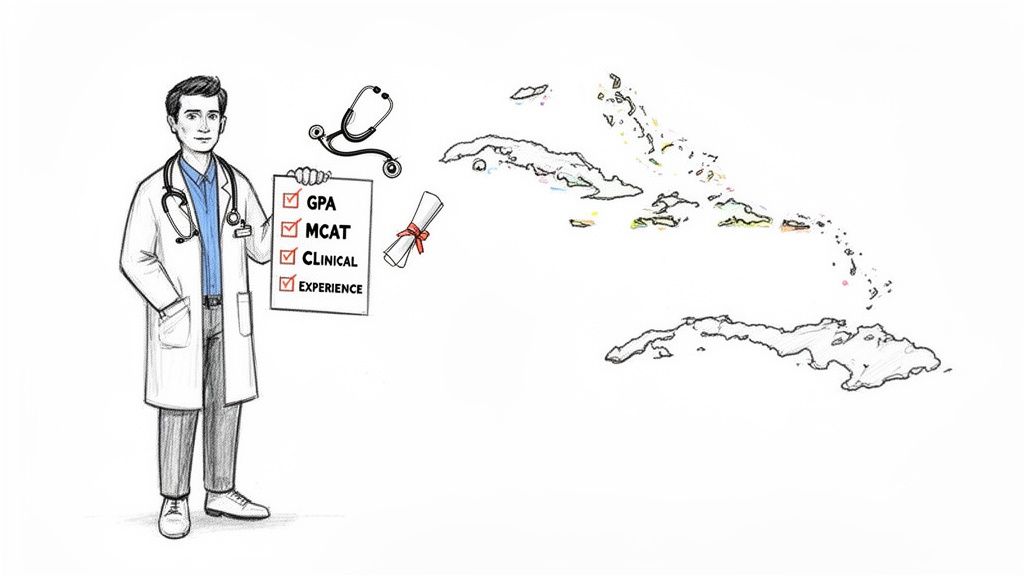
Let’s be direct: your academic record is the first thing an admissions committee sees. It’s their initial litmus test for whether you can handle the intense pace of medical school. But they aren't just scanning for a single number; they're reading the story your transcript tells about your work ethic, intellectual curiosity, and readiness for the road ahead.
Think of it this way: your prerequisite courses are the non-negotiable foundation. Without them, the whole structure is unstable. Your GPA and MCAT score are the framework built on top, showing your overall academic strength and problem-solving ability. Both have to be solid.
The Must-Have Prerequisite Courses
Every Caribbean medical school has a checklist of undergraduate courses you absolutely must have completed. These aren’t just arbitrary hurdles; they represent the fundamental language of medicine. Skipping them is like trying to write a novel without knowing the alphabet. Your application will simply be marked incomplete.
While you should always check the specific requirements for each school, almost every accredited program will be looking for these core classes on your transcript:
- One Year of General Biology with Lab: This is the bedrock. It covers everything from cellular mechanics to genetics, giving you the essential context for human anatomy and physiology.
- One Year of General Chemistry with Lab: Crucial for understanding the molecular tango that governs everything from drug interactions to metabolic pathways.
- One Year of Organic Chemistry with Lab: This builds on general chemistry and is absolutely vital for grasping the complex biochemical reactions you'll be dissecting in your first year of med school.
- One Year of Physics with Lab: The principles of physics explain the mechanics of the human body, from the physics of blood pressure to how an MRI machine actually works.
Most schools also require one year of English and often a semester of college-level math, like calculus or statistics. Bottom line: visit the website of every single school you’re considering and check their specific prerequisite list. Don't get caught by surprise.
Gaining a Competitive Edge with Recommended Courses
Meeting the bare minimum gets your foot in the door. Exceeding it makes you a candidate they remember. Taking advanced science courses shows admissions committees that you’re not just checking boxes—you're genuinely invested and can handle graduate-level material.
Think of recommended courses as an investment in your application. They show a deeper command of the sciences and prove you’re ready for the firehose of information that is medical school.
These courses can give you a serious advantage:
- Biochemistry: If you take one upper-level science, make it this one. It directly prepares you for a massive chunk of your first-year curriculum and is heavily tested on the MCAT.
- Genetics: With the rise of personalized medicine, a strong grasp of genetics is becoming less of a bonus and more of a necessity for modern physicians.
- Physiology and Anatomy: Taking these as an undergrad gives you a huge head start. You'll be reinforcing concepts in medical school instead of learning them from scratch.
How GPA and MCAT Scores Work Together
Your Grade Point Average (GPA) and your Medical College Admission Test (MCAT) score are the two heavy hitters of your academic profile. But admissions committees don’t look at them in a vacuum. They view them as a pair, each telling a part of your academic story.
A strong GPA (for Caribbean schools, you should be aiming for a 3.2 or higher) demonstrates consistency and diligence over time. It proves you can show up, do the work, and master complex material day in and day out. A solid MCAT score (a 495-500+ is a good target) shows you can think critically and apply scientific principles under the pressure of a standardized exam. You can get a clearer picture by reading our guide on the average GPA for medical school acceptance.
These two scores often balance each other. A killer MCAT score can help compensate for a GPA that’s a little lower than you’d like, suggesting you have the raw intellectual horsepower even if you had a slow start in college. On the other hand, a stellar GPA with a slightly lower MCAT can show that while test-taking may not be your superpower, you have a proven track record of academic success.
Of course, the goal is to be strong in both. But if one area is weaker, don’t despair. This is where a holistic review comes in, giving you the chance to make your case with the other, non-academic parts of your application.
Your Story Beyond the Numbers: Building a Standout Non-Academic Profile
Your grades and MCAT score get your foot in the door. They prove you have the academic horsepower to handle the rigors of medical science. But they don't tell the admissions committee who you are, or more importantly, why you want to be a doctor.
Think of it this way: your stats are the black-and-white facts of your case. Your non-academic profile—your experiences, your story, your letters of recommendation—is the closing argument. This is where you connect the dots for them and show the empathy, resilience, and grit that will actually make you a great physician.
Prove It: Why Clinical Experience is Non-Negotiable
Every applicant says they want to help people. It's a given. But saying it isn't enough; you have to show you’ve actually explored what that means in the real world. Clinical experience is your proof. It demonstrates that you’ve stepped out of the classroom and into the chaotic, messy, and deeply human environment of healthcare.
Admissions committees want to see that you've tested your motivation. They’re looking for a variety of experiences that prove you understand the realities of patient care, both good and bad. These hours aren't just for checking a box—they’re for collecting the stories and insights that will give your personal statement and interviews real substance.
A classic mistake is racking up hundreds of hours doing just one thing. Admissions committees aren't impressed by sheer volume; they value quality and variety. They want to see that you’ve looked at medicine from different angles—from the organized chaos of a hospital to the focused calm of a small clinic.
Here are the core experiences you should be aiming for:
- Physician Shadowing: This is your fly-on-the-wall experience. Following a physician lets you see the day-to-day grind, the tough conversations, and the decision-making process up close, without the pressure of having direct responsibility. Try to shadow in a couple of different specialties to broaden your perspective.
- Direct Patient Interaction: This is where you go from watching to doing. Roles like a medical assistant, scribe, certified nursing assistant (CNA), or EMT are gold. They show you can handle the hands-on, and often difficult, human side of medicine.
- Hospital Volunteering: While it's often less hands-on, volunteering still shows a commitment to being in a healthcare setting. You might be transporting patients or stocking supplies, but you’re absorbing the hospital culture and seeing how the system works from the inside.
Getting the Right People in Your Corner: Powerful Letters of Recommendation
A strong letter of recommendation (LOR) is more than just a good review; it's a powerful endorsement from someone who can vouch for your character and potential. A generic letter is a huge missed opportunity, but a great one brings your application to life with specific stories that highlight your best qualities.
The secret is twofold: choose the right people, then make it easy for them to write an amazing letter. The standard expectation is two letters from science professors and at least one from a non-science professor or a physician you've worked with.
Who Should You Ask?
- Science Professors: Pick professors from classes where you did well and, more importantly, where you participated. They need to be able to speak to your academic drive and intellectual curiosity, not just the grade you earned.
- A Physician You Shadowed or Worked With: This letter is critical. It validates your suitability for medicine from someone who’s actually in the field. This needs to come from a doctor who saw you interact with patients and can speak to your professionalism and empathy.
- A Research Mentor or Supervisor: If you have research experience, a letter from your Principal Investigator (PI) is a great way to showcase your analytical skills, work ethic, and ability to contribute to a team.
Don't just ask for a letter and hope for the best. Set your recommenders up for success. Give them a packet with your CV, a draft of your personal statement, and a brief summary of your most meaningful experiences. It's a small step that can turn a decent letter into a truly impactful one.
The Personal Statement: Tying It All Together
This is it. Your personal statement is the heart of your application. It’s your one shot to speak directly to the admissions committee in your own voice and answer the most important question of all: Why do you want to be a doctor?
This is not the place to just re-list your resume. You need to tell a compelling story. Use an anecdote or two from your experiences to show them your journey and what drives you, rather than just telling them.
A winning personal statement does three things really well:
- Shows, Doesn't Tell: Instead of saying, "I'm an empathetic person," describe a specific patient interaction that challenged you and forced you to grow your empathy.
- Reflects, Doesn't Just Report: Don't just list what you did. Dig deeper. What did you learn from that experience? How did it change your perspective and solidify your decision to pursue medicine?
- Connects to the Future: End by looking forward. How has this unique combination of experiences prepared you to become the kind of compassionate, effective physician you hope to be?
Your non-academic profile is your narrative. It’s what gives context and meaning to your grades and scores. It’s your chance to show them the person who will one day wear the white coat. Make it authentic, make it compelling, and make it memorable.
Navigating Your Application Timeline and Logistics
Putting together a strong profile is only half the battle; the other half is actually managing the application process. The logistics of applying to Caribbean medical schools are full of specific timelines and paperwork that can easily trip up even the most qualified candidates.
It’s best to think of this not as a single submission, but as a year-long project with distinct phases. Approaching your application with a clear timeline is the single best way to reduce stress and avoid costly mistakes. It lets you focus on the quality of your work instead of scrambling to meet a deadline. Missing a key date or submitting incomplete documents can sideline your application before an admissions officer even sees your personal statement.
Mapping Out Your Application Year
The journey doesn't start the day you hit "submit"—it begins about a year earlier. Here’s a general timeline to keep you on track, starting 12-15 months before you hope to matriculate.
Summer (12-15 Months Before Matriculation): This is your prep phase. Finalize your school list, register for the MCAT, and start drafting your personal statement. This is also the perfect time to formally ask professors and physicians for letters of recommendation, giving them plenty of notice.
Fall (9-12 Months Before): Take the MCAT if you haven't already. Now's the time to polish your personal statement and gather all your documents, especially transcripts from every undergraduate institution you attended. Double-check that your letter writers have submitted their recommendations.
Winter/Spring (5-9 Months Before): Application season is officially open. Get your primary applications in as early as you can, since many schools use rolling admissions. Once you submit, you’ll start receiving secondary applications. These are school-specific essays that require a quick turnaround—usually within two to four weeks.
A common mistake is underestimating the time and effort secondaries require. They are not an afterthought. They are a critical part of the caribbean medical school requirements and your chance to show genuine interest in a specific program. Treat each one with the same seriousness as your primary application.
Key Logistics for International Applicants
For applicants coming from the US, Canada, or elsewhere, the process has a few extra steps. These are non-negotiable and demand careful attention. Getting them wrong can cause major delays.
Transcript Evaluation Services
Your undergraduate transcripts from non-Caribbean institutions need to be officially evaluated to ensure they meet the school's standards. This isn't just making a photocopy; it’s a formal review done by a third-party agency.
You'll need to use a service like World Education Services (WES) or a similar NACES-accredited organization. This process can take 4-6 weeks, so you must start it well before any deadlines. The service creates a course-by-course evaluation that translates your grades and credits into a standardized format for the admissions committee.
Student Visas and Financial Proof
Once you get that acceptance letter, the next big hurdle is securing a student visa. To do this, you have to prove you have enough money to cover tuition and living expenses for at least your first year.
This is a make-or-break step. Schools will require official bank statements, letters of financial support, or documentation of approved loans. The specific amounts and required documents vary by country and school, so contact the international student office the moment you're accepted. This paperwork is absolutely essential for the embassy or consulate when you apply for your visa.
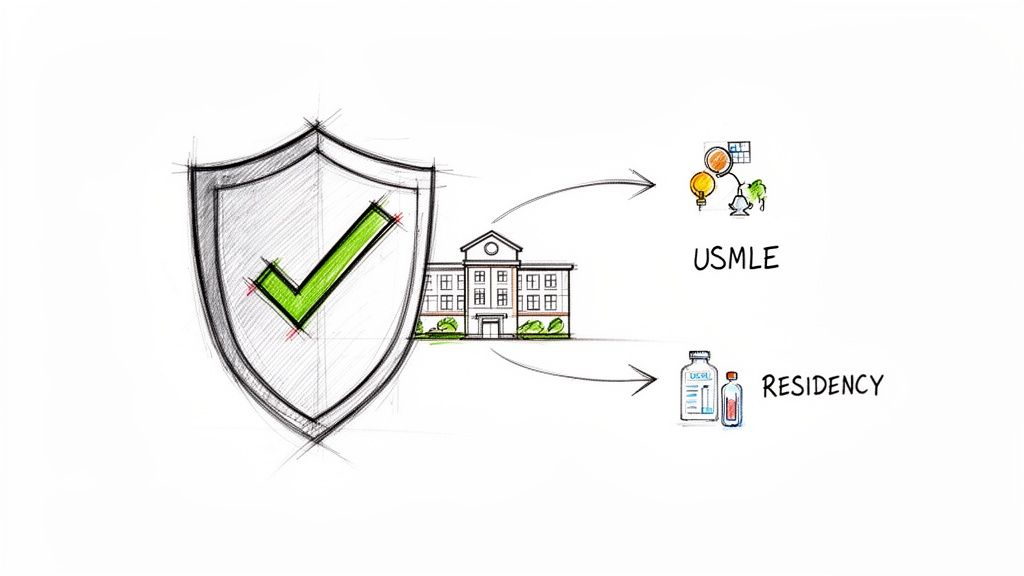
Of all the things you’ll scrutinize when looking at Caribbean medical schools, nothing comes close to accreditation. Think of it as the official passport for your medical degree. Without the right stamps from the right authorities, your MD is essentially stuck on the island, useless for practicing medicine in the United States or Canada.
This isn’t just about checking a box. Accreditation is a tough, independent quality control process. These agencies dig into a school's curriculum, faculty, facilities, and—most importantly—student outcomes to make sure they’re hitting a high, internationally recognized bar. An unaccredited school might hand you a degree, but for your actual career goals, it's a dead end.
Your entire future hinges on this. Can you take the United States Medical Licensing Examination (USMLE)? Can you land clinical rotations back in the U.S.? Can you even enter the residency match? It all comes back to your school's accreditation. It’s the one factor that determines whether your massive investment of time and money actually leads to a license to practice.
Decoding the Alphabet Soup of Accreditation
The world of accreditation feels like an alphabet soup of acronyms, but there are only a few you really need to know. These organizations are the gatekeepers that U.S. and Canadian medical authorities trust. Seeing their stamp of approval is your first green light.
First and foremost, you need to verify that a school has been evaluated by an agency that is itself recognized by the World Federation for Medical Education (WFME). This is the global gold standard.
A common and highly respected accrediting body for Caribbean schools is:
- CAAM-HP (Caribbean Accreditation Authority for Education in Medicine and Other Health Professions): This is one of the big ones in the region. Its standards are intentionally designed to be on par with the Liaison Committee on Medical Education (LCME), which is the body that accredits all U.S. and Canadian medical schools.
Another one you'll likely run into is:
- ACCM (Accreditation Commission on Colleges of Medicine): This is another recognized agency that holds schools to the same tough standards you'd find in the United States.
Here's a crucial piece of the puzzle: the U.S. Department of Education’s National Committee on Foreign Medical Education and Accreditation (NCFMEA) has to determine that the accrediting body's standards are comparable to those used in the U.S. This is the specific determination that unlocks access to U.S. federal student loans for students at these schools.
Before we move on, it's critical to have a clear checklist. Accreditation isn't something you can take a school's word for—you have to verify it yourself. These are the key credentials that ensure your path to residency in the U.S. remains open.
Key Accreditation & Recognition Checklist
| Accreditation/Recognition Body | What It Means for You (The Applicant) | How to Verify |
|---|---|---|
| World Federation for Medical Education (WFME) | This is the global standard. The accrediting agency of your school must be recognized by WFME for you to be eligible for ECFMG certification after 2024. This is non-negotiable. | Visit the WFME Recognition Programme page and check their list of recognized agencies. |
| NCFMEA Comparability Determination | This determination by a U.S. Dept. of Education committee means the standards of the school's accrediting body are comparable to U.S. standards. This is the key that unlocks eligibility for U.S. federal student loans. | Check the NCFMEA's official list of countries with comparable accreditation standards. |
| ECFMG Recognition | The Educational Commission for Foreign Medical Graduates (ECFMG) is the gatekeeper for IMGs entering the U.S. system. Your school must be listed in the World Directory of Medical Schools and recognized by ECFMG. | Search for the school in the World Directory of Medical Schools and check its "Sponsor Notes" tab for ECFMG eligibility details. |
Think of this table as your fraud-detection kit. If a school can't tick every one of these boxes, it's an immediate red flag. Don't just look for logos on a school’s website; go directly to the source and verify their status.
The Connection to Your Medical Career Path
Accreditation isn’t some abstract concept—it has immediate, real-world consequences for every single step of your journey to becoming a doctor. It’s the master key. Without it, you'll find every important door locked shut.
Proper accreditation is what allows you to:
Sit for the USMLE: You literally cannot register for the USMLE Step exams—which are mandatory for practicing in the U.S.—unless you're a student or graduate of a school recognized by the Educational Commission for Foreign Medical Graduates (ECFMG). And ECFMG only recognizes schools accredited by a WFME-recognized agency.
Become ECFMG Certified: Passing your boards is just one step. To even apply for a U.S. residency program, you have to get ECFMG Certification. This is completely impossible if you didn't graduate from a properly accredited school.
Participate in the Residency Match: The National Resident Matching Program (NRMP), or "The Match," is how medical graduates get placed into U.S. residency jobs. To participate, you must be ECFMG certified. No accreditation, no certification, no match. It’s that simple.
Obtain a State Medical License: After residency, every state medical board has its own rules for getting a license. But they all require graduation from a recognized medical school, which brings everything right back to accreditation.
In short, choosing a school with the wrong accreditation is like buying a ticket for a train that doesn't go where you need to go. You might be on board for the ride, but you’ll never arrive at your destination. Always, always verify a school's status directly on the accrediting body's website.
Preparing for the Medical School Interview
After months of grinding away at academics and carefully crafting your story, the interview is the final gateway. It’s where your application gets a pulse. Think of it as a two-way street: the school is absolutely assessing your fit, but you’re also getting a feel for their culture, their expectations, and whether this is truly the right place for you.
A medical school interview isn't like a standard job interview where they just verify your resume. They’re designed to see how you think. Caribbean schools, in particular, need to gauge your resilience, maturity, and self-awareness. They’re looking for proof that you can handle the unique challenge of moving to another country to start one of the most demanding educational paths imaginable.
Understanding the Interview Formats
While some schools stick to the traditional one-on-one interview, many have embraced the Multiple Mini Interview (MMI) format. The MMI isn't one long conversation; it’s a series of short, focused sprints.
In an MMI, you rotate through several stations, each with a different interviewer and a unique scenario. You’ll get a couple of minutes to read a prompt, then 5-10 minutes to discuss it. The whole point is to test your critical thinking, ethics, and communication skills under pressure, giving the school a much more holistic view of who you are.
The great thing about the MMI is that it neutralizes the risk of one "bad" interview. If you stumble at one station, it has zero bearing on the next. You get multiple fresh starts to make a good impression. To get comfortable with the pacing and style, it's a smart move to practice with a medical school mock interview.
What They Are Really Asking
Interview questions are rarely about finding a single "right" answer. They’re built to see your thought process in action. The prompts usually fall into a few key categories, each probing a different facet of your character.
- Ethical Scenarios: These test your moral compass. (e.g., "A patient is refusing a life-saving treatment for religious reasons. What do you do?")
- Situational Judgment: These gauge your problem-solving skills and professionalism. (e.g., "You witness a fellow student cheating on an important exam. What is your course of action?")
- Personal Insight: These questions are all about your motivations and self-awareness. (e.g., "Tell me about a time you failed and what you learned from it.")
- Cultural Awareness: These are especially critical for Caribbean schools. (e.g., "How will you adapt to living and studying in a new country with a different culture?")
Your goal isn't to be perfect; it's to be thoughtful. Articulate your reasoning out loud, acknowledge different perspectives, and always bring your answer back to the core values of medicine—empathy, patient advocacy, and integrity. Show them you're a mature, reflective individual who is ready for the responsibility that lies ahead.
Common Questions About Caribbean Medical Schools
Navigating the path to a Caribbean medical school always brings up a few key questions. Let's tackle some of the most common concerns head-on to give you the clarity you need to make the right choice for your future.
Can I Get Into a Caribbean Medical School Without the MCAT?
The short answer is yes, some schools might let you in without an MCAT score. But the real question is, should you? The most reputable institutions—the ones that lead to U.S. residencies—absolutely require it.
Think of the MCAT as a non-negotiable step. You can't even sit for the USMLE exams, let alone match into a U.S. residency program, without it. A school that's willing to waive this requirement should be seen as a major red flag, as it could seriously limit your career options in the States before you’ve even started.
How Do Clinical Rotations Work?
For most programs, the first two years of your training, which cover the basic sciences, happen on the island campus. After that, you'll spend your final two years doing clinical rotations at affiliated teaching hospitals.
These rotations are typically located in the United States, Canada, or the UK. It is absolutely critical that you dig into a school’s hospital affiliations. The quality and accreditation of these clinical sites directly shape the strength of your residency application and give you the hands-on experience you'll need in the healthcare system you plan to join.
What Is the True Cost of Attending?
On paper, tuition can look similar to private U.S. medical schools. However, the sticker price is just the beginning. Your budget needs to account for the realities of island living, international travel back and forth for rotations, comprehensive health insurance, and all the various exam fees along the way.
You can learn more about the financial side of things by exploring our detailed guide to understanding the medical school acceptance rate and what it means for your investment.
While some top-tier Caribbean schools do participate in U.S. federal loan programs, creating a detailed financial plan is non-negotiable. Understanding the total investment from day one is a core part of the Caribbean medical school requirements and ensures you have a sustainable path to earning your MD.
Prepare for your interviews with a tool designed for success. Confetto offers an AI-powered platform to practice realistic MMI and panel interviews 24/7, with instant feedback on everything from communication to critical thinking. Gain the confidence you need by visiting https://confetto.ai to start your free trial.