
Updated · Published
Healthcare Interview Questions and Answers: Top 10
The top 10 healthcare interview questions with answer strategy: tell me about yourself, ethical dilemmas, why this school, patient safety, teamwork and more.

The 10 most common healthcare interview questions: tell me about yourself, an ethical dilemma, why this school, patient safety, health disparities, teamwork, why medicine, research, failure and global health. Each comes with a model answer below. Answer with a short, specific story. To say your own stories out loud first, Confetto, an AI mock interviewer for medical school and other healthcare program interviews (MMI, traditional, panel), asks questions like these in mock interviews and gives rubric-based feedback on every answer.
The healthcare interview isn't just a test of your knowledge; it's a rigorous assessment of your character, reasoning, and readiness to care for others. Whether you're facing a traditional panel, a high-stakes Multiple Mini Interview (MMI) station, or a hybrid format, a core set of questions consistently appears. These questions are designed to probe your deepest motivations, ethical frameworks, and critical thinking skills under pressure.
This guide moves beyond generic tips to provide a strategic breakdown of the 10 most crucial healthcare interview questions and answers you will encounter. We dissect each question with detailed model responses, explaining the logic that makes them effective. You won't just see what to say; you'll understand why it works.
Inside, you will find:
- Detailed Model Answers: Structured responses for various healthcare programs.
- Strategic Rationale: The "why" behind each component of the answer.
- Common Pitfalls: Critical mistakes to avoid that can derail an interview.
- Scoring Rubric Insights: A look into how admissions committees evaluate your performance.
By mastering the frameworks presented here, you will learn how to articulate your journey with confidence, navigate complex ethical dilemmas with nuance, and demonstrate that you are the compassionate, competent future clinician they are searching for. This is your blueprint for transforming interview anxiety into a compelling performance that proves your suitability for a career in medicine and patient care. Let's begin.
1. Tell Me About Yourself / Background Question
This foundational question is your interview’s opening act, setting the stage for everything that follows. Whether in a traditional panel or a Multiple Mini Interview (MMI) station, your response establishes your narrative, maturity, and core motivations for entering healthcare. It is one of the most common healthcare interview questions and answers you must prepare.
A weak answer simply lists resume items. A powerful answer synthesizes them into a compelling story that connects your past experiences to your future aspirations in medicine, dentistry, or another health profession.
Strategic Breakdown
The goal is to present a concise, 2-to-2.5-minute narrative that bridges your personal story with the professional values of healthcare. Instead of a chronological recitation, structure your answer around a central theme. This theme should reflect your unique motivation-perhaps a specific patient interaction, a family experience, or a passion for scientific inquiry linked to human well-being.
Successful Response Analysis:
- Narrative Hook: "I grew up in a rural community with limited healthcare access. My grandmother's stroke at age 60-treated hours away-inspired me to pursue medicine."
- Evidence: "Since then, I've shadowed rural physicians, volunteered at a free clinic, and led community health initiatives."
- Mission Statement: "I'm drawn to medicine because it lets me combine clinical problem-solving with advocacy for underserved populations."
This works because it establishes a personal connection (grandmother's stroke), demonstrates proactive exploration (shadowing, volunteering), and concludes with a clear, mission-driven career goal that aligns with healthcare values.
Actionable Tips for Your Answer
- Select 2-3 Pivotal Experiences: Choose moments that genuinely shaped your path, not just impressive-sounding activities.
- Connect to Core Values: Explicitly link each experience to a key healthcare competency like compassion, leadership, or critical thinking.
- Tailor to the Institution: Research the school's mission. If they emphasize research, highlight your lab experience; if they focus on community health, lead with your volunteer work.
- Practice, Don't Memorize: Rehearse until your story flows naturally. Record yourself to check for pacing and eliminate filler words.
For a deeper dive into crafting your narrative, explore more tips on how to effectively answer the 'Tell Me About Yourself' question. To practice your delivery and receive targeted feedback, you can explore various prompts in the Confetto question bank.
2. Ethical Dilemma / Moral Conflict Scenario
A cornerstone of healthcare interviews, this question type evaluates your reasoning, not your ability to find a single "correct" answer. Often presented in Multiple Mini Interview (MMI) stations, these scenarios force you to navigate complex situations involving patient autonomy, confidentiality, and resource allocation. They are a crucial test of your ethical compass and professional judgment.
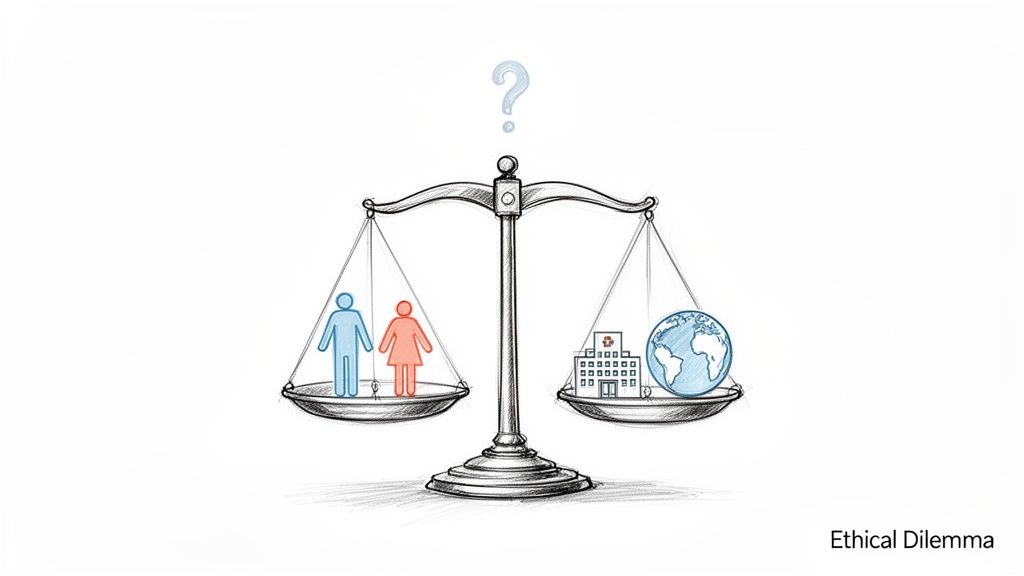
A weak answer offers a quick, definitive judgment. A strong answer demonstrates a thoughtful, structured process for weighing competing values and considering all stakeholders. This is one of the most challenging healthcare interview questions and answers to master, but it reveals your maturity and capacity for nuanced decision-making.
Strategic Breakdown
The goal is to articulate your reasoning process clearly and transparently. Interviewers want to see how you think, not just what you think. Your response should acknowledge the complexity of the situation, identify the core ethical principles in conflict, and outline a balanced, step-by-step approach to gathering information and making a decision.
Successful Response Analysis:
- Acknowledge Complexity: "This is a challenging situation with no easy solution. My immediate priority is the patient's well-being and safety."
- Identify Principles: "The core conflict here is between patient autonomy-the 16-year-old's right to make her own health decisions-and legal or institutional policies."
- Propose Action & Rationale: "I would first speak with the patient privately to understand her reasons and ensure she is not in danger. I would then explain my obligations and the limits of confidentiality, exploring options with her to find the safest path forward."
This response works because it avoids a knee-jerk reaction. It shows a methodical approach: prioritize safety, gather information, identify the ethical conflict, and collaborate with the patient within professional boundaries.
Actionable Tips for Your Answer
- Name the Principles: Explicitly mention key ethical tenets like autonomy, beneficence, non-maleficence, and justice. This provides a framework for your analysis.
- Consider All Stakeholders: Acknowledge the perspectives of the patient, family, healthcare team, institution, and even society.
- Show, Don't Just Tell: Instead of saying "I am empathetic," demonstrate it by describing how you would speak to the patient and what you would ask.
- Embrace Uncertainty: It's okay to state that the situation is complex. Saying "I would need more information" or "I would consult a colleague or ethics committee" shows maturity and humility.
For more practice navigating these complex scenarios, you can explore various prompts and strategies in articles covering MMI interview questions. To rehearse your reasoning in a simulated environment, you can use the extensive library of ethical dilemmas on the Confetto platform.
3. Why This School? / Mission Alignment Question
This question directly tests your genuine interest and research into a specific institution. Whether framed as "Why [School Name]?" or "What attracts you to our curriculum?", your answer reveals whether you see the program as a unique opportunity or just another stop on your interview tour. It's a critical component of healthcare interview questions and answers because it demonstrates respect and intentionality.
A weak answer relies on reputation or rankings. A strong response demonstrates a deep, specific connection between your personal goals and the school's unique mission, programs, and community.
Strategic Breakdown
The goal is to prove you are an excellent "fit" by connecting your specific aspirations to the institution's distinct offerings. This requires moving beyond the homepage and digging into faculty research, specialized clinical tracks, or unique community partnerships. Your answer should articulate not only what you will gain from the school but also what you will contribute.
Structure your response around 2-3 specific, compelling points of connection that are unique to that institution.
Successful Response Analysis:
- Narrative Hook: "I've been following the work of the [Specific Center or Institute] at your school, particularly Dr. Smith's research on Alzheimer's biomarkers, which aligns perfectly with my undergraduate thesis work."
- Evidence: "I am also drawn to your student-run [Name of Clinic], as my experience volunteering at a free clinic has fueled my passion for serving uninsured populations. I see a direct opportunity to apply my skills there."
- Mission Statement: "Ultimately, your school's commitment to translational research and community-embedded care represents the exact environment where I believe I can grow into a physician-scientist who bridges the lab and the clinic."
This works because it's highly specific (Dr. Smith, a particular clinic), shows proactive research, and links the candidate's past experiences to future contributions within the school's existing framework.
Actionable Tips for Your Answer
- Go Beyond the Mission Statement: Find concrete examples of the school’s mission in action, such as specific courses, community projects, or global health opportunities.
- Name Names and Programs: Mention 1-2 faculty members whose work excites you or a unique curricular element (e.g., a rural health track, an early patient contact program) that fits your goals.
- Connect to Your Contributions: Frame your interest in terms of mutual benefit. Explain how your background in public health, for example, would allow you to contribute meaningfully to their community outreach initiatives.
- Tailor Meticulously: Never use a generic "Why this school" answer. Each response must be customized, proving you have invested time and effort in understanding what makes that specific program the right one for you.
4. Patient Safety / Clinical Error Scenario
Scenario-based questions about clinical errors or patient safety are designed to test your real-time judgment, accountability, and communication skills under pressure. Interviewers use prompts like, "You notice a colleague prescribing an incorrect dose. How do you handle it?" to assess whether you prioritize patient well-being above all else, including social awkwardness or fear of confrontation.
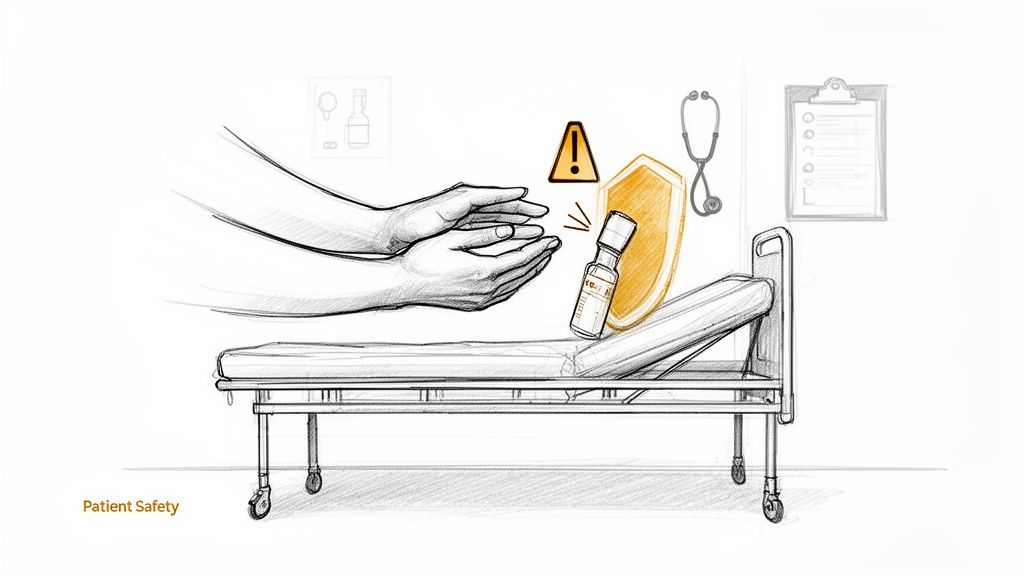
A weak answer is punitive or jumps to conclusions. A strong response demonstrates a nuanced understanding of medical hierarchy, respectful communication, and a systems-based approach to error prevention. This is a critical category of healthcare interview questions and answers, reflecting the core principle of "first, do no harm."
Strategic Breakdown
Your goal is to articulate a step-by-step process that is immediate, respectful, and effective. The framework should always begin with ensuring the patient is safe, followed by direct, private communication with the colleague involved. The final steps involve a clear escalation pathway and a focus on learning from the event to prevent recurrence. This shows maturity and an understanding that safety is a team responsibility, not a matter of individual blame.
Successful Response Analysis:
- Prompt: "During a shift, you see your senior resident hasn't re-examined a post-op patient in 24 hours, and the patient's pain is uncontrolled. What do you do?"
- Direct Action: "My first priority is the patient. I'd approach my resident privately and respectfully: 'I noticed Mr. Smith hasn't been reassessed since yesterday, and he's reporting severe pain. I'm concerned-can we check on him together?'"
- Escalation Plan: "This approach respects the hierarchy while centering the patient. If this behavior was a pattern or my concern was dismissed, I would feel obligated to escalate to the attending physician or use the institution's formal safety reporting system."
This answer succeeds because it is collaborative, not confrontational. It offers a solution ("let's check on him together") and shows awareness of established safety protocols for unresolved issues.
Actionable Tips for Your Answer
- Frame with a "Safety-First" Mindset: Always state that your immediate concern is the patient's welfare.
- Communicate Respectfully and Privately: Avoid blaming or shaming colleagues. Assume good intent but address the action directly.
- Know the System: Mention institutional resources like incident reporting systems, ethics committees, or Morbidity & Mortality (M&M) rounds to show you understand how healthcare systems learn from errors.
- Have a Clear Escalation Pathway: Clearly state who you would talk to next if your initial, direct communication fails. This demonstrates you won't let a safety issue drop.
5. Health Disparities / Social Determinants Question
This question reflects healthcare's critical shift toward equity and social accountability. Prompts like, "How will you address social determinants of health?" or "Describe a time you witnessed a health disparity" are designed to assess your understanding of systemic barriers, your cultural humility, and your commitment to providing inclusive care.
A weak answer attributes health outcomes solely to individual choices. A strong response demonstrates an understanding of the complex interplay between societal factors-like housing, income, and education-and a patient's well-being. This is one of the most important healthcare interview questions and answers to master, as it signals your readiness for modern clinical practice.
Strategic Breakdown
Your goal is to show that you see the patient within their broader life context. The answer should move beyond simple observation of a problem and toward a nuanced analysis of its root causes, coupled with a humble, collaborative approach to solutions. It's an opportunity to showcase your grasp of public health principles and your capacity for advocacy.
Successful Response Analysis:
- Systemic Framing: "In a free clinic, I worked with a diabetic patient who struggled with his A1c levels. It wasn't about non-compliance; it was about food insecurity. He lived in a food desert and couldn't afford or access fresh, healthy options."
- Action & Reflection: "I helped connect him with a local food bank, but I recognized this was a temporary fix for a systemic problem. It taught me that my role as a physician must extend beyond the clinic walls."
- Mission Statement: "As a future physician, I will actively screen for social determinants of health and collaborate with social workers and community resources to address these barriers, while also advocating for policies that promote health equity."
This response works because it avoids blaming the patient, correctly identifies a systemic barrier (food desert), shows proactive problem-solving, and connects the experience to a future professional identity rooted in advocacy and equity.
Actionable Tips for Your Answer
- Use Specific Terminology: Incorporate terms like "social determinants of health," "health equity," and "structural barriers" to show your knowledge.
- Focus on Systems, Not Saviors: Frame your role as a partner or advocate, not a rescuer. Emphasize collaboration with interprofessional teams and community organizations.
- Acknowledge Your Own Biases: Briefly mentioning your commitment to ongoing self-reflection and learning about different cultures demonstrates profound maturity and humility.
- Research Institutional Fit: If the institution has a strong community health mission or specific equity initiatives, align your answer with their values to show genuine interest.
To build confidence in discussing these complex topics, you can practice with similar prompts in the Confetto question bank. For a deeper understanding of the core concepts, the World Health Organization's resources on SDOH are an excellent starting point.
6. Teamwork and Conflict Resolution Scenario
This behavioral question assesses your interpersonal skills and emotional intelligence. Interviewers present scenarios like, "Tell me about a time you worked with someone you didn't get along with" to see if you handle conflict constructively. Healthcare is a team sport; this question tests your ability to prioritize shared goals over personal friction, making it a crucial part of healthcare interview questions and answers.
A weak response blames others and shows a lack of self-awareness. A strong answer demonstrates a mature, systematic approach to resolving interpersonal challenges, focusing on communication, empathy, and a shared mission.
Strategic Breakdown
The goal is to show you are a collaborative problem-solver, not a source of drama. Your answer should frame conflict not as a fight to be won, but as a problem to be solved together. Structure your response using the STAR method (Situation, Task, Action, Result) to provide a clear, concise narrative that highlights your maturity and communication skills.
Successful Response Analysis:
- Situation & Task: "During a biochemistry group project, a teammate consistently missed deadlines, jeopardizing our grade and causing stress for the group."
- Action: "Instead of complaining, I invited them for coffee to understand their perspective. I learned they were dealing with a family issue. We then rearranged the workflow to better support their situation while ensuring all tasks were completed."
- Result & Reflection: "We not only submitted a successful project, but our team dynamic improved. I learned that seeking to understand the 'why' behind someone's actions is the first step to resolving any conflict."
This answer succeeds because it demonstrates proactive communication, empathy, and a focus on solutions rather than blame. It shifts the narrative from "a difficult person" to "a person in a difficult situation."
Actionable Tips for Your Answer
- Choose a Real, Resolved Conflict: Select a story where you played an active role in reaching a positive outcome or learned a valuable lesson.
- Focus on Your Actions: Emphasize what you did, said, and thought. Your internal thought process is as important as your external actions.
- Use “I” Statements: Frame your actions from your perspective (e.g., “I felt concerned, so I decided to...”) to show ownership and reflection.
- Avoid Blame: Never demonize the other person. Acknowledge that conflict is often a result of miscommunication, different working styles, or external pressures.
- Practice Your Delivery: Rehearsing these stories is key to sounding confident and poised under pressure. To manage your time effectively during practice sessions, you can use tools like an MMI timer to ensure your answers are concise.
7. Motivation for Healthcare / Why Medicine Question
This is arguably the most critical question in any healthcare interview, probing the very core of your candidacy. Your answer to "Why do you want to be a doctor/dentist/PA?" reveals your understanding of the profession, your capacity for self-reflection, and whether your motivations align with the service-oriented values of healthcare.
A weak answer is generic, relying on clichés like "I love science and I want to help people." A powerful answer weaves together specific personal experiences, intellectual curiosity, and a realistic understanding of the profession into a compelling narrative that is uniquely yours.
Strategic Breakdown
The goal is to deliver an authentic, 2-to-2.5-minute response that demonstrates multifaceted motivation. Your answer should move beyond a simple desire to help and illustrate how your experiences have shaped a sophisticated understanding of what a healthcare career entails. Structure your response around 2-3 key experiences that led to your decision.
Successful Response Analysis:
- Narrative Hook: "During a volunteer shift at a community clinic, I cared for a patient with uncontrolled hypertension. Her barriers weren't purely medical; she worked two jobs and couldn't afford medications."
- Evidence: "I watched her primary care provider adjust her regimen, connect her with assistance programs, and build a trusting relationship. It showed me how medicine blends clinical problem-solving with patient advocacy."
- Mission Statement: "That experience solidified my desire to pursue a career where I can integrate scientific knowledge with a deep commitment to addressing the social determinants of health."
This answer is effective because it uses a specific anecdote (the hypertension patient) to illustrate a nuanced understanding of healthcare (clinical science + advocacy) and concludes with a mission that is both personal and professional.
Actionable Tips for Your Answer
- Go Beyond the Cliché: Instead of just saying you want to help people, describe a specific time you did help someone and what you learned from it.
- Acknowledge the Challenges: Show maturity by mentioning your awareness of the demanding nature of healthcare, and briefly explain how you've prepared for it.
- Connect Intellect and Compassion: Healthcare is a thinking and a feeling profession. Make sure your answer reflects your interest in both the scientific challenges and the humanistic aspects of care.
- Practice Your Story Arc: Rehearse your key points so they form a coherent narrative. Your motivation should sound like a journey of discovery, not a sudden decision.
8. Research Experience / Intellectual Contribution Question
This question assesses your intellectual curiosity, scientific reasoning, and capacity for scholarly contribution. Whether discussing bench research, a clinical quality improvement project, or a humanities thesis, interviewers want to see how you think, solve problems, and communicate complex ideas. It's a key part of evaluating your fit for research-intensive programs and is a staple in many healthcare interview questions and answers.
A weak answer passively describes tasks performed. A strong answer actively demonstrates your intellectual ownership of a project, highlighting your specific contributions, the challenges you overcame, and the broader implications of the work.
Strategic Breakdown
The goal is to frame your experience as a story of inquiry and discovery, not just a list of techniques. Your narrative should show you as a proactive contributor who thinks critically about a problem, not simply a pair of hands in a lab. Structure your response to highlight the question, your specific actions, the outcome, and your reflection on the process.
This approach demonstrates your ability to engage with the scientific method, persevere through obstacles, and connect scholarly work to the human side of healthcare.
Successful Response Analysis:
- Problem Statement: "My quality improvement project at a federally qualified health center examined barriers to blood pressure control in our Latino patient population."
- Your Contribution: "I designed and implemented a bilingual patient survey and reviewed charts, discovering that health literacy and medication cost were the primary barriers, not adherence alone."
- Impact & Reflection: "My findings led to a new low-cost generic program and translated educational materials. This taught me how crucial it is to integrate patient perspectives and systems-thinking to improve health outcomes."
This works because it clearly defines the problem, isolates the candidate's specific intellectual contribution (analysis beyond data entry), and links the scholarly activity directly to a tangible patient-centered improvement.
Actionable Tips for Your Answer
- Own Your Contribution: Clearly state what you did. Instead of "we found," say "I analyzed the data and discovered..."
- Translate Jargon: Explain your work in clear, accessible terms. Assume your interviewer is a smart, educated professional but not an expert in your specific field.
- Discuss Challenges: Mention a problem you encountered and how you solved it. This showcases resilience and critical thinking.
- Connect to Patient Care: Even if your research was basic science, draw a line to its potential impact on future patients or the healthcare system.
- Practice Your Pitch: Rehearse a concise, 1-2 minute summary of 1-2 key projects. Use a tool like the Confetto question bank to practice articulating your research story clearly and compellingly.
9. Failure / Challenge and Resilience Question
This behavioral question probes your response to adversity with prompts like, "Tell me about a time you failed" or "Describe a challenge you overcame." It assesses resilience, humility, and your growth mindset, all critical traits in high-stakes healthcare environments. Interviewers are looking for candidates who can acknowledge mistakes, take responsibility, and demonstrate genuine learning.
A weak answer deflects blame or claims to have never failed. A powerful answer frames a genuine setback as a catalyst for significant personal and professional growth, making it a key part of your preparation for healthcare interview questions and answers.
Strategic Breakdown
The goal is to narrate a concise story that demonstrates self-awareness and improvement. The focus should be less on the failure itself and more on your response and the resulting lessons. Choose a real, significant challenge with tangible consequences, and structure your answer to highlight accountability, problem-solving, and the application of what you learned.
Successful Response Analysis:
- Acknowledge Failure: "I was devastated when I received a 68% on my first organic chemistry exam. I had always been a strong student and my confidence was shaken."
- Take Ownership & Action: "Instead of blaming the professor, I met with her to review the exam. I realized I was just memorizing facts, not understanding the mechanisms. I completely changed my approach, formed a study group, and started using office hours."
- Demonstrate Growth: "My grades improved significantly, but the real lesson was in learning how to adapt my strategies and proactively seek help. It's a skill I now use in my research and clinical experiences."
This works because it shows accountability, a proactive solution, and a clear, transferable lesson. It transforms a negative experience into evidence of maturity and readiness for the rigors of a healthcare career.
Actionable Tips for Your Answer
- Choose a Genuine Failure: Avoid "humble brags" like being "too much of a perfectionist." Select a real academic, personal, or extracurricular setback.
- Focus on the "What Next": Dedicate most of your answer to the steps you took to recover and what you learned. The STAR method (Situation, Task, Action, Result) can be a helpful framework.
- Connect to Healthcare: Explicitly link the lesson to the demands of being a healthcare professional, such as handling unexpected outcomes or collaborating with a team.
- Show Emotional Maturity: Beyond just recounting experiences, demonstrating genuine growth involves showing how to build emotional resilience in your life. This conveys you can handle pressure without becoming defensive or discouraged.
10. Global Health / International Medicine Interest Question
This question assesses your cultural competence, awareness of systemic health disparities, and understanding of medicine's global context. Interviewers want to see genuine humility and a commitment to partnership, not a "savior" mentality. Your answer is a critical opportunity to demonstrate maturity and a nuanced perspective on global health challenges.
A weak answer frames international experiences as a personal achievement or a one-sided act of "helping." A strong response highlights collaboration, learning from local communities, and understanding the complex socio-economic barriers to health. It is a key topic among healthcare interview questions and answers that reflects the interconnectedness of modern medicine.
Strategic Breakdown
Your goal is to convey that you see global health not as an exotic adventure, but as a complex field requiring partnership, respect, and long-term commitment. Structure your answer to demonstrate a journey from initial interest to a deeper, more informed understanding. The narrative should focus on what you learned and how you collaborated, not just what you did.
Successful Response Analysis:
- Narrative Hook: "During a summer fellowship at a maternal health clinic in rural Peru, my role was not to lead but to listen and support the work of local midwives."
- Evidence: "I learned their primary challenge wasn't a lack of clinical skill but a lack of reliable electricity for sterilizing equipment. I helped them research and write a grant proposal for a small solar power system, a solution they had identified long before my arrival."
- Mission Statement: "This taught me that sustainable global health is about empowering local experts and addressing systemic barriers, a principle I hope to apply in my future practice, whether at home or abroad."
This works because it immediately decenters the applicant, positioning them as a learner and collaborator. It identifies a specific systemic issue (infrastructure) and shows a tangible, supportive action (grant writing) that respects local leadership.
Actionable Tips for Your Answer
- Focus on Partnership, Not Pity: Frame your experience around what you learned from your hosts. Emphasize their expertise and resilience.
- Acknowledge Complexity: Discuss the systemic issues you observed, such as economic policy, infrastructure deficits, or historical power dynamics.
- Show Ongoing Commitment: If possible, mention how you have stayed involved or how the experience continues to shape your local volunteer work and academic interests.
- Research Institutional Ties: Connect your interests to the school's global health programs, specific faculty research, or international partnerships to show genuine alignment.
Three more common healthcare interview questions
These three come up in almost every healthcare interview too.
"What are your strengths and weaknesses?"
Give one strength that matters in patient care, such as clear communication or attention to detail, and back it with one short example from clinical, research or volunteer work. Then name a real weakness, like public speaking or delegating, and spend most of your answer on the steps you took to manage it. Skip "I'm a perfectionist."
"How do you handle stress and burnout?"
Name one specific time you were under real pressure, such as a hard semester or a busy shift. Say what you did about it, both personal habits (exercise, sleep, people you trust) and work habits (planning ahead, asking for help early). End with what you will keep doing in training. "I don't really get stressed" reads as a lack of insight.
"Tell me about your clinical or healthcare exposure."
Open with one line on where you have worked, volunteered or shadowed. Then go deep on one or two moments that taught you something about patients, the care team or yourself, and connect them to why you chose this path. A list of hours and settings is the weak version of this answer.
10-Point Comparison: Healthcare Interview Questions & Answers
| Question | Complexity 🔄 | Prep / Resources ⚡ | Expected Outcomes ⭐ | Ideal Use Cases 📊 | Key Tips 💡 |
|---|---|---|---|---|---|
| Tell Me About Yourself / Background Question | 🔄 Low–Medium — open-ended narrative structure | ⚡ Medium — select 2–3 experiences; time practice | ⭐ High — shows coherence, motivation, communication | 📊 All interview formats; ideal opener/station intro | 💡 Pick pivotal experiences, time to 2–2.5 min, stay natural |
| Ethical Dilemma / Moral Conflict Scenario | 🔄 High — multi-stakeholder, no single solution | ⚡ Medium — learn frameworks; rehearse scenarios | ⭐ High — reveals reasoning, ethics, empathy | 📊 MMI stations, ethics-focused interviews | 💡 Name principles, address stakeholders, show reasoning |
| Why This School? / Mission Alignment Question | 🔄 Medium — requires targeted research | ⚡ High — school-specific research; multiple versions | ⭐ High — demonstrates fit and intentionality | 📊 Panel/1-on-1 interviews, schools evaluating fit | 💡 Cite specific programs/faculty, explain mutual contribution |
| Patient Safety / Clinical Error Scenario | 🔄 Medium–High — systems + interpersonal nuance | ⚡ Medium — review safety frameworks and examples | ⭐ High — shows judgment, accountability, teamwork | 📊 MMI/panel stations, clinical-focused programs | 💡 Prioritize safety-first language, describe escalation paths |
| Health Disparities / Social Determinants Question | 🔄 Medium — requires systemic perspective | ⚡ Medium — learn SDOH frameworks; reflect on experience | ⭐ High — indicates cultural humility and equity focus | 📊 Schools with social accountability/DEI emphasis | 💡 Focus on structural causes, avoid savior language, show humility |
| Teamwork and Conflict Resolution Scenario | 🔄 Medium — behavioral with interpersonal detail | ⚡ Low–Medium — prepare STAR stories from real examples | ⭐ High — demonstrates emotional intelligence, collaboration | 📊 Panel/behavioral interviews, team-based assessments | 💡 Use STAR, emphasize listening and learning, avoid blame |
| Motivation for Healthcare / Why Medicine Question | 🔄 Low — foundational, introspective | ⚡ Low — reflect on genuine experiences and values | ⭐ High — reveals intrinsic motivation and fit | 📊 Everywhere; early rapport-building in interviews | 💡 Provide concrete experiences, balance compassion + curiosity |
| Research Experience / Intellectual Contribution Question | 🔄 Medium — explain technical work clearly | ⚡ High — prepare concise, non-jargon summaries | ⭐ Medium–High — shows critical thinking and scholarship | 📊 Research-intensive schools, MD‑PhD, academic tracks | 💡 State your specific contribution, translate for generalist audience |
| Failure / Challenge and Resilience Question | 🔄 Medium — behavioral with reflective depth | ⚡ Low–Medium — choose real failures and outcomes | ⭐ High — reveals resilience, humility, growth mindset | 📊 All formats assessing maturity and self-awareness | 💡 Own responsibility, describe actions and sustained learning |
| Global Health / International Medicine Interest Question | 🔄 Medium — needs cultural humility & systems view | ⚡ Medium — prepare examples emphasizing partnership | ⭐ Medium — shows global awareness when authentic | 📊 Schools with global health tracks; international programs | 💡 Emphasize partnership, sustainability, avoid voluntourism framing |
Your Next Steps: From Strategic Practice to Interview Day Confidence
You have now explored the strategic architecture behind the most common and challenging healthcare interview questions and answers. From deconstructing ethical dilemmas to articulating your deepest motivations for entering the medical field, this guide serves as your blueprint. We've moved beyond simple examples, offering a deep dive into the "why" behind every effective response and providing a framework for you to build your own compelling narratives.
The core insight is this: a successful healthcare interview is not about memorizing scripts. It's about developing a replicable problem-solving methodology that showcases your critical thinking, empathy, and resilience under pressure. Whether facing an MMI station on health disparities or a panel question about a past failure, the underlying goal remains the same. You must demonstrate your thought process clearly, connect your experiences to your values, and align your professional aspirations with the institution's mission.
Synthesizing Your Strategy: Core Takeaways
As you transition from reading and learning to active preparation, keep these foundational principles at the forefront of your practice sessions. These are the threads that connect every question type we've covered.
- Structure is Your Ally: For every scenario-based question, from ethical conflicts to teamwork disagreements, a structured approach is non-negotiable. Clearly state your understanding of the problem, explore multiple perspectives and potential actions, and justify your final decision with sound reasoning. This demonstrates a mature, methodical mind.
- The "Why" is More Important Than the "What": When discussing your experiences, whether in research, volunteering, or overcoming a challenge, the interviewer is less interested in the raw event and more interested in your reflection. What did you learn? How did it change you? How will that lesson make you a better healthcare provider? Always connect your stories back to your core identity and future professional self.
- Authenticity Builds Trust: Your answers must be rooted in genuine experience and personal conviction. Instead of crafting the "perfect" answer you think they want to hear, focus on delivering an honest, thoughtful response that reflects who you are. This is particularly crucial for motivation-based questions like "Why medicine?" or "Why this school?".
For more practice beyond these ten, browse our list of practice interview questions with sample answers, or our guide to pharmacy school interview questions if that is the path you are on.
Turning Knowledge into Actionable Skill
Understanding these concepts is the first crucial step, but true confidence is forged through deliberate, targeted practice. Your goal now is to internalize these frameworks so they become second nature. Here is a practical, step-by-step plan to guide your preparation from this point forward.
- Develop Your "Story Bank": Go back through the ten question categories in this article. Brainstorm and outline at least two to three personal stories or examples for each. For instance, identify specific times you demonstrated teamwork, resolved a conflict, faced a failure, and navigated an ethical gray area. Flesh these out using the STAR (Situation, Task, Action, Result) method, focusing heavily on the "Result" and reflection.
- Practice Articulating Your Thought Process Aloud: It's one thing to outline an answer on paper and another to verbalize it coherently under pressure. Record yourself answering prompts from each category. Play it back and critique your performance. Are you speaking clearly? Is your structure logical? Are you using filler words like "um" or "like"? Self-analysis is a powerful tool for refinement.
- Simulate Realistic Interview Conditions: The most effective practice mimics the real environment. This means timed responses, unfamiliar questions, and the pressure of being observed. MMI simulations are especially valuable for developing the mental agility to switch between diverse scenarios quickly. Mastering the nuances of healthcare interview questions and answers requires this level of immersive preparation.
Ultimately, your interview is your single best opportunity to bring your application to life. It's where you transform the two-dimensional words on a page into a three-dimensional portrait of a compassionate, resilient, and intellectually curious future healthcare leader. With a strong command of the strategies discussed and a commitment to rigorous practice, you can walk into that room prepared not just to answer questions, but to have a meaningful conversation that showcases the very best of what you have to offer.
Applying to a specific program? Practice with an AI interviewer built for PA school, dental school or residency interviews.
Ready to transform your preparation with realistic, AI-driven practice? Confetto provides an extensive library of over 500 healthcare interview questions and answers, including school-specific prompts and full MMI circuits. Get instant, data-driven feedback on your performance to build the skills and confidence you need to excel on interview day.