
What Is Professionalism in Healthcare and Why It Matters
Discover what is professionalism in healthcare through core principles, real-world clinical scenarios, and practical advice for acing your interviews.
Professionalism in healthcare isn't just about looking the part—it's about earning a patient's trust. It’s the active demonstration of values and behaviors that make high-quality, compassionate care possible. Think of it less as a dress code and more as a social contract—an unspoken promise a clinician makes to society to always act with integrity, accountability, and empathy.
Defining Professionalism Beyond the Basics
When we dig into what is professionalism in healthcare, we're really talking about the very foundation of patient care. It’s the invisible thread connecting a clinician's knowledge and skills to a patient's trust and safety. Imagine it as the operating system for a healthcare provider; without it, even the most advanced medical knowledge can fail to deliver effective, humane care. This set of behaviors and ethical standards is the bedrock promise to put a patient's well-being above all else.
This commitment isn't just a nice-to-have; it's a global necessity. Professionalism, with its emphasis on integrity and ethical conduct, directly shapes health outcomes around the world. This is especially critical when you consider the projected global shortfall of 11 million health workers by 2030, a gap most acute in lower-income countries. In places where healthcare systems are already strained, any lapse in professional standards can make a bad situation worse, as noted by the World Health Organization.
The Social Contract in Medicine
At its core, professionalism is a "social contract." This is the fundamental, unspoken agreement between the medical profession and the public it serves. Society grants healthcare professionals a huge amount of trust, autonomy, and respect. In return, professionals make a binding pledge to:
- Serve Patient Interests: Always, always put the needs and safety of the patient first.
- Maintain Competence: Commit to a lifetime of learning to stay sharp and current with medical advancements.
- Act Ethically: Stick to a strict code of conduct built on integrity and honesty.
- Be Accountable: Take full responsibility for their actions and decisions, both as individuals and as a profession.
This contract is fragile. Every single interaction—from a routine conversation to a complex surgery—either reinforces or chips away at that trust.
Why It's a Core Competency
Let’s be clear: professionalism isn't a "soft skill." It is a core clinical competency, every bit as vital as diagnosing an illness or reading an X-ray. It has a direct, measurable impact on patient safety, whether a patient sticks to their treatment plan, and their overall health outcomes. When professionals communicate clearly, for instance, they dramatically reduce the risk of medical errors. You can learn more about this by checking out our guide on how to measure communication effectiveness.
Professionalism is the bridge between medical science and human compassion. It ensures that care is not just technically correct but also ethically sound and respectfully delivered.
Ultimately, getting a handle on this concept is the first real step for any aspiring healthcare professional. It’s the framework upon which a successful and impactful career is built, ensuring every patient receives the safe, respectful, and effective care they deserve.
Exploring the Seven Pillars of Medical Professionalism
Professionalism in healthcare isn’t just one thing; it's a consistent way of being, built on a foundation of core principles. Think of these principles like the pillars supporting a bridge. If even one weakens, the entire structure of patient trust can crumble. Turning the abstract idea of "professionalism" into real, tangible actions starts with understanding these domains.
These pillars aren't just feel-good ideals pulled from a textbook. They are the practical framework you'll use to navigate the complex, high-stakes world of patient care. They guide your decisions, your communication, and your self-reflection, making sure every move you make aligns with the fundamental promise to put patients first.
This map shows how central ideas like accountability, ethics, and trust are all deeply interconnected branches of professionalism.
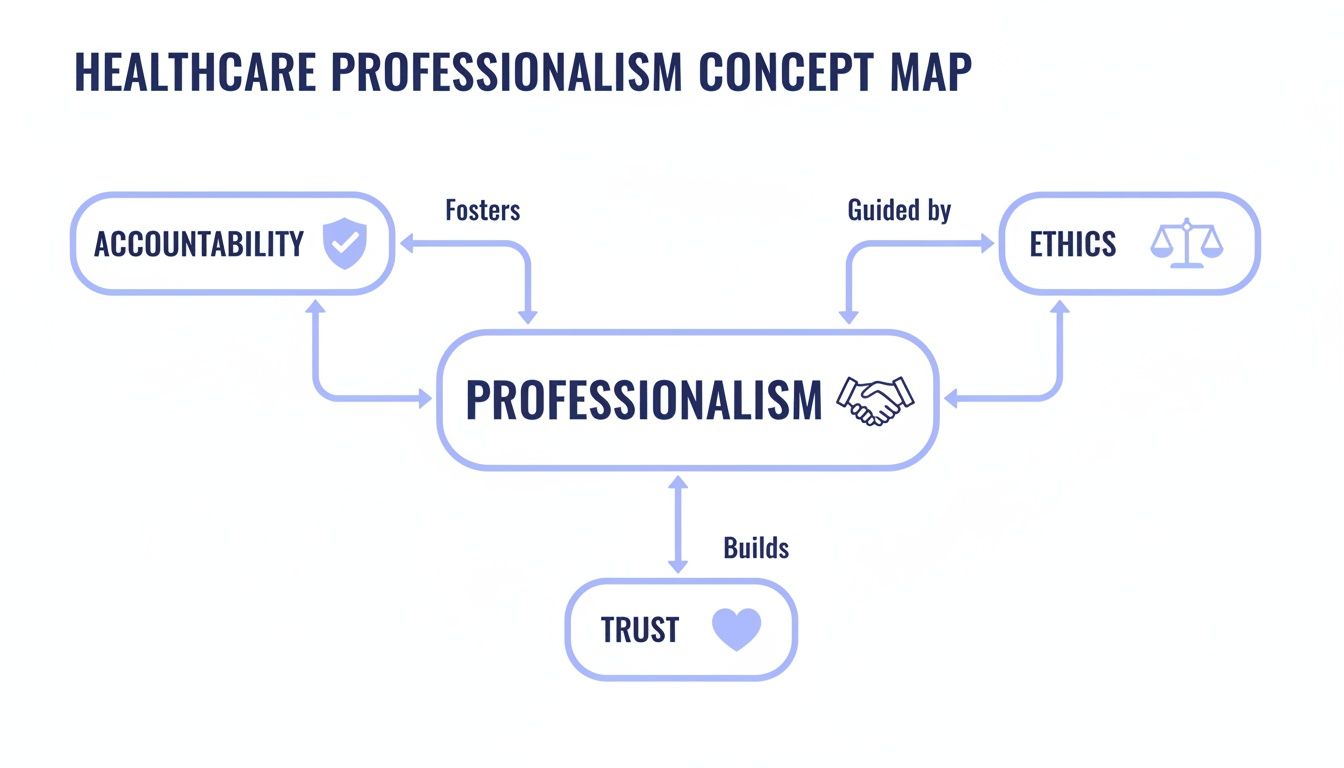
As you can see, professionalism isn’t a standalone trait. It’s what happens when you weave multiple ethical and behavioral threads into a cohesive, trustworthy practice.
1. Accountability and Responsibility
At its heart, accountability is about ownership. It’s the duty to take full responsibility for your actions and their consequences—both the good and the bad. This means being answerable to your patients, your colleagues, your profession, and the public.
In a clinical setting, this goes way beyond just admitting a mistake. It means proactively spotting potential errors, reporting them transparently when they happen, and digging in to fix the system so they don't happen again. It’s about building a culture of safety, not a culture of blame.
Example in Practice: A resident administers the wrong dosage of medication. Instead of trying to hide the error, they immediately alert the attending physician and charge nurse. They fill out an incident report, monitor the patient closely, and later join a root-cause analysis to help improve the medication process for everyone. That’s accountability in action.
2. Compassion and Empathy
People often use these words interchangeably, but they’re two distinct—though related—pillars. Empathy is the ability to understand and share what another person is feeling. Compassion is that empathy paired with the active desire to help.
In healthcare, this means truly hearing a patient’s fears, acknowledging their pain, and responding with genuine kindness. It's about seeing the person, not just the diagnosis. Study after study confirms that compassionate care doesn't just feel better; it can actually improve patient outcomes and make them more likely to stick with their treatment plans.
Professionalism requires connecting with patients on a human level. It's the skill of translating clinical knowledge into care that feels supportive, respectful, and genuinely kind.
3. Upholding Ethical Standards
Ethics is the moral compass of medicine. This pillar is all about a rock-solid commitment to core principles like beneficence (acting in the patient's best interest), non-maleficence (doing no harm), autonomy (respecting a patient’s decisions), and justice (ensuring fair treatment for all).
Upholding ethical standards means navigating tough dilemmas with integrity. It’s about fiercely protecting patient confidentiality, managing conflicts of interest, and making sure every bit of care is delivered without bias. This is a non-negotiable part of what is professionalism in healthcare.
4. Communication and Interpersonal Skills
Clear communication is the lifeblood of safe, effective healthcare. This pillar covers everything from how you explain a complex diagnosis to a terrified patient to how you collaborate with a colleague during a code.
When communication is clear, respectful, and timely, it prevents medical errors and builds trust. This includes:
- Active Listening: Giving your full, uninterrupted attention to what patients and colleagues are saying.
- Clarity and Simplicity: Ditching the jargon when talking to patients so they actually understand what's going on with their health.
- Respectful Collaboration: Speaking to team members in a way that values their input and expertise, creating a positive and safe work environment.
5. Respect for Others
Respect in healthcare isn’t a one-way street. It means honoring the dignity, autonomy, and diversity of patients, their families, and your colleagues. This pillar demands that you treat everyone with courtesy, no matter their background, beliefs, or circumstances.
It also extends to respecting your colleagues' roles and expertise, which is essential for a collaborative atmosphere where every team member feels valued. Disrespectful behaviors like gossip or being dismissive don’t just kill morale; they erode teamwork and can put patients at risk.
6. Commitment to Lifelong Learning
Medicine never stands still. A commitment to lifelong learning isn’t just a good idea; it’s a professional obligation to stay competent and current with new treatments, technologies, and best practices. True professionalism means recognizing the limits of your own knowledge and actively working to expand them.
This pillar shows up in a few key ways:
- Engaging in continuing education opportunities.
- Staying on top of new research and clinical guidelines.
- Being open to feedback and using it to grow.
7. Teamwork and Collaboration
Modern healthcare is a team sport, rarely a solo performance. This final pillar is all about working effectively with other health professionals to provide the highest quality care. It demands mutual respect, open communication, and a shared commitment to the patient's well-being.
Real collaboration means understanding your role inside and out, and seeing how it connects with everyone else's. It’s about coordinating care seamlessly, resolving conflicts constructively, and always putting the team’s success—and the patient's outcome—ahead of your own ego.
Navigating Clinical and Interview Scenarios
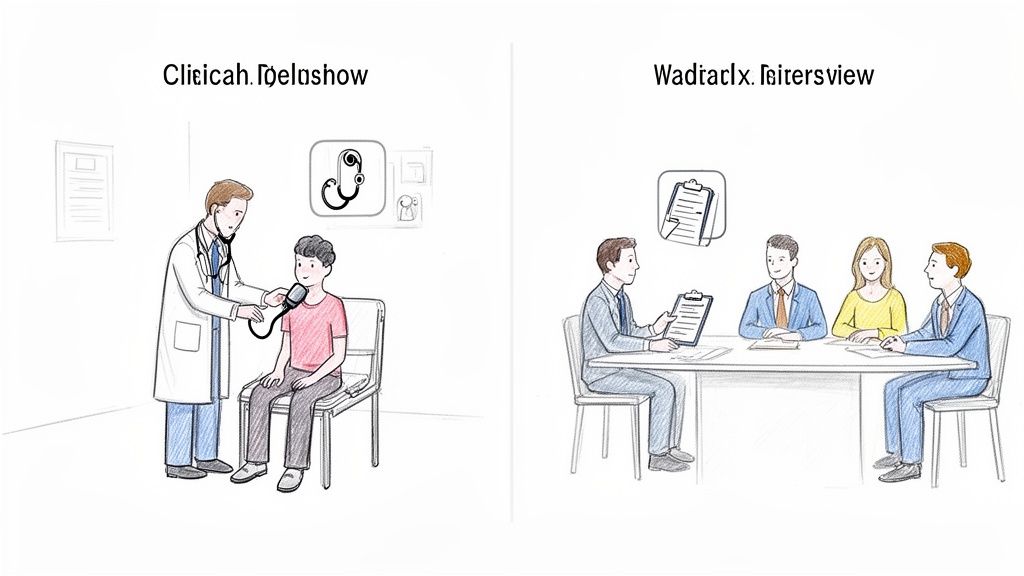
Knowing the pillars of professionalism is one thing. Living them out under pressure is another challenge entirely. The true test of what is professionalism in healthcare isn’t found in a textbook; it happens in the chaotic, unpredictable realities of a busy clinic or a high-stakes interview.
This is where theory has to translate into action, often in a split second. Whether you’re trying to manage a tough patient interaction on the ward or explain your values to an admissions committee, your ability to embody professionalism is always being evaluated. These scenarios are designed to see who you really are and how you think on your feet.
Professionalism On The Wards
Clinical settings are messy. Situations are rarely black and white, and you’re constantly juggling competing priorities like patient autonomy, team dynamics, and institutional protocols. Let’s walk through a scenario that happens more often than you’d think.
Scenario: You’re a third-year medical student on your surgery rotation. You notice a resident, who looks absolutely exhausted after a long shift, forgot to order a critical post-op blood test for a patient. You gently mention it, but they wave you off, saying, "I'll get to it later, it's not a big deal."
How you handle this moment says everything about your professionalism.
- Unprofessional Response: You drop it. You assume the resident knows best, and you’re worried about getting a bad evaluation or looking like you're challenging their authority.
- Professional Response: You acknowledge their workload but gently circle back to patient safety. You might say, "I know you're swamped, but I'm just concerned about the patient's risk for a post-op bleed. Would it help if I wrote up the order for you to sign?"
The professional move puts patient safety above hierarchy and your own comfort. It shows accountability, smart communication, and a true commitment to the team’s ultimate goal: the patient’s well-being.
Professionalism in a clinical setting is not about avoiding conflict; it's about navigating it constructively with patient safety as your unwavering north star.
Translating Skills To The Interview Room
Admissions interviews, especially the Multiple Mini Interview (MMI), are built to simulate these exact kinds of real-world challenges. Interviewers don’t just want to know what you know; they want to see how you think. They’ll throw ethical dilemmas and interpersonal puzzles at you to assess those core pillars of professionalism we’ve been talking about.
For anyone applying to dental, pharmacy, or PA programs, demonstrating these traits is make-or-break. You can get a feel for how to build your confidence by working through some dedicated MMI practice questions and answers.
Let's break down a classic MMI prompt to see the connection.
MMI Prompt: "You are part of a small study group. One member, Sarah, consistently comes unprepared and relies on others' work. Your group's final grade depends on a collaborative project. How do you handle this situation?"
This isn't really about a lazy group member. It's a test of:
- Accountability: How do you hold a peer responsible while keeping the team intact?
- Communication: Can you have a tough conversation without making things worse?
- Respect: How do you address the problem without blaming or gossiping?
- Problem-Solving: What practical steps would you take to fix the situation for everyone?
A strong answer always starts with talking to Sarah privately. You’d express your concern for her and the group's success without being accusatory. This shows you’re committed to finding a solution together before escalating the issue—a mature, professional approach to resolving conflict.
Common Professionalism MMI Prompt Analysis
To get ready for your interview, it helps to break down the types of professionalism questions you’ll likely face. When you understand what the interviewers are really asking, you can frame a much more thoughtful and impressive response.
The table below dissects common MMI prompts that test professionalism, showing you the competency being tested, the key points to hit, and the traps to avoid.
| MMI Prompt Type | Core Competency Tested | Key Points to Address | Common Pitfalls |
|---|---|---|---|
| Ethical Dilemma | Integrity, Ethical Reasoning, Accountability | Acknowledge all sides of the issue. Prioritize patient safety or well-being. Articulate a clear, step-by-step thought process. | Making a snap judgment without exploring nuances. Ignoring key ethical principles like autonomy or confidentiality. |
| Conflict Resolution | Communication, Teamwork, Respect | Emphasize direct, private communication first. Focus on a collaborative solution. Show empathy for all parties involved. | Taking sides immediately. Being confrontational or overly passive. Gossiping instead of addressing the issue directly. |
| Dealing with a Mistake | Accountability, Honesty, Lifelong Learning | Take immediate ownership of the error. Explain steps to mitigate harm and prevent recurrence. Show a commitment to learning from the experience. | Blaming others or external factors. Downplaying the severity of the mistake. Failing to mention a plan for improvement. |
| Patient Interaction | Empathy, Compassion, Communication | Validate the patient's feelings and concerns. Use non-judgmental language. Demonstrate active listening and a desire to help. | Being dismissive of the patient's emotions. Using medical jargon. Failing to show genuine empathy or compassion. |
Ultimately, whether you’re on the hospital floor or in an interview room, demonstrating professionalism means showing that you can be trusted with the profound responsibility of caring for others. It’s about proving you have the judgment, character, and communication skills to handle whatever comes your way.
Avoiding Common Lapses in Professionalism
Knowing the pillars of professionalism is one thing; putting them into practice day after day is another. It takes constant self-awareness. Even the most dedicated students and clinicians can hit common pitfalls that chip away at their professional standing. These lapses rarely come from a bad place—more often, they’re born from a moment of carelessness, high stress, or a simple misunderstanding of boundaries.
Recognizing these traps ahead of time is the key to avoiding them. Think of it like a pilot running through a pre-flight checklist. By knowing where things commonly go wrong—like a thoughtless social media post or a casual breach of confidentiality in the hallway—you can build the habits you need to navigate your career safely and protect the trust patients place in you.
The Blurry Line of Social Media
In a world where everyone is connected, the line between our personal and professional lives has never been thinner, making social media a huge risk area. A seemingly innocent post complaining about a tough shift or a vague comment about an interesting case can spiral into serious trouble.
You might think your profile is locked down, but screenshots are forever. Admissions committees, residency programs, and employers can and do look at your digital footprint. As a healthcare professional, you're held to a higher standard, both online and off. It’s a reality of the job.
To stay out of trouble, stick to these critical rules:
- Never Post Patient Information. This means any detail, no matter how small or "anonymized," that could possibly identify someone.
- Don't Complain About Work. Venting online about colleagues, your hospital, or your workload is unprofessional. It reflects poorly on you and everyone you work with.
- Maintain Professional Boundaries. Don't "friend" or follow current patients. This creates a messy dual relationship that can seriously complicate their care.
Breaches in Confidentiality
Confidentiality is a sacred trust in medicine, backed by strict rules like HIPAA. Yet, breaches happen with shocking frequency, often in the most casual settings. Discussing a patient's case in a public elevator, leaving a computer screen unlocked in a busy hallway, or even telling your family about an interesting case without scrubbing every single identifier—these are common, dangerous mistakes.
A single breach of confidentiality, even an accidental one, can permanently destroy a patient's trust and lead to severe professional and legal consequences. It's a non-negotiable part of the job.
These slips don't just violate a patient's privacy; they erode the public's faith in the entire healthcare system. It’s also about accountability. When professionalism slips, the whole work environment can suffer. For instance, data from Press Ganey shows that in 2024, employee engagement dropped for both physicians and advanced practice providers. This highlights how a poor professional climate can directly impact workforce stability and morale. You can read a full analysis of the link between workplace environments and employee retention in healthcare.
Inappropriate Communication Habits
How you talk to patients and colleagues says everything about your professionalism. Lapses here can range from using dense medical jargon with a patient who is clearly overwhelmed to showing dismissive body language during a team huddle.
Emotional reactivity is another major pitfall. Healthcare is incredibly stressful, but letting your frustration or exhaustion come out as shortness with a patient or a colleague is a professional failure. It poisons teamwork and can make patients feel like they’re an inconvenience. Keeping your cool and showing respect, even on the absolute worst days, is the mark of a true professional.
How Admissions Committees Evaluate Professionalism
Admissions committees are looking for much more than high stats and a long list of extracurriculars. They’re really trying to answer one fundamental question: Does this applicant have the character and judgment to become a trustworthy clinician?
That’s why understanding what professionalism in healthcare actually means is so critical. Committees size you up on this from every angle—your essays, your interview, even how you interact with the admissions coordinator over email. It’s not about checking a box; it's about building a consistent picture of who you are.
They're piecing together a mosaic of your character from multiple data points. Every detail, from the tone of your personal statement to your body language on interview day, offers a clue about your maturity, integrity, and ethical compass.
Beyond The Personal Statement
Your personal statement is their first real look at how you think. Sure, you'll write about a meaningful experience, but what they're really looking for is your capacity for self-reflection. Can you learn from your experiences? Do you show genuine empathy?
An essay that just rattles off accomplishments falls completely flat. A powerful statement, on the other hand, pulls back the curtain on your thought process. It connects your actions to the core values of medicine—compassion, accountability, service—long before you’ve even set foot in a clinic.
The Interview Gauntlet: MMI and Panel
The interview, especially a Multiple Mini Interview (MMI), is where your professionalism gets put under a microscope. The scenarios are intentionally ambiguous and designed to see how you handle pressure. This isn't a test of knowledge; it's a test of judgment.
Interviewers are trained to spot specific behaviors that signal you have what it takes. They want to see candidates who can:
- Acknowledge Complexity: You don't jump to a simple, black-and-white conclusion. You show that you can see the gray areas and weigh competing values in a tough situation.
- Communicate Thoughtfully: You articulate your reasoning clearly and respectfully, even when you’re nervous. This is a huge indicator of how you'll handle sensitive conversations with patients and colleagues.
- Demonstrate Empathy: You can verbally and non-verbally show that you understand the emotional stakes for everyone involved in the scenario—the patient, the family, or your coworker.
Admissions committees use interviews not just to hear what you think, but to see how you think. Your ability to navigate an ethical gray area with maturity is a far better indicator of future professionalism than a perfectly rehearsed answer.
This is exactly the kind of structured assessment that platforms like Confetto help you prepare for. The goal isn't to memorize answers but to build the core competencies—like ethical reasoning and communication—that committees are actively measuring.
When you understand that every single touchpoint is a test of character, you can present a much more authentic and consistent story of who you are and the kind of compassionate, reliable clinician you're ready to become.
Cultivating and Demonstrating Your Professionalism
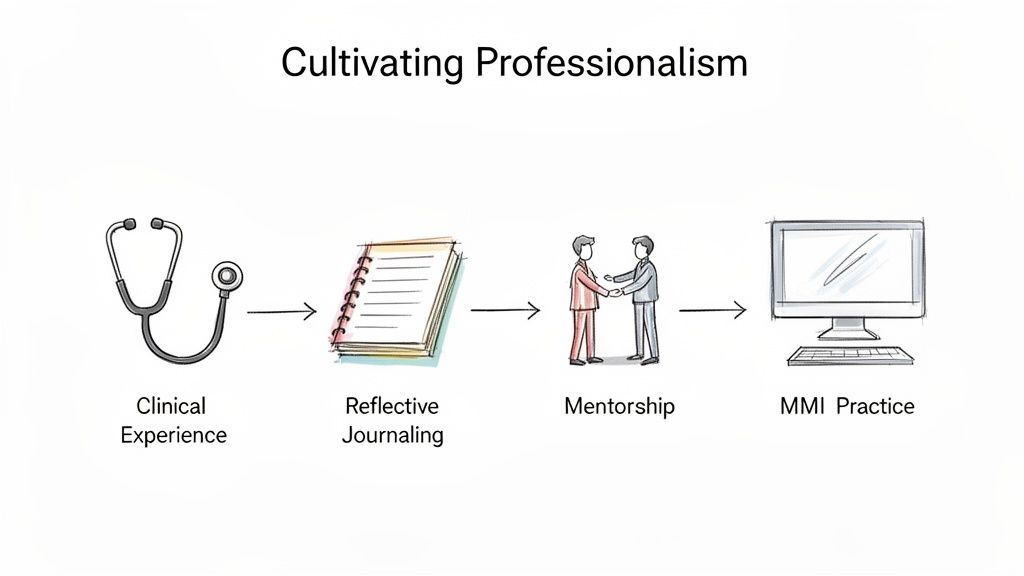
Knowing the definition of professionalism is one thing. Living it, building it, and showing it is something else entirely. This isn't about cramming for an interview; it’s about a deliberate, long-term commitment to your own growth as a future physician. Think of it as a roadmap for turning abstract ideals into skills you can actually point to.
The whole process kicks off with a simple but powerful first step: finding meaningful experiences and really thinking about them. It all starts with developing strong self-awareness. After all, if you don’t understand your own strengths, blind spots, and biases, how can you practice ethically?
Building Your Professional Toolkit
Just showing up to your volunteer shifts or shadowing hours isn't enough. The real work happens when you turn passive observation into active reflection. That’s how you build a library of experiences that actually say something about your character.
Here are a few concrete ways to do that:
- Seek Meaningful Clinical Exposure: Don't just be a fly on the wall. When it’s appropriate, engage with patients. Ask clinicians about the tough ethical calls they’ve had to make. Pay attention to how the team works together—or doesn't.
- Practice Reflective Journaling: After a difficult day or a challenging patient interaction, write it down. What was the real conflict? What did you see? If you were in the doctor's shoes, what would you have done? This practice turns a simple anecdote into a powerful story about your own ethical compass.
- Find Strong Mentors: Look for clinicians who embody the qualities you want to develop. A great mentor does more than just write a recommendation letter; they push you to think differently, challenge your assumptions, and model what integrity looks like in practice.
Articulating Your Growth
The last piece of the puzzle is learning how to talk about this growth. You have to connect the dots between your experiences and the core principles of professionalism. This is what turns a flat, one-line entry on your application into a compelling story.
Instead of saying, "I volunteered at a clinic," you can say, "While volunteering, I witnessed a communication breakdown between a provider and a patient's family. It drove home just how critical it is to translate complex medical information with real empathy to ensure everyone is truly on the same page."
See the difference? That shift in framing is everything. It shows an admissions committee that you don’t just rack up hours—you learn from them.
This is also where practicing with tools like AI-powered MMI simulations can give you a serious edge. They provide a safe space to practice putting these complex thoughts into words, especially under pressure. For more on this, check out our guide on how to improve interview communication skills. The more you practice in a realistic setting, the more natural and confident you'll sound when it really matters.
Frequently Asked Questions About Professionalism
Even after getting a handle on the core concepts, you'll find that real-world situations often bring up tricky questions. This section tackles some of the most common ones that pop up for aspiring healthcare professionals.
Think of it as your quick guide for navigating the nuances you'll face in both clinical settings and your interviews.
What Is the Difference Between Medical Ethics and Professionalism
It's easy to use "ethics" and "professionalism" interchangeably, but they're two sides of the same coin, not the same thing.
Picture medical ethics as the "rulebook" for healthcare. It’s the set of moral principles that guide our decisions—concepts like beneficence (doing good), autonomy (respecting patient choice), and justice. These are the foundational ideas of what's right and wrong.
Professionalism, on the other hand, is how you "play the game." It’s the daily, observable behavior that brings those ethical principles to life. It's not just about knowing the rules; it's about embodying them through how you communicate, take responsibility, and treat everyone around you.
Bottom line: Ethics is the foundational 'what' (the moral code), while professionalism is the practical 'how' (the actions that demonstrate that code).
How Can I Demonstrate Professionalism with Limited Clinical Experience
Don't worry, admissions committees get it. They know not everyone has hundreds of hours of clinical experience. What they're really looking for is your character and potential, not a flawless resume. You have countless opportunities to showcase professionalism in your day-to-day life.
Think about how you can demonstrate these key traits in everything you do:
- Reliability: Were you always on time for your part-time job or volunteer shifts? Did you follow through on commitments you made to a team or a project? That proves you're dependable.
- Respectful Communication: Every email you send to a professor or conversation you have with a coworker is a reflection of your interpersonal skills.
- Accountability: Be ready to talk about a time you made a mistake—it doesn't have to be a clinical one. Taking ownership and explaining what you learned from it is a powerful sign of maturity.
These experiences are solid proof that you have the character to build on.
How Should I Handle Witnessing Unprofessional Behavior in an MMI Scenario
This is a classic MMI prompt designed to test your judgment, integrity, and your grasp of workplace dynamics. The goal is to show a calm, patient-centered response that doesn't needlessly escalate the situation.
A strong, thoughtful answer will usually follow these steps:
- Assess for Immediate Harm: First and foremost, is a patient in immediate danger? If the answer is yes, your duty is to intervene or alert a supervisor right away. Patient safety always, always comes first.
- Consider a Private Conversation: If there’s no immediate threat, the most professional first move is often to speak with the colleague privately and respectfully. You want to frame your concern as a collaborator, not an accuser.
- Escalate Appropriately: If a direct conversation isn't the right move or doesn't solve the problem, you have an obligation to bring your concern up the chain of command. This means talking to a trusted superior like a charge nurse, attending physician, or program director.
This structured approach shows you can think critically and understand how to navigate professional hierarchies responsibly.
Beyond these specific questions, you may have broader curiosities about the patient experience and how the healthcare system works. For more information from a patient's perspective, exploring general healthcare frequently asked questions can offer some valuable insights.
Ready to turn interview theory into practice? Confetto provides an AI-powered platform with over 500 MMI prompts to help you build confidence and master the skills admissions committees are looking for. Start your 7-day trial today at https://confetto.ai.