
8 Crucial MMI Interview Tips to Master Your Medical School Interview in 2026
Unlock your potential with these 8 actionable mmi interview tips. Learn frameworks, timing, and strategies to excel in your medical school MMI.
The Multiple Mini Interview (MMI) is more than just a hurdle in the medical school admissions process; it’s a direct assessment of your capacity to think, act, and communicate like a future healthcare professional. Unlike traditional interviews that reward rehearsed narratives, the MMI format uses a series of timed, independent stations to evaluate your character, critical thinking, ethical reasoning, and communication skills under pressure. Success doesn't hinge on finding a single "correct" answer. Instead, it’s about transparently demonstrating your thought process and proving you have the core competencies required for a demanding and compassionate career.
This guide provides a comprehensive list of actionable MMI interview tips designed to move you beyond generic advice. We will equip you with structured frameworks, proven response strategies, and a deliberate practice plan to build unshakable confidence. You will learn precisely how to:
- Deconstruct any prompt, from ethical dilemmas to policy questions.
- Manage the clock effectively at each station.
- Communicate with empathy and professionalism.
- Align your authentic self with the specific values and rubrics of your target programs.
By mastering the strategies outlined here, you can transform the MMI from a source of anxiety into a powerful opportunity. This is your chance to showcase your unique strengths and prove you are ready for the challenges and responsibilities of medical school. Let's begin breaking down the exact techniques you'll need to turn this interview into your competitive advantage.
1. Master the Station Format and Time Management
The Multiple Mini Interview (MMI) is less a single conversation and more a marathon of short, intense sprints. Unlike traditional interviews, the MMI format breaks the assessment into a circuit of 5-10 independent "stations." At each station, you'll have a brief period (typically two minutes) to read a prompt before entering a room to discuss it with an evaluator for a set time (usually 6-8 minutes). This structure, used by schools like McMaster in Canada and UCSF in the US, demands rapid context-switching and impeccable time management.
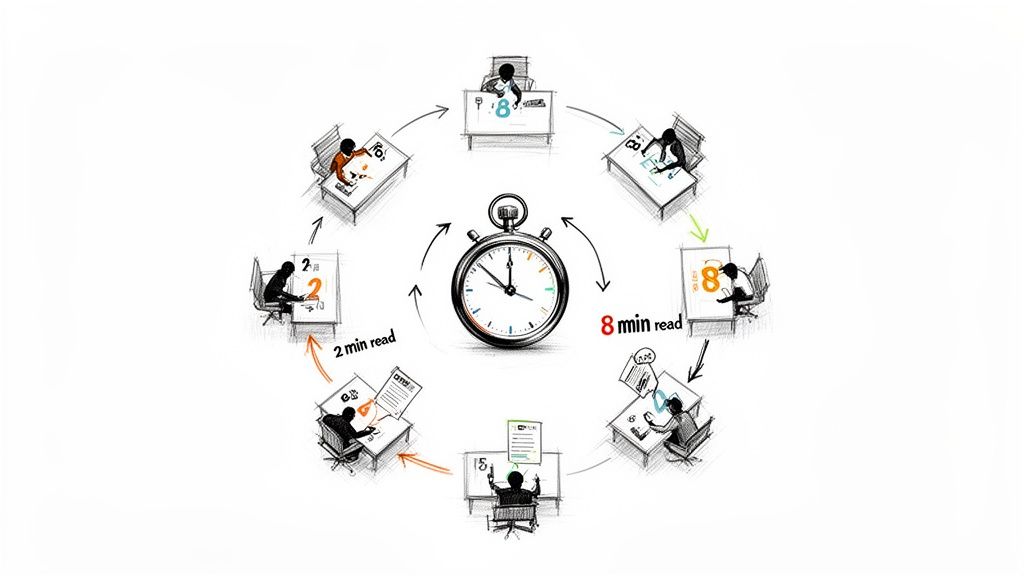
Understanding this rhythm is the first and most critical of all MMI interview tips. Acing one station means little if you mismanage time and deliver incomplete answers in the others. The goal is consistency across the board.
How to Implement This Strategy
Effective time management in an MMI begins before you even start speaking. It’s about structuring your approach to fit neatly within the allotted minutes, ensuring you convey a complete, thoughtful response every single time.
- Deconstruct the Prompt (2 Minutes): Use your two-minute reading time outside the station to do more than just understand the scenario. Actively outline your response. Identify 3-4 core themes or talking points. This prevents rambling and gives your answer a clear, logical flow.
- Structure Your Spoken Response (6-8 Minutes):
- First Minute: State your understanding of the prompt and introduce the key issues you plan to discuss.
- Next 4-5 Minutes: Methodically address each of your outlined points. Dedicate about one minute to each, providing your reasoning, considering multiple perspectives, and connecting back to core competencies like empathy or ethics.
- Final Minute: Summarize your position concisely. Reiterate your main points and offer a concluding thought. This leaves a strong, polished impression.
Key Insight: Do not feel obligated to use the entire time. A concise, well-structured answer delivered in six minutes is far more powerful than a rambling, eight-minute response that loses focus. Examiners appreciate clarity and efficiency.
Actionable Tips for Mastering MMI Pacing
To turn theory into practice, you need to simulate the environment. Consistent, timed practice is essential.
- Use a Timer for Everything: When practicing, strictly enforce the 2-minute reading and 8-minute response windows. This builds muscle memory for the MMI's unique pacing.
- Reset Between Stations: The moment a station ends, it’s over. Use the brief transition time to take three deep breaths, clear your mind, and approach the next prompt with a completely fresh perspective. Don’t let a poor performance in one station bleed into the next.
- Simulate Realistically: To truly master the format, you need to practice with a system that mimics real conditions. Using an AI-powered tool can be an effective strategy. For a deeper dive into preparation methods, review our comprehensive guide on the medical school mock interview. This approach allows you to rehearse station transitions and get objective feedback on your pacing.
2. Prepare for Ethical Dilemmas with a Structured Framework
Ethical dilemma stations are a cornerstone of the MMI, designed to test your moral reasoning, not to find a single "correct" answer. These scenarios often involve complex issues like resource allocation, patient confidentiality, or conflicts of interest. Instead of improvising, the most successful applicants use a structured framework to show they can navigate real-world healthcare complexity with thoughtfulness and balance.
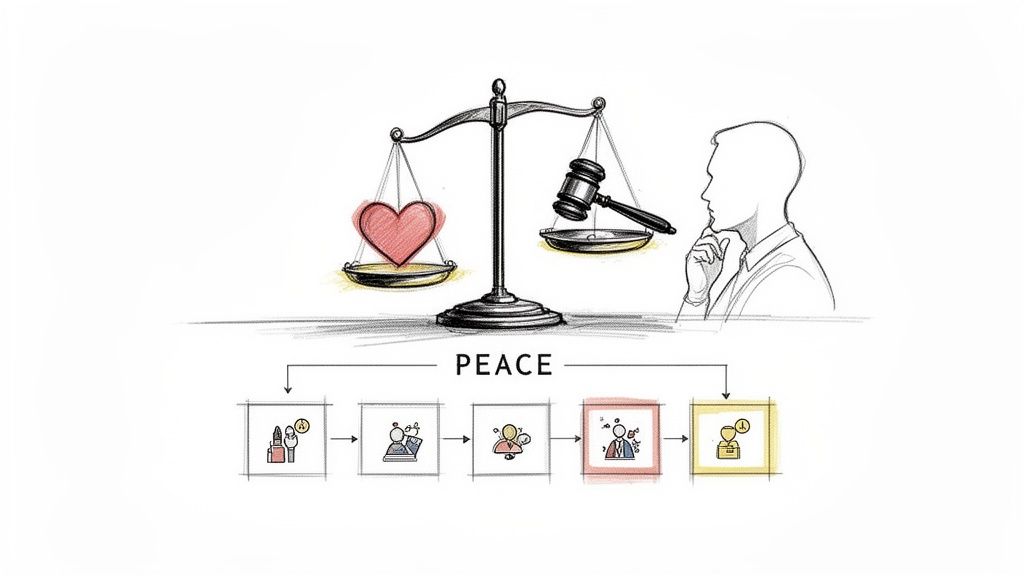
This approach is one of the most critical MMI interview tips because it demonstrates a mature, methodical thought process. Examiners are less interested in your final decision and more interested in how you arrive at it, weighing competing values and considering all stakeholders involved.
How to Implement This Strategy
Adopting an ethical framework allows you to organize your thoughts under pressure and articulate a nuanced response. It provides a reliable roadmap for any moral scenario, from a patient refusing life-saving treatment to a colleague acting unprofessionally.
- Choose and Internalize a Framework: Select a recognized ethical framework and know it well. A common and effective one is the four-principles approach to bioethics:
- Autonomy: Respecting the patient's right to make their own decisions.
- Beneficence: Acting in the best interest of the patient.
- Non-maleficence: Doing no harm.
- Justice: Ensuring fair distribution of resources and treatment.
- Structure Your Spoken Response:
- First Minute: Identify the core ethical conflict. Explicitly state the competing values (e.g., "This scenario presents a direct conflict between the patient's autonomy and our duty of beneficence.").
- Next 4-5 Minutes: Analyze the situation through the lens of your chosen framework. Discuss how each principle applies, who the stakeholders are (patient, family, healthcare team, society), and what the potential consequences of different actions would be.
- Final Minute: Synthesize your analysis and state your proposed course of action, justifying it based on your reasoning. Acknowledge any remaining uncertainties or unresolved issues.
Key Insight: Avoid absolute statements. Using phrases like, "While patient confidentiality is paramount, there may be a compelling ethical argument to breach it in this specific circumstance to prevent harm..." shows nuance and an appreciation for complexity, which is highly valued by evaluators.
Actionable Tips for Mastering Ethical Scenarios
Consistent practice is the only way to make your ethical framework feel like a natural part of your thought process.
- Identify the Core Tension Immediately: During your two-minute reading time, pinpoint the primary ethical conflict. Is it autonomy vs. safety? Justice vs. beneficence? Naming it early gives your response a strong, clear focus.
- Gather Information (When Possible): If the prompt feels ambiguous, articulate what additional information you would need. For instance, you might say, "Before proceeding, I would want to assess the patient's decision-making capacity." This shows you are thorough and not prone to making assumptions.
- Practice with Diverse Scenarios: You need to apply your framework to a wide variety of situations. To see this in action, review our collection of MMI practice questions with answers, which includes detailed ethical dilemmas and model responses that break down this structured approach.
3. Develop Strong Communication and Active Listening Skills
More than your knowledge, the MMI evaluates how you think and interact. Examiners are trained to assess not just what you say, but how you say it. Strong candidates demonstrate a thoughtful presence by listening carefully, seeking clarification when needed, and responding directly to the prompt, rather than delivering a rehearsed speech. This approach reveals core competencies like empathy, adaptability, and professionalism.

Poor communication habits, such as interrupting, over-explaining, or misinterpreting the question, can quickly undermine an otherwise strong applicant. Effective communication is a cornerstone of this format, making it one of the most crucial MMI interview tips to master.
How to Implement This Strategy
Implementing active listening involves a conscious shift from formulating your answer while the examiner is speaking to fully absorbing their words first. It’s about engaging in a genuine dialogue, not a monologue.
- Clarify Before Answering: Many scenarios are intentionally ambiguous to see if you will make assumptions. For a prompt like, "How would you respond to a patient who doesn't trust doctors?", an excellent candidate first clarifies. They might ask, "To give the best answer, could you tell me more about the source of their distrust? Is it from a past negative experience, cultural beliefs, or something they saw online?" This demonstrates critical thinking and a patient-centered mindset.
- Structure Your Response Collaboratively: Treat the interaction as a conversation.
- Pause and Reflect: Take 2-3 seconds after the examiner finishes speaking. This shows you are considering their words, not just waiting for your turn to talk.
- Confirm Understanding: Briefly rephrase the core issue. For instance, "So, if I understand correctly, the central conflict is balancing patient autonomy with my duty to ensure safety..."
- Deliver a Focused Answer: Address the question directly, using your clarified understanding as a guide.
Key Insight: Asking for clarification is a sign of strength and confidence, not weakness. It shows the evaluator that you are meticulous, thoughtful, and committed to understanding the full picture before acting, a critical skill for any healthcare professional.
Actionable Tips for Mastering MMI Communication
Genuine communication skills are built through deliberate practice. Focus on developing habits that convey engagement and respect.
- Practice Mindful Pausing: Resist the urge to jump in with an answer. Intentionally wait a few seconds before responding in your practice sessions. This builds poise and prevents you from interrupting.
- Use Open and Engaged Body Language: Your non-verbal cues speak volumes. Sit upright, lean slightly forward to show interest, maintain natural eye contact, and keep your arms uncrossed.
- Modulate Your Vocal Tone: A monotone voice can be misinterpreted as disinterest. Vary your pitch and pace to convey enthusiasm and engagement. Avoid speaking too quickly, which can signal nervousness.
- Analyze Your Verbal Habits: Use a tool with tone and posture analysis to identify and correct habits like using filler words ("um," "like," "you know") or upspeak. To build a stronger foundation, explore these practical strategies on how to improve interview communication skills.
4. Use the STAR Method for Behavioral and Situational Scenarios
MMI stations frequently feature behavioral prompts ("Tell me about a time you...") or situational dilemmas ("What would you do if...?"). The STAR method provides a proven framework for structuring your answers, ensuring they are concrete, evidence-based, and focused on outcomes. It prevents vague claims by grounding your competencies in specific, real-world examples.
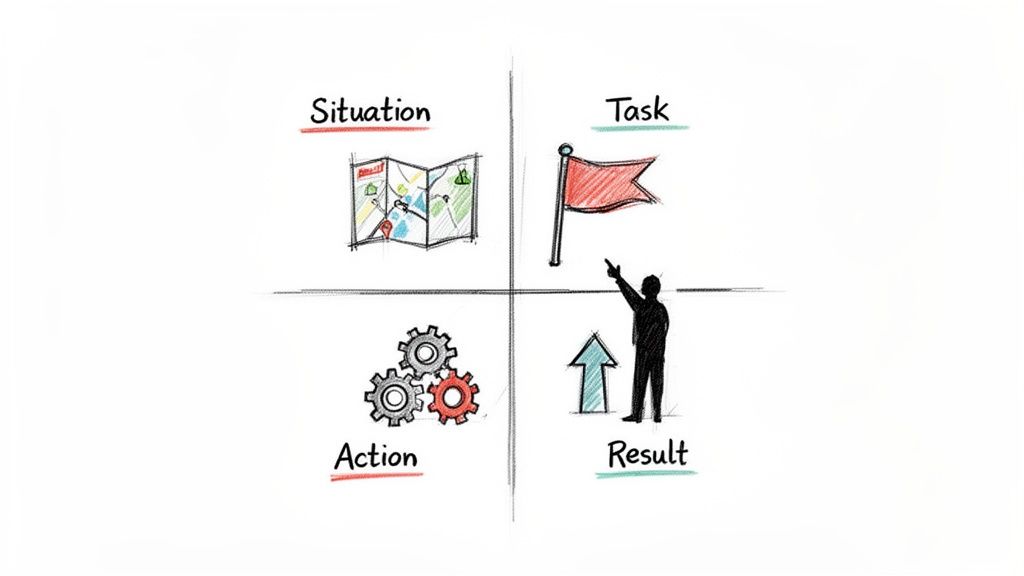
This method is one of the most effective MMI interview tips because it transforms your stories from simple anecdotes into compelling evidence of your skills. It demonstrates not just what you did, but why you did it and what you learned, which is precisely what interviewers are assessing.
How to Implement This Strategy
The STAR method organizes your narrative into four logical parts: Situation, Task, Action, and Result. Applying this structure keeps your response concise and impactful, especially under the MMI's strict time constraints.
- Deconstruct Your Experience (Before the Interview): Prepare 5-7 versatile stories from your work, volunteer, academic, or personal experiences. For each story, explicitly define the STAR components.
- Situation: Briefly set the scene. (e.g., "During a group research project, our team had conflicting opinions on the data analysis approach.")
- Task: Describe your specific role or responsibility. (e.g., "As the person responsible for compiling the final report, my task was to facilitate a consensus.")
- Action: Detail the steps you took. Focus on your thought process. (e.g., "I organized a meeting where I first asked each member to explain their rationale without interruption. Then, I proposed a hybrid model that incorporated the strongest elements of each approach.")
- Result: Explain the outcome and, most importantly, what you learned. (e.g., "The team adopted the compromise, and we successfully submitted the report. This taught me the value of creating psychological safety to navigate disagreements productively.")
Key Insight: The "Action" is the core of your answer. Don't just list what happened; explain your reasoning. Use phrases like, "I recognized that..., so I decided to..." or "My priority was..., which led me to..." to reveal your critical thinking.
Actionable Tips for Mastering the STAR Method
To make this framework second nature, you must practice applying it to different types of MMI prompts until it feels natural rather than rehearsed.
- Keep the Setup Brief: The 'Situation' and 'Task' should take no more than 30-45 seconds. The bulk of your time should be dedicated to 'Action' and 'Result'.
- Always Link to Learning: The 'Result' is incomplete without reflection. Conclude by stating what the experience taught you or how it will influence your future actions as a healthcare professional. This shows maturity and self-awareness.
- Adapt for Hypotheticals: For situational questions ("What would you do?"), frame your response using a future-tense STAR structure. Explain the situation as you see it, state your immediate task or goal, describe the actions you would take and why, and project the likely result or desired outcome. The MMI often presents complex scenarios requiring quick and effective problem-solving, a skill that can be significantly enhanced through structured practice. You can improve problem-solving skills by working through these types of hypothetical challenges repeatedly.
5. Research Target Programs and Align with Rubrics
While MMI stations often seem like abstract ethical or situational puzzles, they are fundamentally designed to find candidates who are a good "fit" for a specific program's mission and values. Medical schools are not interchangeable; each has a distinct identity, whether it's a focus on rural health, primary care, cutting-edge research, or serving urban underserved populations. One of the most underrated MMI interview tips is to move beyond generic answers and demonstrate a genuine, well-researched alignment with the institution.
Simply stating you admire a school is not enough. The key is to understand their evaluation rubric, whether explicit or implicit, and tailor your responses to highlight the competencies they value most. This strategy shows you've done your homework and envision yourself as a contributing member of their specific community, not just any medical school.
How to Implement This Strategy
Effective program alignment involves a two-part process: first, deep research into the school's identity, and second, mapping your personal experiences and values to their core competencies. This allows you to weave authentic, program-specific details into your answers, making them more memorable and impactful.
- Identify Core Values (Pre-Interview Research): Before your interview, spend time on the school's website, specifically reading their "Mission," "Vision," and "Values" pages. Look for recurring themes. Does the school repeatedly mention community engagement, innovation, or global health? Note these key priorities. For example, a program focused on rural medicine will value demonstrated commitment to underserved areas.
- Connect Your Experiences to Their Mission (During the Interview):
- Introduction: Briefly frame your understanding of a prompt through a lens the school values. For a scenario about resource allocation, you might start by saying, "This issue highlights the importance of equitable care, which I know is a core value here."
- Body: When discussing your actions, connect them to your personal experiences that mirror the school's focus. For a research-intensive school, you could say, "My approach to problem-solving is influenced by my time in a lab, where we had to systematically test hypotheses, much like the process needed here."
- Conclusion: Subtly reinforce the connection. A good concluding thought might be, "Ultimately, a solution that prioritizes community trust aligns with the kind of physician I aspire to be and the values I've seen in this program."
Key Insight: The goal is not to flatter the interviewers by simply repeating their mission statement. It is to show, through your reasoning and examples, that your values and priorities are already in sync with theirs. Authenticity is crucial; the connection must feel natural, not forced.
For a worked example of program-specific preparation, see our LECOM interview guide.
Actionable Tips for Mastering Program Alignment
- Create a "Program Profile" Sheet: For each school you interview at, create a one-page summary. List their top 3-4 values, a specific program or initiative that excites you (e.g., a student-run free clinic, a particular research institute), and 1-2 faculty members whose work you admire.
- Map Competencies to Your Stories: Identify which of your core experiences (research, volunteering, work) best demonstrates empathy, critical thinking, teamwork, or leadership. Then, consider how you can frame that story to align with the school's unique mission. For instance, a teamwork story could be framed around collaborative research for one school, or interprofessional community outreach for another.
- Practice Weaving In-Alignment Naturally: Instead of saying, "Your program is great at X," try, "I was drawn to the opportunity to learn about [topic] through initiatives like your [specific program name], as it aligns with my passion for..." This shows genuine interest rather than superficial praise.
6. Practice Self-Awareness and Reflective Thinking
MMI examiners are looking for more than just correct answers; they are assessing your capacity for growth. Self-awareness, the ability to critically reflect on your strengths, weaknesses, and biases, is a hallmark of a mature and coachable applicant. Demonstrating this quality signals that you can handle feedback, learn from mistakes, and evolve as a professional. Conversely, candidates who are defensive, shift blame, or lack self-insight raise significant red flags.
This focus on reflective thinking is one of the most crucial MMI interview tips because it reveals your potential to develop into a competent, compassionate healthcare provider. Stations are often designed to probe your response to failure, feedback, or personal limitations, making self-awareness a core competency for success.
How to Implement This Strategy
Integrating self-awareness into your answers involves framing your experiences through a lens of growth and learning. It’s not just about listing strengths and weaknesses but about telling a story of your personal and professional development.
- Acknowledge and Analyze: When asked about a mistake or a time you received criticism, start by clearly acknowledging the situation without making excuses. For example, when discussing a mistake, state what happened, what your role was, and what the immediate impact was.
- Demonstrate Growth and Change: The most critical step is to articulate what you learned and how you changed your behavior as a result. Connect the lesson from a past experience to your present actions and future intentions.
- Show, Don't Just Tell: Instead of saying "I learned to be a better communicator," provide a specific example. Describe a subsequent situation where you applied your newfound communication skills successfully.
Key Insight: True self-awareness includes recognizing how your personal background and experiences shape your perspective. Acknowledging this shows humility and an open mind, for instance, by saying, "Coming from a non-scientific background, I initially found it difficult to grasp complex lab protocols, which taught me the importance of asking clarifying questions early and often."
Actionable Tips for Cultivating Self-Reflection
To develop and showcase this skill, you must move beyond surface-level answers and prepare to discuss your journey with honesty.
- Prepare Stories of Growth: Identify 2-3 specific examples of failures, challenges, or critical feedback you have received. For each, map out the situation, your initial reaction, the lesson learned, and how you have since applied that lesson.
- Frame Weaknesses Constructively: When asked about a weakness, choose a genuine area for growth (e.g., public speaking, over-committing) rather than a "humblebrag" (e.g., "I'm a perfectionist"). The key is to spend most of your answer detailing the concrete steps you are actively taking to improve.
- Analyze Your Practice Sessions: Use feedback from mock interviews to identify patterns. Do you become defensive when challenged? Do you fail to acknowledge other perspectives? Recognizing these habits during practice is the first step to correcting them before the real interview.
7. Manage Anxiety and Build Confidence Through Deliberate Practice
MMI interviews are high-stakes and emotionally taxing, making anxiety and self-doubt common obstacles. Confidence isn't innate; it is built through repeated, deliberate practice in realistic conditions. One of the most overlooked MMI interview tips is that each mock interview reduces novelty-induced anxiety, allowing you to test responses and create muscle memory for handling pressure.
A candidate who practices consistently, for example, two times per week for eight weeks, might see their scores improve from 5/10 in early mocks to 8-9/10 in their final sessions. More importantly, they report feeling calm and prepared on the actual interview day because the format is no longer intimidating.
How to Implement This Strategy
The goal is to move from a state of reactive fear to proactive preparedness. This involves creating a structured practice routine that desensitizes you to the pressure of the MMI format, allowing your critical thinking and communication skills to shine through.
- Schedule Deliberate Practice: Create a consistent schedule, aiming for a minimum of 2-3 mock sessions per week in the 6-8 weeks leading up to your interview. Consistency is more important than cramming.
- Structure Your Improvement:
- Early Mocks: Treat these purely as learning opportunities. Your initial scores don't matter; focus on getting comfortable with the format and identifying your baseline.
- Mid-Phase Mocks: Use feedback to target specific weaknesses. If you struggle with ethical dilemmas, dedicate practice sessions to those scenarios until you develop a reliable framework.
- Final Mocks: Shift your focus to assessment and refinement. By this stage, you should be fine-tuning your delivery, pacing, and non-verbal cues.
Key Insight: Confidence comes from competence. Every practice station you complete is evidence of your capability. Before interview day, review your strongest practice transcripts to remind yourself that you are prepared and have already succeeded in this format multiple times.
Actionable Tips for Building MMI Confidence
Systematic practice turns a daunting experience into a manageable one. Here’s how to make your preparation as effective as possible.
- Practice Under Realistic Conditions: Use a quiet space, dress professionally, and sit upright. Your posture and environment directly affect your mindset and confidence.
- Focus on Incremental Improvement: After each mock, review the feedback while the session is fresh in your mind. Identify just one or two specific areas to improve for the next time, rather than trying to fix everything at once.
- Target Your Weaknesses: It's tempting to only practice stations where you feel comfortable. Deliberately seek out and work on the scenario types that intimidate you most, as this is where the most significant growth occurs.
- Manage Your Nerves: To stay calm and focused during high-pressure scenarios, it's beneficial to understand how to manage stress effectively. Techniques like deep breathing between stations can reset your mind.
8. Balance Authenticity with Strategic Messaging
MMI evaluators are trained to spot rehearsed, inauthentic answers. They want to connect with the real you, not a perfectly polished but robotic candidate. However, pure, unfiltered honesty without context can miss the mark. This is where the balance between genuine self-expression and strategic communication becomes one of the most vital MMI interview tips. The goal is to present your true experiences and personality in a way that naturally highlights the competencies the school is looking for.
This approach means framing your real stories to demonstrate qualities like resilience, empathy, and critical thinking. It’s the difference between a generic statement and a memorable, personal narrative. True authenticity isn't about being flawless; it’s about being honest about your journey, including your challenges, and showing how those experiences have prepared you for a career in healthcare.
How to Implement This Strategy
Authentic strategic messaging involves introspection before you even begin practicing. You need to connect your genuine life experiences to the core values of medicine and then learn to articulate that connection clearly and concisely.
- Identify Your Core Narrative: Before memorizing answers, ask yourself: Who are you, really? What pivotal experiences shaped your drive for this profession? Define your personal story and the key values that guide you.
- Frame, Don't Fabricate:
- Weak Answer (Generic): "I'm a very resilient person and I never give up."
- Strong Answer (Authentic & Strategic): "I failed my first organic chemistry exam, which was a huge shock. Instead of dropping the class, I sought help from a tutor, formed a study group, and created a new study plan. That experience taught me the importance of being resourceful and asking for help, skills I know are essential for a collaborative field like medicine."
Key Insight: Humility is a powerful tool. Admitting a past failure or a gap in your knowledge and explaining how you addressed it is far more compelling than pretending to be perfect. Evaluators respect self-awareness and a commitment to growth.
Actionable Tips for Authentic Communication
To master this balance, you need to practice articulating your real stories in a way that feels natural to you yet meets the interview's objectives.
- Mine Your Real Life for Examples: Look beyond your formal resume. Think about volunteer work, family situations, academic challenges, or even part-time jobs. These experiences are often richer and more unique than standard pre-med activities.
- Avoid Clichés: Instead of saying, "I want to help people," tell a specific story. For example, "Seeing my grandfather struggle to understand his medication regimen showed me how crucial clear patient communication is. It inspired me to volunteer at a local clinic to practice breaking down complex information."
- Practice Out Loud: When you rehearse your stories, pay attention to how they feel. If an answer feels forced or unnatural when you say it, it will sound that way to the interviewer. Stick to stories that resonate with you personally.
- Embrace Nuance: Not every situation is black and white. When asked about a disagreement, don't say you always respect authority. A more authentic response is, "I've learned it's important to voice concerns respectfully, even with senior team members, when patient safety is at stake. For instance, I once..." This shows genuine judgment, not blind compliance.
8-Point MMI Interview Tips Comparison
| Approach | 🔄 Implementation complexity | ⚡ Resources & time | ⭐ Expected effectiveness | 📊 Typical outcomes / impact | 💡 Ideal use cases / key advantage |
|---|---|---|---|---|---|
| Master the Station Format and Time Management | Moderate — consistent structure but high cognitive load | Low–Medium: timed mock stations; 10–30 hrs practice | ⭐⭐⭐⭐ | More complete answers, steadier pacing, fewer omissions | Essential for timed MMI days; use reading period to outline key points |
| Prepare for Ethical Dilemmas with a Structured Framework | High — requires nuanced reasoning under time pressure | Low–Medium: learn one framework + scenario practice (5–15 hrs) | ⭐⭐⭐⭐ | Clear, balanced arguments; stronger rubric scores for reasoning | Best for ethics stations; name competing values and consequences |
| Develop Strong Communication and Active Listening Skills | Low–Medium — habit change and nonverbal practice | Low: feedback on tone/posture; 10–20 hrs of focused practice | ⭐⭐⭐⭐⭐ | Improved rapport, alignment with questions, ability to recover | Crucial across all stations; pause, reflect, and ask clarifying questions |
| Use the STAR Method for Behavioral and Situational Scenarios | Low — formulaic but needs authentic examples | Low–Medium: prepare 5–7 stories; 5–15 hrs | ⭐⭐⭐⭐ | Concise, evidence-based responses; easier examiner assessment | Ideal for behavioral/situational prompts; emphasize action + learning |
| Research Target Programs and Align with Rubrics | Medium — targeted research and mapping to rubrics | Medium–High: program study + tailored practice (5–20 hrs) | ⭐⭐⭐⭐ when genuine | Answers tailored to program priorities; higher perceived fit | Use when applying to specific schools; avoid over‑tailoring or mistakes |
| Practice Self-Awareness and Reflective Thinking | Medium — requires honest introspection and examples | Low–Medium: prepare 2–3 reflection stories; get feedback | ⭐⭐⭐⭐ | Signals maturity and growth mindset; reduces defensiveness | Useful for mistakes/weakness prompts; show change + evidence |
| Manage Anxiety and Build Confidence Through Deliberate Practice | Medium — sustained schedule and iteration | High: 20–30+ hrs recommended, regular realistic mocks | ⭐⭐⭐⭐ | Lower interview anxiety, greater consistency, score gains | Recommended for anxious candidates; treat early mocks as learning |
| Balance Authenticity with Strategic Messaging | Medium — craft truthful narrative with intentional framing | Low–Medium: refine core story and delivery; iterative practice | ⭐⭐⭐⭐ | Memorable, trustworthy responses; reduced cognitive load | Best for personal narrative and motivation questions; avoid clichés |
Your Next Steps to MMI Confidence
Navigating the path to medical school is a marathon, and the Multiple Mini Interview (MMI) is one of its final, most critical hurdles. The comprehensive set of mmi interview tips we've explored is not just a checklist; it's a strategic framework designed to transform your preparation from a source of anxiety into a wellspring of confidence. Mastering this unique format is less about finding a single "right" answer and more about consistently demonstrating the core competencies that define an exceptional future healthcare professional.
The journey you've taken through this guide has equipped you with a powerful toolkit. You now understand the critical importance of mastering the station format and managing your time effectively, ensuring you can articulate your thoughts clearly within strict constraints. You have a structured framework for dissecting complex ethical dilemmas, allowing you to move beyond gut reactions to reasoned, principled analysis. These foundational skills are the bedrock of a strong MMI performance.
From Theory to Practice: Activating Your MMI Skills
Knowledge alone is not enough. The true differentiator between a good candidate and a great one is the ability to apply these concepts under pressure. This is where deliberate practice becomes your most valuable asset.
- Internalize the Frameworks: Don't just memorize the STAR method or ethical principles. Practice applying them to a wide range of prompts until they become second nature. Your goal is to make your thought process organized and transparent for the evaluator, even when you're nervous.
- Embody Active Listening: Strong communication is a two-way street. In collaborative or acting stations, your ability to listen attentively and respond with empathy is just as important as what you say. Practice truly hearing what others are saying, not just waiting for your turn to speak.
- Connect with the Mission: Remember that your research into specific programs isn't just for show. It's about demonstrating genuine alignment. When you can connect your personal experiences and values to a school's specific mission or a rubric's core values (like empathy or professionalism), your answers become far more compelling and authentic.
The Mindset of Success
Ultimately, the MMI is a test of your character, critical thinking, and maturity. The most impactful takeaway from these mmi interview tips is the need to cultivate a mindset of growth and self-awareness. Your ability to reflect on your own experiences, acknowledge your biases, and demonstrate a commitment to lifelong learning is what admissions committees are truly looking for. They don't expect perfection; they expect potential.
Think of each practice session not as a test to be passed or failed, but as an opportunity to refine your approach. Record yourself, get feedback from peers or mentors, and critically analyze your own performance. Were you structured? Were you empathetic? Did you consider multiple perspectives? This reflective practice is what builds the unshakable confidence you need to walk into your interview day and genuinely showcase who you are. The goal is to be so well-prepared that you can let your authentic self shine through, secure in the knowledge that you have the tools to handle any scenario thrown your way. You are not just preparing for an interview; you are preparing for a career of service, and this is your first opportunity to prove you are ready.
Ready to turn these mmi interview tips into muscle memory? The key to MMI success is realistic, high-volume practice with targeted feedback, and Confetto is built for exactly that. Start practicing today with unlimited, AI-powered mock interviews that provide instant, rubric-aligned scoring to help you master every station.