
Essential Guide: how to prepare for medical school interviews
Discover how to prepare for medical school interviews with expert strategies for MMI and panel formats to boost admissions.
The medical school interview is the last hurdle standing between you and that white coat. It’s where your entire application—every grade, every MCAT point, every hour of volunteering—comes to life. This is your one real chance to show the admissions committee the person behind the paper, the empathy and personality that a transcript just can't capture.
Success here isn't about luck; it’s about a smart, deliberate preparation strategy. Let's break down how to move from understanding the interview formats to absolutely nailing your follow-up.
Building Your Preparation Foundation
After all the grinding for your GPA and MCAT, the interview is where you prove you have the emotional maturity and people skills to actually be a physician. It's an incredibly competitive stage. A Kaplan survey of admissions officers revealed that a staggering 68% rank interview skills as a top factor when deciding between similar applicants.
This is good news. It means that even if your stats aren't perfect, a masterful interview performance can dramatically shift the odds in your favor. Building a solid foundation is everything, and a great starting point is a complete guide to preparing for an interview to get a bird's-eye view of the whole process.
At its core, a strong prep strategy is built on three pillars.
Before we dive into the pillars, here's a quick overview of how they fit together to create a comprehensive preparation plan.
Key Pillars of Medical School Interview Preparation
A summary of the essential components for a successful interview preparation strategy.
| Pillar | Objective | Key Actions |
|---|---|---|
| Foundational Research | To deeply understand each school's unique identity and articulate a compelling "why them." | Dig into mission statements, specific curriculum tracks, faculty research, and community partnerships. |
| Story Development | To craft a memorable narrative that demonstrates your core competencies and personal journey. | Identify key experiences, structure them using frameworks like STAR, and build a "story bank" of examples. |
| Advanced Practice | To build confidence and refine your delivery until your answers feel natural and authentic. | Engage in mock interviews (with peers, mentors, or AI), record yourself, and actively incorporate feedback. |
This table provides the roadmap. Now, let's explore what each pillar really means in practice.
The Three Pillars of Preparation
A winning strategy balances knowing the school, knowing your story, and practicing until your delivery is second nature.
Foundational Research: This is about more than just glancing at a school's website. You need to dig deep into their mission, curriculum, and unique programs. The goal is to get beyond generic compliments ("You have a great reputation!") and articulate precisely why you are a perfect fit for their specific community.
Story Development: This is where you connect the dots of your journey. It's the art of identifying key experiences—from your academic, clinical, and personal life—that showcase core physician competencies like resilience, empathy, and teamwork. You’ll end up with a "story bank" you can pull from to answer almost any question thrown your way.
Advanced Practice: This pillar is all about simulating the real thing. Through mock interviews with advisors, peers, or even AI tools, you'll sharpen your answers, get your pacing down, and build the kind of quiet confidence that only comes from repetition. This is how you perform under pressure.
The interview is where your application comes to life. It’s not just about what you’ve done; it’s about who you are. Your ability to communicate your journey and motivations with clarity and passion is what will set you apart.
Deconstructing Different Interview Formats
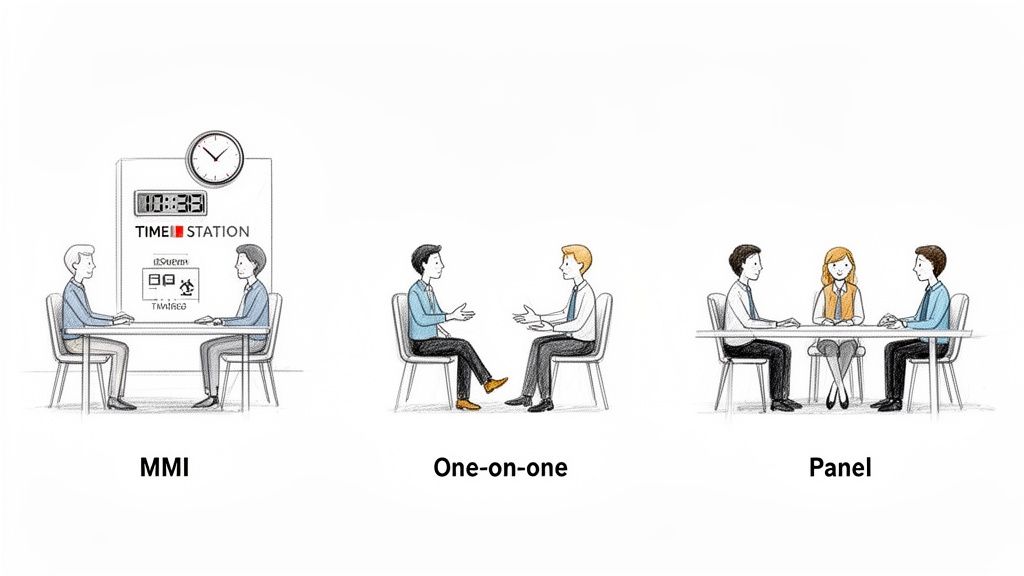
Medical schools use a few distinct interview styles, and your prep strategy has to be tailored to each one. The first step to walking in with confidence is knowing the structure and purpose behind the format you'll face. The three big ones you’ll see are the Multiple Mini Interview (MMI), the traditional one-on-one, and the panel interview.
Each is designed to test different skills. A traditional interview zooms in on your personal journey and why you want to be a doctor, while an MMI is built to see how you think on your feet and communicate under pressure. Let's break down what to expect from each.
The Multiple Mini Interview MMI
The Multiple Mini Interview (MMI) is like a series of short, focused sprints. You’ll rotate through several timed stations, usually lasting 6-10 minutes each, with a new interviewer and a unique scenario at every stop. You typically get a couple of minutes outside the door to read a prompt before jumping in.
MMI prompts are incredibly varied because they’re designed to test specific competencies, not just rehash your application.
- Ethical Dilemmas: You might face a complex ethical situation, like navigating a conflict between a patient’s autonomy and a family’s demands.
- Teamwork Scenarios: A prompt might describe a collaborative challenge, asking how you’d work with a difficult colleague to get a job done.
- Policy Questions: You could be asked to discuss a current healthcare issue, showing you’re aware of the bigger picture.
- Acting Stations: Some MMIs even have stations with an actor, where you have to show empathy or break bad news in a simulated patient encounter.
The point isn't about finding the one "right" answer. Interviewers want to see your thought process. They’re assessing your ability to reason clearly, communicate effectively, and demonstrate professionalism and empathy on the fly. For a deeper look at this format, you can learn more about how to prepare for MMI interviews in our specialized guide.
The Traditional One-on-One Interview
This is the classic interview most people imagine. It’s a more personal, in-depth conversation with a single faculty member or admissions officer, usually lasting 30 to 60 minutes. Unlike the MMI, this format is all about you.
The focus here is your story. The interviewer wants to get to the heart of your motivations, understand your experiences, and see why you’re a good match for their program specifically.
In a traditional interview, your main job is to build rapport and make a genuine connection. The interviewer is really trying to answer one question: "Would I want this person as a student at our school and as a future colleague?"
You'll get the foundational questions like "Why medicine?" and "Tell me about yourself." It's also your chance to add color and depth to the experiences you listed on your application. Success here comes down to telling compelling, well-structured stories that reveal your personal growth and core competencies.
The Panel Interview
Think of the panel interview as a traditional interview with the pressure dialed up. You’ll be in a room with a group of two to five interviewers at once—a mix that can include faculty, current students, and even community members. The whole thing feels more formal and requires you to split your attention effectively.
Managing the group dynamic is crucial. When you answer a question, make eye contact with everyone on the panel, not just the person who asked. It shows you can command a room and engage a team—a skill every future physician needs.
The questions in a panel interview are often a hybrid:
- Some will be standard "get-to-know-you" questions.
- Others might be tougher ethical or situational prompts, almost like a mini-MMI station.
- Each panelist might have their own focus, like your research, clinical background, or community service.
The panel format is a test of your composure under scrutiny. It’s about delivering thoughtful, well-reasoned answers when all eyes are on you. A great way to prepare is to practice your responses in front of a few friends or mentors to get comfortable with the dynamic.
Crafting Compelling Answers to Common Questions
Generic, canned answers are the fastest way to blend into the crowd. Your goal isn’t to recite a perfect script but to tell your authentic story in a way that shows the admissions committee you have the makings of a great physician. This is about moving beyond rehearsed lines for "Why medicine?" and preparing to tackle tough questions on ethical dilemmas, healthcare challenges, and personal setbacks with genuine self-awareness.
To pull this off, you need a system. Rote memorization will only make you sound robotic. A structured approach, however, ensures your answers are both impactful and memorable. This is where building a personal "story bank" comes in—a curated collection of your key experiences, ready to be adapted to whatever question comes your way.
Structuring Your Stories with the STAR Method
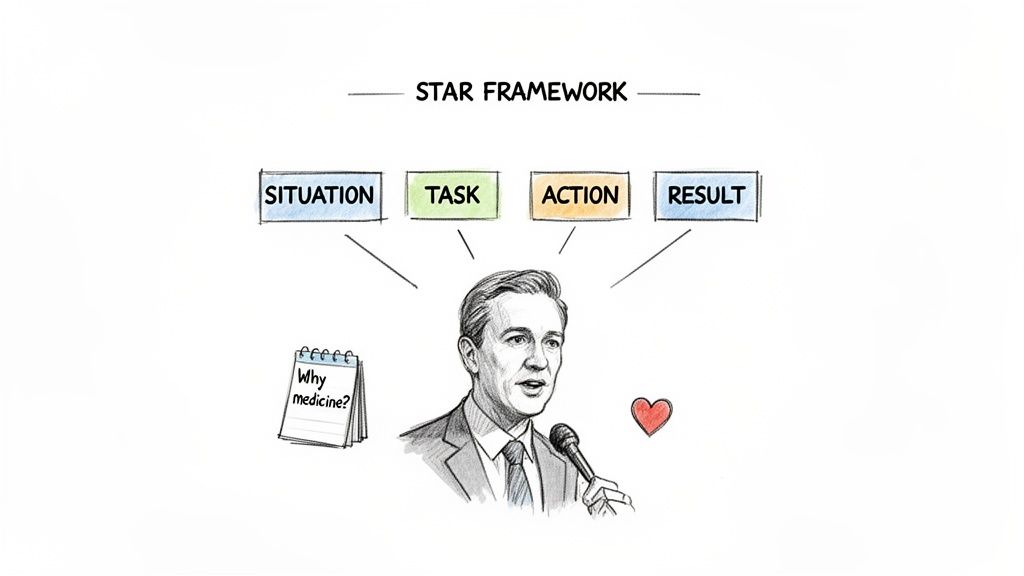
The STAR method is a simple but incredibly powerful tool for structuring your answers, especially for behavioral questions that start with "Tell me about a time when..." It forces you to be concise, specific, and focused on the outcome.
The framework breaks your story into four key parts:
- Situation: Briefly set the scene. What was the context? (e.g., "While volunteering in the ER, a distressed family member arrived...")
- Task: What was your specific job or the challenge you had to tackle? (e.g., "...my role was to provide them with an update while the patient was being stabilized.")
- Action: What specific steps did you personally take? This is the heart of your answer, so focus on your own contributions using "I" statements. (e.g., "I calmly escorted them to a private waiting area, actively listened to their concerns...")
- Result: What was the outcome? If you can quantify it, great. More importantly, what did you learn from it? (e.g., "As a result, the family felt heard and supported during a critical moment. That experience taught me just how vital compassionate communication is under pressure.")
Using this structure keeps you from rambling and ensures you hit all the key points an interviewer is listening for. It transforms a simple anecdote into a compelling demonstration of your skills.
Building Your Personal Story Bank
Your "story bank" is your most valuable prep asset. It’s a list of experiences from your academic, clinical, volunteer, and personal life that showcase the core competencies medical schools are looking for. Think of it as a mental library you can pull from on the fly.
Start by brainstorming experiences that highlight key traits:
- Empathy and Compassion: A time you connected with a patient or supported someone through a tough time.
- Teamwork and Leadership: A moment you collaborated with a group to solve a problem or took charge of a project.
- Resilience and Problem-Solving: An experience where you faced a big setback and what you did to overcome it.
- Ethical Integrity: A situation where you had to make a difficult moral choice.
For each experience, write out the story using the STAR framework. Don't just list them; flesh them out. This process helps solidify the details in your mind, making it easier to recall them naturally during the actual interview.
Your story bank isn’t about memorizing scripts. It’s about deeply understanding your own journey so you can articulate your growth and motivations with confidence, no matter how the question is phrased.
Weak vs. Strong Responses: A Practical Example
Let's apply this to a classic question: "Tell me about a time you handled a conflict."
Weak Response:
"I had a disagreement with a lab partner once over how to run an experiment. We argued a bit, but eventually, we just compromised and moved on. It all worked out in the end."
This answer is vague and forgettable. It doesn't demonstrate any specific skills or thoughtful reflection.
Strong Response (Using STAR):
- (Situation): "In my cell biology lab, my partner and I had conflicting ideas about the protocol for our final project. He was set on using a newer, riskier technique he'd read about, while I felt we should stick to the proven method to guarantee we got a good grade."
- (Task): "My goal was to find a solution that respected his desire for innovation without jeopardizing our project's success or our working relationship."
- (Action): "I suggested we meet outside the lab to map out the pros and cons of each approach. I made sure to listen to his reasoning and acknowledged the potential of the new technique. Then, I presented data from previous studies showing the reliability of the standard protocol. We decided to incorporate a small, low-stakes pilot of his method while using the established protocol for the main experiment."
- (Result): "The compromise worked perfectly. We successfully completed the project, and the pilot actually yielded some interesting preliminary data that we included in our final report. That experience taught me how to validate a teammate's ideas while still advocating for a pragmatic path forward, which ultimately strengthened our professional relationship."
The strong response demonstrates maturity, communication skills, and a collaborative mindset—exactly the qualities every admissions committee wants to see. This is the level of detail and reflection that will make your answers stand out.
Building Your Mock Interview Strategy
Having compelling answers ready is a huge first step, but the real test is delivering them under pressure. This is where a smart mock interview strategy comes in—it’s what separates a good candidate from a great one. It’s not about reciting memorized stories. It's about simulating the real environment to build the confidence and muscle memory you need to perform when it actually counts.
The goal is to move from simply knowing your material to delivering it with poise and authenticity. That requires a practice schedule that’s both demanding and reflective, giving you the space to find your weak spots and turn them into strengths.
Designing an Effective Practice Schedule
One of the most common mistakes I see is applicants cramming all their mock interviews into the last few days. A much better approach is to space out your practice over several weeks. This gives you time to actually absorb feedback and make meaningful adjustments without getting completely overwhelmed.
Think of it as a gradual ramp-up, starting with low-stakes practice and slowly increasing the pressure.
Start with Solo Practice. In the first week or two, just record yourself answering common questions. Use your phone or laptop to watch your body language, listen for filler words like "um" or "like," and check your pacing. This phase is all about self-correction and getting comfortable with your core stories.
Move to Peer Practice. Next, find a trusted classmate or friend—ideally another pre-med—to run mock interviews with. Giving each other honest feedback helps you see your answers from the admissions committee's perspective. It’s a fantastic way to test how your stories land with a live audience.
Finish with Expert Practice. In the final weeks, schedule mocks with your pre-health advisor, a mentor, or a medical school admissions consultant. These are the people who have the experience to give you the high-level, critical feedback that will really push you to polish your performance. This is your dress rehearsal.
A well-designed practice schedule builds momentum. It’s not about hitting perfection in one session, but about making small, consistent improvements over time that add up to a confident performance on interview day.
Leveraging AI for Unlimited Practice
Let’s be honest: one of the biggest hurdles in interview prep is getting enough high-quality practice. Advisors and mentors have limited time, and your friends might not always give you the critical feedback you truly need. This is where AI-powered platforms can be a total game-changer.
Tools like Confetto offer unlimited, on-demand mock interviews that simulate real MMI, panel, and traditional formats. You can practice with a massive library of prompts anytime you want, which gets rid of scheduling headaches and gives you a judge-free zone to make mistakes and get better. The real power, though, is in the instant, data-driven feedback you get. For a deeper dive into how this all works, check out our guide on the modern medical school mock interview.
In the era of holistic review, the interview has become a critical showcase for your soft skills. AAMC data reveals that at top schools, only 20-30% of interviewees end up with an acceptance offer, making your interview performance a key differentiator. In MMIs, professionalism alone can account for up to 40% of a station's score. AI platforms help you dial in on these metrics. We've seen users improve their empathy scores by an average of 22% and cut their filler word usage by 45% after just five sessions. You can discover more insights about medical school acceptance rates to see just how crucial these skills are.
Turning Feedback into Measurable Improvement
Getting feedback is the easy part. It’s what you do with it that drives improvement. Whether the critique comes from a person or an AI platform, you need a system to turn it into action.
I recommend keeping a dedicated interview journal or even just a simple spreadsheet. After every single mock interview, log this info:
- Question/Prompt: What were you asked?
- Key Feedback: Jot down specific critiques on both content (e.g., "weak example for resilience") and delivery (e.g., "spoke too fast," "avoided eye contact").
- Action Item: What is one specific thing you will change for the next session? (e.g., "Re-work my STAR story for the teamwork example," or "Practice pausing for two seconds before answering").
This structured approach forces you to actively engage with the feedback you receive. Instead of just hearing that you use filler words, you're creating a concrete plan to fix it. Reviewing your log before each new session reinforces your goals and helps you track your progress, turning criticism into genuine confidence.
Mastering Interview Day Logistics
All the hard work you've put into crafting answers and practicing your delivery comes down to interview day. But success here is about more than just what you say—it's about how you manage the entire experience with composure and professionalism. Whether your interview is online or in person, sweating the small stuff beforehand means you can focus completely on making a great impression when it counts.
For anyone with virtual interviews on their calendar, mastering remote meeting etiquette is just as critical as your content. A shoddy technical setup can easily distract interviewers and chip away at your credibility before you even get to the first question. You have to treat the virtual space with the same seriousness you would a physical one.
Preparing Your Virtual Interview Space
Your environment sends a powerful message. A clean, professional, and quiet background isn't just nice to have; it's non-negotiable.
- Background: Keep it simple and neutral. A clean wall, an organized bookshelf, or a subtle virtual background works best. Avoid anything cluttered or overly personal that could pull focus away from you.
- Lighting: Always position your main light source in front of you, never behind. Natural light from a window is ideal, but a ring light or a well-placed lamp can do the trick. The goal is to make sure your face is clearly visible and free of shadows.
- Audio: This one is huge. Use headphones with a built-in microphone. This simple step drastically improves audio quality by cutting out echo and background noise, ensuring your interviewers hear every word perfectly.
Do a full tech rehearsal the day before. Log into the video platform, check your camera angle (it should be at eye level), and make sure your internet connection is solid. On interview day, close every unnecessary application on your computer to free up bandwidth and kill any chance of a distracting notification popping up.
The In-Person and Virtual Dress Code
What you wear communicates your respect for the process and the institution. For medical school interviews, the standard is always business professional.
Your outfit should be conservative and professional, never distracting. The goal is for the admissions committee to remember what you said, not what you wore.
This means a well-fitted suit in a neutral color like navy, charcoal gray, or black is your safest and most effective bet. Pair it with a conservative shirt or blouse and clean, polished dress shoes. Keep jewelry and accessories to a minimum, and skip the strong fragrances. Your appearance should project quiet confidence and seriousness.
Post-Interview Best Practices
Your interaction with the school isn't over when you log off or walk out the door. A thoughtful follow-up is a crucial final step that reinforces your interest and professionalism.
Send a thank-you note within 24 hours of your interview. Email is the standard and is perfectly acceptable.
What a Great Thank-You Note Includes:
- Personalization: Address each interviewer by name. If you can't remember, a note to the general admissions committee is okay, but individual notes are better.
- A Specific Connection: Mention a specific point from your conversation that really resonated with you. This proves you were actively listening and engaged.
- Reiterated Interest: Briefly restate your enthusiasm for the program, connecting it back to something you learned during your interview day.
- Brevity: A few well-written paragraphs are all you need. Keep it concise and professional.
This final touch is a simple but powerful way to leave a lasting positive impression. For those facing the marathon of an MMI, using an MMI timer during practice can help you nail your pacing in each station, leaving you with enough mental energy to handle these important post-interview tasks without feeling completely drained.
Your Personalized Preparation Timeline
A smart plan turns frantic, last-minute cramming into calm, confident progress. Preparing for your medical school interview isn't a one-shot deal; it's about breaking a big job into smaller, manageable chunks over several weeks. Think of it less like a sprint and more like a training regimen.
The goal here is to build from foundational work (research and reflection) to intense practice (mock interviews), and finally, to mental conditioning. This way, you walk into your interview feeling ready, not completely burned out.
The 4 to 6 Week Mark: Building Your Foundation
This is your research and story-gathering phase. Your first job is to become a mini-expert on every school that offered you an interview. Go way beyond their mission statement—dig into their curriculum tracks, find unique research opportunities, and identify faculty whose work genuinely interests you.
At the same time, start building your "story bank." This isn't about memorizing scripts; it's about organizing your experiences so you can pull from them naturally.
- Brainstorm Key Experiences: List the moments that shaped you—academically, clinically, in the lab, and in your personal life. What truly mattered?
- Structure Your Narratives: For each key experience, sketch out the story using a simple framework like STAR (Situation, Task, Action, Result). The most important part is focusing on what you learned or how you grew.
- Connect Stories to Core Competencies: Map each story back to the qualities of a good physician, like empathy, resilience, or teamwork.
The 2 to 4 Week Mark: Intensive Practice and Feedback
Now it’s time to shift from what you're going to say to how you're going to say it. This is when the mock interviews begin in earnest.
Start by yourself. Record your answers on your phone to catch filler words ("um," "like") and pinpoint any awkward phrasing. Once you’ve done a few solo runs, schedule sessions with peers, mentors, or advisors. The key here is to get honest, direct feedback.
Keep a running log of the critiques you receive and turn them into actionable goals. For example, if a mentor says you sound a bit rehearsed, your next goal is to practice telling a core story in a more conversational, off-the-cuff way.
The Final Week: Fine-Tuning and Mental Prep
In the last week, it's time to ease up on the high-intensity mock interviews. The goal is to stay sharp without hitting burnout. Run through your strongest and weakest questions a couple of times, but shift most of your energy to mental and logistical prep.
Your final week is about cultivating a quiet confidence. Lay out your clothes, test your tech if it's a virtual interview, and get plenty of sleep. Trust the work you’ve already put in and focus on being present and authentic on the day.
A polished interview can be the deciding factor. The data is clear: applicants who get an interview have 5-7 times higher acceptance odds than those who don't. And it's not just about grades; 82% of admissions officers say they prioritize life experiences and communication skills. Small mistakes, like poor pacing or rambling, contribute to up to 50% of rejections at US and Canadian schools.
Putting in 15+ hours of dedicated prep can boost holistic scores by as much as 25%—often the difference between an acceptance and a waitlist. You can learn more about these medical school acceptance statistics to see just how much a great interview moves the needle.
This graphic lays out the key steps for managing the logistics before, during, and after the big day.
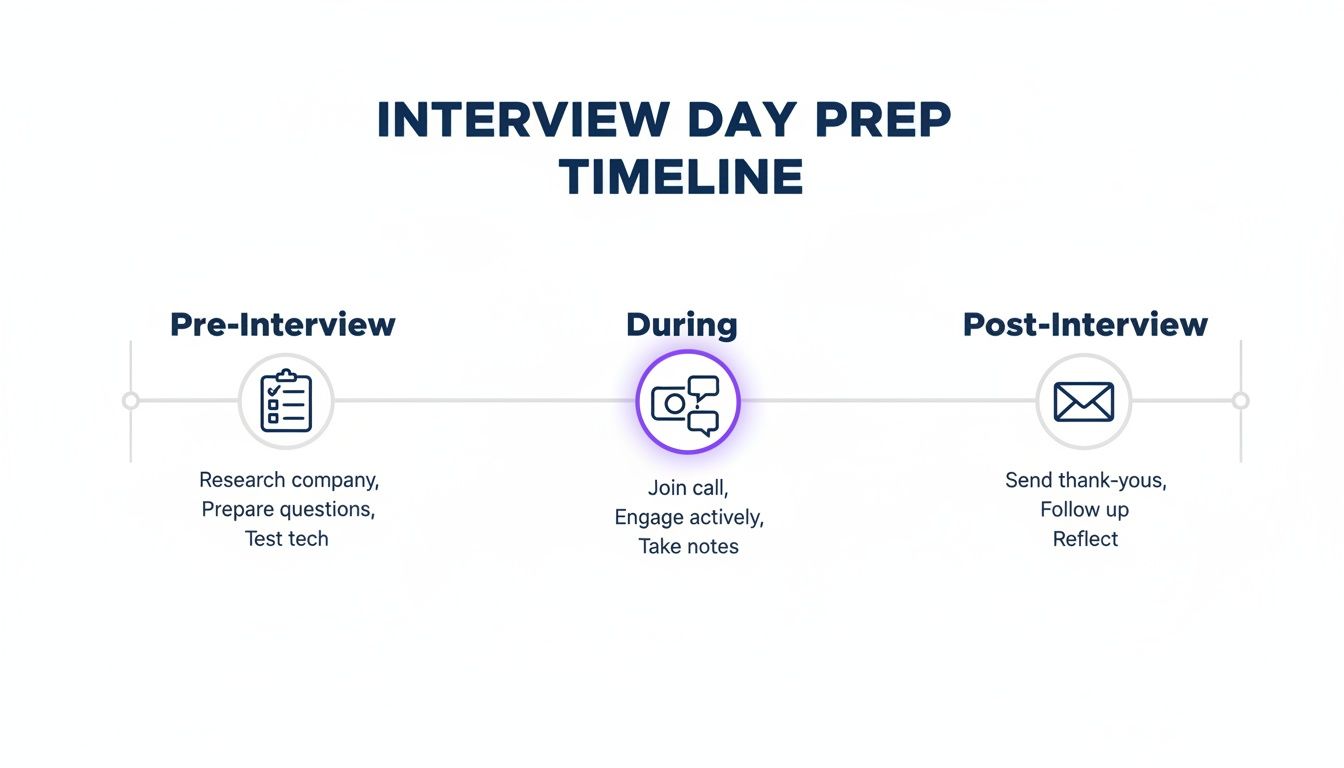
As the timeline shows, success is about managing all three phases—before, during, and after—with equal care and attention to detail.
Frequently Asked Questions
Even with a solid game plan, a few questions always seem to pop up during med school interview prep. Let's tackle some of the most common ones we hear from applicants so you can fine-tune your strategy and walk in feeling ready for anything.
How Early Should I Start Preparing?
The minute you hit "submit" on your secondary applications is the ideal time to pivot to dedicated interview prep. This usually gives you a 4-6 week window before the first interview invitations start arriving.
That timeframe is the sweet spot. It’s enough runway to do deep dives into school-specific programs, build out your story bank, and run through a few mock interviews without feeling like you're cramming. Starting early lets you methodically build your skills, get meaningful feedback, and actually implement it.
Should I Memorize My Answers?
Definitely not. Admissions committees can spot a canned, robotic answer from a mile away. It feels inauthentic and, worse, it suggests you can’t think on your feet when the conversation goes off-script. The goal isn’t to memorize a speech; it’s to have a deep command of your own stories.
Instead of memorizing, focus on developing a "story bank."
- Identify Your Greatest Hits: Pinpoint 5-7 core experiences that really showcase qualities like resilience, teamwork, or empathy. These are your go-to narratives.
- Know the Talking Points: For each story, be crystal clear on the key takeaways and the competencies it demonstrates. What's the "so what?"
- Practice, Don't Script: Rehearse telling these stories in response to different kinds of prompts. This helps you sound natural and conversational, not like you're reading a teleprompter in your head.
This approach keeps you prepared but flexible, allowing your real personality to come through.
What Is the Biggest Mistake Applicants Make?
One of the most common—and avoidable—pitfalls is failing to show genuine, specific interest in the school you're interviewing with. Too many applicants give generic answers that could apply to any medical program in the country, which just signals a lack of serious investment.
The biggest mistake is not doing your homework. When you ask a question at the end that a 30-second website search could have answered, you're telling the committee you didn't care enough to prepare properly.
Dodge this by digging into each school's unique mission, specific curriculum tracks, and community outreach programs. Prepare a few thoughtful questions that prove you’ve gone beyond the homepage and are truly picturing yourself as part of their community.
How Can I Use AI for MMI Prep?
This is where AI tools can be incredibly powerful. They're particularly well-suited for MMI practice because they excel at simulating the format's unique time pressures and scenario-based structure. You can use a platform to run through a high volume of diverse scenarios—ethical dilemmas, teamwork conflicts, policy questions—under the exact timing you'll face on interview day.
The real advantage is the instant feedback. Pay close attention to data on your pacing, how often you use filler words, and your overall communication style. The goal is to build the muscle memory needed to think on your feet and structure a coherent response in just a couple of minutes. That’s how you get comfortable with the MMI format.
At Confetto, we've designed our AI-powered platform to provide the realistic, on-demand practice you need to excel. Get instant, data-driven feedback on MMI, panel, and traditional interview formats to turn preparation into confidence. Start your journey with a free trial at Confetto.ai.