
· 14 min read
PA School Mock Interview: A Scored Walkthrough (MMI + One-on-One)
A full PA school mock interview: 8 questions and MMI stations with weak vs strong answers, scores against criteria PA programs publish, and how 9 programs run interview day.

What a PA school mock interview should test
A good PA school mock interview copies the format you'll actually face, asks the questions PA programs actually ask, and scores your answers against what programs say they evaluate. Most programs use a Multiple Mini Interview (MMI), one or more one-on-one interviews, a group activity, or a mix of these. Nearly all of them probe the same few things: why you want to be a PA and not a physician or nurse practitioner, what your patient care experience taught you, how you work on a team, and how you reason through an ethical problem.
The stakes are real. PAEA, which runs the CASPA application, counted 35,280 applicants in the 2025-26 cycle. In 2024-25, 13,195 people started PA school out of 34,625 applicants, so roughly 38% of applicants enrolled that year (our calculation from PAEA's matriculant data). ARC-PA lists 335 accredited PA programs.
This guide is a full mock interview on paper. You'll see eight questions and stations, a weak answer and a strong answer for most of them, a score for each on a 1 to 5 scale, and the reason for each score. Then you'll find how to run the same mock yourself with real timing. If you want a longer list of questions to practice, use our PA program interview questions guide alongside this one.
Confetto isn't affiliated with PAEA, ARC-PA or any PA program. Program facts below come from each program's own admissions pages, read on October 4, 2026. Formats change between cycles, so check your invitation.
How 9 PA programs run interview day
Before you run a mock, find out which format you're preparing for. This table shows only what each program's own page says.
| Program | Format | Key detail | Source |
|---|---|---|---|
| Duke | Two individual interviews plus a group exercise, on Zoom | About 250 applicants invited to interview | Application page |
| Emory | Online MMI on Zoom | Plus a Q&A with admissions and current students | Interview page |
| OHSU | MMI, one-on-one and group activity | 10-minute stations (2 min to read, 8 to respond); 15-minute individual interview; 25-minute group task in groups of five | Interviews page |
| Rosalind Franklin | In-person MMI | 5 minutes per station, a different rater at each, 1 minute to move and 1 to read the next prompt | Interview details |
| University of Florida | 8-station MMI | Raters include PA faculty, community stakeholders and a clinical-year student; in-person or virtual | Interviews page |
| University of Iowa | In-person MMI | Also orientation, student panels and a debrief; July to December | Student selection |
| Baylor College of Medicine | Three individual faculty interviews, virtual for 2026 | Scores combined into an "Interview Index" | Application process |
| UNMC (Nebraska) | MMI with timed stations | October and November | Admissions FAQ |
| Wake Forest | Faculty interview plus a mock inquiry-based learning (IBL) group session | All virtual for the 2026-2027 cycle | How to apply |
Three patterns stand out. MMIs are common, but station timing varies a lot: OHSU gives you 8 minutes to respond, Rosalind Franklin gives you 5. Group activities show up at Duke, OHSU and Wake Forest. And some programs, such as Baylor, rely on several individual interviews instead of stations.
What PA interviewers score
Several programs publish what their interviewers evaluate. OHSU lists communication, self-reflection and self-awareness, empathy, teamwork, ethical responsibility, cultural awareness, resilience and adaptability, and professional and personal preparation. Emory says its MMIs assess communication skills, understanding of medical ethical issues or health policy, problem-solving, maturity, attitudes and interpersonal skills, and that they don't test medical knowledge. Baylor's rating criteria include "role awareness," and Iowa assesses "knowledge of the PA role in the health care system."
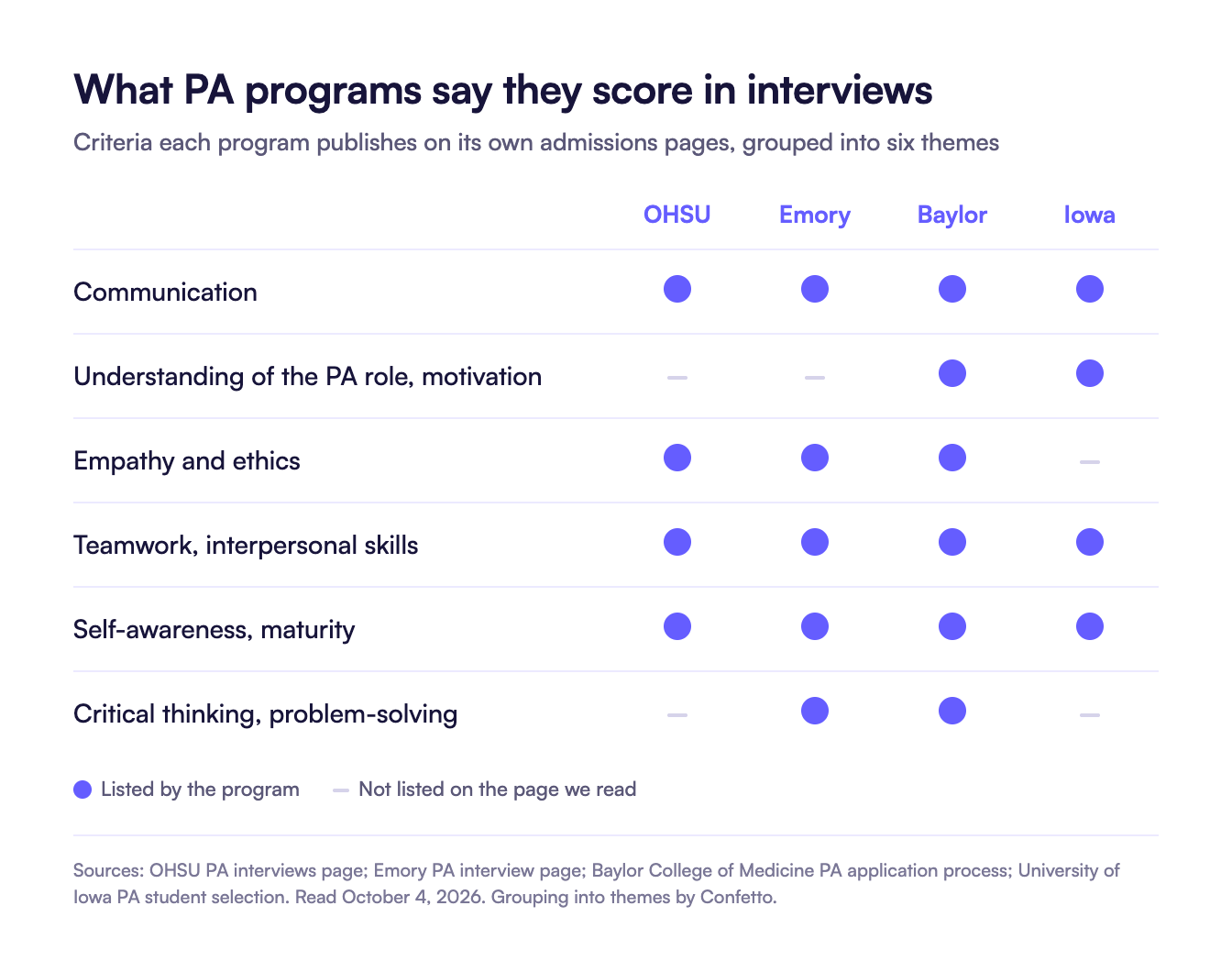
Programs don't publish their numeric scales, so for this walkthrough we score each answer from 1 to 5 against those published themes:
- 1 to 2: generic or off target. The answer could come from anyone, or it misses what the question tests.
- 3: relevant but thin. The right idea, with no specific example or no reflection on it.
- 4: specific and well structured, with one gap, such as a vague outcome.
- 5: specific, reflective, and clearly shows the trait being tested, with a link to how PAs actually work.
The mock interview: 8 questions, scored
The candidate in this mock is illustrative: an applicant with two years as an emergency department scribe and a year as a certified nursing assistant (CNA). The answers are written for this guide, not taken from a real applicant. Read each weak answer and decide what's wrong with it before you read the score.
1. "Why do you want to be a PA, and not a physician or a nurse practitioner?"
Tests: understanding of the PA role, motivation. This is the question Baylor and Iowa are scoring when they list role awareness and knowledge of the PA role.
Weak answer (2/5): "I've always wanted to help people. PA school is shorter than medical school, and I like that PAs can switch specialties."
Why it scores low: every fact in it is true, but the reasons are about convenience. To an interviewer, it sounds like PA is your backup plan, and nothing in it comes from your own experience.
Strong answer (5/5): "As a scribe, I worked most of my shifts beside a PA. She would see a patient, form a plan, talk it through with the attending in a couple of minutes, then go back and explain the plan to the family. That's the kind of practice I want: real clinical decisions, made as part of a team that works in collaboration with physicians. I took medical school seriously and shadowed a family physician, but I don't want to lead the team. I want to be a strong clinician inside it. I'm not a nurse, and NP programs are built for registered nurses, so the PA route fits my background. I also like that PAs can move between specialties without going back to school. I've loved both emergency medicine and primary care, so that flexibility matters to me."
Why it scores high: it starts from something the applicant actually saw, shows they tested other paths, and describes the PA role accurately. PAEA describes PAs as working "as part of a medical team in collaboration with a physician." It also turns flexibility from a perk into a reason that fits this applicant.
Likely follow-up: "What will you do if you aren't accepted this cycle?"
2. "Walk me through your patient care experience."
Tests: communication, professional and personal preparation.
Weak answer (2/5): a list of jobs and hours in date order, ending with "so I have over 3,000 hours."
Why it scores low: the interviewer already has your hours from CASPA. Repeating them uses up your time and shows nothing about what you learned.
Strong answer (4/5): "I've spent about three years in direct patient care, first as a CNA on a med-surg floor, then as an ED scribe. As a CNA I learned the basics of care, and how much a patient's day depends on small things done on time. Scribing taught me how clinicians think: I documented thousands of assessments and started to predict the workup before the provider ordered it. One moment tied the two together. A patient I'd helped as a CNA came into the ED, and I saw how much faster the team could help her because the nursing notes were clear. That's when I decided I wanted to be the one making the plan."
Why it isn't a 5: the structure is good (one line summary, what each role taught, one story), but the last line jumps to a conclusion. A 5 would add one sentence on what the applicant did to test that decision, such as shadowing a PA.
3. "Tell me about a time you disagreed with someone you worked with."
Tests: teamwork, maturity, communication. This is a behavioral question, so use a short story: the situation, what you did, the result, and what you learned.
Weak answer (2/5): "I don't really have conflicts. I get along with everyone and I always try to stay positive."
Why it scores low: it avoids the question. Interviewers read it as low self-awareness or a lack of real team experience.
Strong answer (5/5): "As a CNA, a nurse I worked with wanted all morning vitals done before 7 a.m. to fit the medication pass. One patient with dementia became very agitated when we woke her early. I asked the nurse if we could talk at a quiet moment, explained what I was seeing, and suggested doing her vitals last on the round. She agreed to try it for a week. The patient was calmer, her vitals were easier to get, and the nurse added it to the care plan. I learned to bring a specific observation and a small proposal, not just a complaint."
Why it scores high: a real disagreement, handled at the right level, with a measurable result and a clear lesson. It also stays respectful of the other person.
4. MMI ethics station: the exam you didn't do
Prompt: "You are a PA student on a clinical rotation. The clinic is running late, and your preceptor asks you to document a normal heart and lung exam on a patient you haven't examined. What do you do?" (Practice it the way OHSU runs stations: 2 minutes to read, 8 minutes to respond.)
Tests: ethics, professionalism, communication under pressure.
Weak answer (1/5): "He's my supervisor and he's responsible for the patient, so I'd do what he asks."
Weak answer (2/5): "That's fraud. I'd refuse and report him to the program director right away."
Why both score low: the first documents something false. The second has the right value but jumps to the most extreme step without trying to solve the problem, and ignores that the preceptor may have misspoken or be under pressure.
Strong answer (5/5): "My first concern is the patient, because a chart that says an exam was normal when no one checked could hide a real problem. I also need to be honest, and I want to keep a working relationship with my preceptor. So I'd say right away, 'I haven't examined him yet. Can I do it now? It'll take two minutes.' If we really can't, I'd document only what I actually did. If my preceptor pushed back, I'd stay respectful but wouldn't sign a note I know is false. Afterward I'd ask to talk about it privately, because it may have been a rushed comment. If it happened again, I'd talk to my program's clinical coordinator, since that's what they're there for."
Why it scores high: it names the stakeholders, offers a practical fix first, holds a clear line on honesty, and escalates in steps. MMI stations rarely have one right answer. OHSU says so directly and asks you to explain your reasoning, which is what raters score.
5. MMI role-play station: "Am I going to see the real doctor?"
Prompt: "You are a PA in a family medicine clinic. A patient you've just introduced yourself to says, 'No offense, but when do I get to see the real doctor?' An actor plays the patient."
Tests: understanding of the PA role, communication, empathy. OHSU notes that its stations may include role play with an actor.
Weak answer (2/5): "I'd tell them PAs go to medical school too and are fully qualified, so they don't need a doctor."
Why it scores low: it's defensive, it's inaccurate (PAs don't attend medical school), and it ignores what the patient is actually worried about.
Strong answer (5/5): "That's a fair question, and I'm glad you asked. I'm a physician assistant. I'm trained in medicine, and I work as part of a team with Dr. Lee, who supervises the practice. I'll take your history, examine you and put together a plan, and if anything needs her input, I'll bring her in. Is there something specific you're worried about today that you'd like to make sure a physician sees?"
Why it scores high: it stays warm, explains the role accurately in plain language, and turns the question back to the patient's concern. In a role-play station, the rater watches what you do with the patient, not what you say about PAs in general.
6. "Tell me about a mistake you made."
Tests: self-awareness, maturity, resilience.
Weak answer (2/5): "I'm a perfectionist, so my mistake is that I sometimes work too hard."
Strong answer (5/5): "As a new CNA, I recorded a patient's blood pressure in the wrong room's chart because I was charting from memory at the end of a busy round. The nurse caught it within the hour, before anything happened. I told her right away it was my error, fixed it with her, and since then I chart at the bedside or immediately after leaving the room. It changed how I think about small shortcuts in patient care."
Why it scores high: a real mistake with real stakes, full ownership, a concrete change in behavior and no excuses. Avoid mistakes that harmed a patient seriously or that suggest poor judgment you haven't fixed.
7. Group activity: how you're scored when there's no question
Duke runs a group exercise, OHSU a 25-minute activity in groups of five, and Wake Forest a mock inquiry-based learning session. There's no answer to script here. The observers watch how you work with people you just met.
- Scores well: restating the task so everyone agrees on it, inviting a quiet member in by name, building on someone else's idea, keeping an eye on time, and summarizing where the group landed.
- Scores badly: taking over to "show leadership," staying silent, arguing to win, or ignoring the task to perform for the observers.
To practice, do a timed group task with two or three friends, such as ranking items for a scenario or planning a clinic outreach event, and ask one person to only observe and score each of you on participation, listening and collaboration.
8. "Do you have any questions for us?"
Tests: motivation and real interest in this program.
Weak (1/5): "No, I think you've covered everything." Also weak: asking something that's answered on the program's website.
Strong (5/5): one or two specific questions that show you've read about the program, such as "How are clinical rotation sites assigned, and can students request a rural site?" or "When a student struggles in the didactic year, what support does the program offer?"
Scorecard for the mock
| Question | Main theme tested | Weak | Strong |
|---|---|---|---|
| Why PA, not MD or NP? | PA role, motivation | 2 | 5 |
| Patient care experience | Communication, preparation | 2 | 4 |
| Disagreement at work | Teamwork, maturity | 2 | 5 |
| Ethics station | Ethics, professionalism | 1 to 2 | 5 |
| "Real doctor" role-play | PA role, empathy | 2 | 5 |
| A mistake you made | Self-awareness | 2 | 5 |
| Group activity | Teamwork | Scored on behavior | |
| Your questions | Motivation | 1 | 5 |
The pattern is the same in every row. Weak answers are generic or defensive. Strong answers are specific, show what you did and learned, and connect to how PAs actually work.
How to run your own PA school mock interview
Set up your mock to match your invitation. If you don't know the format yet, practice both stations and individual interviews.
| Format to rehearse | Timing to use | Based on |
|---|---|---|
| Long MMI stations | 2 minutes to read, 8 minutes to respond, new prompt each station | OHSU |
| Short MMI stations | 1 minute to read, 5 minutes to respond, 1 minute to move | Rosalind Franklin |
| Full MMI circuit | 8 stations back to back | University of Florida |
| Individual interview | 15 minutes, or three separate interviews with different people | OHSU; Baylor |
| Group activity | 25 minutes, groups of about five | OHSU |
- Pick 6 to 8 prompts you haven't seen, mixing the question types above. Don't practice only questions you've already polished.
- Use a timer and don't stop it. Our free MMI timer handles reading time, answer time and the gap between stations.
- Record yourself on video. You'll notice filler words, rushed endings and missing examples that you can't hear while talking.
- Score each answer 1 to 5 with the scale above, or have a friend do it. Write down the one change that would raise each score by a point.
- Repeat with new prompts two or three days later and compare scores. Improvement on unseen prompts is the real test.
For more prompts, the Confetto question bank has PA, MMI and ethics questions, and our PA school requirements guide covers the rest of the application.
Practicing with Confetto
Confetto runs AI mock interviews for PA school in MMI, panel and traditional formats. The AI interviewer pushes on "why PA and not MD?", your patient care hours and scope-of-practice scenarios, and asks follow-up questions based on what you actually said. When you finish, you get a scored report that points to the exact moments to fix. You can start with a 7-day free trial; paid plans come after that.
PA school mock interview FAQ
How long is a PA school interview?
It depends on the program. OHSU combines MMI stations, a 15-minute individual interview and a 25-minute group activity. Baylor runs an orientation day, then three individual faculty interviews the next day. Florida's visit spans two days, with an 8-station MMI on the second.
Do PA schools use the MMI?
Many do. Emory, OHSU, Rosalind Franklin, Florida, Iowa and UNMC all describe MMI formats on their own pages. Others, such as Baylor, use individual interviews, and Duke combines individual interviews with a group exercise.
When do PA school interviews happen?
Mostly in the fall and early winter. Florida interviews from late August through December, Iowa from July through December, UNMC in October and November, and Wake Forest in fall 2026 on a rolling basis. The 2026-2027 CASPA cycle, for classes starting in 2027 or January 2028, opened April 30, 2026, and closes April 1, 2027.
Do PA programs require Casper?
It varies, so check each program. Northwestern, for example, says Casper, PA-CAT and MCAT scores aren't required and won't be evaluated if you send them.