Practice the questions pediatrics programs ask about working with families, advocating for children, and caring for adolescents, plus questions written from your own application.
“Confetto showed me the answer moments that sounded rushed, vague, or missing empathy. The rewrite suggestions made my next mock feel different.”
— Priya K. - completed 120 AI mock interviews
How it works
From your specialtyto interview day
Tell us your specialty. We build your plan, teach you the residency interview, run mocks with follow-ups on your stories and show you exactly what to change.
1
A plan built just for you
Tell us your specialty and interview dates. We map out every day until your interview, so you know what to do each day.
2
We teach you everything
Our Zero to Hero course for residency: short lessons on your story bank, why this specialty, behavioral answers, red flags and the Match, with practice in every one.
Short lessons
3 to 5 min each
Practice in every lesson
3+ checks each
3
Unlimited mocks for your specialty
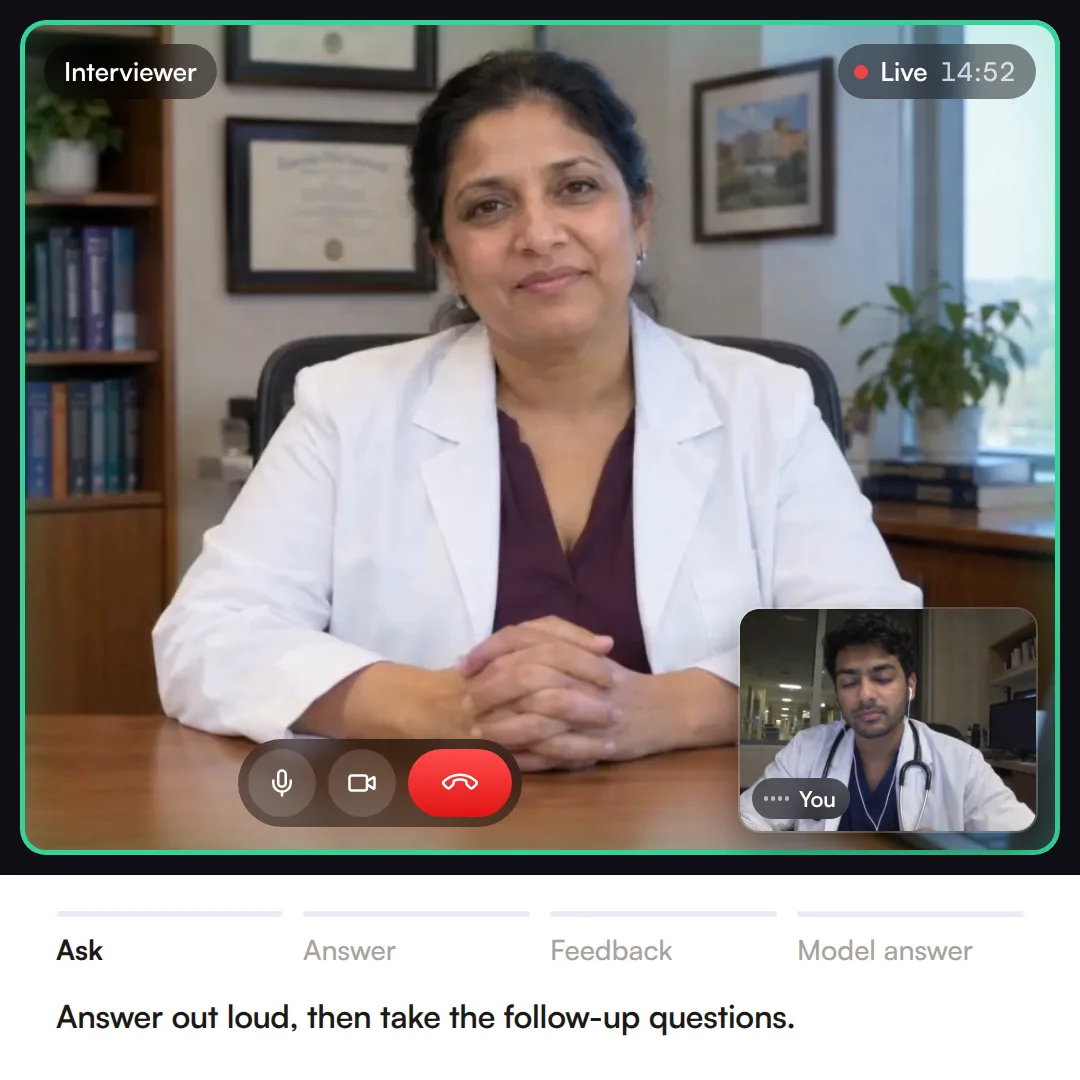
A live AI interviewer that asks behavioral, specialty and program-fit questions and follows up on what you just said, out loud.
Behavioral, specialty and program-fit questions, with follow-ups on your stories
Questions written from your own ERAS experiences
Question sets for 13 specialties, plus CanMEDS questions for CaRMS
4
We show you exactly how to improve your score
A score and line-by-line edits to what you actually said, seconds after you answer, so you can fix it right away.
Score out of 100
Every answer
Line-by-line edits
In seconds
AI interviewer
Your score86/100
Start practicing with Confetto today.
Three free mocks are enough to see your score, review your delivery, and understand your highest-impact improvements.
Programs are checking that you like caring for children and their families, including the hard parts, and that your answer goes past “I like kids.”
1
Your reason, then one child and one family
Open with the part of the work that draws you, in one sentence. Then a patient you helped care for, and what you did for the child and for the parents.
2
What you learned about families
Anxious parents, disagreements, adolescent confidentiality. This is the part many answers skip.
3
What you want from training
General pediatrics, hospital medicine, a subspecialty or advocacy, and the experiences pointing you there.
What a strong answer does
A strong answer is about one child and the family around them, and what you did for both. It names the electives that tested your interest and ends on the kind of pediatrics you're leaning toward.
ERAS, NRMP, and CaRMS are trademarks of their respective owners. Confetto is not affiliated with them.
Sample Results Report
What feedbackactually looks like.
The same view applicants see after a Confetto mock: rubric scores, your own answer improved line by line, video coaching, and exact next steps before the real interview.
Residency mock · Patient autonomy
Residency interview report
The full report after a live mock — same view inside the product.
Ethics · 8 min response
86
Overall · +14
Overall · 86
+14 from your baseline mock
Rubric breakdown
3 scored areas
Empathy91/100
You validated the patient's concern before moving into shared decision making.
Ethical reasoning86/100
Strong autonomy framing. Add one sentence on capacity and informed consent.
Structure82/100
Clear opening, but your final recommendation needed a sharper summary.
Summary
You opened with empathy and held space for the patient's autonomy — the strongest move in this answer. The clearest unlock is naming capacity and informed consent before your recommendation, and tightening the final sentence so it lands.
Response analysis
How to improve your answer
86
You scored 86. With these two changes, about 91.
From your answer at 04:42+3
“If they still refused, I would explain why the surgery is necessary and try to convince themI'd check they have capacity, ask what matters most to them, and then walk through the options.”
“If they still refused, I would explain why the surgery is necessary and try to convince them.”
Leads with capacity and consent instead of persuading, which is what the rubric scores. Ethical reasoning
From your answer at 07:10+2
“So overall, I think it depends on the situationI'd respect their decision, document it, and leave the door open if they change their mind.”
“So overall, I think it depends on the situation.”
Ends on a clear recommendation: values, plan, safety net. Structure
What you did well
“I would first confirm the patient understands the risks, then ask what matters most to them.”
Strong patient-centered framing. You led with autonomy instead of arguing for the procedure.
Sample only. Your real report uses your transcript, video, and the residency rubric.
Get your first score report before you pay.
Start with 3 free mock interviews, then upgrade when you are ready for unlimited practice.
A live AI interviewer that asks follow-up questions
One-on-one, panel and MMI, at real timing
A score out of 100 after every answer
Notes on tone, pace, eye contact and posture from your video
Filler-word counts and phrasing suggestions
Model answers and your score history
Add your own questions, as many as you like
Start with 3 free mock interviews · secure checkout with Stripe
FAQs
FrequentlyAsked Questions
Everything you need to know about Confetto, answered in one place.
Yes. The pediatrics set has questions on parents who disagree with the plan, adolescent confidentiality and advocating for a child beyond the hospital, with follow-ups like an interviewer would ask.
Pick a case with a child and a family, say what you did for each, and what you learned about communicating with both. Specific beats impressive.
“I love kids.” Everyone says it. Show what you did for a child and a family. Leaving the parents out. Pediatric interviewers want to know you can work with parents who are scared or who disagree. Avoiding hard cases. Seriously ill children are part of the work. One reflective line about a hard case helps.
This season, applicants get 5 program signals in ERAS, and programs read them as interest (AAMC, ERAS 2027 program signaling).
ERAS opens to programs in late September. Interviews run October to February, mostly virtual. Rank lists are due in early March. Match Day is in mid-March. Most applicants start practicing as soon as they apply, so they're ready when the invite comes.
It depends on the program: behavioral one-on-one, panel, virtual interviews or mMI-style stations (CaRMS). Confetto lets you practice each of them out loud, with follow-up questions and a score after every answer.
Tell me about yourself, why this specialty, why our program, a challenging patient or a mistake you learned from, a conflict on your team, where you see yourself in five to ten years, and questions about anything unusual in your application.
Know your ERAS application well enough to talk about any line of it, prepare five or six stories that answer the behavioral questions, learn each program's specialty-specific details, and practice out loud with follow-up questions. Have questions ready for the program director, faculty and residents.
Yes. Paste your experiences, personal statement or CV into Residency Prep and Confetto writes the questions an interviewer who read it would ask. Your text stays private to your account.
Internal medicine, family medicine, pediatrics, emergency medicine, general surgery, psychiatry, OB/GYN, anesthesiology, neurology, radiology, dermatology, ophthalmology and orthopedic surgery, plus general residency questions for every specialty, including program signals, your rank list and the red flags on your application.
Yes. Tell Confetto you're matching in Canada and feedback names the CanMEDS roles your answer showed. You can also practice MMI-style stations as a full circuit.
Yes. As a residency applicant you're expected to use clinical terms and reasoning, and feedback holds you to that.
After signing up, Confetto places you in a video call with an AI interviewer that asks follow-ups and probes your answers just like a real admissions committee member. Afterward, you receive a report card broken down by category: content (what you said), delivery, and visual analysis of your professionalism, posture, tone, and more—all extracted from your video.
Yes. You can add any question, and as many questions as you'd like.
Yes. Confetto analyzes your video feed to assess professionalism, posture, tone, eye contact, and other non-verbal cues, giving you a full breakdown alongside your content feedback.
Your free trial includes 3 free mock interviews. You'll see exactly how long it lasts before you start.
You can upgrade to any plan for unlimited practice and cancel anytime. Your notes and feedback stay saved if you decide to return later.
Email us anytime at hello@confetto.ai and we'll respond within 24 hours.
Any laptop or mobile phone with a webcam and microphone is all you need. Confetto runs in your browser—no downloads required.