Built to raise the exact scores board examiners grade.
Practice every question type, run pressure-tested mocks, then get video, tone, and phrase-level feedback ChatGPT simply can't give you.
Question BankBoard-style cases
Top pick for you·Intraoperative crisis
A healthy 19-year-old is having an ACL repair under sevoflurane after succinylcholine. His end-tidal CO2 has climbed to 68 despite doubled ventilation. What do you do?
A strong answer opens
“I treat this as malignant hyperthermia.”
Model answer includedPractice
34Surgery CE cases
15SOE stems
15Additional topics
8OSCE stations
Every Question Type
72 board-style cases for anesthesiology and general surgery, each with a model answer for every step.
72 cases · SOE + OSCE + CE
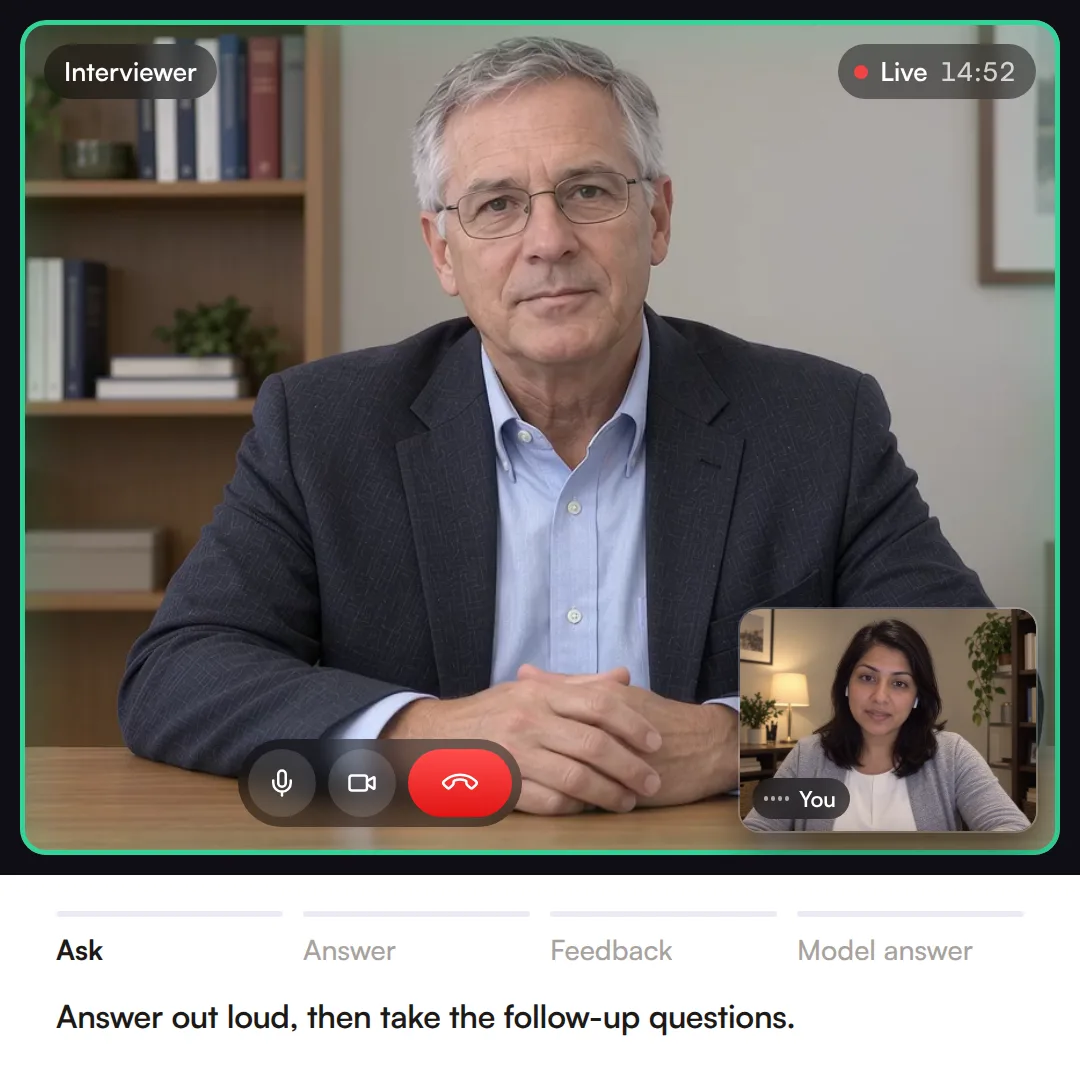
Anesthesiology SOE · IntraoperativeLive 06:12
Interviewer
Live conversation
InterviewerOn one-lung ventilation, her saturation falls to 86%. What do you do?
YouI go to 100% oxygen, check the tube with the bronchoscope, then add CPAP to the operative lung.
Follow-upHer saturation is now 82%. What now?
Ultra-realistic Mock Interviews
A live AI examiner by voice reads the stem, gives data only when you ask, changes the facts and makes you commit.
Live examiner · Scripted follow-ups
Your answer · 2:14Posture open · Smiling
Pace142 wpmSteady
Filler words3Low
Eye contact92%Strong
ToneWarmCalm
Video & Tone Analysis
Eye contact, pacing, filler words, body language, and vocal warmth — the non-verbal signals ChatGPT can't see or hear.
Not possible in ChatGPT
Your answer, line by line · Patient autonomy74 → 81 with this fix
You said · 1:32
“I’d explain why the surgery is necessary and make sure she agrees.”
Try saying
“I’d ask what worries her most, explain the options plainly, and respect her choice.”
Empathy6.8 9.1
Ethics7.2 8.9
Line-by-line Feedback
Rubric scores across empathy, ethics, structure, and delivery — with transcripts and the exact phrasing to use next.
8 rubric dimensions · Transcripts
AI interviewer
Your score86/100
Your first mock oral can start today.
Pick a case, answer out loud, and see exactly what an examiner would mark down.
A few of the board-style cases you'll practice, from the bank the AI examiner draws on. Pick a set and practice one now.
Intraoperative crisis
“A healthy 19-year-old is having an ACL repair under sevoflurane after succinylcholine. His end-tidal CO2 has climbed to 68 despite doubled ventilation. What do you do?”
“A 32-year-old at 36 weeks with severe preeclampsia needs an urgent cesarean. Her platelets have fallen from 121,000 to 88,000 in six hours. Is a neuraxial block safe?”
“Two minutes after a supraclavicular block with 30 mL of 0.5% bupivacaine, a 70-year-old man tastes metal and has a seizure. What is happening and what do you do?”
“An 84-year-old with a hip fracture fainted two months ago and gets short of breath after one block. The surgeon wants to operate this afternoon. Should her valve be treated first?”
“A 23-year-old with an anterior mediastinal mass now sleeps on three pillows and is booked for mediastinoscopy. How do you assess his risk of collapse under anesthesia?”
“A 52-year-old woman with a ruptured anterior communicating artery aneurysm is booked for clipping. Her troponin is up and her ECG is abnormal. Does she need a cardiology workup first?”
Scripted follow-ups that change the facts mid-case
OSCE communication stations for ABA APPLIED
Scored on each board's own attributes
A pass-risk verdict after every case
Line-by-line fixes to what you actually said
A model answer for every step of every case
Start with a free week · secure checkout with Stripe
FAQs
FrequentlyAsked Questions
Everything you need to know about Confetto, answered in one place.
Start with a free week. Then it's $149 a week, $299 a month or $579 a year, with unlimited mock orals on every plan.
Yes. Cancel in the app anytime, including during your free week. Your cases and feedback stay saved if you come back later.
The examiner reads a stem, gives data only when you ask and moves from preop to intraop to postop. It changes the facts mid-case, pushes you to commit and moves on at time.
Each case opens with a short stem. You ask for what you need, walk through the operation step by step and manage the complication that follows. A session is four cases back to back.
The ABA APPLIED Exam for anesthesiology (the SOE and the OSCE) and the ABS General Surgery Certifying Exam.
Yes. The examiner plays the patient or colleague in the communication and professionalism stations, such as disclosing an error or a patient refusing blood. The technical stations (echo, monitors, ultrasound) are talked through out loud: you describe what you see and what you would do.
On the attributes each board says it grades, like judgment, adaptability and organization. You get a pass-risk verdict, a score out of 100 and line-by-line fixes to what you said.
No. Like a real examiner, it stays neutral and never hints. Your feedback comes right after the case ends.
We write every case to follow the boards' published formats and current guidelines, such as MHAUS for malignant hyperthermia and ASRA for local anesthetic toxicity.
A laptop or phone with a microphone. Confetto runs in your browser, with no downloads.
Email us anytime at hello@confetto.ai and we'll respond within 24 hours.