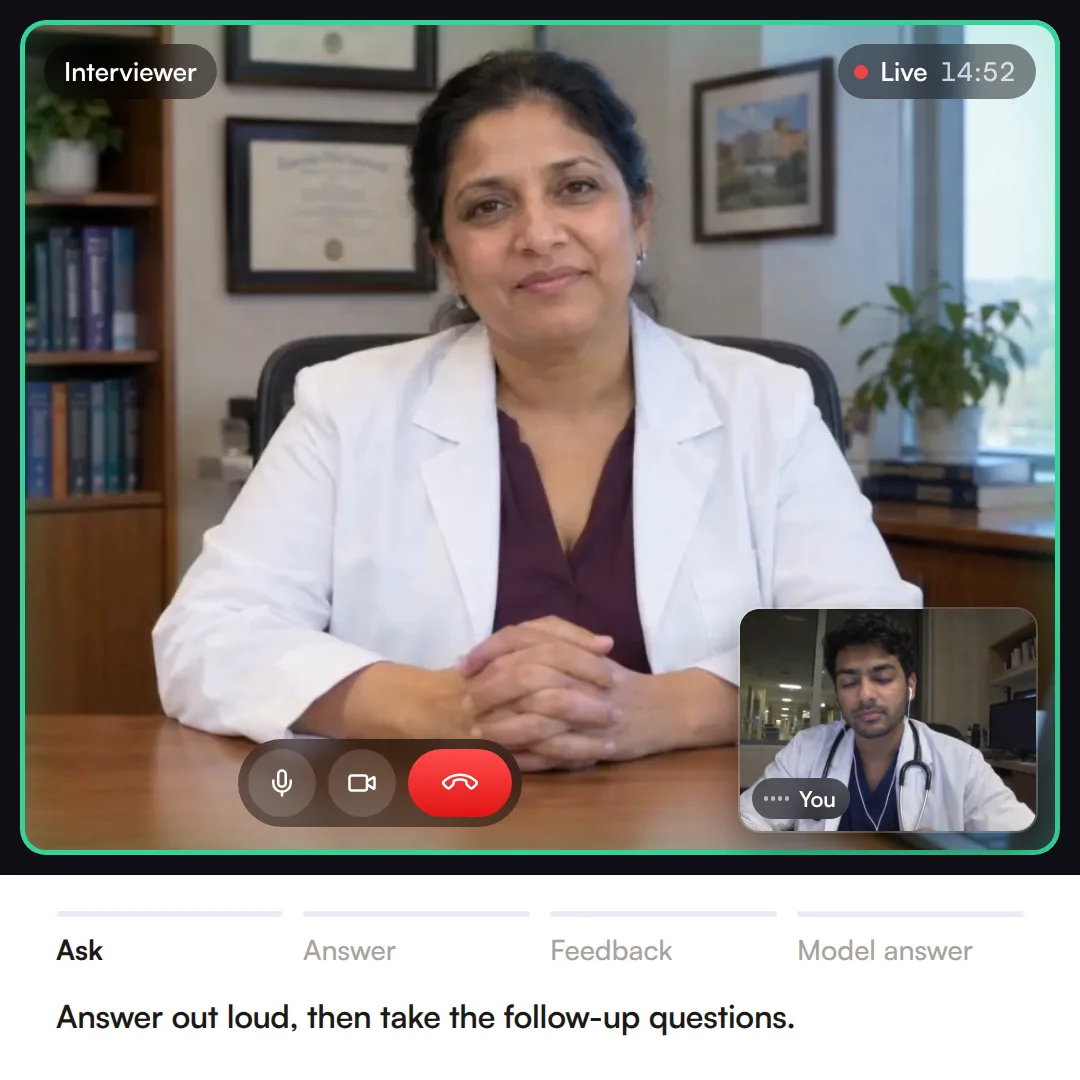
General surgery residency interviews ask why you chose surgery, how you keep going through hard training, when you spoke up for safety in the operating room, and how you build technical skill. Confetto is an AI interviewer that asks these questions, plus ones written from your own application, with follow-ups on every answer.
Rank lists are due March 3, 2027, and Match Day is March 19.
Tell us your specialty. We build your plan, teach you the residency interview, run mocks with follow-ups on your stories and show you exactly what to change.
1
A plan built just for you
Tell us your specialty and interview dates. We map out every day until your interview, so you know what to do each day.
2
We teach you everything
Our Zero to Hero course for residency: short lessons on your story bank, why this specialty, behavioral answers, red flags and the Match, with practice in every one.
Short lessons
3 to 5 min each
Practice in every lesson
3+ checks each
3
Unlimited mocks for your specialty
A live AI interviewer that asks behavioral, specialty and program-fit questions and follows up on what you just said, out loud.
Behavioral, specialty and program-fit questions, with follow-ups on your stories
Questions written from your own ERAS experiences
Question sets for 19 specialties, plus CanMEDS questions for CaRMS
4
We show you exactly how to improve your score
A score and line-by-line edits to what you actually said, seconds after you answer, so you can fix it right away.
Score out of 100
Every answer
Line-by-line edits
In seconds
AI interviewer
Your score86/100
Start practicing with Confetto today.
A free week is enough to see your score, review your delivery, and understand your highest-impact improvements.
Programs are checking that you know what five or more years of surgical training costs and want it anyway, that you like the care around the operation as well as the operation, and that you have thought about where it leads.
1
Your reason, then a patient from decision to recovery
Open with the part of the work that draws you, in one sentence. Then a case where you saw the decision to operate, the operation and the recovery, and what your part was.
2
Proof you know the hard parts
A hard rotation or stretch of call, and what kept you going. Honest beats heroic.
3
What you want from training
Operative volume, autonomy and a career direction: general surgery, a fellowship, rural or academic practice.
What a strong answer does
A strong answer follows one patient from the decision to operate through follow-up, so it's about ownership and not only the operating room. It shows how you tested your stamina and ends on the training you want.
The same view applicants see after a Confetto mock: rubric scores, your own answer improved line by line, video coaching, and exact next steps before the real interview.
Residency interview report
Residency mock · Difficult team
+14 from your baseline mock
86
Strong
+14 from your baseline mock
Rubric breakdown
Teamwork · 8 min response
Teamwork
91
You listened to both residents before moving into what the team should do.
Situation, action, result
86
Strong, specific opening. Add one sentence on what changed for the patient.
Reflection
82
Clear story, but your closing line needed a sharper takeaway.
Summary
You opened with one real rotation and named your own role, the strongest move in this answer. The clearest unlock is stating the result for the team and the patient before your takeaway, and tightening the final sentence so it lands.
Response analysis
How to improve your answer
91
You scored 86. With these two changes, about 91.
From your answer at 04:42+3
“Once it got tense, I just tried to stay out of it and let the residents sort it outI asked each resident what worried them most and wrote both concerns on one list.”
“Once it got tense, I just tried to stay out of it and let the residents sort it out I asked each resident what worried them most and wrote both concerns on one list.”
Shows what you personally did instead of what the team did, which is what the rubric scores. Situation, action, result
From your answer at 07:10+2
“So overall, I think it worked out in the endthe patient went home on the plan we agreed, and I'd ask what each person needs sooner next time.”
“So overall, I think it worked out in the end the patient went home on the plan we agreed, and I'd ask what each person needs sooner next time.”
Ends on the result and what you learned. Reflection
What you did well
“On my medicine sub-internship, two residents disagreed about a discharge plan, and I was the student in the middle.”
Strong, specific opening. You named your role in the first sentence instead of describing the team.
Sample only. Your real report uses your transcript, video, and the residency rubric.
Get your first score report before you pay.
Start with a free week, then upgrade when you are ready for unlimited practice.
Confetto prepares you for interviews across a wide range of healthcare programs, so you can train with confidence on any path.
Dental School
Pharmacy School
Nursing School
Physician Assistant
Physical Therapy
Residency
Veterinary School
CRNA School
Occupational Therapy
Dental School
Pharmacy School
Nursing School
Physician Assistant
Physical Therapy
Residency
Veterinary School
CRNA School
Occupational Therapy
The Best OptionOut There
Confetto replaces a coach, a course and a practice partner: realistic interviews in your residency program's format, with feedback seconds after every answer.
Features
Confetto
Coach
Course
Buddy
Practice out loud, any hour
By appointment
When they're free
Unlimited mock interviews
Limited
Varies
Feedback seconds after every answer
Score out of 100 and line-by-line edits
Their notes
Video & body-language analysis
Sometimes
Never cancels on you
Judge-free practice
Varies
Varies
Sometimes
Price
Unlimited from $149
~$600/session
One-time fee
Free
14K+
Applicants on Confetto
500+
Residency questions
120+
Programs supported
Plans and Pricing
Simple pricingfor every timeline
Full access to Confetto's AI interviewer. Start with a free week before choosing a plan—cancel anytime.
A live AI interviewer that asks follow-up questions
One-on-one, panel and MMI, at real timing
A score out of 100 after every answer
Notes on pace, plus eye contact and posture when your camera is on
Filler-word counts and phrasing suggestions
Model answers and your score history
Add your own questions, as many as you like
Start with a free week · secure checkout with Stripe
Applicant reviews
Practicing withConfetto
What applicants say about their interview practice.
“I finally had a way to explain the part of my application I was most nervous about. Confetto helped me practise talking about a difficult rotation without getting defensive or making the whole answer about what went wrong.”
Maya R.
University of Cincinnati
“After rotations, I rarely had the energy to arrange another mock with a classmate. I used Confetto when I got home, and it helped me get comfortable talking through my clinical experiences without reading from my notes.”
Owen T.
Wayne State University
“My answer to why pediatrics sounded like my personal statement read aloud. Working through it on Confetto helped me find a smaller story from a rotation that explained it much better. It sounded more like me, too.”
Emily L.
University of Iowa
“I could tell a patient story, but a follow-up about my own contribution would throw me. The practice made me separate what the team did from what I did. That was a surprisingly useful thing to sort out before interviews.”
Daniel B.
University of Arizona
“The biggest change was my opening answer. I used to walk through my entire CV and lose track of the question. After practising on Confetto, I could introduce myself, explain my interest in the specialty and actually stop talking.”
Hannah W.
University of Colorado
Your score5874/100
I also thought about internal medicine, but I didn't like rounding all day. I liked internal medicine too, but I wanted to fix the problem myself and follow the patient through recovery.
+16 Contrast without a dig
See your score climb, mock by mock.
Start with a free week. Every mock gets a score out of 100 and line-by-line edits to what you said.
Everything you need to know about Confetto, answered in one place.
Expect “why general surgery,” how you will get through the hardest parts of training, a time you spoke up during a surgical time-out, a post-operative patient whose condition changed, and how you practice a technical skill. Answer each with one real case: what happened, what you did, and what you learned. Confetto asks all of them and follows up on the details.
Use one real hard stretch and say what you did and what changed afterward. Confetto's follow-ups ask for the specifics a rehearsed answer skips.
“I like working with my hands.” It sounds like a hobby reason. Say what you like about caring for surgical patients. Pretending the hours don't matter. Interviewers trust an honest line about the hard parts and how you cope. No picture of the career. Say what you might do after residency, even if it may change.
This season, applicants get 15 program signals in ERAS, and programs read them as interest (AAMC, ERAS 2027 program signaling).
ERAS opens to programs in late September. Interviews run October to February, mostly virtual. Rank lists are due in early March. Match Day is in mid-March. Most applicants start practicing as soon as they apply, so they're ready when the invite comes.
It depends on the program: behavioral one-on-one, panel, virtual interviews or MMI-style stations (CaRMS). Confetto lets you practice each of them out loud, with follow-up questions and a score after every answer. For MMI stations, try our AI MMI simulator.
Tell me about yourself, why this specialty, why our program, a challenging patient or a mistake you learned from, a conflict on your team, where you see yourself in five to ten years, and questions about anything unusual in your application.
Know your ERAS application well enough to talk about any line of it, prepare five or six stories that answer the behavioral questions, learn each program's specialty-specific details, and practice out loud with follow-up questions. Have questions ready for the program director, faculty and residents.
Yes. Paste your experiences, personal statement or CV into Residency Prep and Confetto writes the questions an interviewer who read it would ask. Your text stays private to your account.
Internal medicine, family medicine, pediatrics, emergency medicine, general surgery, psychiatry, OB/GYN, anesthesiology, neurology, radiology, dermatology, ophthalmology, orthopedic surgery, urology, otolaryngology (ENT), neurosurgery, pathology, plastic surgery and PM&R, plus general residency questions for every specialty, including program signals, your rank list and the red flags on your application.
Yes. Tell Confetto you're matching in Canada and feedback names the CanMEDS roles your answer showed. You can also practice MMI-style stations as a full circuit.
Yes. As a residency applicant you're expected to use clinical terms and reasoning, and feedback holds you to that.
After signing up, Confetto places you in a video call with an AI interviewer that asks follow-ups and probes your answers just like a real admissions committee member. Afterward, you get a score and line-by-line feedback on every answer, notes on your pace and filler words, and, when your camera is on, notes on your posture, eye contact and expression from your video.
Yes. You can add any question, and as many questions as you'd like.
Yes, when your camera is on. Confetto looks at your video for posture, eye contact and facial expression, and gives you those notes alongside your content feedback. Pace and filler words come from what you said, camera or not.
Your free trial lasts a full week.
You can upgrade to any plan for unlimited practice and cancel anytime. Your notes and feedback stay saved if you decide to return later.
Email us anytime at hello@confetto.ai and we'll respond within 24 hours.
Any laptop or mobile phone with a webcam and microphone is all you need. Confetto runs in your browser—no downloads required.