Practice the questions ophthalmology programs ask about why you chose the eye, your hand skills, patients losing vision and a busy call night, with questions written from your own application.
Tell us your specialty. We build your plan, teach you the residency interview, run mocks with follow-ups on your stories and show you exactly what to change.
1
A plan built just for you
Tell us your specialty and interview dates. We map out every day until your interview, so you know what to do each day.
2
We teach you everything
Our Zero to Hero course for residency: short lessons on your story bank, why this specialty, behavioral answers, red flags and the Match, with practice in every one.
Short lessons
3 to 5 min each
Practice in every lesson
3+ checks each
3
Unlimited mocks for your specialty
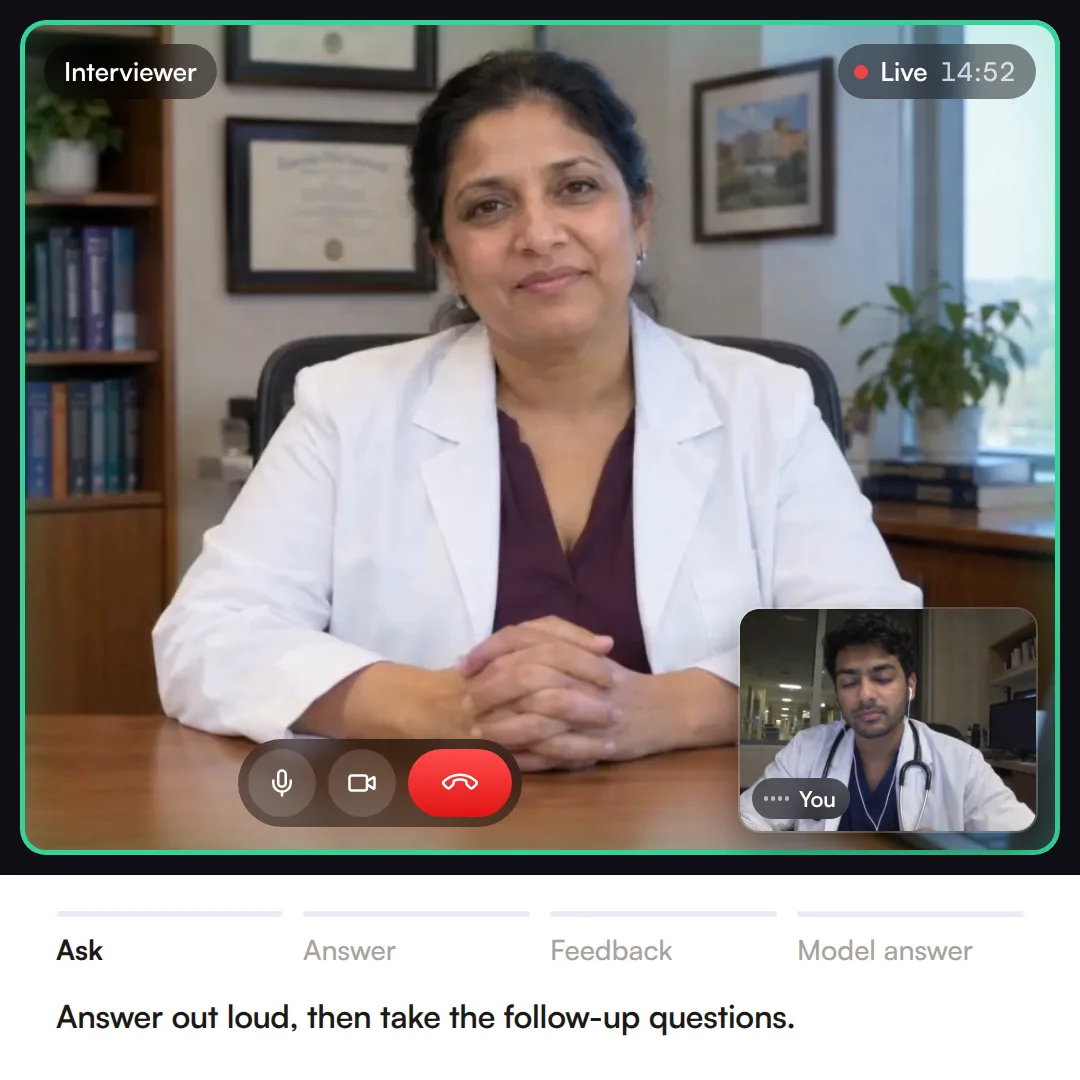
A live AI interviewer that asks behavioral, specialty and program-fit questions and follows up on what you just said, out loud.
Behavioral, specialty and program-fit questions, with follow-ups on your stories
Questions written from your own ERAS experiences
Question sets for 19 specialties, plus CanMEDS questions for CaRMS
4
We show you exactly how to improve your score
A score and line-by-line edits to what you actually said, seconds after you answer, so you can fix it right away.
Score out of 100
Every answer
Line-by-line edits
In seconds
AI interviewer
Your score86/100
Start practicing with Confetto today.
A free week is enough to see your score, review your delivery, and understand your highest-impact improvements.
Programs are checking that you found ophthalmology on purpose, often with little exposure in school, and that you want the medicine and the patients as much as the microscope.
1
Your reason, then one patient
Open with the part of the work that draws you, in one sentence. Then a patient whose sight, or fear of losing it, showed you what the field does.
2
How you tested it
Clinic and OR time, a wet lab or research, and how you went looking for exposure your school didn't give you.
3
What you want from training
The area that draws you, like retina, glaucoma or pediatrics, and the patients you want to serve.
What a strong answer does
A strong answer is one patient whose vision changed their whole life, then the work you did to find the field and build your hands. It ends on the kind of ophthalmologist you want to be.
“Tell me about a patient you met who was losing vision that couldn't be restored. How did the team talk with them, and what would you do the same or differently?”
“You're the ophthalmology resident on call and get paged about an eye injury in the emergency department while another urgent consult is waiting. How do you decide what to do first, and who do you call?”
“Have you had a chance to use a surgical microscope or a wet lab? What was hardest about it, and what do you do outside the OR to build your hand skills?”
The same view applicants see after a Confetto mock: rubric scores, your own answer improved line by line, video coaching, and exact next steps before the real interview.
Residency interview report
Residency mock · Difficult team
+14 from your baseline mock
86
Strong
+14 from your baseline mock
Rubric breakdown
Teamwork · 8 min response
Teamwork
91
You listened to both residents before moving into what the team should do.
Situation, action, result
86
Strong, specific opening. Add one sentence on what changed for the patient.
Reflection
82
Clear story, but your closing line needed a sharper takeaway.
Summary
You opened with one real rotation and named your own role, the strongest move in this answer. The clearest unlock is stating the result for the team and the patient before your takeaway, and tightening the final sentence so it lands.
Response analysis
How to improve your answer
91
You scored 86. With these two changes, about 91.
From your answer at 04:42+3
“Once it got tense, I just tried to stay out of it and let the residents sort it outI asked each resident what worried them most and wrote both concerns on one list.”
“Once it got tense, I just tried to stay out of it and let the residents sort it out I asked each resident what worried them most and wrote both concerns on one list.”
Shows what you personally did instead of what the team did, which is what the rubric scores. Situation, action, result
From your answer at 07:10+2
“So overall, I think it worked out in the endthe patient went home on the plan we agreed, and I'd ask what each person needs sooner next time.”
“So overall, I think it worked out in the end the patient went home on the plan we agreed, and I'd ask what each person needs sooner next time.”
Ends on the result and what you learned. Reflection
What you did well
“On my medicine sub-internship, two residents disagreed about a discharge plan, and I was the student in the middle.”
Strong, specific opening. You named your role in the first sentence instead of describing the team.
Sample only. Your real report uses your transcript, video, and the residency rubric.
Get your first score report before you pay.
Start with a free week, then upgrade when you are ready for unlimited practice.
Confetto prepares you for interviews across a wide range of healthcare programs, so you can train with confidence on any path.
Dental School
Pharmacy School
Nursing School
Physician Assistant
Physical Therapy
Residency
Veterinary School
CRNA School
Occupational Therapy
Dental School
Pharmacy School
Nursing School
Physician Assistant
Physical Therapy
Residency
Veterinary School
CRNA School
Occupational Therapy
The Best OptionOut There
Confetto replaces a coach, a course and a practice partner: realistic interviews in your residency program's format, with feedback seconds after every answer.
Features
Confetto
Coach
Course
Buddy
Practice out loud, any hour
By appointment
When they're free
Unlimited mock interviews
Limited
Varies
Feedback seconds after every answer
Score out of 100 and line-by-line edits
Their notes
Video & body-language analysis
Sometimes
Never cancels on you
Judge-free practice
Varies
Varies
Sometimes
Price
Unlimited from $149
~$600/session
One-time fee
Free
14K+
Applicants on Confetto
500+
Residency questions
120+
Programs supported
Plans and Pricing
Simple pricingfor every timeline
Full access to Confetto's AI interviewer. Start with a free week before choosing a plan—cancel anytime.
A live AI interviewer that asks follow-up questions
One-on-one, panel and MMI, at real timing
A score out of 100 after every answer
Notes on pace, plus eye contact and posture when your camera is on
Filler-word counts and phrasing suggestions
Model answers and your score history
Add your own questions, as many as you like
Start with a free week · secure checkout with Stripe
Applicant reviews
Practicing withConfetto
What applicants say about their interview practice.
“I finally had a way to explain the part of my application I was most nervous about. Confetto helped me practise talking about a difficult rotation without getting defensive or making the whole answer about what went wrong.”
Maya R.
University of Cincinnati
“After rotations, I rarely had the energy to arrange another mock with a classmate. I used Confetto when I got home, and it helped me get comfortable talking through my clinical experiences without reading from my notes.”
Owen T.
Wayne State University
“My answer to why pediatrics sounded like my personal statement read aloud. Working through it on Confetto helped me find a smaller story from a rotation that explained it much better. It sounded more like me, too.”
Emily L.
University of Iowa
“I could tell a patient story, but a follow-up about my own contribution would throw me. The practice made me separate what the team did from what I did. That was a surprisingly useful thing to sort out before interviews.”
Daniel B.
University of Arizona
“The biggest change was my opening answer. I used to walk through my entire CV and lose track of the question. After practising on Confetto, I could introduce myself, explain my interest in the specialty and actually stop talking.”
Hannah W.
University of Colorado
Your score5874/100
I also thought about dermatology, but I wanted to do surgery. I liked internal medicine too, but I wanted clinic and microsurgery in the same week.
+16 Contrast without a dig
See your score climb, mock by mock.
Start with a free week. Every mock gets a score out of 100 and line-by-line edits to what you said.
Everything you need to know about Confetto, answered in one place.
Yes. Ophthalmology has its own set in the app, with questions on why you want to be the ophthalmologist, how you found the field, hand skills, vision loss, call, consults and research, plus general residency questions and questions written from your own application.
Ophthalmology matches through the SF Match, and you apply through its Central Application Service. Invitations went out in two batches, on October 13 and 20. You wait 24 hours before you can respond, then each program gives you 48 hours to 5 days. Interviews are virtual, and programs may hold open houses from December 28, 2026, to January 13, 2027. Preliminary results come January 22, 2027. If you apply to joint programs, you also register with the NRMP for your intern year. Our SF Match ophthalmology guide has the full calendar.
Cover three things. What the team said and how the patient took it. What you noticed about the words, the pace or the silence. And what you would keep or change when it is your conversation. Name the patient's feelings, not just the diagnosis.
Open with your reason in one sentence: the part of the work that draws you. Then name a patient whose sight mattered to their whole life, then say how you found and tested the field and what you want from training. The section above has a three-part outline and what a strong answer does.
“I like the lifestyle.” Programs hear it often. Talk about the patients, the exam and the surgery. Only the OR. Much of the work is clinic. Show you want the medical side too. Research you can't explain. Expect follow-ups on your role and what you would do next. Know every project on your application.
This season, applicants get up to 15 program signals in the SF Match application, which can't be changed once you submit, and programs read them as interest (SF Match, ophthalmology residency).
It depends on the program: behavioral one-on-one, panel, virtual interviews or MMI-style stations (CaRMS). Confetto lets you practice each of them out loud, with follow-up questions and a score after every answer. For MMI stations, try our AI MMI simulator.
Tell me about yourself, why this specialty, why our program, a challenging patient or a mistake you learned from, a conflict on your team, where you see yourself in five to ten years, and questions about anything unusual in your application.
Know your ERAS application well enough to talk about any line of it, prepare five or six stories that answer the behavioral questions, learn each program's specialty-specific details, and practice out loud with follow-up questions. Have questions ready for the program director, faculty and residents.
Yes. Paste your experiences, personal statement or CV into Residency Prep and Confetto writes the questions an interviewer who read it would ask. Your text stays private to your account.
Internal medicine, family medicine, pediatrics, emergency medicine, general surgery, psychiatry, OB/GYN, anesthesiology, neurology, radiology, dermatology, ophthalmology, orthopedic surgery, urology, otolaryngology (ENT), neurosurgery, pathology, plastic surgery and PM&R, plus general residency questions for every specialty, including program signals, your rank list and the red flags on your application.
Yes. Tell Confetto you're matching in Canada and feedback names the CanMEDS roles your answer showed. You can also practice MMI-style stations as a full circuit.
Yes. As a residency applicant you're expected to use clinical terms and reasoning, and feedback holds you to that.
After signing up, Confetto places you in a video call with an AI interviewer that asks follow-ups and probes your answers just like a real admissions committee member. Afterward, you get a score and line-by-line feedback on every answer, notes on your pace and filler words, and, when your camera is on, notes on your posture, eye contact and expression from your video.
Yes. You can add any question, and as many questions as you'd like.
Yes, when your camera is on. Confetto looks at your video for posture, eye contact and facial expression, and gives you those notes alongside your content feedback. Pace and filler words come from what you said, camera or not.
Your free trial lasts a full week.
You can upgrade to any plan for unlimited practice and cancel anytime. Your notes and feedback stay saved if you decide to return later.
Email us anytime at hello@confetto.ai and we'll respond within 24 hours.
Any laptop or mobile phone with a webcam and microphone is all you need. Confetto runs in your browser—no downloads required.