
· 11 min read
Can You Get Into Dental School With a 3.0 GPA? What ADEA Data Shows
About 1 in 4 applicants with a 3.00-3.24 GPA enrolled in dental school in 2025, per ADEA data. What a 3.0 means, how to strengthen your file and explain it.
The short answer
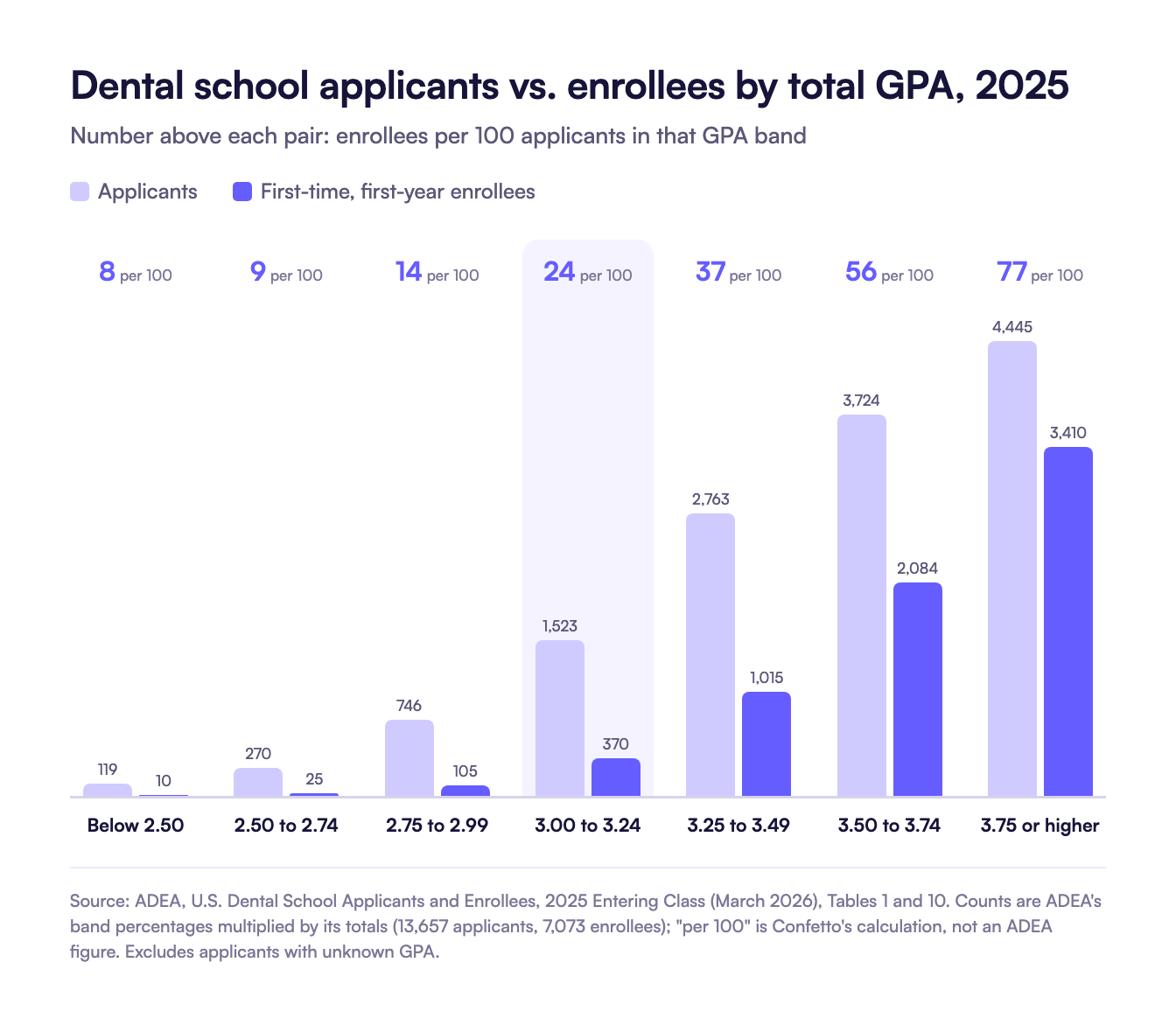
Yes, people get into dental school with a 3.0 GPA every year, but it's the hard version of the process. In ADEA's data on the 2025 entering class, 11.2% of applicants had a total GPA between 3.00 and 3.24, and 5.2% of first-time, first-year enrollees did. Put those percentages against the head counts and roughly 1 in 4 applicants in that band enrolled, compared with about 1 in 2 applicants overall and about 3 in 4 applicants with a 3.75 or higher.
So a 3.0 doesn't close the door. It means the rest of your file has to do more of the work: a strong DAT, recent grades that are clearly better than your old ones, a school list built around where you're actually competitive, and a calm, honest answer when an interviewer asks about your transcript. This guide walks through the numbers first, then the paths that move a 3.0 application, then the interview.
What ADEA's 2025 data says about a 3.0
The American Dental Education Association publishes applicant and enrollee statistics every year. The most recent full report covers the 2025 entering class: 13,657 applicants and 7,073 first-time, first-year enrollees at 74 U.S. dental schools, which works out to 51.8% of applicants enrolling (ADEA, U.S. Dental School Applicants and Enrollees, 2025 Entering Class, Tables 1, 9 and 10).
The averages are what most articles quote. Applicants averaged a 3.53 total GPA and a 3.42 science GPA. Enrollees averaged a 3.68 total and a 3.60 science. If you want the full picture of those averages and how they've changed over time, our guide to the average GPA for dental school covers them.
Averages hide the part you care about, though. ADEA's Table 10 breaks applicants and enrollees into GPA bands, which lets you see how people with a GPA like yours actually did.
| Total GPA | Share of applicants | Share of enrollees | Enrollees per 100 applicants (our calculation) |
|---|---|---|---|
| 2.75 to 2.99 | 5.5% | 1.5% | about 14 |
| 3.00 to 3.24 | 11.2% | 5.2% | about 24 |
| 3.25 to 3.49 | 20.2% | 14.3% | about 37 |
| 3.50 to 3.74 | 27.3% | 29.5% | about 56 |
| 3.75 or higher | 32.6% | 48.2% | about 77 |
Shares come straight from ADEA's Table 10. The last column is our arithmetic: we multiplied each share by ADEA's totals (13,657 applicants, 7,073 enrollees) and divided enrollees by applicants in each band. For the 3.00 to 3.24 band, that's roughly 1,520 applicants and 370 enrollees. ADEA doesn't publish this ratio itself, and it describes a whole applicant pool, not your personal odds.
A few things stand out:
- A 3.0 is not rare in the pool. About 1 in 9 applicants had a total GPA between 3.00 and 3.24.
- It is rare in the class. Only about 7% of enrollees had a total GPA below 3.25, and about 2% were below 3.00.
- Science GPA follows the same pattern. In the 3.00 to 3.24 science GPA band, ADEA's shares work out to roughly 30 enrollees per 100 applicants, again by our calculation.
- Individual schools range widely. UCSF's DDS Class of 2029 averaged a 3.78, but its cumulative GPAs ran from 3.11 to 4.00 and its science GPAs from 2.87 to 4.00, according to the school's own class profile. Averages describe the middle of a class, not its floor.
The honest read: with a GPA around 3.0, applying "as is" with an average DAT and a broad list is a long shot. Applying with a clear story of improvement and a DAT that sits well above average is a different application, and the paths below are about building that one.
First, figure out which 3.0 you have
Two applicants with the same 3.0 can look very different to an admissions committee. Before you plan anything, pull your transcript and answer three questions.
- Is it your science GPA or your total GPA? ADEA AADSAS calculates GPAs by year, by school and by subject category, including a biology, chemistry and physics GPA. A 3.0 total with a 3.4 in science reads differently from the reverse.
- Which direction is it moving? A 2.6 freshman year followed by 3.5 and 3.7 is a recovery story. A 3.6 freshman year that slid to 2.8 raises the question of whether you can handle a heavier load.
- What's in it? Withdrawals, repeated courses and a bad semester tied to something specific are all things you'll need to explain. ADEA AADSAS doesn't honor grade forgiveness or replacement policies: all grades earned for repeated courses are factored into your AADSAS GPA (ADEA AADSAS Help Center). Retaking a C won't erase it; it adds a second grade next to it.
Six paths that actually move a 3.0 application
1. Post-baccalaureate science coursework
Post-bacc work means undergraduate-level courses taken after your bachelor's degree. In AADSAS, those grades are combined with your undergraduate years to create your cumulative undergraduate GPA, so they move the number schools see first.
Be realistic about how much they move it. If you finished with 120 credits at a 3.0 and add 30 credits of straight A's, your cumulative becomes (120 x 3.0 + 30 x 4.0) / 150 = 3.2. That's simple arithmetic, not a guarantee of any outcome. The bigger value is the separate post-bacc GPA AADSAS shows next to your old years. A full-time load of upper-level biology and chemistry with A's is direct evidence that the old transcript is not the student who'll show up in dental school.
Pick courses that look like dental school: biochemistry, physiology, anatomy, microbiology, immunology. Take a real load. Two easy classes a semester won't convince anyone.
2. A special master's program
A special master's program (SMP) is a graduate program built for people trying to show they can handle health professions coursework, sometimes taught alongside professional students. It's a bigger commitment in time and money than a post-bacc.
One detail matters here: AADSAS keeps graduate coursework out of your cumulative undergraduate GPA and adds it into a separate overall GPA. So an SMP won't raise your undergraduate number. What it does is give you a second, graduate-level record to point to. If a program is linked to a specific dental school, read that school's own page for what it actually offers; don't assume any program comes with an interview or a seat.
3. A DAT that carries weight
The DAT is the one academic measure where every applicant is on the same scale, which is why it matters so much when your GPA is low. ADEA's 2025 data (Tables 9 and 11) shows how the scores split:
- Enrollees averaged a 20.9 Academic Average; applicants averaged 19.6.
- 52.5% of enrollees had an Academic Average of 21 or higher, compared with 33.8% of applicants.
- About 14% of enrollees scored 18 or below on Academic Average.
Those figures are on the old 30-point scale used for the 2025 class. The ADA moved the DAT to a 200 to 600 scale starting March 1, 2025, so newer score reports look different; compare yourself against data on the same scale. The Academic Average is the rounded average of Biology, General Chemistry, Organic Chemistry, Quantitative Reasoning and Reading Comprehension, so it doesn't include Perceptual Ability (ADA, DAT scores).
With a 3.0, an average DAT doesn't offset the GPA. Plan your study time as if the DAT is the most important single thing you control this year, because for you it probably is. Don't sit for it until your practice scores are consistently where you want them.
4. An upward trend you can point to
Because AADSAS lists a GPA for each year, admissions readers can see your trajectory at a glance. If your last 60 credits are much stronger than your first 60, say so plainly in your application and be ready to say it in the interview. If you're still in school, your remaining semesters are worth more than any essay you'll write about them.
5. Application strategy
- Apply early. The 2026-27 ADEA AADSAS application opened May 12, 2026 and accepted submissions from June 2. ADEA's advice is to submit during the summer and not wait for deadlines, and schools may notify applicants of acceptance starting December 15 (ADEA GoDental). A late application with a 3.0 is competing for fewer interview slots.
- Use the academic update windows. AADSAS lets you add new grades between August 13 and September 29, 2026 and again between December 1, 2026 and February 5, 2027. If you're applying while finishing post-bacc courses, those strong grades can reach schools mid-cycle.
- Build the list from class profiles, not rankings. Look at each school's own published class profile and GPA range, your state schools (many favor residents), and school missions that fit your background. Leave out schools where you're far below the range.
- Don't apply "to see what happens." If your post-bacc grades or DAT aren't in yet, a one-year delay to apply once with a stronger file is often better than applying twice.
6. Interview preparation
If a school invites you, your GPA got you through the screen. From there, the interview often weighs heavily, and applicants with a low GPA tend to get a version of the same question: "Walk me through your transcript." The rest of this guide is about that conversation, because most low-GPA advice stops right before it.
How to answer "Tell me about your grades"
Interviewers aren't asking you to relive a bad year. They want to know three things: do you understand what went wrong, what did you change, and is there evidence the change worked. A good answer covers all three in about a minute.
- Own it in one sentence. "My first two years don't reflect what I can do, and that's on me." No long backstory.
- Name the cause specifically. Working 30 hours a week, a family situation, poor study habits. Specific is believable; vague sounds like an excuse.
- Describe what you changed. A schedule, a study method, a reduced work load, tutoring, office hours.
- Show the evidence. Your last four semesters, your post-bacc GPA, your DAT. Numbers you can say out loud.
- Connect it to dental school. How you'll handle a heavier load now, in one sentence. Then stop.
Here's a fictional example to study, written by us, not taken from a real applicant:
"My GPA is a 3.0 overall, and most of that comes from my first two years, when I was working nights and treating classes as something to get through. My sophomore organic chemistry grade was the wake-up call. I cut my hours, started studying on a fixed schedule, and went to office hours every week. Over my last four semesters I've had a 3.7, and I took 32 credits of upper-level science in a post-bacc year with a 3.9. That year taught me how I actually learn, and it's the same approach I'll use in the first year of dental school."
Compare that with a weak version: "I had some personal stuff going on, and the professors at my school were really hard graders." It blames others, gives no evidence and leaves the interviewer to guess whether anything changed.
Expect follow-ups. "What would you do if you started struggling in the first semester?" "Why should we take you over someone with a 3.7?" Practice answers that stay calm and specific when someone pushes. Our list of dental school interview questions covers the rest of what you'll be asked, from "why dentistry" to ethics scenarios, and the Confetto question bank has more prompts to rehearse with.
Common mistakes with a low GPA
- Hiding from it. Readers see your transcript before your essay. Address it briefly where your application gives you room, then move on.
- Over-explaining it. A whole personal statement about a bad semester makes the GPA your story. One clear paragraph is enough.
- Retaking only the courses you already passed. All attempts count in AADSAS. New, harder coursework with strong grades usually says more.
- Taking the DAT before you're ready. With a 3.0, an average score doesn't help you much, and a retake costs months you could spend elsewhere.
- Treating the interview as a formality. If you get one, it's where you get to show the person behind the transcript. Practice out loud.
Practicing with Confetto
An interview is where a below-median applicant can change the picture, and it's also the part you can practice the most. Confetto's dental school interview practice runs mock interviews in MMI and traditional formats, with "why dentistry" prompts and dental ethics and patient-care questions. An AI interviewer asks follow-up questions based on what you actually said, including the uncomfortable ones about your grades, and then you get rubric-based feedback on what to fix. You can start with a 7-day free trial.
FAQ
Can you get into dental school with a 3.0 GPA?
Yes, but it's uncommon. In ADEA's 2025 data, about 5% of enrollees had a total GPA between 3.00 and 3.24, and by our calculation roughly 1 in 4 applicants in that band enrolled. Strong recent grades, a well-above-average DAT and an early, well-targeted application improve your position.
Does science GPA matter more than total GPA?
Both are reported, and schools see your biology, chemistry and physics GPA alongside your cumulative and year-by-year GPAs. A low science GPA is usually the harder one to overcome, because it's the clearest signal of how you'll handle dental school coursework. Recent upper-level science grades are the most direct fix.
Will retaking a class replace the old grade?
Not in ADEA AADSAS. All grades for repeated courses are factored into your AADSAS GPA, regardless of your college's forgiveness or replacement policy. A retake can still show mastery, but it won't erase the first attempt.
What DAT score do I need with a 3.0?
There's no published cutoff that guarantees anything. For reference, enrollees in the 2025 class averaged a 20.9 Academic Average on the old 30-point scale, and 52.5% scored 21 or higher. With a low GPA, aim to be above the enrollee average, and check the class profiles of the schools on your list.
Is a post-bacc or an SMP better?
It depends on what you need to fix. A post-bacc adds to your undergraduate GPA and works well if you need more science coursework. An SMP builds a separate graduate record and is a bigger commitment. If your undergraduate science GPA is the main problem, many applicants start with post-bacc coursework.